10 Compliance Monitoring Software Platforms Compared
The popular advice is to find the “best” compliance monitoring software and standardize on it. That's the wrong starting point. A platform that continuously tests cloud controls may be a poor fit for regulatory change, ethics case management, privacy governance, or business-entity verification. The monitoring problem determines the useful platform.
This comparison evaluates monitoring scope, evidence collection, integrations, framework coverage, pricing visibility, and implementation effort. It also separates internal control monitoring and audit readiness from broader enterprise GRC, regulatory intelligence, privacy and AI governance, ethics programs, and official entity-level due diligence.
That distinction matters because the market has expanded beyond periodic audit preparation. One estimate places the compliance software market at USD 35.37 billion in 2025, with a projection of USD 74.12 billion by 2031 at a 12.67% CAGR from 2026 to 2031. The same estimate reports that cloud deployment held 69.23% of market share in 2025, while large enterprises represented 57.14% of demand. Mordor Intelligence's compliance software market analysis supports a practical conclusion: buyers are choosing infrastructure for ongoing oversight, not a document repository.
Table of Contents
- 1. SOSfinder
- 2. Vanta
- 3. Drata
- 4. Secureframe
- 5. Hyperproof
- 6. AuditBoard CrossComply
- 7. ServiceNow Governance Risk and Compliance CAM
- 8. NAVEX One
- 9. OneTrust
- 10. CUBE
- Top 10 Compliance Monitoring Software Comparison
- How to Shortlist Your Compliance Monitoring Platform
1. SOSfinder
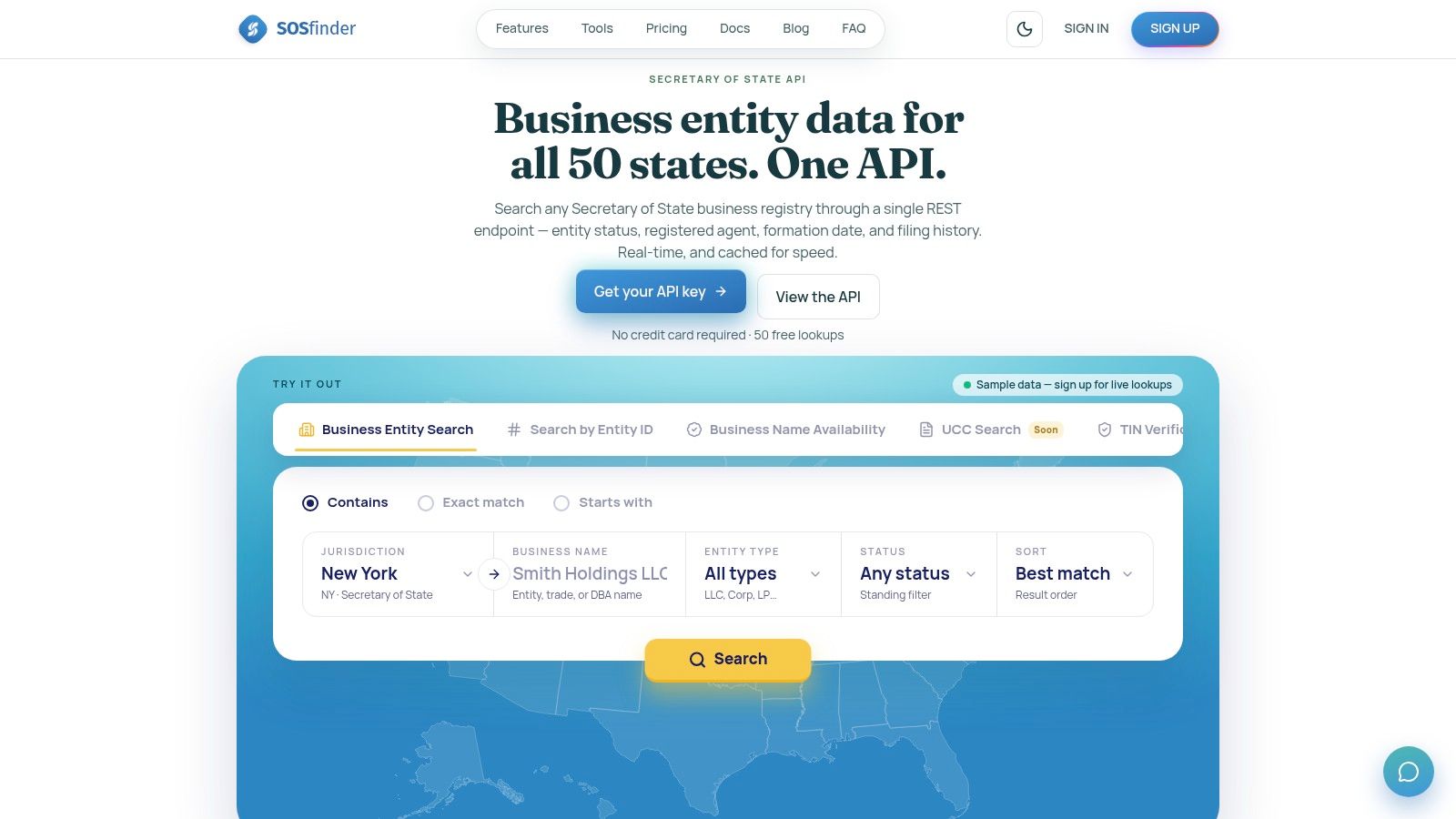
SOSfinder belongs in a different category from most GRC platforms. It continuously monitors official business-entity records, rather than testing internal security controls or mapping regulatory obligations to frameworks. Its developer-focused API brings the 50 U.S. Secretary of State registries plus the District of Columbia behind one REST endpoint, giving product and compliance teams a consistent way to retrieve entity status, type, formation or registration dates, registered agent, principal address, identifiers, and filing history.
That scope makes it useful for onboarding, KYC, vendor due diligence, procurement, legal filing services, and ongoing entity verification. Monitoring can surface changes to a tracked company's status, registered agent, or address, while filing-history retrieval can provide state PDF links where available. Bulk CSV verification and webhooks extend the service from one-off lookup to portfolio monitoring.
Why it stands apart
The main implementation advantage is integration consistency. Teams don't need to maintain separate connectors for every state registry or normalize different response formats themselves. SOSfinder combines real-time registry retrieval with low-latency caching, automatic retries for temporary registry blocks, predictable JSON responses, clear error semantics, and examples for cURL, Python, JavaScript, PHP, and Go.
The platform also offers an API playground and a hosted MCP server for plain-language queries from AI tools. Officer and UCC lookups are available in beta, so buyers should treat those capabilities as supplementary rather than assume every advanced workflow has the same maturity as entity search.
Practical rule: Use SOSfinder when the compliance question is “Does this company still exist in the expected state, under the expected status and ownership context?” It isn't a replacement for control testing, regulatory intelligence, or privacy governance.
Pricing is unusually visible for this category. The service includes 50 free lookups per month without a credit card, with subscription options including Starter at $49 per month for 1,000 lookups, Pro at $99 per month for 2,500, and Scale at $449 per month for 15,000. Overage rates decrease by plan, and non-expiring credit packs support pay-as-you-go use. Higher tiers add webhooks, analytics, priority support, and a 99.9% uptime SLA, while enterprise options add dedicated infrastructure, SSO, audit logs, and custom SLAs. See the entity search documentation before estimating implementation effort.
The limitation is important: SOSfinder aggregates official state data but isn't a government agency. Registry availability and document access can vary by state, and teams should validate source coverage for their specific due-diligence workflow.
2. Vanta
Vanta is designed for teams that need to keep security and compliance controls ready between audits. Its core workflow connects systems, runs continuous tests, collects evidence, and maps artifacts to controls across programs such as SOC 2, ISO 27001, and HIPAA. That makes it a natural fit for startups and mid-market companies building a repeatable audit-readiness process without creating every evidence request manually.
The platform also supports vendor questionnaire automation and AI-assisted workflows for questionnaires and remediation. Those features matter when compliance work extends beyond the security team, because a control repository alone won't resolve the follow-up required from vendors, system owners, and business teams.
Scope and operating fit
Vanta's strength is its out-of-the-box coverage for common security frameworks and its centralized view of control status, evidence, and audit tasks. It helps teams answer whether evidence exists, which control it supports, and what needs attention. The model aligns with the broader move from point-in-time reviews toward year-round monitoring, automated evidence collection, alerts, and remediation described in Scrut's overview of compliance monitoring.
Integration breadth is central to the experience, but buyers should test the exact connectors required for identity, cloud, code, ticketing, HR, and vendor workflows. A prebuilt integration can reduce implementation effort, while a missing connector may shift work back to manual uploads or custom processes.
Pricing isn't publicly transparent. Vanta typically requires a sales conversation, so teams should request a package based on frameworks, users, integrations, support, and remediation workflows rather than compare a headline subscription price. That makes budgeting less predictable than a usage-priced API such as SOSfinder.
Vanta is a strong choice for organizations prioritizing security controls, evidence collection, and common certification programs. It's less suited as the sole system for regulatory horizon scanning, official company-record monitoring, or a highly customized enterprise GRC operating model.
3. Drata
Drata focuses on continuous controls monitoring for growing companies that are moving beyond their first certification. Automated tests report pass or fail status, route remediation, and connect evidence to an internal control framework. That combination gives compliance owners a clearer operating picture than a static folder of audit artifacts.
The platform's broad integrations and open API are especially relevant for engineering-led teams. Custom tests, including a “Compliance as Code” approach, let technical teams represent organization-specific requirements rather than force every control into a fixed template. This can reduce repetitive manual validation when the environment changes frequently.
Where Drata fits best
Drata is well suited to a multi-framework roadmap involving programs such as SOC 2, ISO, and PCI. Its control and evidence repository establishes ownership, while automated testing helps teams identify exceptions before an auditor asks for proof. The open API also makes it more adaptable than a platform that depends entirely on its native connectors.
Implementation still depends on control design. An API can move data efficiently, but it doesn't decide which systems are authoritative, who owns a failed control, or how exceptions should be approved. Buyers should test a representative workflow from detection through remediation closure, not just the initial evidence import.
Drata doesn't publish standard pricing on its website. The sales process is used to size packages, which may be appropriate for organizations with different framework combinations but makes early comparison harder. Ask for separate costs for additional frameworks, custom tests, integrations, auditor collaboration, support, and historical evidence retention.
Use Drata when the central problem is automated internal control testing with developer-friendly extensibility. It shouldn't be evaluated as a substitute for a regulatory intelligence platform or entity-record verification service. For teams handling corporate names during onboarding or formation workflows, a separate business name check tool addresses a different data problem.
4. Secureframe
Secureframe emphasizes broad integration coverage and automated security compliance. Its platform collects evidence across more than 300 integrations and supports more than 30 frameworks, including SOC 2, ISO 27001, HIPAA, PCI, and CMMC. Those figures come from the product brief, and they point to a specific buying advantage: teams with varied cloud, identity, endpoint, and business systems can reduce the number of manual data pulls required for evidence.
Secureframe also provides continuous control monitoring and CVE monitoring, often without installing agents. That no-agent approach can lower deployment friction when security teams don't want another endpoint component or when infrastructure ownership is distributed across departments.
Integration depth versus implementation reality
A large integration catalog only creates value when the connectors collect the right evidence at the right frequency. Buyers should ask which controls each integration supports, whether evidence is refreshed automatically, and how the platform handles revoked access, failed API calls, and incomplete records.
Secureframe is a good fit for teams that want wide SaaS and cloud connectivity, vulnerability-related alerts, and prebuilt framework support. It can shorten the path from disconnected system data to an audit-ready view, especially when the alternative is recurring spreadsheet collection.
The trade-off is commercial and organizational. Pricing and packaging are customized through sales, and an enterprise-oriented implementation may increase total cost. Teams should also examine who configures framework scope, who owns exceptions, and whether the platform's reporting matches the evidence format their auditor or customer program expects.
Secureframe works best when the compliance program is closely connected to security posture and technical evidence. It is less appropriate when the primary monitoring question concerns ethics incidents, regulatory change, or the legal status of vendors and customers.
5. Hyperproof
Hyperproof treats compliance as part of a broader GRC workflow. Its continuous controls monitoring connects directly to data sources, while dashboards show control health, exceptions, and current status. That makes it useful for organizations that want to move from collecting evidence before an audit to managing control performance throughout the year.
The platform also centralizes compliance, risk, and audit work. Cross-framework control mapping allows teams to reuse evidence and standardize how requirements are represented. In practice, that means the value isn't only automated testing. It is the ability to connect a failed control to an owner, a risk record, an audit request, and a remediation process.
Monitoring scope and implementation load
Hyperproof suits companies managing multiple frameworks and stakeholders. Its live reporting can give compliance leaders a shared operating view, while direct data connections reduce the need for repeated manual requests. The platform's broader scope may also help teams avoid running separate evidence, risk, and audit processes that disagree about control ownership.
That breadth can increase implementation effort. A team must define its control taxonomy, map frameworks, agree on exception handling, and establish responsibility for remediation. If those decisions remain unresolved, a configurable platform may expose organizational ambiguity rather than eliminate it.
Pricing isn't publicly listed, and the typical enterprise sales process makes package comparison difficult. Ask for a clear implementation plan, connector list, data-retention terms, support model, and costs for additional frameworks or business units. Validate whether the live dashboard reflects the evidence sources that matter most to your program.
Hyperproof is strongest for continuous controls monitoring inside a broader compliance and risk operating model. It isn't a specialist tool for entity-level verification or regulatory horizon scanning. Teams integrating external data should also review authentication and access requirements in the API authentication documentation for any separate entity-data service.
6. AuditBoard CrossComply
AuditBoard positions CrossComply within a larger audit and risk suite. That context matters. The product supports multi-framework compliance programs, including SOC, ISO, PCI, NIST, GDPR, and CMMC, while related modules connect compliance work with internal audit, enterprise risk, and third-party risk.
Its centralized control library can map requirements across frameworks, automate attestations and evidence requests, and support programs with multiple teams. This is a different buying proposition from a narrowly focused certification automation platform. The question isn't only whether a control passed. It's how compliance evidence relates to audit plans, risk assessments, vendors, and executive reporting.
Enterprise workflow strength
CrossComply is a practical fit for organizations that already run formal internal audit and risk processes or want compliance to sit inside that structure. Integrations with AuditBoard's broader modules can reduce duplication between audit requests, risk records, and compliance evidence.
Implementation will likely be heavier than a lightweight control-monitoring deployment. Teams need to define governance, ownership, framework mappings, request workflows, and reporting audiences. That effort may be justified for complex programs, but smaller teams should test whether they need the suite or only continuous evidence collection.
Pricing is quote-based, and enterprise licensing can raise both software and implementation costs. Request a scenario-based proposal that separates CrossComply from adjacent modules, services, integrations, and user or business-unit expansion. Also confirm how much configuration your team must maintain after rollout.
AuditBoard is best for complex compliance programs linked to internal audit and enterprise risk. It isn't primarily a regulatory change scanner, privacy operations platform, or business registry monitor.
7. ServiceNow Governance Risk and Compliance CAM
ServiceNow Governance, Risk, and Compliance, including Continuous Authorization and Monitoring, is most compelling when the organization already runs core IT workflows on the Now Platform. CAM supports monitoring indicators, alerts for violations, policy adherence, and governance aligned with NIST RMF and similar programs.
The platform's key advantage is workflow continuity. A control issue can move into ownership, ticketing, escalation, approval, and remediation through the same enterprise workflow engine used for IT service and operations. That reduces the risk that compliance findings remain trapped in a dashboard that system owners rarely visit.
The platform decision is also an operating-model decision
ServiceNow is a strong fit for organizations with established ServiceNow administration, ITSM, and ITOM processes. Native workflow connections can make ownership and remediation more practical than adding another disconnected compliance application.
Configuration is the main cost. CAM and GRC require platform expertise, data modeling, indicator design, role configuration, and ongoing administration. Teams without that capability may need implementation partners or dedicated internal ownership. The buyer should test a complete violation workflow, including evidence, assignment, exceptions, service tickets, escalation, and closure validation.
ServiceNow GRC is licensed through the broader platform, so pricing requires direct engagement. The quote should distinguish module fees from implementation, configuration, integration, and administration costs. A team already invested in ServiceNow may see a different total value from a company starting without it.
Choose this option for enterprise control monitoring embedded in IT and operational workflows. It isn't the simplest route for a startup seeking fast certification automation, and it doesn't replace specialist regulatory intelligence or entity verification. For multi-state corporate records, a dedicated single API for fifty states addresses a separate integration problem.
8. NAVEX One
NAVEX One monitors a different part of compliance maturity, the human and organizational layer. Its modules cover policy management, training, disclosures, hotline and incident management, third-party risk, and compliance analytics. That makes it particularly relevant for organizations that need to monitor whether employees understand policies, disclose conflicts, report concerns, and receive appropriate follow-up.
EthicsPoint hotline and case-management capabilities give NAVEX a distinct role in this comparison. A security control platform can show whether a technical setting meets a requirement, but it won't manage a whistleblowing case, an investigation workflow, or policy acknowledgment in the same way.
Ethics programs need more than control evidence
NAVEX One's strength is breadth across ethics and compliance programs, rather than technical control validation alone. Centralized policy, training, disclosures, incident records, and reporting can help compliance leaders connect program activity to oversight. Packaged Compliance Essentials options may support a faster initial rollout when the required modules are clear.
The implementation question is modularity. Pricing and functionality vary by package, so buyers should define whether they need policy distribution, learning, conflicts disclosures, hotline operations, third-party risk, analytics, or a combination. A broader package may be valuable, but unused modules increase complexity and cost.
NAVEX uses quote-based pricing. Request a demonstration that follows a real case from report intake through triage, assignment, investigation, closure, retention, and reporting. Also check how the platform integrates with HR, identity, learning, vendor, and enterprise reporting systems.
NAVEX One is the right category for ethics, policy, training, and incident oversight. It should not be judged primarily by the same criteria used for automated cloud control testing. Its value lies in monitoring conduct and program execution, not only technical evidence.
9. OneTrust
OneTrust covers privacy governance, third-party risk, technology risk, and AI governance in a single enterprise platform. Its monitoring scope includes website risk through the Consent Management Platform, privacy assessments and reporting, and AI governance aligned with the EU AI Act, NIST, and ISO 42001.
That makes OneTrust a better fit for organizations whose compliance questions concern data use, consent, privacy obligations, vendor exposure, and AI systems. A conventional internal-control platform may collect evidence for a security framework, but it won't necessarily maintain data inventories, privacy assessments, consent operations, or AI oversight.
Privacy and AI require domain-specific workflows
OneTrust's strength is the depth of its privacy and AI governance capabilities. Teams can connect assessments, regulatory obligations, reporting, and operational workflows across domains that often sit with privacy, legal, security, procurement, and product stakeholders.
The challenge is scope. A platform this broad requires clear ownership and careful module selection. Buyers should identify which processes need continuous monitoring, which require scheduled assessments, and which depend on authoritative data from websites, vendors, applications, or model inventories. They should also confirm how alerts become assigned remediation work.
Pricing is modular and enterprise-oriented, with exact quotes requiring engagement with sales. Ask for a package that separates privacy, consent, third-party, technology risk, and AI governance capabilities. Implementation planning should include data discovery, workflow configuration, regulatory mapping, user roles, and integration ownership.
OneTrust is a strong choice for privacy governance and AI risk management, especially where those needs must connect to broader enterprise risk. It isn't the most focused option for technical control evidence or official business-entity records, and buyers shouldn't assume that broad GRC coverage automatically delivers deep monitoring in every domain.
10. CUBE
CUBE is a regulatory intelligence and horizon-scanning platform. Its continuous monitoring problem is regulatory change, not whether a cloud configuration or internal policy control currently passes. The platform scans and classifies global updates, prioritizes relevant changes, and turns them into obligations that compliance teams can assess and act on.
That focus addresses an evidence gap many buyers miss. Internal controls may exist and operate correctly, yet a team can still fail to prove that it identified a relevant regulatory change, assessed applicability, assigned ownership, and updated its obligations. A platform that monitors external rules closes a different part of the compliance lifecycle.
Regulatory change is not control testing
CUBE uses structured regulatory intelligence, RegInsights, agentic AI, applicability assessment, and certainty scoring to help teams distinguish relevant updates from noise. This is particularly useful for institutions managing complex, multi-jurisdictional obligations where manual research is difficult to maintain.
The product usually complements rather than replaces a GRC or continuous controls monitoring platform. CUBE may identify a new obligation, but another system may own the control, evidence, remediation, audit request, or policy attestation. Buyers should test how regulatory updates flow into existing governance workflows and whether legal or compliance specialists can review classification decisions.
Pricing and implementation details should be assessed through a scoped evaluation. Ask about jurisdictions, regulatory domains, applicability rules, review workflows, export formats, APIs, alert routing, and the division of responsibility between automated classification and human validation.
CUBE is best for regulatory change management at scale. It isn't a substitute for technical evidence collection, ethics case management, privacy operations, or business-entity verification. Selecting it alongside a controls platform may be more effective than forcing one product to perform both jobs.
Top 10 Compliance Monitoring Software Comparison
| Product | Core features | UX & reliability (★) | Pricing & value (💰) | Target audience (👥) | Unique selling point (✨) |
|---|---|---|---|---|---|
| SOSfinder 🏆 | Single POST → all 50 states+DC; normalized entity records; filings & PDF links; monitoring, webhooks, bulk CSV; UCC/officer beta | ★★★★★, predictable JSON, retries, 99.9% SLA (higher tiers) | 💰 Free 50/mo; Starter $49 (1k/$0.09), Pro $99 (2.5k/$0.08), Scale $449 (15k/$0.06); credit packs | 👥 Engineers, product teams, KYC/onboarding, vendor DD, legal/compliance workflows | ✨ Single-endpoint nationwide registry access; low-latency cache + real-time; hosted MCP for AI queries |
| Vanta | Continuous tests, prebuilt SOC2/ISO workflows, vendor questionnaires, AI assistant for remediation | ★★★★, audit-readiness focus, centralized evidence | 💰 Quote/demo-based; pricing opaque | 👥 Startups → mid-market security & compliance teams | ✨ Strong out-of-the-box controls + AI assistant for questionnaires |
| Drata | Automated tests & remediation routing; control/evidence repo; open API & custom tests; broad integrations | ★★★★, developer-friendly automation & APIs | 💰 Quote-based; sales engagement required | 👥 Fast-growing companies scaling compliance programs | ✨ "Compliance as Code" via open API and custom tests |
| Secureframe | Continuous monitoring, CVE alerts (no-agent often), 300+ integrations, multi-framework support | ★★★★, wide integration coverage, reduced manual pulls | 💰 Customized enterprise pricing | 👥 Teams needing broad integration coverage and faster rollout | ✨ Large integration catalog (300+) + agentless CVE monitoring |
| Hyperproof | Centralized GRC, continuous control monitoring, cross-framework mapping, live control health dashboards | ★★★★, real-time posture tracking for ongoing oversight | 💰 Enterprise/quote-based pricing | 👥 GRC teams shifting to continuous compliance & risk ops | ✨ AI-powered GRC with cross-framework evidence reuse |
| AuditBoard (CrossComply) | Central control library, automated attestations, integrations with audit & risk modules | ★★★★, built for complex, multi-team programs | 💰 Enterprise/quote-based | 👥 Large enterprises with integrated audit & risk needs | ✨ End-to-end audit + compliance suite with CrossComply module |
| ServiceNow GRC / CAM | Continuous Authorization & Monitoring, NIST RMF alignment, native ITSM/ITOM workflows | ★★★★, enterprise-grade workflows, configurable at scale | 💰 Licensed via ServiceNow; quote-based | 👥 Organizations already on ServiceNow platform | ✨ Native CAM + workflow engine tied to ITSM/ITOM |
| NAVEX One | Policy & training, hotline/incident mgmt (EthicsPoint), third‑party risk & consolidated reporting | ★★★★, broad ethics & compliance coverage | 💰 Modular, quote-based pricing | 👥 Ethics/compliance teams needing hotlines, training & policy mgmt | ✨ Integrated hotline + training + policy management bundle |
| OneTrust | Always-on privacy, CMP website monitoring, third-party & AI governance, assessments mapped to regs | ★★★★, deep privacy & regulatory templates | 💰 Modular enterprise pricing; quote-based | 👥 Privacy, AI governance, and risk teams at regulated orgs | ✨ Strong privacy & AI governance suite (CMP + regulatory mapping) |
| CUBE | Continuous regulatory horizon scanning, prioritization, applicability scoring, AI-assisted RegInsights | ★★★★, reduces manual legal/regulatory research | 💰 Quote-based; usually integrated with GRC stacks | 👥 Institutions with multi-jurisdiction regulatory obligations | ✨ Automated, scored regulatory intelligence and prioritization |
How to Shortlist Your Compliance Monitoring Platform
Start with the compliance problem, not the vendor category. If the priority is continuous evidence for SOC 2, ISO, HIPAA, PCI, or similar programs, evaluate Vanta, Drata, Secureframe, and Hyperproof around control tests, evidence freshness, framework mapping, and remediation. If the organization needs enterprise ownership and audit linkages, AuditBoard or ServiceNow may fit better. If the concern is employee conduct, policy completion, disclosures, and hotline cases, NAVEX One belongs in the shortlist. Privacy and AI risk point toward OneTrust, regulatory change toward CUBE, and official business-entity monitoring toward SOSfinder.
The market data supports treating these as distinct buying categories. One estimate values the continuous compliance monitoring segment at USD 5.19 billion in 2025, projected to reach USD 16.35 billion by 2034. It also reports that software accounted for 58.2% of revenue and cloud deployment held 62.5% share. DataIntelo's continuous compliance monitoring market coverage suggests that software-led, hosted monitoring is now central to buyer expectations, but it doesn't mean every hosted platform solves the same operational problem.
Match integrations to accountable owners
Build an integration map before requesting final proposals. List the systems that hold authoritative data, such as identity, cloud, endpoint, ticketing, HR, procurement, vendor, privacy, learning, website, and business registry sources. Then identify the person or team responsible when each signal changes. A platform that detects an issue but can't route it to the right owner creates another queue, not continuous compliance.
Implementation burden deserves equal weight with feature breadth. Research on regulatory technology identifies integration complexity at 31%, data quality challenges at 27%, legacy dependencies at 23%, and skills shortages at 19% as major restraints. Those figures come from Market Reports World's regulatory technology market coverage. The practical lesson is that a technically impressive platform can still fail if the organization can't provide clean data, stable integrations, and accountable workflow owners.
Compare monitoring behavior, not dashboard screenshots
During a proof of concept, validate the full path from signal to defensible action:
- Monitoring frequency: Confirm whether the platform checks continuously, on a schedule, at event time, or only after a manual upload.
- Alert handling: Test routing, severity, suppression, escalation, duplicate handling, and closure validation.
- Evidence retention: Ask how the system preserves historical evidence, source context, timestamps, approvals, and changes.
- Framework mapping: Verify whether one control can support several frameworks without obscuring differences in obligation or scope.
- Integration recovery: Simulate expired credentials, failed calls, incomplete records, and changed source schemas.
- API and webhook access: Determine whether findings and changes can enter the systems where teams work.
- Data-source limitations: Document registry availability, regulatory coverage, connector boundaries, document access, and any beta capabilities.
Pricing transparency should be part of the comparison, not a footnote. SOSfinder publishes usage-based options, free access, credit packs, and higher-tier capabilities, while most platforms in this list use customized or quote-based pricing. Those models are not naturally good or bad. Usage pricing is easier to model for API volume, while enterprise pricing may reflect frameworks, users, integrations, services, and support. The buyer should insist on a total-cost view that includes implementation, administration, expansion, and required adjacent tools.
The strongest conclusion is also the least obvious one: compliance monitoring software isn't one market problem operationally, even when vendors use similar language. Internal control monitoring proves that systems and processes operate as expected. Enterprise GRC connects controls to risk, audit, and remediation. Ethics platforms monitor conduct and case workflows. Privacy and AI platforms govern data use and model risk. Regulatory intelligence tracks changes outside the organization. Entity monitoring verifies whether a company's official records still match the business relationship.
For teams that need the final category, SOSfinder is a focused option. It brings official records from all 50 U.S. states and the District of Columbia into a consistent API, supports search, monitoring, filing history, bulk verification, and webhooks, and fits onboarding, due diligence, procurement, and ongoing compliance workflows. It won't replace a GRC suite, and that narrowness is its advantage: the platform addresses business-entity data without asking a control-monitoring system to become a registry integration layer.
SOSfinder gives product, engineering, procurement, and compliance teams one API for official multi-state business-entity data, with normalized records, filing histories, monitoring, bulk verification, and webhooks for workflow integration. If your compliance program needs reliable entity checks during onboarding, vendor due diligence, or ongoing monitoring, visit SOSfinder to evaluate the platform.