KYB API: What It Is, How It Works, and How to Integrate

You've probably had this moment already. A business wants to go live, the deal is otherwise ready, and someone on your team is still cross-checking a company name against a registry export, an ownership note, and a spreadsheet that's already stale. That's the point where a KYB API stops being a nice integration idea and starts being the difference between a smooth onboarding flow and a queue full of manual reviews.
A good KYB API turns business verification into a programmable workflow. Instead of asking analysts to bounce between registries, filing PDFs, and watchlist tools, your product sends one authenticated request and gets back structured entity data that software can use immediately. That matters for both sides of the house, product teams get faster activation, and compliance teams get a repeatable evidence trail they can defend later.
Table of Contents
- What a KYB API Actually Does for Product and Compliance Teams
- Defining KYB and Why It Became an API Problem
- Core Capabilities Every KYB API Should Expose
- How Unified Endpoints Normalize Fifty State Registries
- Anatomy of a KYB API Request and Response
- From One-Time Checks to Continuous Business Monitoring
- The Hidden Gaps in KYB API Implementations
- Choosing and Integrating a KYB API With Confidence
What a KYB API Actually Does for Product and Compliance Teams
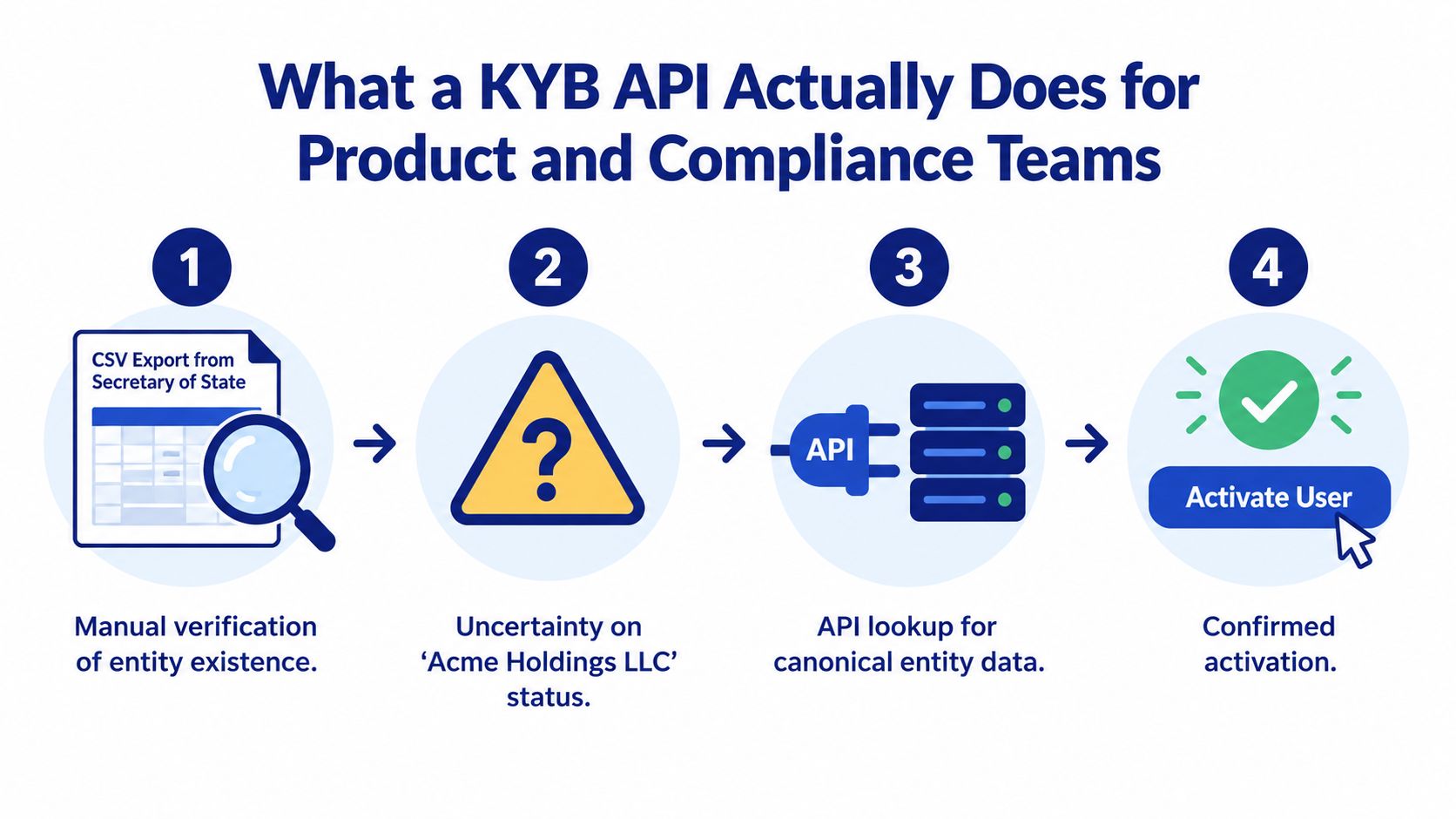
A product team at a B2B payments platform usually doesn't notice how messy business verification is until the first high-value merchant hits the queue. One person opens a state registry page, another checks a filing history PDF, and a third tries to decide whether the company name in the application matches the legal record. By the time everyone agrees, the activation flow has already slowed down enough that the customer feels it.
A KYB API replaces that ad hoc process with one request that returns a normalized business record. The API sits between your onboarding logic and authoritative sources, then packages the result into fields your system can trust, regardless of which jurisdiction the company came from. That's why it's useful to both product and compliance teams, product gets a faster decision path, and compliance gets a clear audit trail.
The operational job it solves
The job isn't “look up a business.” It's “decide whether this business should be activated, escalated, or blocked, using evidence your team can reproduce later.” That distinction matters because a manual lookup can answer the first question, but it doesn't scale cleanly across multiple jurisdictions, changing registry formats, and repeated reviews.
Practical rule: if a result can't be traced back to a source your compliance team understands, it isn't really verified, it's just looked up.
The value of the API form factor is that it makes verification part of the product flow instead of a separate analyst workflow. When the onboarding service can call the verification layer directly, the same logic can be reused for signup, periodic review, and exception handling. That's the shift, from human-led registry searching to software-driven verification.
Defining KYB and Why It Became an API Problem
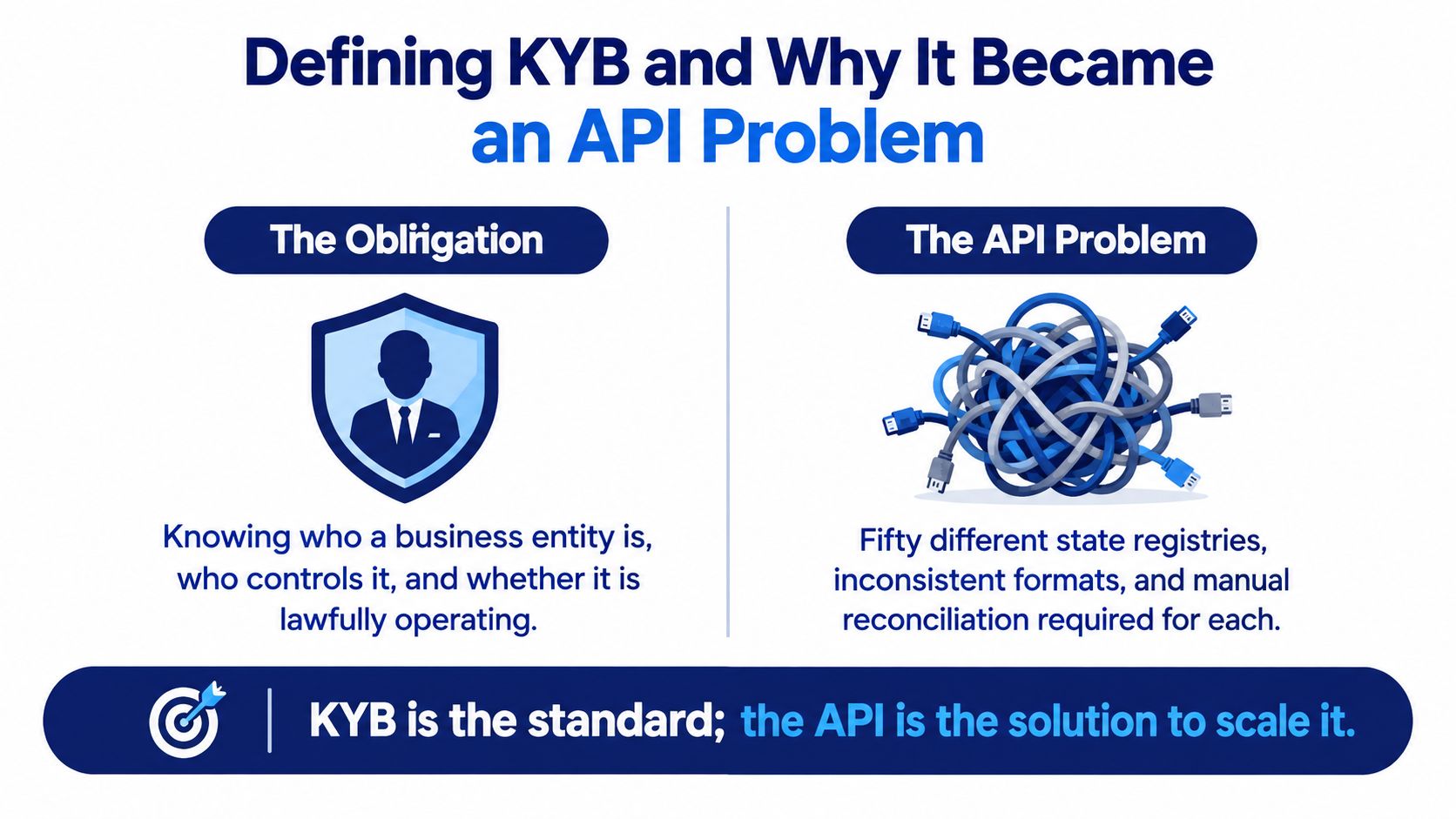
KYB means Know Your Business. In practice, it's the process of verifying a business's identity and legitimacy, and the core tasks usually include name verification, address verification, officer and owner verification, domestic registration verification, and watchlist screening. That's a compliance obligation first, and a technical integration problem second.
Why KYB is different from KYC
KYC focuses on people. KYB focuses on legal entities, the records that define them, the people who control them, and the filings that show whether they're still active and legitimate. Those two workflows sometimes overlap, but the data layer is different, so the software layer has to be different too.
The hard part is fragmentation. Business identity data lives across state registries, government watchlists, corporate filings, and other jurisdiction-specific systems, all with different field names and update patterns. You can't build a dependable onboarding flow if every new jurisdiction requires a new parser and a new exception path.
That's why KYB became an API problem. The API abstracts the aggregation work and exposes a consistent contract, so product logic can ask the same question every time, “what entity is this, what's its status, and who controls it?” The implementation details stay behind the interface, where they belong.
The clearest mental model is this, KYB is the obligation, the API is the scaling mechanism. Once you see it that way, the integration work becomes easier to reason about, because you're not chasing every source directly. You're wiring a business decision into software.
Core Capabilities Every KYB API Should Expose
A credible KYB API should do more than say whether a company name exists. It needs to support the actual decisions teams make during onboarding and review, and those decisions usually break down into a few operational questions. The right capabilities answer those questions in a way that's easy to automate.
| Capability | Question Answered | Onboarding Stage |
|---|---|---|
| Entity search | Does this company exist, and where is it registered? | Initial intake |
| Entity status | Is this business legally allowed to operate right now? | Approval review |
| Filings and history | Has the structure changed in ways that affect risk? | Due diligence |
| Officers and ownership | Who actually controls this business? | Beneficial ownership review |
| Ongoing monitoring | Has anything changed since activation? | Continuous controls |
Search and status first
Entity search is the starting point because it anchors the record to a canonical company. It resolves a name or registration number into a business identity your system can reference consistently. The next step is status, because existence alone isn't enough, your workflow needs to know whether the entity is active, dissolved, or otherwise not fit for onboarding.
Ownership and history after that
Officers and beneficial ownership matter because the legal entity is only part of the picture. Compliance teams need to know who controls the business, and product teams need enough confidence to route the case correctly when the ownership trail is unclear. Filing history adds another layer, because amendments, registered agent changes, and similar events can shift the risk profile over time.
Monitoring closes the loop
A static lookup is useful, but a monitoring hook is what turns verification into a control. If the business changes status after onboarding, the system shouldn't discover that during a manual audit months later. It should surface the change when it happens.
For a deeper look at the search side of this flow, the entity-search pattern in SOSfinder's entity search documentation shows how a single lookup can anchor a canonical record.
How Unified Endpoints Normalize Fifty State Registries
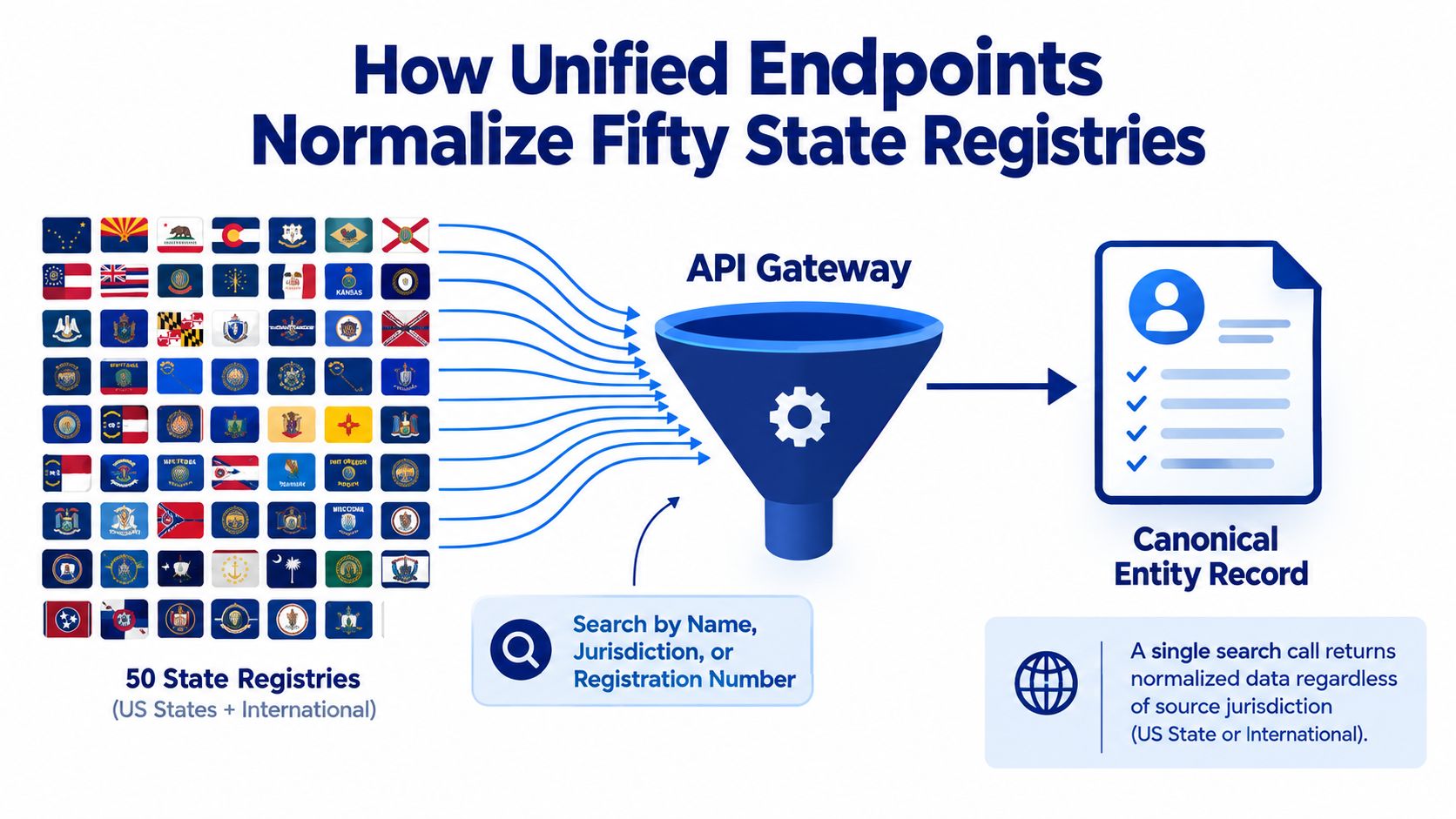
The engineering problem isn't just coverage. It's that each registry names the same thing differently, updates on its own schedule, and exposes a slightly different response shape. A unified endpoint absorbs that variability and returns a stable record your product can use without country-by-country or state-by-state branching.
The normalization layer is the real product
At the data layer, normalization means mapping different registry fields into one canonical schema. Instead of parsing a different response every time, your code gets stable values such as legal name, entity type, status, formation date, and registered agent. That's what lets one integration support many jurisdictions without turning into a maintenance trap.
A normalized endpoint also reduces engineering drag. You maintain one contract, one set of response handlers, and one test harness, instead of building new logic whenever a state changes its schema. That matters more than it sounds, because schema drift is usually what breaks production flows, not the happy path.
Edge cases still matter
Unified endpoints don't erase ambiguity. Merged entities, name reservations, stale cache layers, and similar cases still need explicit handling, because a “best match” is not always the same thing as a confirmed legal entity. The right implementation keeps those states visible instead of burying them in a generic success response.
A clean response is useful only if your system can tell the difference between a confirmed match, a partial match, and a result that needs human review.
For a broader comparison of registry coverage patterns, SOSfinder's one API for fifty states article shows why a single schema is easier to operationalize than dozens of per-state adapters.
Anatomy of a KYB API Request and Response
A production integration usually starts with a request that gives the service enough context to find the right entity without making the caller overcomplicate things. A typical payload includes the legal name, jurisdiction, and registration number, with optional fields for tax ID or an internal reference. That gives the API enough signal to match the registry record and enough metadata for your own audit trail.
A realistic request flow
A simple verification request might look conceptually like this, your application posts the business identity, the service resolves the record, and the response comes back with a request ID for tracking. If the lookup is idempotent, repeated submissions with the same input shouldn't create conflicting results, which is important when retries happen in the background. Pagination matters too, especially when beneficial owner arrays or filing histories get long.
The response should be read as structured evidence, not as a blanket guarantee. Fields like matched entity, legal name, entity type, status, formation date, jurisdiction, addresses, and source registry tell you what the service found. They do not automatically tell you whether every downstream compliance question is fully answered.
How to interpret the response
Here's the field mapping you need:
| Request Field | Response Field | Purpose | Notes |
|---|---|---|---|
| legal_name | matched_entity, legal_name | Anchors the lookup | Watch for partial matches |
| jurisdiction | jurisdiction | Narrows the source | Needed for disambiguation |
| registration_number | source_registry reference | Finds the canonical record | Best when present |
| tax_id | matched_entity metadata | Extra confidence signal | Optional, not always available |
| requester reference | request_id | Correlates logs and retries | Useful for support and audits |
The most common mistake is trusting a successful status code too much. A 200-level response means the API processed the request, not that every legal nuance has been resolved. That's why your application still needs explicit handling for partial matches, fuzzy collisions, and empty result sets.
For the auth side of the integration, SOSfinder's authentication documentation is the right place to verify how signed requests are handled.
From One-Time Checks to Continuous Business Monitoring
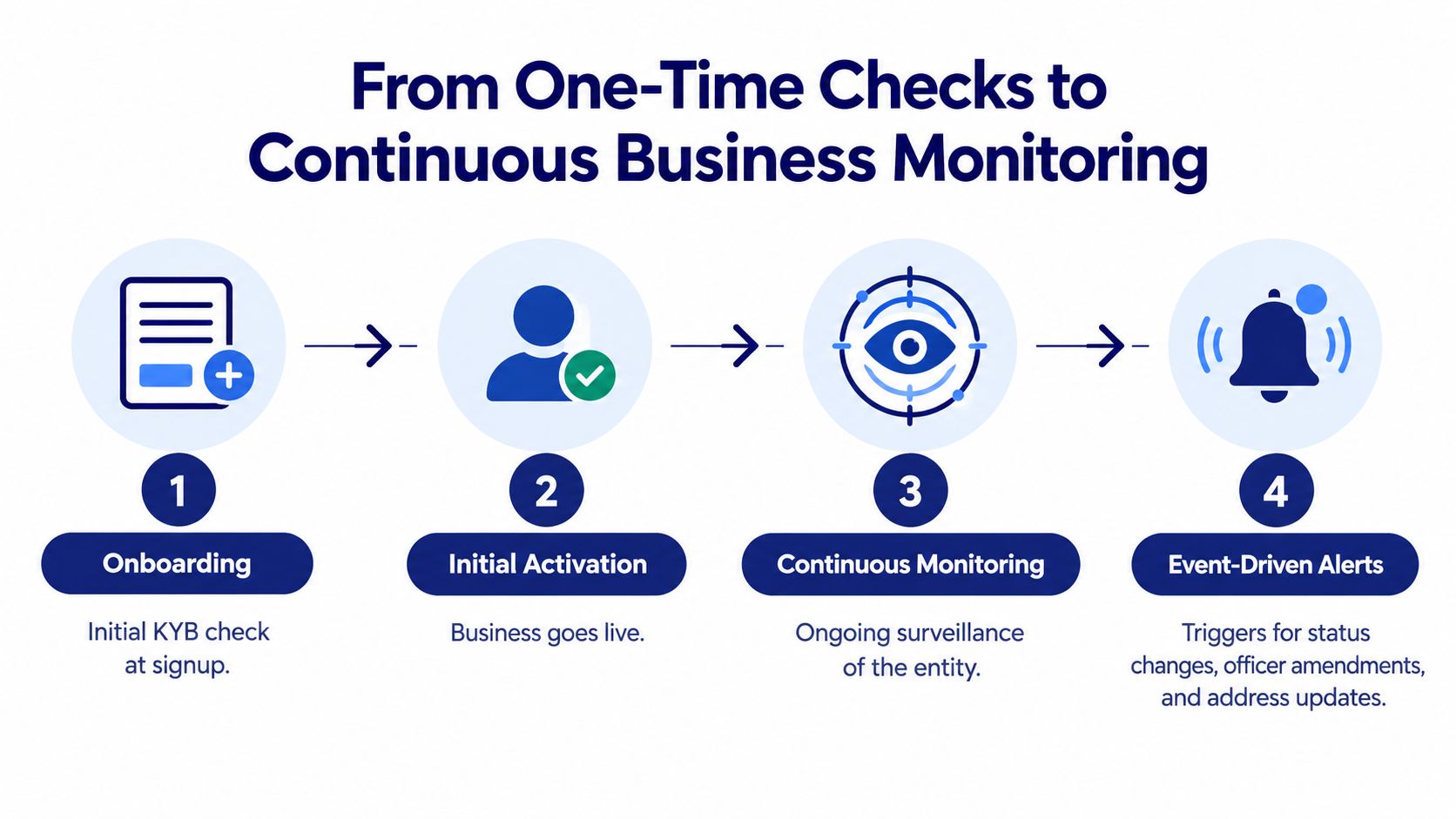
A single verification at signup catches the obvious issues, but it doesn't protect you from changes that happen later. Businesses can change status, officers can be amended, and addresses can shift, which means the entity you approved last quarter might not be the same risk profile today. Monitoring turns KYB from a gate into an ongoing control.
What a continuous workflow looks like
The cleanest pattern is simple, onboard the entity, subscribe to change events, push those alerts into your compliance queue, then update risk scoring or case status as new evidence arrives. Webhooks are usually better than polling for this because they let the system react to change instead of wasting cycles rechecking records on a timer.
That matters most in workflows where evidence freshness matters more than raw lookup speed. If your team is reviewing corporate customers, vendors, or counterparties over time, the question isn't only “did they pass once?” It's “are they still the same business we approved?”
How teams usually wire it
- Onboard the business. Create the initial verification record and store the canonical entity ID.
- Subscribe to changes. Listen for status, officer, or address updates.
- Route alerts. Send important changes into compliance review or case management.
- Re-score risk. Update the internal record, then decide whether the relationship stays active, gets reviewed, or gets paused.
The strategic shift here is subtle but important. KYB is not a one-time check when the business relationship starts, it's a living data feed that keeps the record honest.
The Hidden Gaps in KYB API Implementations
A successful response can still hide problems. The biggest mistake teams make is treating a clean lookup as the end of the verification story, when it's really just the start of evidence collection. Three gaps show up over and over: freshness, source coverage, and edge-case handling.
Freshness is usually the first trap
Registry data can change faster than an integration refreshes it. If the API caches too aggressively, your system may show a status or address that no longer reflects the current filing record. The fix is to inspect timestamps, understand update frequency, and treat stale data as a compliance risk instead of a minor technical detail.
Coverage and completeness are different problems
A vendor can cover many jurisdictions and still return sparse data for specific entity types or ownership questions. That's where teams need multi-source reconciliation, especially when beneficial ownership or filing detail lives in a separate registry record. An empty array is not the same thing as “no owners exist,” and null is not the same thing as a verified absence.
Edge cases need explicit rules
Merged entities, reinstatements, and DBA structures can confuse a system that expects one clean legal name and one permanent status. The right defensive pattern is simple, expose ambiguity rather than smoothing it away. If the lookup is partial, your workflow should know it's partial.
| Gap | What Goes Wrong | Defensive Pattern |
|---|---|---|
| Freshness | Cached records lag behind current filings | Inspect timestamps and refresh policy |
| Source coverage | Important details are missing or split across sources | Reconcile multiple records |
| Entity edge cases | Partial matches get treated as confirmed matches | Handle empty arrays and partials explicitly |
Choosing and Integrating a KYB API With Confidence
A good selection process starts with operational questions, not feature names. Before you sign anything, ask how broad the jurisdiction coverage is, how the normalized schema behaves, how errors are represented, and whether you can tell a partial match from a confirmed record without reverse-engineering the response. If the API cannot answer those questions predictably, your onboarding flow will carry that uncertainty forever.
What to verify before you commit
- Coverage breadth: Does the service reliably cover the jurisdictions you onboard?
- Normalization quality: Are the response fields stable enough for product and compliance to share one schema?
- Latency and reliability: Can the service support the approval path without slowing users down?
- Monitoring model: Do you get polling, push events, or both?
- Sandbox realism: Does the test environment behave like production, or does it hide the hard cases?
- Error semantics: Can your team tell the difference between no match, partial match, and source failure?
- Audit logging: Can compliance teams reconstruct what was checked and when?
Those questions separate a demo from a production control. A polished interface is helpful, but it will not save you when a failed lookup needs to be defended in a review or replayed after a customer dispute.
Caching deserves the same scrutiny. If records are cached too aggressively, the system may keep showing an older filing record, which is why SOSfinder's caching article is useful context on why response freshness and repeatability both matter. The right vendor choice is the one your team can keep operating under real traffic, real exceptions, and real audit pressure.
If you are building KYB into an onboarding flow, SOSfinder offers a single API for searching U.S. Secretary of State records and returning normalized entity data, status, officers, and filing history. Visit SOSfinder to see how that fits into search, monitoring, and compliance workflows, and use it as a reference point while you design a production-ready KYB integration.