Business Entity Data: Fields, Sources, and Integration
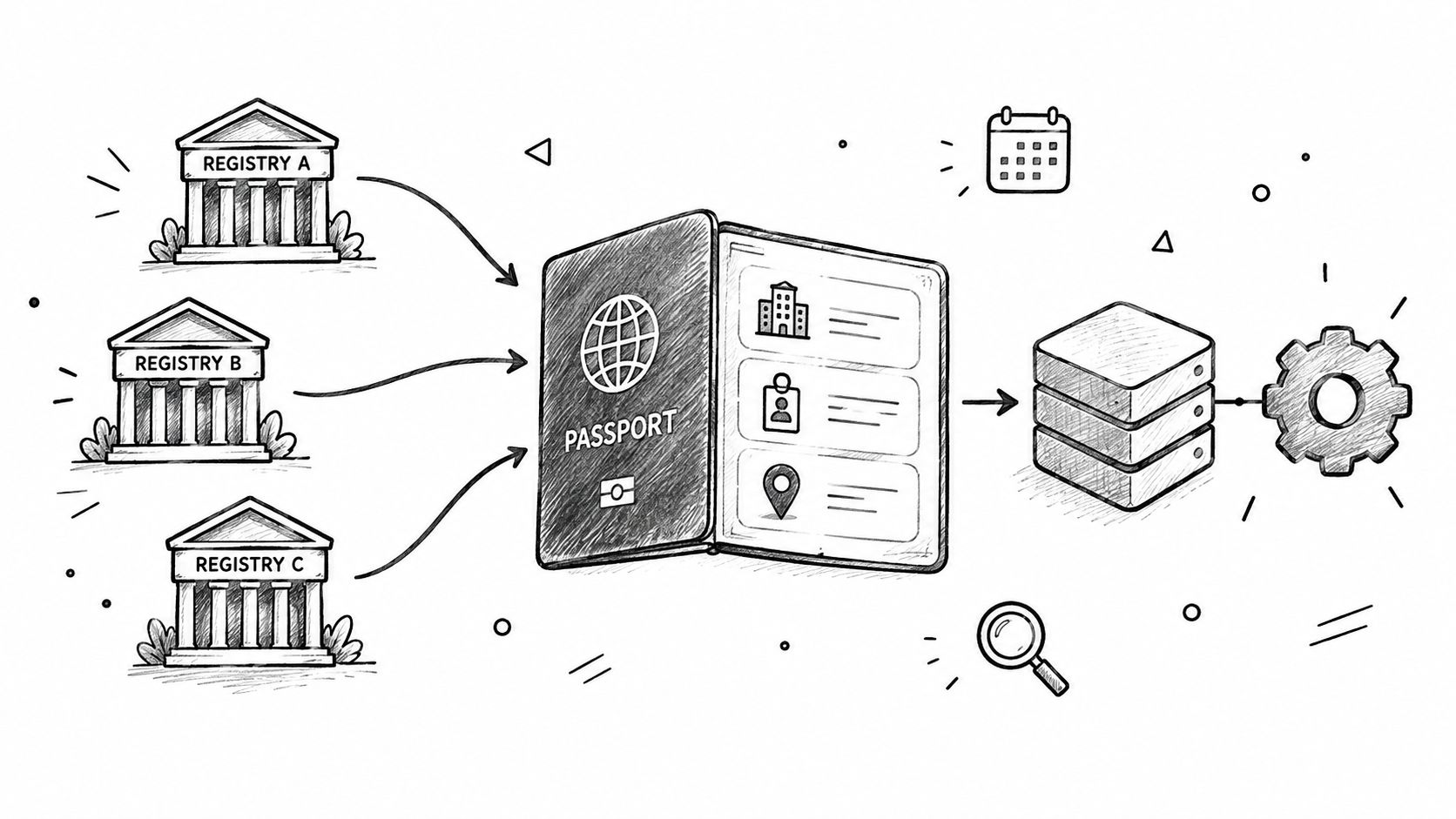
A fintech onboarding team pulls an official registry record for a new vendor. The record shows an active LLC, a valid legal name, and an address that matches the application. The team approves the vendor, then discovers weeks later that the registered agent and entity status have changed.
Nothing was necessarily wrong with the original lookup. The problem was treating business entity data as a permanent fact instead of a time-stamped view of a changing legal record.
That distinction affects every workflow built on company identity. KYB checks, vendor onboarding, procurement, compliance monitoring, name clearance, underwriting, and audit preparation all depend on knowing not only what a registry says, but also when it said it, where the value came from, and whether the record has changed since retrieval. A practical overview of KYB verification helps frame the identity question, but reliable systems must also handle freshness, provenance, normalization, and reconciliation.
Why Business Entity Data Matters More Than You Think
A business registry lookup often feels like a simple yes-or-no operation. Does the company exist? Is it active? Can the applicant provide a matching name and registration number? Those questions matter, but they're only the first layer of a dependable decision.
The record may contain a registered agent that no longer matches your internal profile, an address that changed after your last review, or a status that moved from active to another state while an onboarding case was still open. A product manager who models the lookup as a single API request will eventually face a harder question: how does the system know that yesterday's answer is still safe to use today?
Business entity data works better as infrastructure. Your application needs a source record, a normalized representation, a retrieval timestamp, a source jurisdiction, and a way to detect later changes. Without those pieces, downstream systems may reuse an outdated answer without notice.
Practical rule: Treat every registry result as a versioned observation, not as an eternal truth.
The historical record supports this infrastructure view. The U.S. Census Bureau's Business Register has been continuously updated since 1972 and includes business locations, organization types, industry classifications, receipts, and employment across a broad set of company and establishment records. The World Bank's Entrepreneurship Database methodology likewise describes business-register data gathered across 188 economies, with firm entry and exit information covering 2006 to 2024.
For an engineering team, the practical takeaway is straightforward. Store the raw source response, map it into a stable internal schema, preserve the source timestamp, and create a process for rechecking important entities. The rest of this guide shows how to do that without confusing registry coverage with proof of ownership, control, or overall business risk.
What Business Entity Data Actually Contains
Think of a company's registry record as a passport for a legal entity. A passport identifies a person using standardized attributes. A business entity record performs a similar job for a company, giving systems a shared way to recognize the organization and describe its legal presence.
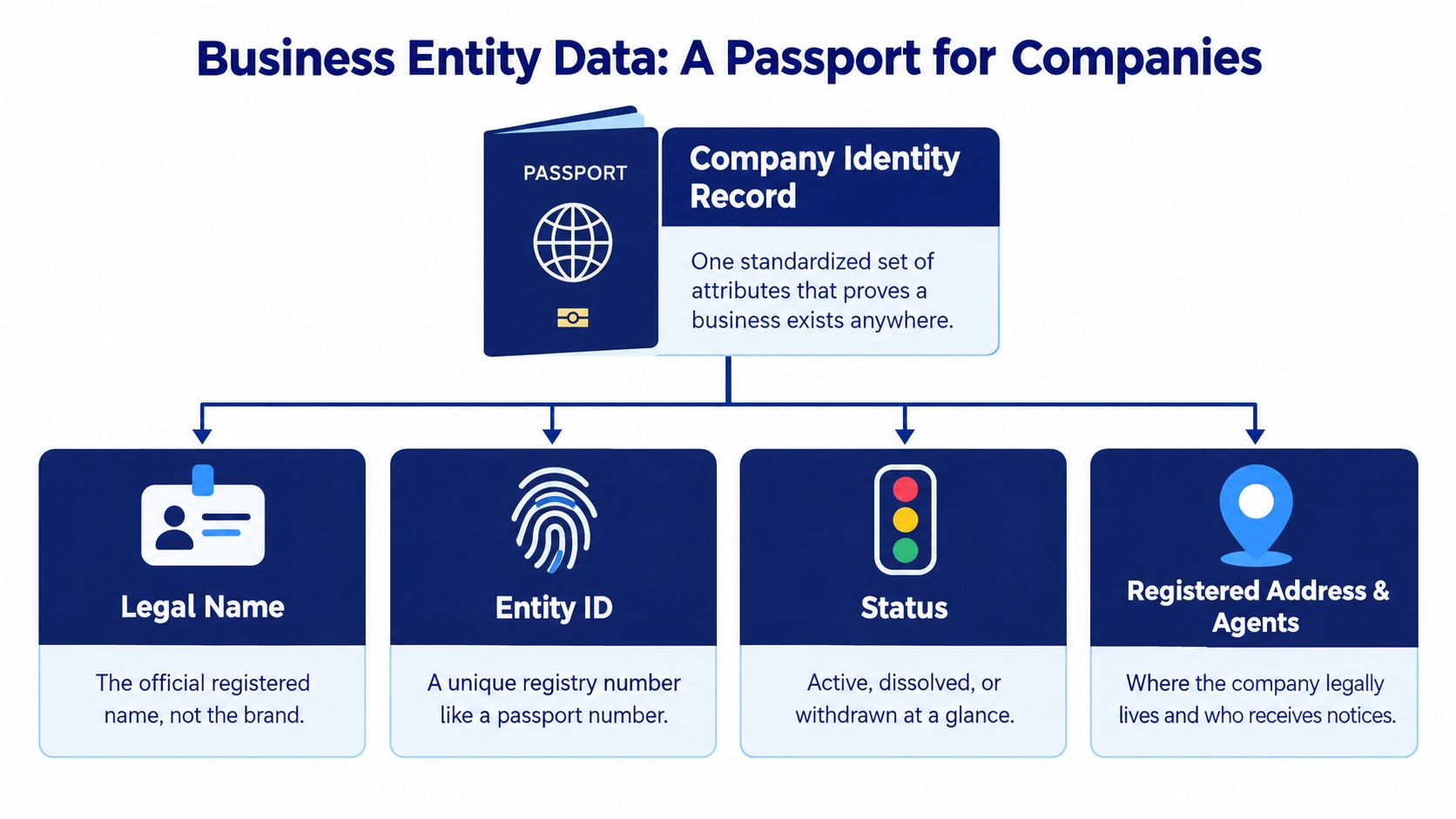
A high-quality record normally starts with a unique identifier and core fields such as legal name, legal form, status, registered address, annual accounts, and director information. The Global Data Barometer company-register indicators treat identifiers and structured register fields as important quality tests because they support reliable joins between datasets.
The core fields
Legal name: The official name filed with the registry. It may differ from a trading name, product brand, website name, or abbreviated name shown by an applicant.
Entity identifier: The registry's unique number for the organization. It's more dependable than a name search because names can be similar, reused, abbreviated, or formatted differently.
Entity type or legal form: This describes the organization's legal structure, such as an LLC or corporation where the jurisdiction provides that classification.
Status: A lifecycle indicator such as active, dissolved, withdrawn, or another jurisdiction-specific state. Status helps answer whether the entity currently appears in good standing, but the exact meaning depends on the source's definitions.
Formation or registration date: The point at which the registry recorded the entity. This helps distinguish a recently formed organization from an older one with a similar name.
Registered agent: The person or service designated to receive legal notices. A registered agent isn't automatically an owner, executive, or beneficial owner.
Principal or registered address: The address associated with the entity in the registry. It may be a legal contact address rather than an operating location.
Officers and directors: People listed by the relevant registry. Availability and completeness vary by jurisdiction, so a missing person field doesn't prove that no such person exists.
Filing history: Amendments, annual reports, formation documents, status changes, and other filings. Filing history provides context that a current summary record can't show by itself.
The entity search documentation is useful when translating these fields into application behavior, especially if your interface needs search by name, identifier, or jurisdiction.
Business entity data answers, “What legal organization does this record describe?” It doesn't automatically answer, “Who controls it, how risky is it, or whether every registry field is current?”
That boundary matters. Financial data describes performance or accounts. Ownership data describes control and beneficial interests. Credit data describes repayment behavior and exposure. Registry data establishes legal identity and filing context, but teams often need to combine it with other evidence before making a risk or approval decision.
Where Entity Data Comes From
The authoritative starting point for a U.S. company is usually the registry maintained by the state where the entity was formed or registered. In practice, that means working across 50 Secretary of State offices and the District of Columbia, each with its own search interface, response format, status vocabulary, filing access rules, and update behavior.
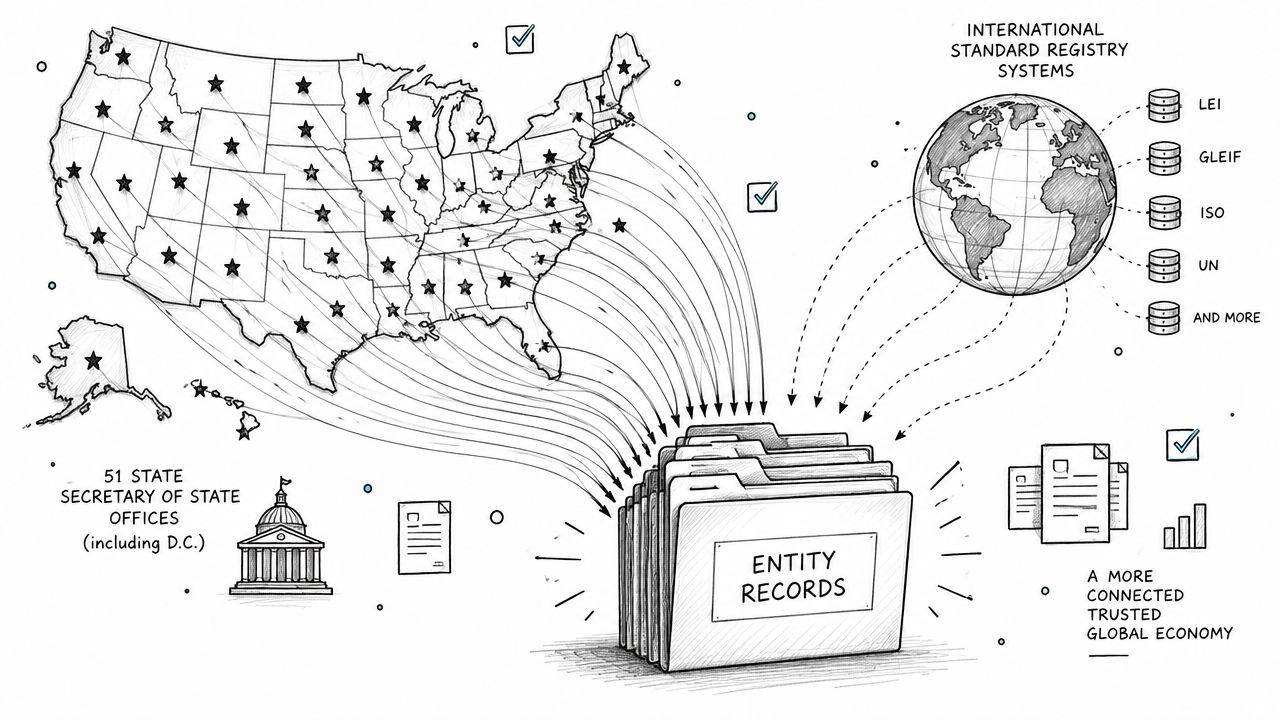
One registry may expose an officer list directly. Another may provide only a summary page. A third may use a status label that looks familiar but carries a different operational meaning. Some filings may be available as structured data, while others require document retrieval and interpretation.
That fragmentation creates an identity-resolution problem. A name, address, or date that looks identical across two sources may describe different entities. Conversely, one company may appear with punctuation changes, suffix variations, abbreviations, or different address formats. Provenance lets your system explain which source supplied each value and prevents a normalized record from looking more authoritative than its underlying evidence.
Global identifiers provide another layer
The Global Legal Entity Identifier system shows how entity identity can operate as shared infrastructure across jurisdictions. By Q2 2026, more than 92,000 organizations worldwide had obtained an LEI, the active LEI population exceeded 3.1 million, and the total LEI population exceeded 3.35 million, according to GLEIF's Q2 2026 LEI figures. The system's renewal rate reached 57.1% in that quarter, while the Global LEI Index publishes daily statistics.
Those figures illustrate an important design principle. Entity records aren't merely created and forgotten. They require maintenance, renewal, and ongoing interpretation as organizations change status or remain active.
Evaluate providers by origin and freshness
A provider's coverage claim is only the beginning. Ask these questions before building a dependency:
- Where does each value originate? Is it pulled from an official registry, a secondary directory, a customer submission, or an inferred source?
- What does the provider preserve? Look for raw filings, source timestamps, jurisdiction metadata, and links to official documents.
- How does it handle gaps? Missing officers or unavailable filings should be represented as missing, not converted into negative conclusions.
- How does it detect changes? A system that only answers searches may still leave your stored portfolio stale.
A single endpoint can reduce integration overhead, but it doesn't remove the need to understand the sources behind that endpoint. A multi-state entity API approach is valuable when the application needs one request pattern, while the data model still needs to retain jurisdiction and provenance.
How Data Normalization Turns Mess Into One Schema
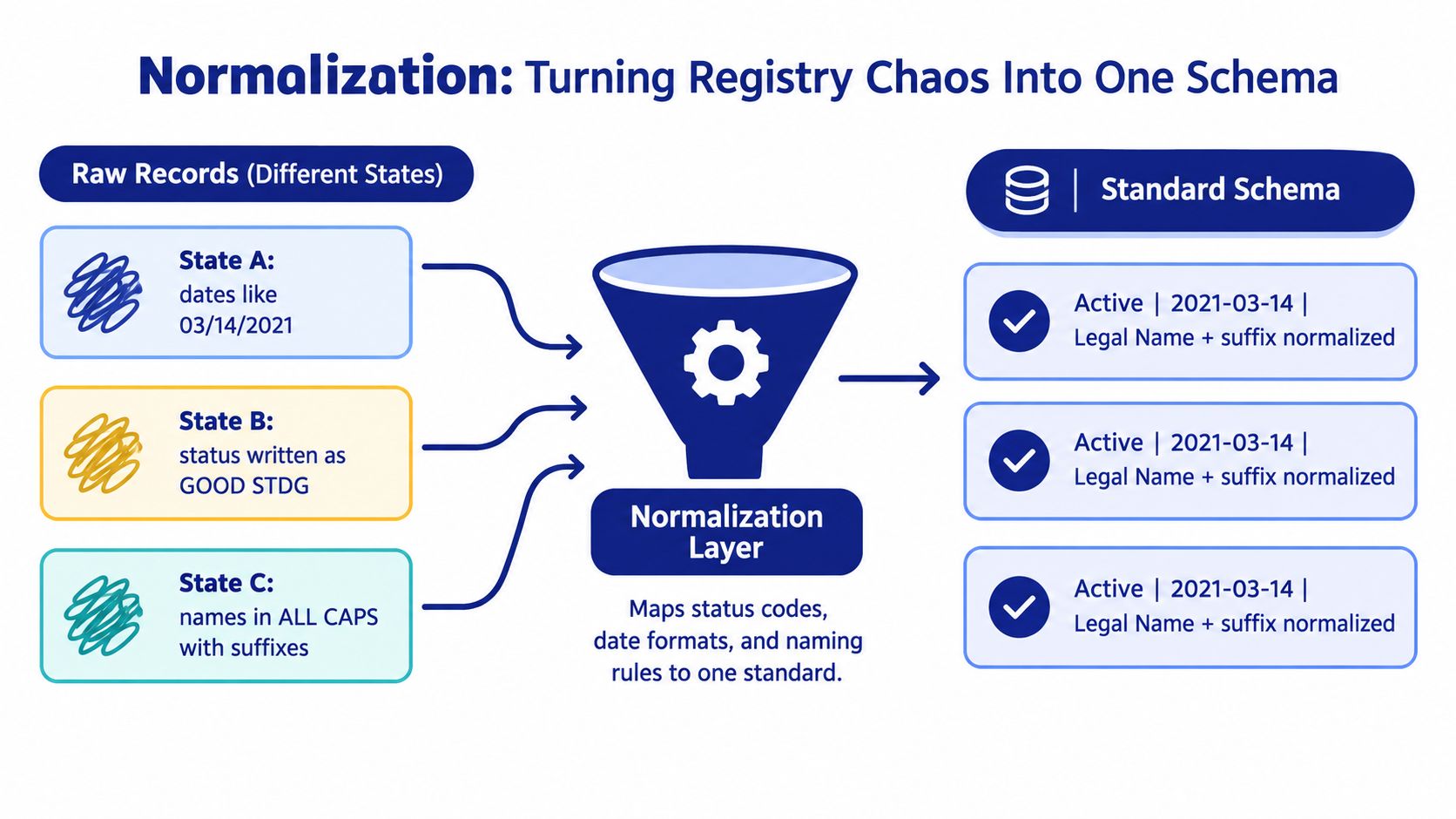
Raw registry data rarely arrives in the shape your application wants. One source may return 03/14/2021, another may return 2021-03-14, and a third may place the date inside a filing object. Status values can appear as GOOD STDG, Active, or a jurisdiction-specific phrase.
Normalization is the translation layer between those source conventions and your product's stable data contract.
Suppose your system receives two records for similarly named entities:
- A Delaware response contains
ENTITY NAME,FILE NUMBER,DATE OF FORMATION, andSTATUS: GOOD STANDING. - A California response contains
Entity,Entity Number,Date Incorporated, andStatus: Active.
A human can understand that these fields are related. Application code shouldn't have to implement a separate interpretation for every jurisdiction.
Start with field mapping
Create a canonical schema with explicit names and types. For example:
legal_name
entity_id
jurisdiction
entity_type
status
formation_date
registered_agent
principal_address
officers
filings
source_url
retrieved_at
The Delaware FILE NUMBER and California Entity Number can map to entity_id, while the source-specific value remains available as metadata. DATE OF FORMATION and Date Incorporated can map to formation_date after conversion to a consistent date representation.
Harmonize carefully
Status mapping requires more than string replacement. Your system should maintain a jurisdiction-aware translation table and preserve the original value. If GOOD STDG maps to an internal active category, store both values so an analyst can see the source wording and your normalized interpretation.
Names need similar care. Normalize capitalization, punctuation, spacing, and legal suffixes for matching, but retain the original legal name for display and document comparison. A normalized search key is not a replacement for the filed name.
Engineering principle: Normalize for comparison and workflow logic. Preserve the source value for evidence, review, and auditability.
Resolve identity, not just formatting
A common-name search may return several plausible records. Best-match selection should consider jurisdiction, entity identifier, address, formation date, registered agent, and filing history. The system should expose competing matches when confidence is low rather than forcing a silent choice.
The embedded walkthrough below shows how a normalization layer can sit between inconsistent registry responses and downstream product logic.
Normalization reduces per-jurisdiction branching in onboarding rules, databases, analytics, and monitoring services. It doesn't make the source records identical, and it doesn't resolve missing information. It gives your team one predictable structure while keeping the differences visible where they matter.
The Freshness Gap Nobody Plans For
Most teams design entity verification as a lookup: send a name or identifier, receive a result, approve or reject the case. That model breaks when the registry changes after the request, or when the registry itself has not yet reflected a real-world event.
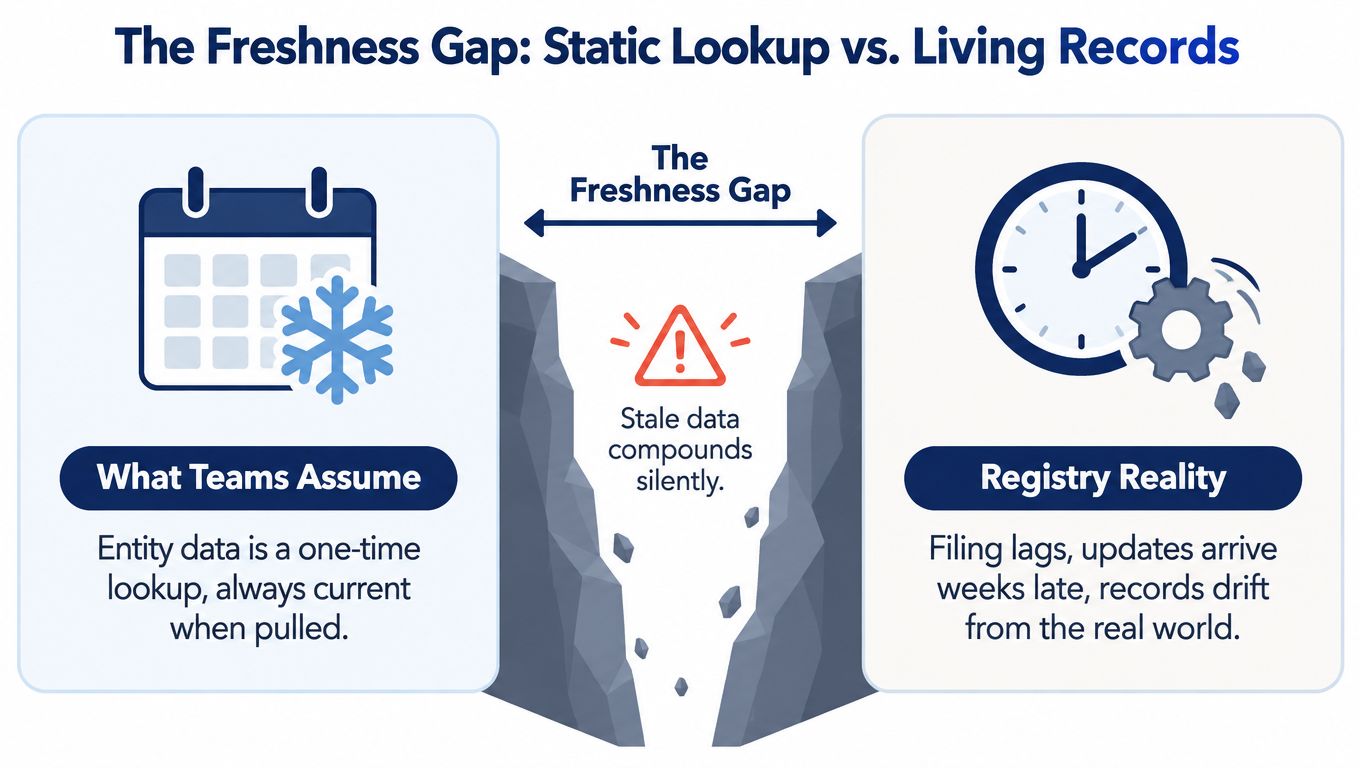
Different jurisdictions update records at different cadences and use different validation standards. Coverage can also be uneven. Recent reporting on the difficulty of finding U.S. company data notes that officer or director information can be missing in some registries, while access may be fragmented across paywalls, inconsistent APIs, and different disclosure rules.
Registry drift changes the engineering problem
Registry drift is the gap between the record your system has stored and the record that the authoritative source would return after a change. A legal name, registered agent, address, or status may change without your application receiving an immediate notification.
A retrieved record can therefore be accurate at retrieval time and stale for the decision you're making later. Caching helps with speed and cost, but a cache without an invalidation or monitoring strategy merely preserves old answers efficiently. A caching and lookup design should define what gets cached, how long it remains suitable for each workflow, and what event causes an early refresh.
Build freshness into the data model:
- Record retrieval time: When did your system obtain the value?
- Source update time: Does the registry provide a filing or update timestamp?
- Jurisdiction expectation: How quickly does this source typically expose relevant changes?
- Field criticality: Does a status change require faster action than an address change?
- Change history: What was the previous value, and who consumed it?
Entity existence isn't ownership proof
A registry record can establish that an entity appears in an official system. It may show legal form, status, registered agent, officers, address, and filings. It often won't establish the full ownership or control picture required for KYB, underwriting, procurement, or sanctions screening.
The 2025 policy analysis of legal entity identifiers explains why identifiers alone are insufficient without beneficial ownership information. The same analysis discusses incomplete and inconsistent registry data, while noting that U.S. company-data access averages 31 out of 100 in the referenced assessment. A separate global assessment cited in the brief found that only 44.9% of respondents had national business unique-identifier systems, which makes cross-system matching harder.
Use layered verification instead. Combine the registry identity record with beneficial ownership evidence, submitted documents, screening data, relationship analysis, and change monitoring. Your system should state exactly what each layer proves and what it leaves unresolved.
Real-World Uses Across Teams
The value of business entity data appears at the point where a team must make a decision. An onboarding analyst needs to know whether the applicant's legal identity matches the vendor profile. A compliance manager needs to know whether a monitored entity changed status. A legal filing product needs to know whether a proposed name is available before a customer submits an application.
The same underlying fields support each workflow, but the required capability differs.
| Use Case | Key Fields | Capabilities Needed |
|---|---|---|
| KYB and vendor due diligence | Legal name, entity ID, status, entity type, address, agent, officers, filings | Search, normalization, source provenance, document review, layered verification |
| Company name clearance | Proposed name, jurisdiction, existing legal names, entity status | Availability search, similarity review, jurisdiction-specific rules |
| Compliance monitoring | Entity ID, status, registered agent, address, filing history | Scheduled checks, change detection, alerts, review history |
| Underwriting and case review | Identity fields, formation date, filings, officers, source documents | Historical retrieval, timestamps, document access, audit trail |
| Procurement controls | Legal name, status, address, officers, identifiers | Portfolio matching, bulk verification, exception handling |
KYB and vendor onboarding
A procurement or fintech workflow can begin with an entity identifier when the applicant provides one. If it doesn't, the system can search by legal name and jurisdiction, then ask an analyst to confirm the best match. Status and filing history support the initial identity check, while officers, ownership information, and external evidence address questions the registry alone can't answer.
Name clearance
Name clearance should happen before a formation workflow reaches submission. Search results can reveal similar names, inactive entities, or records that require human review. The result isn't a guarantee of acceptance, because each jurisdiction applies its own rules, but early screening can reduce avoidable rework.
Compliance monitoring
Monitoring turns a one-time verification into an operational process. Instead of waiting for an analyst to repeat every search, the system records the entity identifier and watches selected fields such as status, agent, and address. A change event can create a review task, preserve the old and new values, and route the case according to risk.
Document retrieval
A summary record often isn't enough for an audit or underwriting file. Filing histories and official PDFs can provide the evidence needed to explain how an entity was formed, amended, or restored. Store the document reference alongside the normalized record so reviewers can move from a decision to its source.
Integration Best Practices for Engineering Teams
Start with the data contract, not the endpoint. Define which fields your workflow requires, which are optional, how missing values appear, and what evidence must be retained. Then choose an integration pattern that can provide those fields across the jurisdictions you support.
A multi-state product shouldn't force application teams to maintain separate logic for every registry. A single REST endpoint with a jurisdiction parameter can consolidate source access, while a normalized response keeps downstream code consistent. The integration still needs to expose the original source, retrieval time, and jurisdiction so abstraction doesn't hide important limitations.
Build for identity and failure
Assign an internal entity key and retain the source-specific identifier. The World Bank guidance on interoperability and business identifiers recommends assigning a unique business identifier at incorporation and sharing it across government systems. In your own platform, that principle reduces accidental merges and makes it easier to connect filings, tax records, compliance reviews, and vendor profiles.
Error handling deserves the same consistency as successful responses. Use predictable categories for not found, ambiguous match, source timeout, temporary blocking, malformed source data, and unavailable documents. Retry transient failures with bounded backoff, but don't retry a confirmed absence indefinitely or turn a source outage into an approval decision.
Monitor changes instead of guessing
Scheduled re-pulls can work for low-risk use cases, but important portfolios benefit from change events and alerts. Subscribe to webhooks where available, record field-level differences, and route material changes to a human or automated control. Bulk verification helps teams process existing portfolios without writing one-off scripts, while real-time lookup combined with caching balances freshness against latency and repeated retrieval.
Test the workflow with an API playground and representative requests in the languages your team uses, such as cURL, Python, JavaScript, PHP, or Go. Include cases with common names, missing officer data, changed addresses, source timeouts, duplicate matches, and unavailable filing documents.
Treat business entity data as a continuously maintained layer. The strongest systems don't only answer whether a company exists. They show which source supplied the answer, when it was retrieved, what changed afterward, and when the record no longer supports the decision.
SOSfinder provides a single REST endpoint for normalized business entity records from all 50 U.S. states and the District of Columbia, with search, filing history, bulk verification, and monitoring capabilities. If you're building onboarding, KYC, procurement, or compliance workflows that need change detection rather than one-time lookups, visit SOSfinder to explore the API.