What Is KYB Verification and How It Actually Works

KYB verification is a workflow that confirms a business is real, identifies who owns or controls it, and checks the business and relevant people for sanctions, PEP, and adverse-media risk before you onboard, transact, or pay. In the U.S., the practical ownership trigger is often 25% or more, alongside one control person, under FinCEN's Customer Due Diligence requirements.
A procurement officer may encounter this process while onboarding a new supplier. The form asks for an EIN, articles of incorporation, a certificate of good standing, registered-agent details, and a list of owners. The request can feel excessive until you consider what a business name alone fails to reveal: the entity might be inactive, the documents might not match the registry, or control might sit several companies away from the legal customer.
KYB turns those unknowns into documented checks and a decision your product, compliance, or procurement team can defend later.
What KYB Verification Means in Practice
Start with the business itself. Entity identity means confirming that the legal entity exists and that its claimed name, jurisdiction, registration number, entity type, and status agree with an authoritative registry. A vendor calling itself Northstar Logistics LLC should resolve to the same legal name and state record, not merely resemble one in a search result.
Next comes ownership and control. The reviewer traces individuals and corporate owners through intermediate entities until the people who ultimately benefit from or control the business are identified. Under FinCEN's CDD framework, covered financial institutions identify and verify beneficial owners holding 25% or more, plus one control person, before onboarding a legal-entity customer. The practical workflow can also require attention to people with significant control below that threshold, depending on the jurisdiction and risk.
The third layer is risk screening. The entity and relevant individuals may be checked against sanctions lists, politically exposed person records, watchlists, and adverse media. A clean registration record doesn't make a relationship safe by itself. A legitimate company can still be controlled by a sanctioned person or connected to credible reports of misconduct.
Working definition: KYB asks three questions. Does the business exist, who is really behind it, and is the relationship acceptable at its risk level?
KYB and KYC are related, not interchangeable
KYC focuses primarily on an individual customer. KYB focuses on a legal entity and then connects that entity to the individuals or organizations behind it. If a payments product onboards a corporation, it may need both: KYB for the company and KYC for its beneficial owners or control person.
The process isn't a binary checkbox. A low-risk business with consistent registry information may follow a lighter path, while layered ownership, high-risk jurisdictions, unclear documents, or screening alerts can trigger enhanced review. The rule should be explicit in the product: what evidence supports approval, which discrepancies create a referral, and what conditions require rejection.
How KYB Became a Regulatory Expectation
Commercial account opening once looked like a file on a bank officer's desk. The officer collected incorporation documents, asked who owned the company, and formed a judgment from paper records and conversations. That approach worked only while volumes were manageable and records were comparatively easy to inspect.
Anti-money-laundering obligations gradually turned that internal practice into a formal control. In the United States, FinCEN introduced Customer Due Diligence requirements in 2016, and those rules took effect in 2018. They require covered financial institutions to identify and verify beneficial owners holding 25% or more of a legal entity, together with one control person, before opening an account for a business customer. The requirement connects KYB to AML enforcement, rather than treating it as an ordinary registration lookup. (FinCEN CDD and KYB background)
Equivalent beneficial-ownership and due-diligence expectations also operate across major markets, including the EU and UK. The details differ by jurisdiction, so a global product can't safely assume that one U.S. workflow satisfies every relationship.
The Corporate Transparency Act, enacted in 2021, expanded U.S. beneficial-ownership reporting expectations and showed how KYB was becoming part of a wider transparency regime. Government reporting and counterparty verification overlap, but they aren't the same activity. A filing to a government database doesn't replace your responsibility to verify the entity, understand the ownership chain, screen relevant parties, and document why your business accepted the relationship.
A product team can also treat KYB as a reusable compliance service instead of scattering checks through onboarding screens. A dedicated compliance monitoring workflow can retain evidence, trigger rechecks, and route exceptions without forcing engineers to rebuild the process for every product surface.
The Core Checks Inside a KYB Workflow
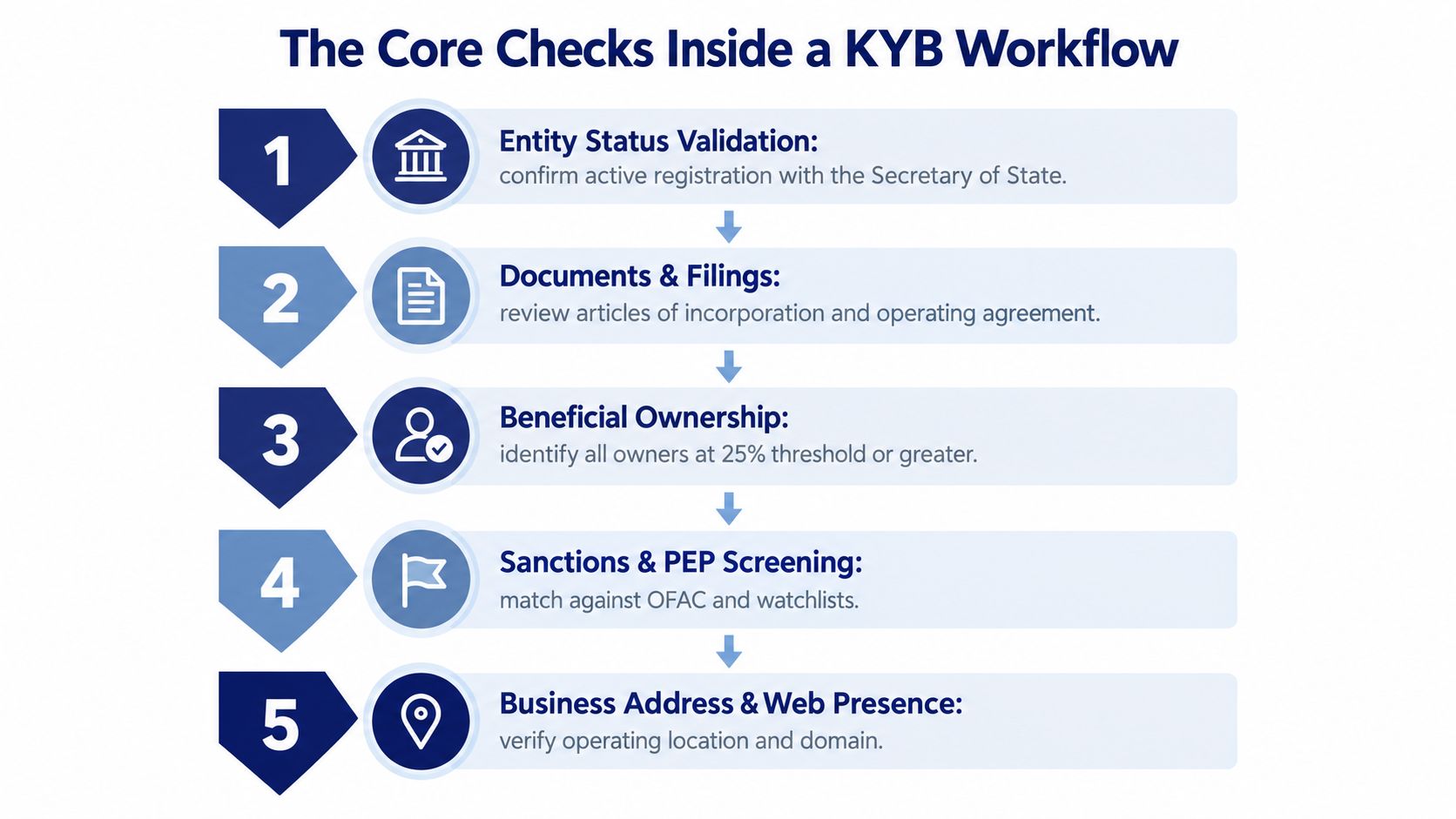
A real workflow starts with the entity record, then moves toward documents, control, and risk. The order matters because later checks depend on resolving the correct business first.
1. Confirm the entity record
Search the relevant Secretary of State registry or equivalent authority. Capture the legal name, entity type, formation or registration date, current status, registered agent, principal address, and available filing history. “Active” is useful, but it doesn't prove that the applicant's documents, owners, or business activity are genuine.
Federal tax information can add another comparison point where an EIN is available and can be matched through the permitted process. Treat tax identifiers as corroborating information, not as a substitute for state registration and ownership analysis.
2. Compare documents with public filings
Ask for documents that fit the relationship and risk. Articles of incorporation, certificates of good standing, operating agreements, ownership schedules, and relevant licenses can reveal discrepancies that a registry summary hides.
Check names, dates, addresses, signatures, entity numbers, and amendments. A document with a different legal name or an ownership schedule that conflicts with the available filing should create a clear referral, not an automatic pass.
3. Resolve ownership and control
Build an ownership graph rather than copying a single owner field into a spreadsheet. If Company A is owned by Company B, follow Company B's owners until you reach the individuals who ultimately own or control the customer.
Apply the relevant threshold and control-person rule. In many programs, the practical trigger is 25% ownership or control, while a person exercising significant control may still require review even without that ownership stake. (KYB ownership and entity-resolution guidance)
4. Screen the entity and people
Screen the business, UBOs, directors, authorized representatives, and control person against applicable sanctions and watchlists. Depending on your footprint, this may include OFAC, UN, EU, and UK lists, plus PEP and adverse-media sources.
A name match is an alert, not a conclusion. Analysts need identifiers such as date of birth, nationality, address, entity relationship, and source material to distinguish a true match from a common-name false positive. Adverse media also needs human judgment, especially across languages and jurisdictions.
5. Produce evidence, not just a score
The final record should preserve the inputs, source timestamps, matched or cleared parties, ownership paths, documents, analyst notes, and decision rule. A business entity search API can provide the registry layer, but your KYB system still needs screening, document handling, escalation, and retention controls around it.
The workflow becomes useful when each check feeds a defined operational outcome rather than disappearing into a report.
What a KYB Review Actually Decides
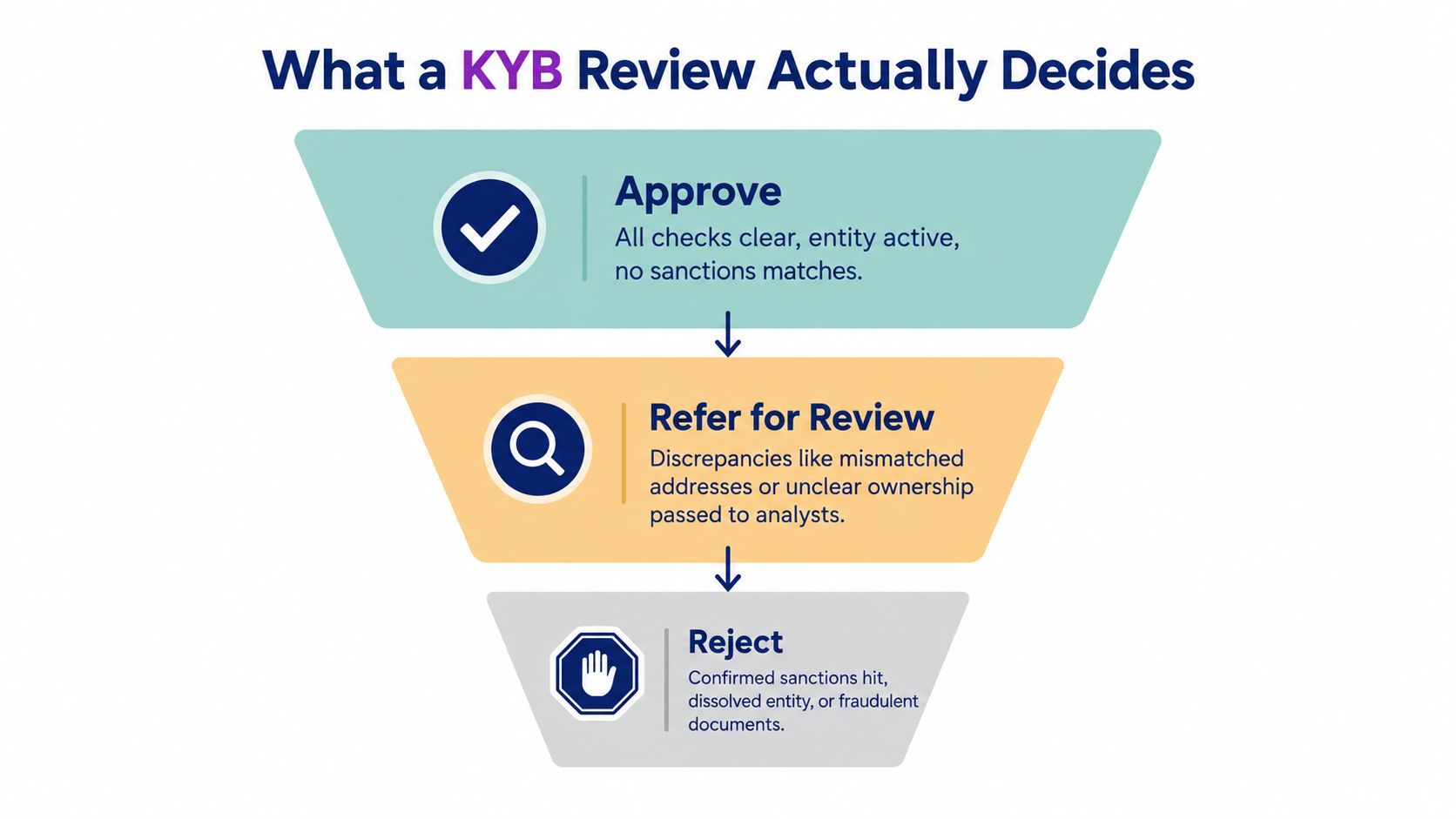
KYB works better as a three-state decision engine than as a yes-or-no gate. The three states separate clean cases from confirmed prohibitions and uncertain cases that need a person.
Approve
Approval means the entity resolved to an active record, submitted evidence is consistent, ownership and control are sufficiently understood, and screening produced no unresolved concern. The downstream product can activate the account or vendor, subject to any transaction or monitoring controls that apply to the relationship.
An approval record should still contain the evidence behind it. “Passed KYB” is too thin for an audit. Store the resolved entity identifiers, ownership findings, screening results, document versions, timestamps, and policy version used for the decision.
Reject
Rejection blocks onboarding or stops the relevant transaction. Typical triggers include a confirmed sanctions match, a dissolved or otherwise unacceptable entity, or documents that show fraud or cannot be authenticated.
The system should distinguish confirmed rejection reasons from technical failure. A registry timeout isn't the same as a dissolved company. If your interface collapses both into “failed,” operations staff may make inconsistent decisions and applicants may receive misleading explanations.
Refer for review
Referral is for unresolved ambiguity. An address mismatch, incomplete ownership chain, common-name screening hit, image-only filing, or unclear control relationship should route to an analyst with the exact evidence attached.
Practical rule: A referral should reduce analyst searching, not restart the investigation from an empty inbox.
The output is structured data, not a verdict detached from context. Downstream teams use the outcome, risk signals, source records, and analyst reasoning together. A decision should be replayable months later, even if the registry has changed or a screening result has been updated.
Why Manual KYB Breaks at Scale
The U.S. registry problem is structural. A team checking businesses across all 50 Secretary of State registries and the District of Columbia faces different portals, field names, search behaviors, document formats, access methods, and update patterns. That count comes from SOSfinder's coverage description, while the operational challenge is the direct consequence of treating separate government interfaces as one workflow.
One state may return a clean structured record. Another may require a browser search followed by a PDF download. An analyst then copies the legal name, status, registered agent, address, and filing dates into an internal system. Every transcription step creates an opportunity for a mismatch, and every exception needs a new instruction in the team's playbook.
Ownership adds a second failure point. A customer may be a Delaware LLC owned by a holding company, with another entity registered in Cayman or Luxembourg somewhere higher in the chain. The state record may confirm the customer's existence while revealing little about the person who ultimately controls it.
Where spreadsheets lose control
| Dimension | Manual KYB | Automated KYB |
|---|---|---|
| Registry access | Analysts use separate state portals and procedures | One integration selects the jurisdiction and normalizes results |
| Data entry | Names, dates, statuses, and agents are rekeyed | Structured fields flow into the case or onboarding system |
| Documents | PDFs are downloaded, opened, and compared individually | Filing links and extracted fields can feed review queues |
| Ownership | Analysts build chains by hand | Entity relationships can be represented as structured records |
| Change detection | Staff revisit records when someone remembers | Monitoring can generate a re-review event |
| Exceptions | Decisions live in email, notes, and spreadsheets | Evidence and status can remain attached to the case |
Manual KYB also grows stale. Registries can lag behind real-world changes, registered-agent addresses can change, and ownership or control can shift after approval. Industry guidance warns that one-time onboarding checks don't solve ongoing risk, especially where ownership is opaque or escalation paths are weak. (Why KYB needs risk-based monitoring)
Industry coverage describes a complete KYB workflow as averaging 6.2 distinct data checks, compared with 3.1 for KYC, which illustrates why business verification creates a heavier operational burden. (Manual KYB challenges and data-check comparison)
A caching strategy can reduce repeated registry work, but caching doesn't solve identity resolution or risk judgment. It only becomes useful when the system records freshness and knows when a new event should force a lookup. SOSfinder describes this approach in its lookup caching documentation.
How a Business Verification API Fits In
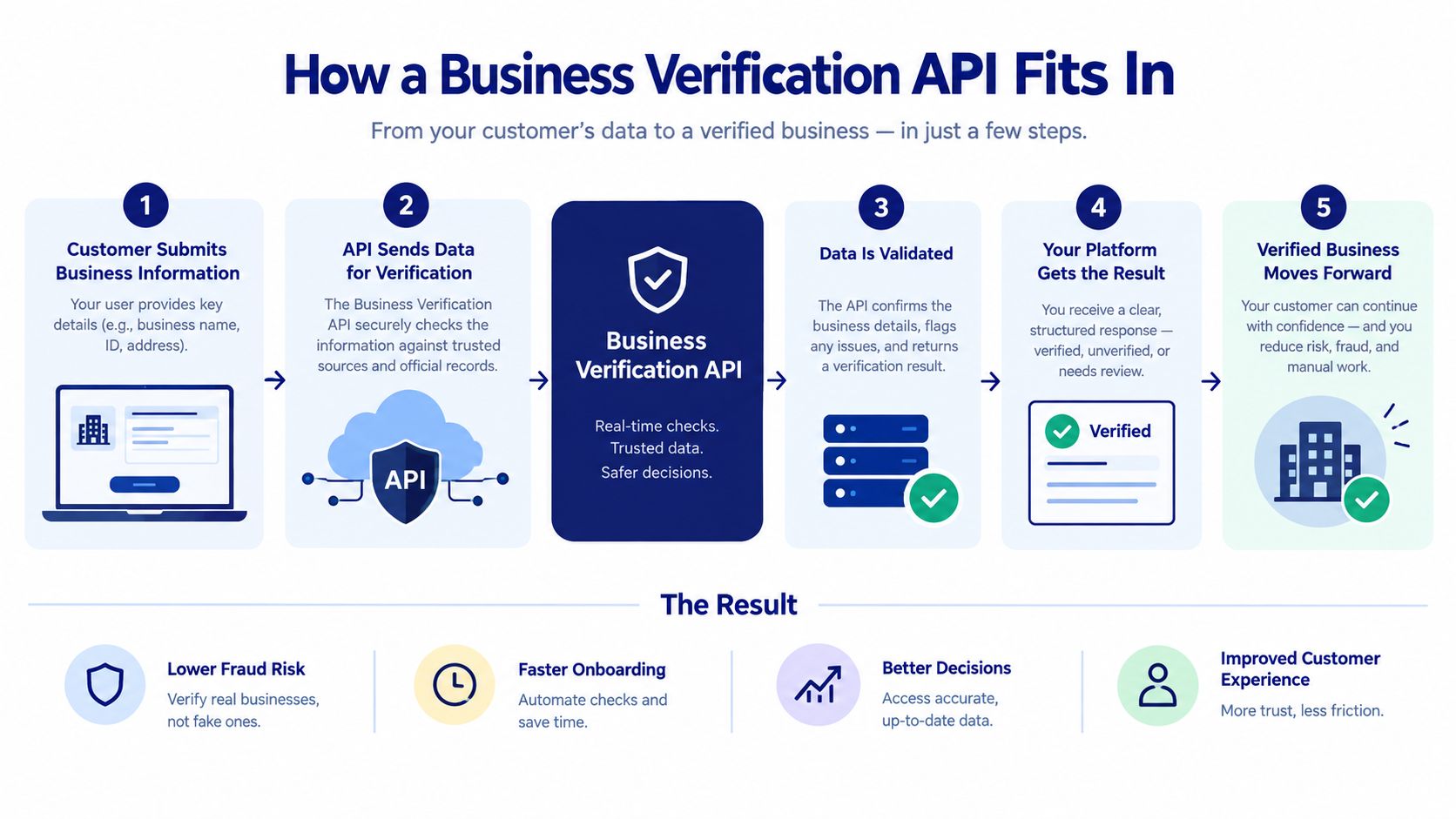
An aggregator API gives your product one integration point for a fragmented registry environment. A developer submits a business name and state, or an entity identifier when available, and receives a normalized record that can include legal name, entity type, status, formation date, registered agent, principal address, officers or principals where available, and filing history.
The important part isn't merely the endpoint. It's the normalization layer behind it. A Kentucky result, Delaware result, and California result may originate from different schemas, but your application can map each response into the same internal fields. The jurisdiction remains a parameter, while the rest of the onboarding logic stays consistent.
The request and the record
A sensible product flow looks like this:
- The applicant enters a legal business name and jurisdiction.
- Your service sends the search request to the registry aggregation layer.
- The response returns candidate entities and confidence or matching information.
- Your application asks the user to confirm the correct entity when names are ambiguous.
- The normalized record enters the KYB case, where documents, ownership, and screening are added.
That separation matters. The API resolves and standardizes government data. Your policy engine decides whether the result is enough for auto-approval, referral, or rejection. A registry lookup shouldn't claim to prove that a company is trustworthy.
Extending beyond the initial lookup
Once the entity is resolved, the same case can support additional controls:
- Document retrieval: Link filing histories and available PDFs to the review record.
- Ownership analysis: Extract possible principals from filings, then request missing ownership evidence.
- Screening: Screen the resolved entity and associated people against sanctions, PEP, and adverse-media sources.
- Monitoring: Recheck status, address, registered agent, or officer changes and create a review event.
- Portfolio backfill: Run bulk verification over existing customers or vendors instead of processing each record manually.
The limits are real. Not every state exposes real-time data, some filings are image-only and need OCR, and international ownership chains may still require direct document review. An API can reduce the mechanical work, but it can't infer an undisclosed beneficial owner with certainty or replace a compliance analyst's judgment on a complex alert.
SOSfinder is one example of this aggregation approach. Its KYB API documentation describes a normalized interface for U.S. entity records, with registry data supporting status, formation, agent, address, and filing-history workflows. Use that kind of service as connective tissue between raw public records and your internal decision engine, not as the entire KYB program.
Putting KYB Together for Your Product
A product manager can make KYB manageable by defining the control points before selecting endpoints or designing screens. Start with the events that should trigger verification: a new business account, a first payout, a material transaction threshold, a change in ownership, or a screening alert.
Then assemble the case in a deliberate sequence. Capture the applicant's legal name and jurisdiction, resolve the entity record, collect the relevant corporate documents, and request ownership and control information. Send the normalized business record and associated people through sanctions, PEP, and adverse-media screening. Keep each response connected to the same case identifier.
Define the three outcomes first
Your product should answer these questions in configuration, not in an analyst's memory:
- Auto-approve: Which fields must agree, and which screening results are clear enough to activate?
- Manual review: Which discrepancies create a queue item, and what evidence must accompany it?
- Hard decline: Which confirmed conditions block onboarding or payment immediately?
Monitoring belongs to the same contract. If a registered agent, address, entity status, officer, ownership record, or screening profile changes, the system should create a re-review event with the original decision and the new evidence side by side. That prevents a second, disconnected KYB process from growing beside onboarding.
The first implementation exercise
Take one real onboarding and replay it from application to decision. Record what the system knew, what it asked the applicant to provide, which fields were manually copied, which alerts lacked context, and whether another analyst could reproduce the outcome.
Build for uncertainty. A good KYB product doesn't pretend every business can be verified automatically. It makes clean cases fast, difficult cases explainable, and unresolved cases visible.
The immediate deliverable should be a decision map, not a large feature backlog. Once you know the exact conditions for approval, referral, decline, and re-verification, you can choose the registry API, screening provider, document workflow, storage model, and analyst tooling that support those decisions.
SOSfinder provides one option for the registry portion of that design, with a single endpoint for U.S. entity searches, normalized corporate records, filing-history access, monitoring, and bulk verification. Visit SOSfinder to evaluate how its registry aggregation could fit into your KYB onboarding and ongoing-review workflow.