In Good Standings: What It Means and How to Verify
A U.S. business is in good standing when its state registry shows it has filed the reports it owes and paid the required fees, as of a stated date. That's narrower than the advice you'll hear most often, which treats a certificate as proof a company is safe to work with. It isn't. A registry confirms filings and fees, not honesty, solvency, tax compliance, or whether the information in those filings is true. Read the status for what it is, a dated record from one jurisdiction, and you'll use it well. Read it as a trust score, and you'll approve risk you never checked.
What In Good Standing Means for a Business
A U.S. business is in good standing when its state registry shows it has filed the reports it owes and paid the state fees due, as of a stated record date. The wording makes searches for businesses in good standings sound broader than the underlying record. It's an administrative finding about registry obligations, not a general judgment about the company.
The phrase itself is old. The Online Etymology Dictionary entry for standing traces documented English usage of "in good standing" to 1789, where standing described reputation, rank, position, or status within a system. In membership settings it often meant dues were paid. In regulatory settings it meant required procedures were completed and charges were paid. That second, administrative sense is the only one that matters for a business registry.
Confusion starts because registries use several nearby labels. A company can exist on a registry and still have a filing problem, or it can be current for one cycle and fall behind in the next. The terms below separate signals that readers often collapse into one.
Status Terms and What Each One Signals
| Status term | What it signals | What to check next |
|---|---|---|
| In good standing | Required filings made and state fees paid as of the record date | Record date and the state that issued it |
| Active | Entity exists on the registry, but may still lack required filings | Filing history and annual report status |
| Current | Annual reports and fees brought up to date for the cycle | Next annual report due date |
| Delinquent | A required filing or fee is overdue | Due date, penalty and cure deadline |
| Dissolved | Entity no longer exists on the registry | Dissolution date and any reinstatement option |
Say a vendor sends you a screenshot that says Active. That tells you the entity exists. It doesn't, by itself, tell you the latest annual report is on file. Your next move is to open the filing history, not to file the screenshot away as proof.
Practical rule: A status is a registry field with a date and a jurisdiction, not a permanent attribute of the company.
Store the registry's own status language, filing history, jurisdiction, and record date together. If you reduce everything to a single yes or no label, you lose the detail you'll need when two records disagree later.
How Each State Defines and Reports Standing
Standing works like a dated registry signal. It says a state accepted the required filings as of a point in time, under that state's rule, and it can change when the next filing, fee, agent update, or payment problem hits the record.
What Good Standing Confirms in Six States
| State | What the record can confirm | What to verify elsewhere | Trigger that can move status |
|---|---|---|---|
| Colorado | Statutory filing requirements met with the Secretary of State | Accuracy of submitted information or business practices | Each filing as it comes due |
| Tennessee | A useful reminder that registry status and tax status may live in different systems | Tax account standing and other agency obligations | Report and fee deadlines in the registry's own calendar |
| Rhode Island | A typical filing-and-agent pattern to test: reports on file and agent information present | Tax balances, licenses, liens, and litigation | A missed report, agent change, or unpaid fee |
| Vermont | A registry-only view of standing | IRS, labor, state-tax, lien, and lawsuit checks | Filings or fees no longer current |
| Washington | An annual-report-driven example of how active status can depend on recurring filings | Obligations outside the report requirement | A missed report deadline and later administrative action |
| Minnesota | A payment-issue example: standing can remain cloudy while a rejected payment is unresolved | Whether the payment issue has been cured at the source | A rejected or dishonored payment until resolved |
Colorado draws the line most plainly: its certificate of good standing means statutory filing requirements were met with the Secretary of State, and the office says it does not verify submitted information or investigate business practices in the Colorado Secretary of State certificate of good standing FAQ. Use the other rows as recognition patterns, not legal summaries. The reliable habit is to read the issuing office's own language, then separate what the registry confirms from what other systems still have to confirm.
A certificate also freezes the record on its issue date. The registry field can move after the document is generated, so a clean PDF from last quarter can coexist with a fresher delinquency today.
How to Read Any State Record
Work through four questions every time you receive a status or certificate.
- Which state issued it: Confirm whether it is the formation state, a foreign-registration state, or both, because a multi-state business can be clean in one registry and exposed in another.
- What it confirms: Match the certificate language to that state's rule instead of assuming every “good standing” means the same thing.
- What it excludes: List the tax, licensing, lien, and lawsuit checks that remain outside the registry record.
- Which trigger changes it: Find the next report deadline, fee date, registered-agent dependency, or payment defect that could move the status.
Store the answer as separate fields: jurisdiction, status text, record or issue date, filing basis, exclusions, and next trigger. That keeps a dated, state-specific signal from collapsing into a generic badge. Teams pulling many jurisdictions feel the definition problem immediately, which is why one API for fifty states matters in a verification workflow. If a record looks wrong, the correction belongs with the state office that maintains the filing.
Good Standing Numbers Across State Registries
States count standing, publish it, and track how it moves. Colorado's Secretary of State quarterly reporting counted 483,288 entities in good standing by March 2012, according to the Colorado Secretary of State quarterly report for the first quarter of 2012, up from 480,230 in the comparable reported period. That's an increase of 3,058 entities, or about 0.64%.
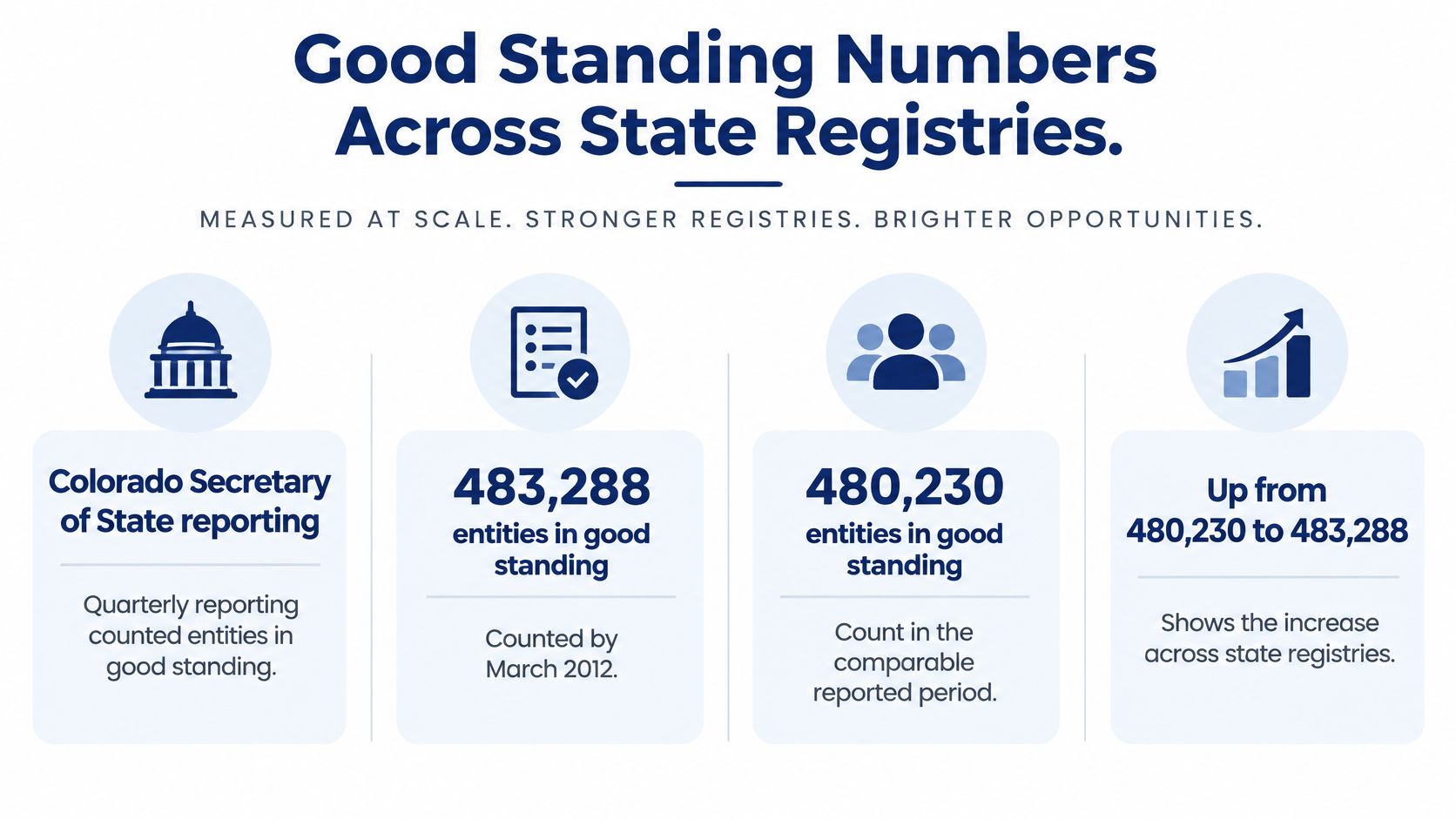
A registry count works like a census snapshot. It freezes one jurisdiction's records at a moment in time, so read the March total as a dated signal attached to a specific state, not a figure that carries forward on its own. Here is how that total breaks down by entity type.
Colorado Entities in Good Standing, March 2012
| Entity type | Count |
|---|---|
| LLCs | 257,164 |
| Corporations | 126,085 |
| Foreign entities | 46,222 |
| Nonprofit corporations | 43,412 |
| Other entity types | 10,405 |
| Total | 483,288 |
LLCs alone accounted for more than half of the Colorado total, and the report credits limited liability companies with much of the registry's longer-term growth. Entity type matters in verification work because each type carries its own filing calendar. A portfolio dominated by LLCs faces different report deadlines than one dominated by corporations, so the mix in this table changes what a monitoring schedule looks like.
Other registries publish the same kind of tracking, sometimes across longer windows, and the pattern repeats. The share of entities in good standing drifts within a narrow band year over year rather than swinging sharply. Slow movement is the point. It means a standing figure reflects accumulated filing behavior, and a single bad quarter rarely changes it on its own.
Two practical rules follow from that. First, never read two states as a head-to-head comparison, because they report different populations in different periods. Second, store what you pull as separate fields rather than one label: jurisdiction, entity type, status wording, and the as-of date the registry published. A good standing entry without its date and state is a number detached from the only context that makes it true, which is why onboarding, due diligence, and monitoring teams refresh the signal instead of filing it away permanently.
Why Good Standing Is Not a Trust Score
A certificate of good standing works like a dated receipt. It proves the specified filings and fees were current, in one jurisdiction, on one day. Everything else sits outside the receipt. The Colorado Secretary of State good standing FAQ spells out the limit: good standing only means statutory filing requirements were met, and the office does not verify information submitted in filings or investigate business practices. A company can be in good standing while its self-reported details are inaccurate, its tax exposure is unresolved, or its operations carry risks no registry examines.
That scope limit is the point most workflows miss. A certificate answers one question well: are the filings current? It answers no other question at all.
A Layered Way to Verify
Treat registry status as the first layer of a check.
- Confirm the registry status: Record the exact status wording, the jurisdiction, and the record date, so you know what was true and when.
- Check filing history and agent continuity: Review past reports and whether the registered agent has changed. Gaps and churn tell a story a single status cannot.
- Validate tax and licensing separately: Run those checks through the authorities that govern them, since a registry certificate may not reflect either.
- Assess wider risk elsewhere: Screen sanctions, litigation, beneficial ownership, and financial exposure through sources built for those questions.
For a broader walk-through of building these layers into one review, see this guide on how to see if a company is legitimate. Sequencing does the work here: registry status comes early because it is cheap and fast, and the wider checks follow it.
Approving a counterparty solely because its Secretary of State record is active is a control failure.
For KYC, lending, procurement, and onboarding teams, the implication is direct. Store good standing as one normalized field inside a dated record: the status string, the issuing jurisdiction, the timestamp, the entity identifier, and the source document behind it. Kept separate, each field can be refreshed on a schedule and compared across states. The moment a system collapses that record into a binary pass or fail flag for overall risk, every downstream decision inherits the error.
How to Verify Good Standing Through the API
Manual registry checks work for one company. They break down when you're verifying counterparties across many states, each with its own portal and status vocabulary. We expose all 50 states and DC through one POST endpoint, so the jurisdiction becomes a parameter rather than a separate integration for each registry. You send the same request shape every time and read a normalized response.
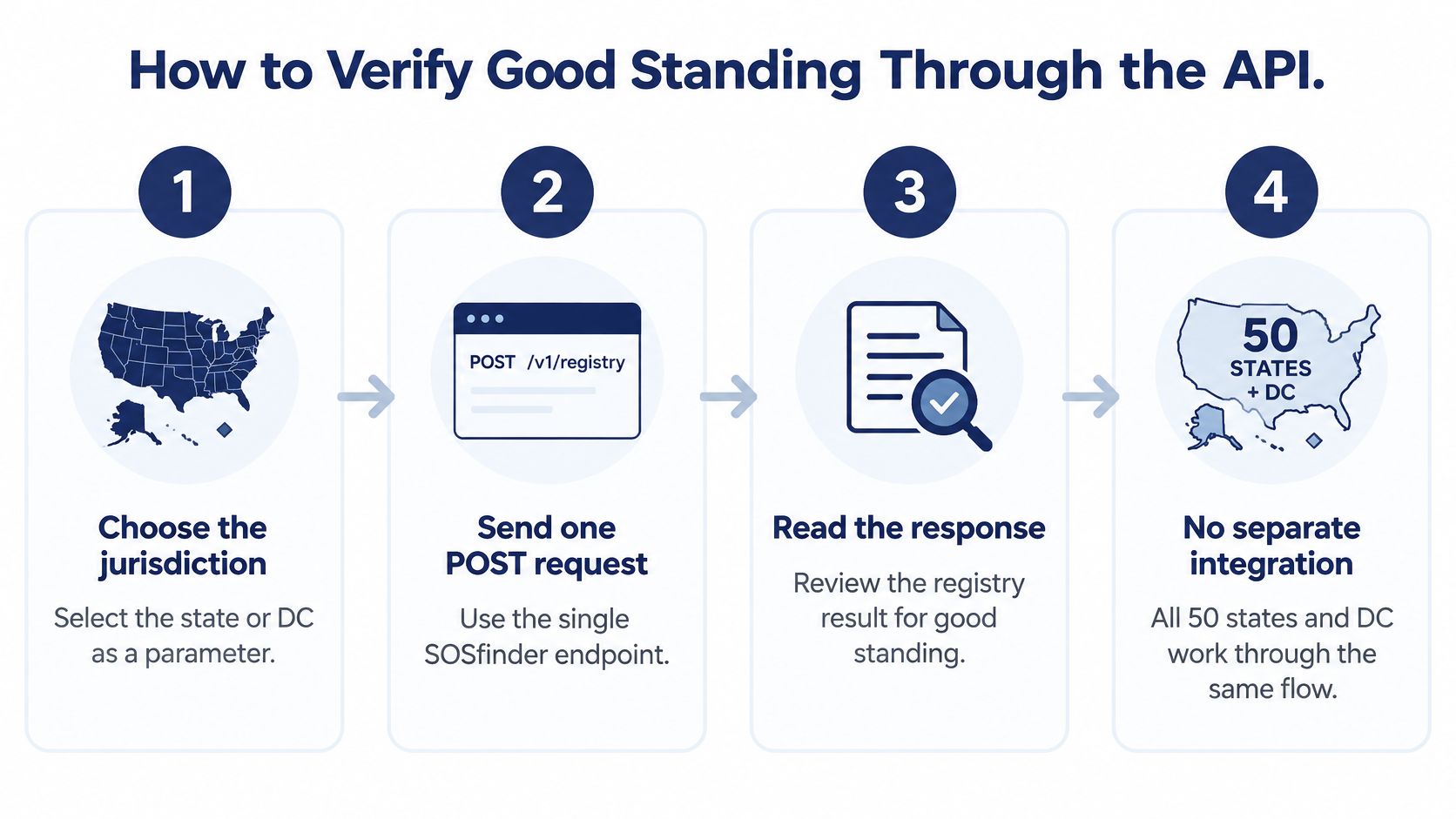
Steps for a Single Lookup
- Choose the jurisdiction and exact legal name: Add the Entity ID when you have it, because a name search returns a best match and common names produce near duplicates.
- Send the POST request: Start from the cURL, Python, JavaScript, PHP, or Go examples in the API playground and adapt the jurisdiction and name fields to your counterparty.
- Read bestMatch first:
bestMatchis the top record or null, and results lists the best match first, then similar filings. Review those similar filings so a different entity with a close name isn't mistaken for your counterparty. - Confirm identity before status: Check that the name, entity type, and principal address match your own records. A correct status attached to the wrong entity is worse than no result, because it looks authoritative.
- Read the status as written: Store the status field exactly as the registry phrases it, along with the record date. Don't translate delinquent, current, or active into good standing during ingestion.
- Check the filing history: Find the latest annual report and its date. That date tells you how much of the current cycle the status covers.
- Handle missing data: Fields a state does not publish are returned as null, or as an empty list for officers, filings, and documents. Treat a null as unknown and an empty list as not returned, never as proof that nothing exists.
- Save and monitor: Store the response with the jurisdiction, retrieval timestamp, and source link, then turn on monitoring for status, agent, and address changes so the record stays useful.
Step 3 is where most integration errors happen. Developers often take the first result and move on, which works until a name like Summit Holdings LLC exists in several formations within one state. Comparing the Entity ID and principal address against your onboarding data takes seconds and prevents a wrong-entity approval that no later check will catch, because every later check inherits the wrong record.
Step 7 matters just as much. If a state doesn't publish officers, an empty officers list says nothing about who runs the company. Systems that render that as "no officers on record" mislead reviewers. Render it as "not published by this state" and route the case to a source that can answer.
A Short Python Pattern
In Python, wrap the call in a function that returns three things, the standing, the record date, and a reason code when the match is uncertain. Send the jurisdiction, legal name, and Entity ID if available, then read bestMatch. If it's null, return a no-match reason code instead of a status. If the Entity ID or principal address doesn't match your records, return an uncertain-match code and the similar filings for review. Only when identity checks pass should the function return the registry status wording and its date.
That structure keeps your application honest. Downstream code receives either a verified status with a date or an explicit reason it can't proceed, never a silent guess. For the wider design of entity data in product workflows, this overview of a company data API covers how normalized fields fit together across states.
Discrepancies and Edge Cases to Expect
The most common problem isn't a wrong registry. It's a stale snapshot. A certificate or status captured before a delinquency, a rejected payment, or a missed report can be wrong by the time someone uses it, which is why the retrieval date matters as much as the status itself.
Washington shows how quickly a record can move. The Washington Secretary of State annual reports guidance requires domestic and foreign entities to file annual reports to maintain active status and good standing, and missing the deadline causes delinquency and may lead to administrative dissolution. Minnesota adds a different trigger, since a rejected or dishonored payment can remove good standing until the issue is resolved. A certificate issued the week before either event still looks clean on paper.
Common Discrepancies, Causes and Fixes
| Symptom | Likely cause | Fix |
|---|---|---|
| Status reads active, but the certificate shows delinquent | Record dates differ, or a filing became overdue after the last pull | Re-pull the record and order a current certificate from the state |
| Wrong entity returned for a common name | Best match chosen among similar names | Compare Entity ID and principal address, then review similar filings |
| Registered agent or address is null | The state does not publish the field | Treat as unknown and confirm against the state record |
| Officers or filings come back empty | Not published by the state, or none on record | Check the state's own portal before concluding none exist |
| Lookup fails during the request | Registry temporarily blocked or down | Retry after the registry recovers and log the failure |
| Record is wrong at the source | Filing data in the state office is incorrect | Correct it with the state office that maintains the filing |
When a lookup returns nothing at all, work through the name, jurisdiction, and Entity ID before concluding the business doesn't exist, as this guide to handling a no match found result explains. A punctuation difference or a trade name submitted instead of the legal name causes many empty results.
Edge Cases the Table Misses
Three situations deserve their own handling.
- A fixed delinquency: A business cures a missed filing after its certificate was issued, so the certificate shows a problem the registry no longer reports. Re-pull the record and use the newer date.
- An agent change after a report: The registered agent changes after the annual report, so two documents name different agents and both were accurate when created.
- Split multi-state standing: A company's foreign-registration state shows standing while its formation state doesn't, or the reverse. Check both jurisdictions and record each result separately.
When a record is wrong at the source, corrections must be made with the state office that maintains the filing. We can't amend a state record, and neither can the counterparty by sending you a corrected PDF. Wait for the registry itself to change, then re-pull.
Rule of thumb: Re-pull any record older than the next filing due date before you rely on it.
If a counterparty's record is delinquent, there's a defined cure path. Read the penalty and cure deadline on the state record first. Then the entity files the overdue report or pays the fee or dishonored payment, as that state requires. Confirm on the registry that the status has changed, because payment alone doesn't prove the update posted. Finally, order a fresh certificate dated after the change, so the older delinquent snapshot isn't passed along to a lender or partner as current evidence.
Confirm Good Standing Before You Rely On It
Don't rely on a good standing result until you've confirmed the jurisdiction, the date, and the entity behind it. That single decision prevents most of the failures described throughout this guide, from stale certificates to wrong-entity matches. The checklist below turns it into a repeatable habit.
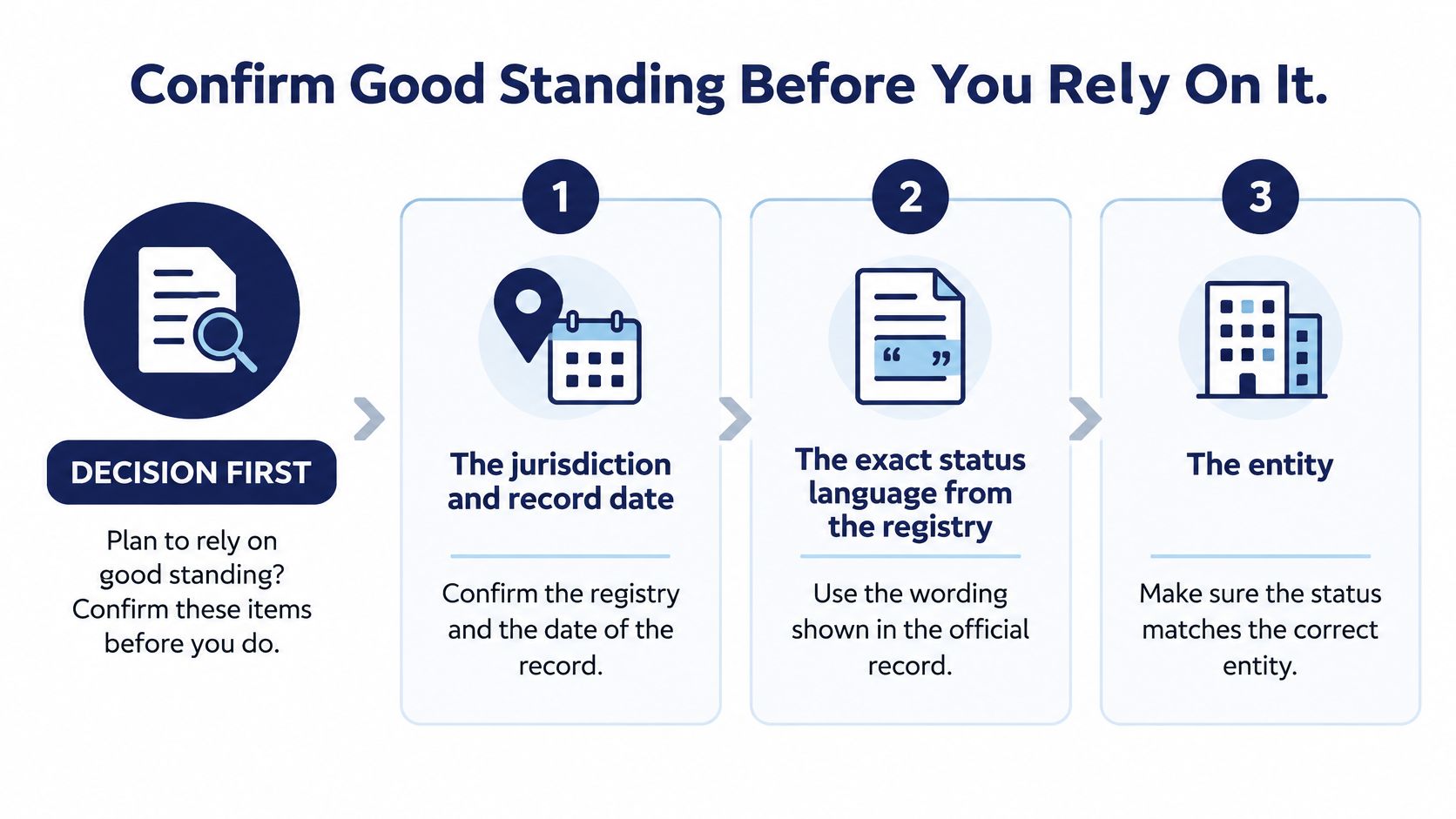
Your Pre-Reliance Checklist
- Jurisdiction and record date: Confirm which state issued the status and how recent the record is.
- Exact status language: Keep the registry's wording rather than converting it to a generic pass or fail.
- Entity identity: Match the entity name, Entity ID, and principal address to your counterparty.
- Latest annual report: Note the most recent report on file and the next due date.
- Separate risk checks: Run tax, licensing, and sanctions screening through their own sources.
- Official proof where required: Obtain a current official certificate or certified copy for any transaction needing legal proof.
Order an official certificate for lending, closings, licensing applications, and any filing where a state-issued document is required. Those processes ask for the state's own document, not a summary of the state's data. For a company in good standings documentation, the certificate's issue date is part of the evidence, so order it close to the transaction date.
Our place in that workflow is verification at scale. SOSfinder supports bulk verification across states, filing history and PDF retrieval, and alerts on status, agent, or address changes, which suits portfolio monitoring and onboarding queues. SOSfinder results are not a substitute for an official certificate of good standing or a certified copy. SOSfinder does not warrant that results are accurate, complete, or current, and the Service is not a substitute for an official certificate of good standing or a certified copy.
Your next action is concrete. Pull the registry record for each counterparty, record the jurisdiction and date beside the status, and set monitoring for the statuses that matter to your workflow. When a transaction needs formal proof, order the state's certificate on top of that verified record.
Check whether every counterparty is in good standing before you onboard, lend, or pay, with normalized status, filing history, and registered agent data from all 50 states and DC through one endpoint. Set monitoring so a status change reaches you before it reaches a closing table. Visit SOSfinder to run your first entity lookup and build jurisdiction and record date into every verification you store.