What Is a UCC Filing? Meaning, Types and Searches

A UCC filing is a public notice that a creditor, called the secured party, claims a security interest in a debtor's personal property, usually recorded as a UCC-1 financing statement with a state office. That's the whole of it: a recorded claim, indexed under a name, sitting in a government database for anyone to find.
So why does a filing against a company's record get read as proof that the company is in debt, in trouble, or about to lose its equipment? Because the record looks like an answer. It has a file number, a date, and a list of assets. What it doesn't carry is the detail readers often assume it carries: how much is owed, whether that amount has been paid, or whether the claim still holds up. Reading a filing well means treating it as the start of a question rather than the end of one.
What a UCC Filing Is and What It Records
What sits on a UCC filing, and what never does?
A filing works like a sign posted on a shared storage unit. Anyone walking past can see that a particular party claims what is inside. The sign is silent on the dollar size of that claim and on whether the bill has already been paid. A UCC filing does the same job in a public index instead of a hallway.
The usual document is a UCC-1 financing statement. It records three things: who owes (the debtor), who holds the claim (the secured party), and what property secures it (the collateral). The concept map below shows how those pieces connect.
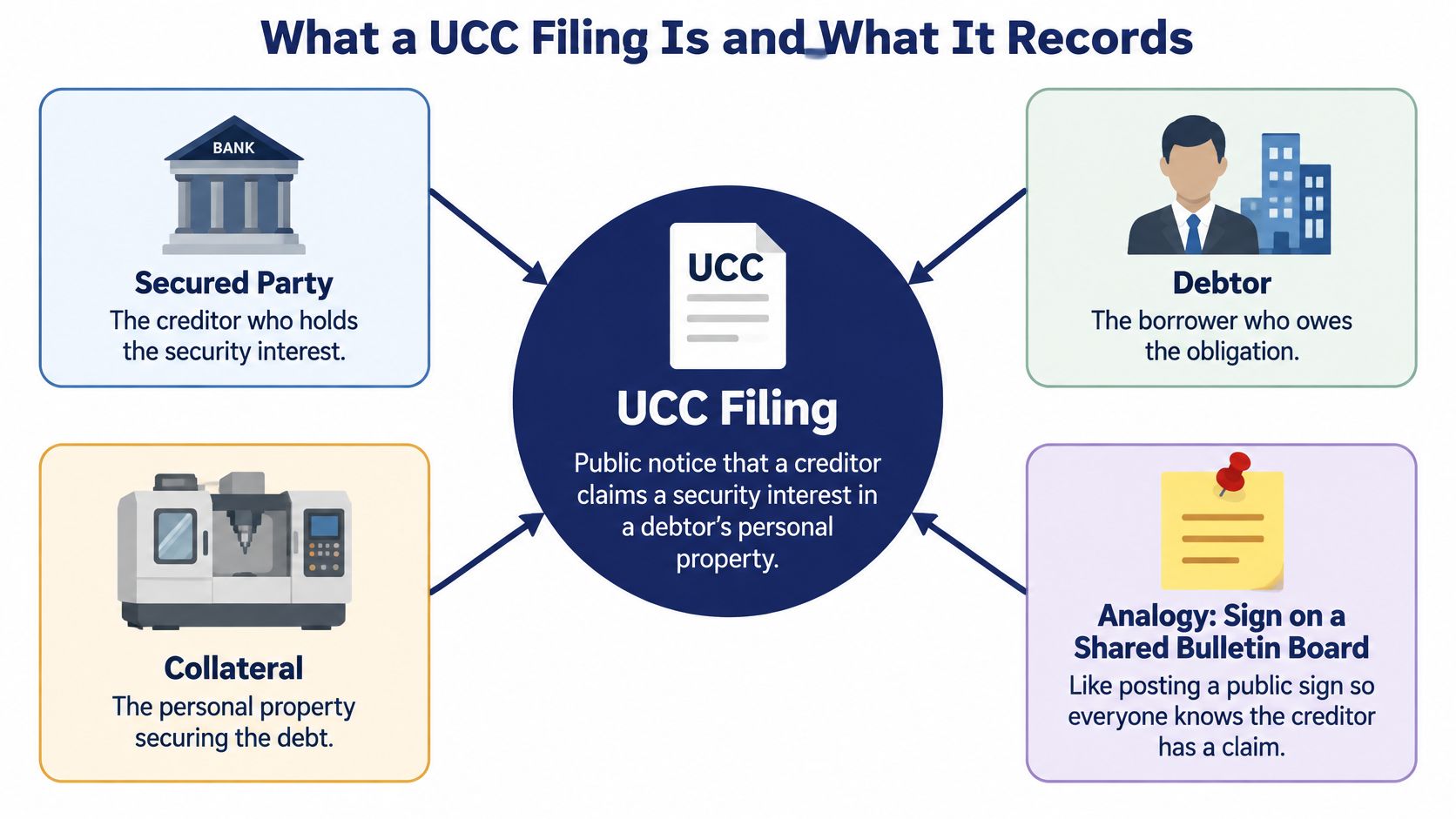
The governing law is Article 9 of the Uniform Commercial Code. Article 9 covers credit secured by personal property rather than real estate: equipment, inventory, accounts receivable, farm products, instruments, and similar assets. Each state runs its own filing office, so there is no single federal UCC registry. A company with debtors across four states can have four separate records to track down. Each record is maintained separately by its own state office and is searched under the debtor's name.
| Field | What it shows | Why it matters |
|---|---|---|
| Debtor name | The exact legal name the filing is indexed under | A misspelled or outdated name can hide the filing from a name search |
| Secured party | The creditor claiming the interest | Tells you who holds the recorded claim and who to ask about it |
| Filing number | The unique identifier the state office assigns | Lets you pull the exact record and anything filed against it later |
| Filing date | When the notice was recorded | Places the notice in time against competing claims |
| Collateral description | The assets covered, or a broad phrase such as all assets | Defines how wide the creditor's claim runs |
| Status | Active, lapsed or terminated | Separates a live notice from a historical one |
Those fields still leave the important limits in place. A filing does not establish the debt, does not establish its value, and does not transfer ownership of anything listed. The Cornell Legal Information Institute's text of Article 9, Part 3 is direct about this: a financing statement is generally not the security agreement itself, and it does not by itself prove money was advanced or that a balance is unpaid. Treat every search hit as a question to verify. A recorded claim is the start of that question, and the file number only tells you which notice to pull next. If you want to know how a company's formation records define its legal name before you search, company formation documents explains what those filings contain.
The UCC Filing Types and What Each One Changes
One secured loan can generate a sequence of records rather than a single notice, which is why a debtor's file often looks like a short history instead of one page. The table sets out the cast.
| Filing type | What it does | When it is filed |
|---|---|---|
| UCC-1 initial financing statement | Creates the public notice of a security interest | When a creditor first perfects by filing |
| UCC-3 continuation | Extends the notice past its lapse date | Within six months before the lapse date |
| UCC-3 amendment | Changes debtor, secured party or collateral details | When recorded terms change |
| UCC-3 assignment | Moves the secured party's rights to a new creditor | When a loan or claim is sold or transferred |
| UCC-3 termination | Records that the security interest has ended | After the debt is paid and the creditor releases it |
| Fixture filing | Ties a notice to equipment attached to real estate | Usually recorded with county real-estate records |
The initial UCC-1 opens the story. Everything after it is a UCC-3 of some kind, and the type matters because each one changes the record in a different direction.
A continuation keeps the notice alive. Under UCC § 9-515 the filing lapses five years after its filing date unless the secured party files a continuation inside the six-month window that closes on that date. Miss the window and the filing ends, no matter how much is still owed.
An amendment corrects or updates the parties or the collateral language. An assignment shifts the secured party when a loan is sold, which is why the creditor named on an older filing may not be the one you'd call today. A termination closes the record after payoff and release.
The fixture filing is the odd one out, and it trips people up. As the California Secretary of State's Article 9 filing guidance explains, interests in fixtures and certain timber, mineral or real-estate-related collateral may belong in a county land-record office rather than the state system, and filing against an organization generally belongs in the state where the debtor is legally organized, not where the equipment sits. When several records exist for one debtor, sort them by date and find the last action taken. That's the position you're reading.
Why Creditors File and What Priority Really Means
Say a machine shop borrows money to buy a CNC machine, and the lender takes the machine as collateral. The lender files a UCC-1 so that every other creditor, landlord and buyer who runs the shop's name learns the machine is spoken for. That one scenario runs through four separate stages, and merging them is where confusion starts.
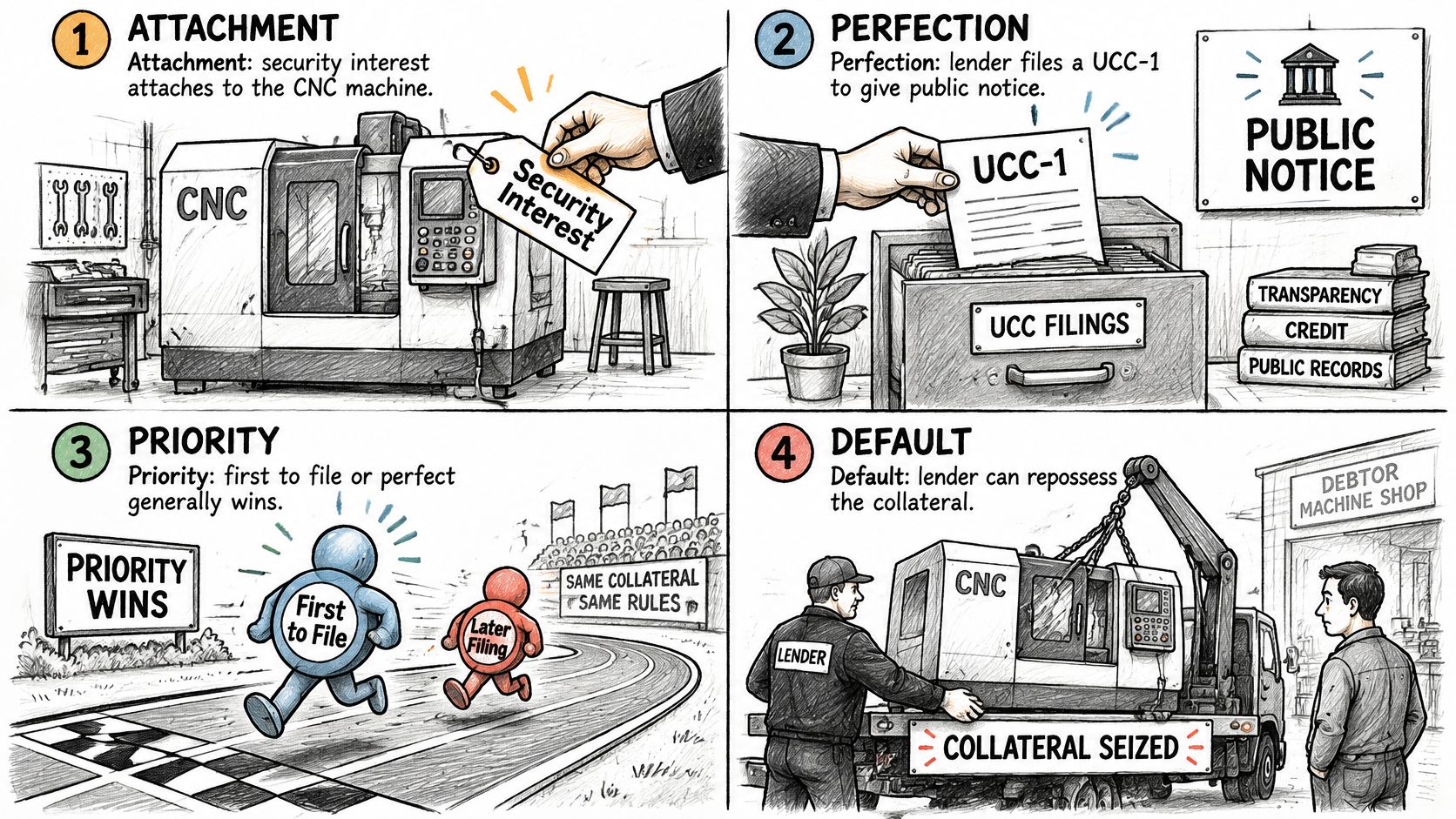
Attachment comes first. The security interest becomes enforceable between the shop and the lender under their agreement, and that's a private event between two parties, invisible to everyone else.
Perfection is what makes the claim hold against the outside world, and filing is the standard route. The Uniform Law Commission's Article 9 page describes the mechanism plainly: Article 9 governs secured transactions, each state maintains an office where financing statements are filed to disclose security interests, and a UCC-1 identifies the debtor, the secured party and the collateral covered. A filing doesn't prove money is owed, establish the debt's value, or transfer ownership of the listed assets. It gives other creditors notice that a claim may take priority over theirs.
The walk-through below shows how those stages move from agreement to enforcement.
Priority answers a narrower question: if the shop defaults and the machine gets sold, who is paid first. Timing and perfection status decide that. A filing number is just an identifier the office assigned when it stamped the document, never a ranking.
A UCC filing announces a claim. It does not measure it.
Default and enforcement come last, and they're where the collateral moves. A filing, a lien, a security agreement and a default are four different things, and treating them as one is the most common reading error. Lenders, vendors and underwriters care about the sequence because it tells them who stands ahead of them. How to see if a company is legitimate covers the entity records that sit alongside these filings when you're vetting a counterparty from scratch.
How to Search UCC Filing Records Step by Step
Delaware alone recorded 765,136 total UCC transactions in 2025, including 159,284 UCC-1 filings, 199,772 UCC-3 filings and 406,080 searches, according to the Delaware Division of Corporations 2025 annual report. Searches outnumbered new filings by more than two to one. Most of the work is looking, not filing.
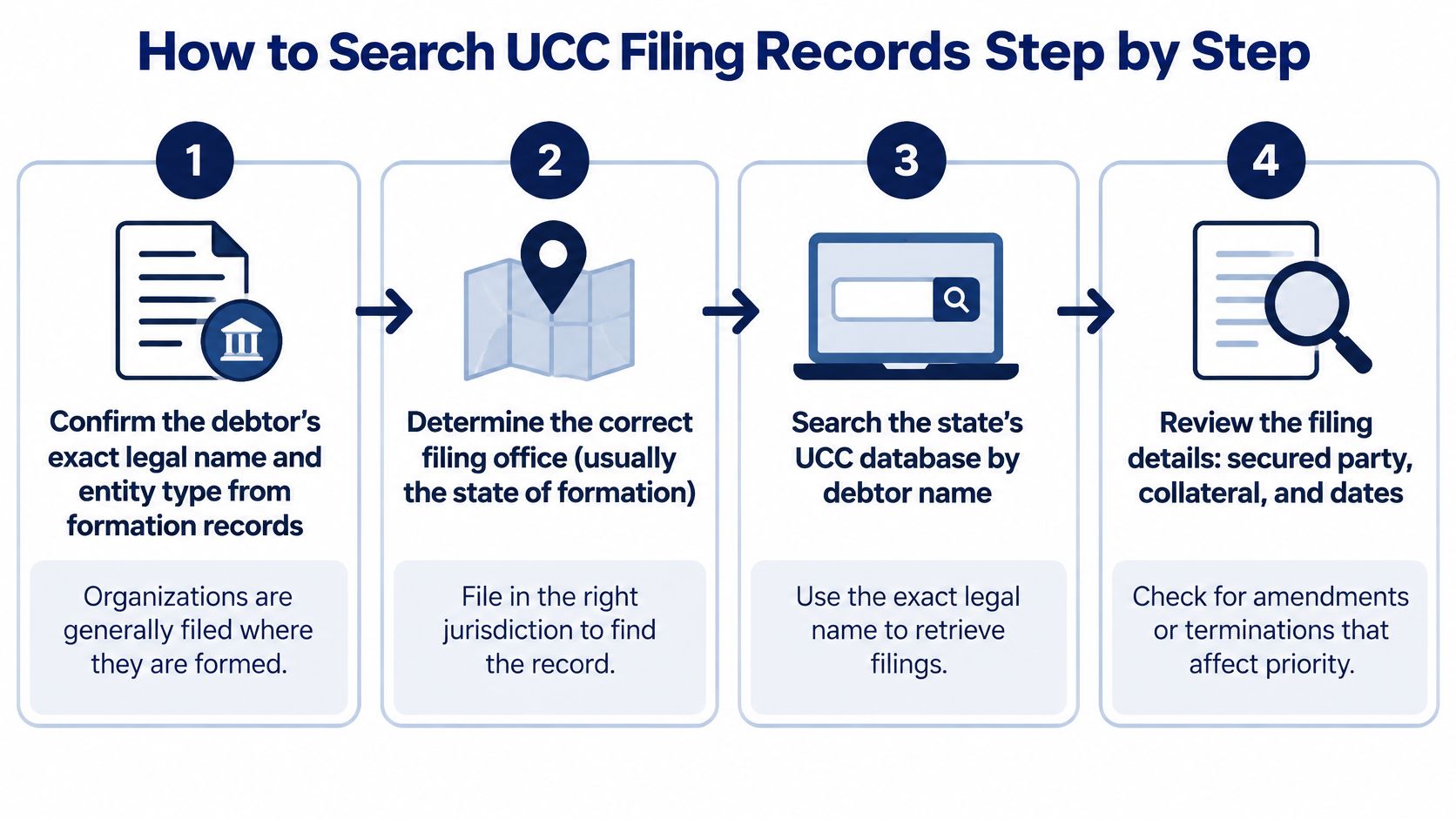
- Confirm the debtor's exact legal name and entity type from formation records before you type anything into a search box. Organizations are generally filed where they're legally organized, so the name on the formation document is the name the filing office indexes.
- Collect the variants you might need: former legal names, assumed or trade names, and plausible spelling differences. Each one can surface a filing that the exact name misses.
- Choose your record scope on purpose. Active or unlapsed records answer the question about current exposure. All records answer a historical question in due diligence. Pick before you search, not after.
- Search the state of organization first, then repeat the search in other states where the debtor operates or holds assets, because collateral doesn't always follow the paperwork.
- Read every hit before you conclude anything. Status, filing date, collateral wording, amendments and assignments all change what a record means.
- Pull the filing document and save it with the search date, the parameters you used, and the jurisdiction. A result you can't reproduce isn't evidence.
A search log earns its keep later, when someone asks how you reached a conclusion. Record the debtor name exactly as searched, every variant you tried, the scope you selected, each jurisdiction, the date and time, the hits returned, and who reviewed them. Keep those parameters attached to the result too, which is easier when the UCC search runs from one interface instead of six state portals. That log is what lets a clean result be defended instead of just asserted.
Fixing Errors, Lapses and Missing Filings
A debtor name error is not a clerical inconvenience. The Uniform Law Commission's current Uniform Commercial Code catalog notes that Article 9 was amended in 1999, 2000, 2001 and 2010, and that the 2010 amendments gave greater guidance on the form of an individual debtor's name precisely because a statement indexed under the wrong name can be hard to find and may fail to provide effective notice at all.
To spot a lapse, compare the filing date against the continuation history. If the lapse date has passed with no continuation recorded inside the window before it, the notice has ended.
Who fixes what matters. If a record is wrong at the source, corrections must be made with the state office that maintains the filing. We can't file documents, register entities, or change any official record on a customer's behalf, so a wrong record has to be corrected where it lives.
Practical rule: confirm the error against the source document first, then ask the secured party to file the correction or termination it's responsible for.
After that, record the steps you took and the date of each request. If the secured party doesn't act after payment or a valid demand, keep the correspondence, run a fresh search to capture the current state of the record, and take legal advice on your options. And remember the asymmetry: a missing filing isn't a missing claim. The creditor may have filed under a different name or in a different state.
Reading Search Results and Confirming a Record
The costliest mistake in UCC work isn't missing a record. It's misreading one that turns up. Two opposite errors cause most of the damage: treating every hit as an active debt that must be cleared, or treating a clean search as proof that no liens exist anywhere.
New York's Department of State describes a UCC-1 plainly as notice that a creditor claims an interest in a debtor's property, and says the filing is not itself the underlying agreement, as set out in its UCC frequently asked questions. Attachment, perfection, priority and enforcement after default are separate questions that need legal review, not a database lookup.
| Search outcome | What it establishes | What it does not establish |
|---|---|---|
| Active UCC-1 covering all assets | A secured party has a recorded claim against that collateral | That the debt is unpaid or what amount is owed |
| Lapsed UCC-1 with no continuation | The filing is no longer effective | That the debtor has no other claims |
| Terminated filing | The recorded security interest has ended | That no other filings exist for the debtor |
| Clean search with no records | No matching records under the requested name and scope | That the company has no liens anywhere |
| Name variant match | A possible record that needs confirmation | That the record belongs to the same legal entity |
Search limits explain why a clean result is a statement about your query, not about the company. Exact-name variations, former legal names, assumed names, individual versus organization debtors, jurisdictional filing rules and amended or assigned filings can each push a record out of view. Some systems also let you request all records or only unlapsed ones, and a certified result covers the debtor name you requested and nothing beyond it. Confirming the entity itself comes first, and how a secretary of state business search works covers the registry side of that name check.
When a hit matters to your transaction, work through the confirmation checklist in order.
- Match the debtor's legal name exactly to the name on the filing, character for character.
- Check the status and the lapse date so you know whether you're reading a live notice or a closed one.
- Read the collateral wording closely, paying attention to broad all-assets language that reaches everything the debtor owns.
- Reconcile every amendment, assignment and continuation in date order to find the current secured party and the current terms.
- Pull the filing document and save your search log so the conclusion can be reproduced.
- Escalate to legal review when the collateral touches what you're lending against, buying, or relying on for payment.
UCC filing search is in beta and available on the Pro plan and higher, and the Free plan's business entity search covers all 50 states and DC, which is enough to confirm a debtor's legal name and status before you look for filings.
A filing starts a review. It does not end one.
That's the discipline worth keeping. Every record you find is a claim someone chose to publish, and every record you don't find is a limit of your search rather than a fact about the company. Read the document, date the conclusion, and write down how you got there.
If you're building UCC checks into onboarding or underwriting, SOSfinder returns best-match and similar filings from state registries through one endpoint, with normalized fields so the same code handles every state. Each lookup takes a business name and a state, and every result comes back with the filing details your reviewers need to make the call. Start with a name and a state, then let your team decide what the record means.