Company Formation Documents: Where to Find and Read Them

The usual advice on company formation documents is to download the articles from the state registry and keep the PDF on file. That's a useful starting point, but it's a poor stopping point. A formation filing records the company's creation, not everything you need to know about the company today.
For onboarding, underwriting, procurement, or legal review, you need a document trail that connects the original filing to later changes and the decision you're making. Start by separating what each record proves from what still needs independent confirmation.
What Each Company Formation Document Proves
A formation filing is the legal act that creates an entity's separate existence under the governing jurisdiction. The accepted certificate is therefore the foundation of the record, not just another identification document.
Delaware's 1899 General Corporation Law replaced the older special-charter approach with a general certificate-filing system, as described in Penn Carey Law's history of the statute. That distinction still matters: the filing establishes a legal event, while later records explain what happened afterward.
Core company formation documents and what each proves
| Document | Filed or issued by | Typical contents | Generally public | What it proves |
|---|---|---|---|---|
| Certificate of formation or articles of organization (LLC) | State filing office | Name, registered agent, principal address, organizer, purpose if stated | Yes | Legal existence and formation date |
| Certificate of incorporation (corporation) | State Secretary of State | Name, registered office and agent, authorized shares, incorporator | Yes | Legal existence and capital structure as first filed |
| Bylaws (corporation) | Internal, not filed | Officer roles, board procedures, share transfer rules | No | Governance rules the company has adopted |
| Operating agreement (LLC) | Internal, usually not filed | Members, contributions, management, transfer rules | No | Documented ownership arrangements and authority among members |
| Annual or periodic report | State filing office | Officers or managers, principal address, registered agent, where required | Yes | Who and what the company reported as of that filing |
| Certificate or articles of amendment | State filing office | Changed provisions and effective date | Yes | A specific change to the original terms |
| Foreign qualification filing | State where the entity operates | Home jurisdiction, name, registered agent | Yes | Registration to transact business in that state |
| Certificate of good standing | State, on request | Status as of the issue date | Usually on request | State-certified status at a particular time |
Match the function, not just the title
These are typical contents, not a universal list of required fields. A sparse LLC certificate isn't necessarily incomplete, and an annual report won't necessarily identify every person with management authority.
State terminology also differs. When reviewing articles of incorporation in Colorado, identify the filing's legal function rather than expecting it to carry the same title or layout as a Delaware certificate.
Practical rule: Label each document with the question it answers. Don't label the entire folder as proof that the company is legitimate.
How to Download Formation Documents from a State Registry
You need the formation state first, because the home state holds the core formation record even when the business operates elsewhere. An address on an invoice tells you where someone receives mail, not necessarily where the company was created.
Use the official state business filing portal rather than a search-result preview or a third-party profile. The process below keeps the document attached to the correct entity.
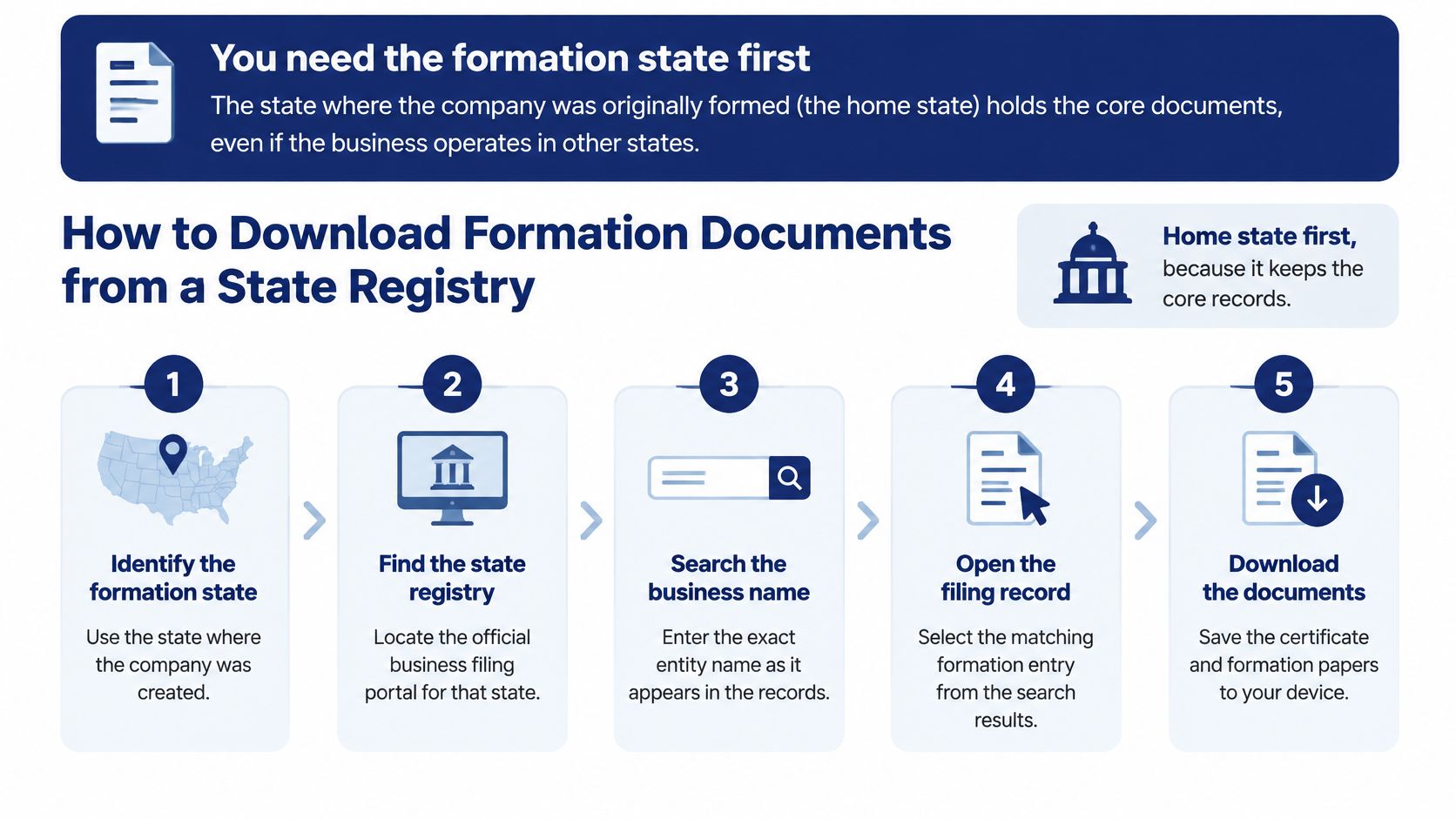
Follow a repeatable retrieval routine
Confirm the formation state. Check the contract's entity description, available tax paperwork, or a registry name search for evidence of jurisdiction. Treat the result as a lead until it matches the official entity record.
Search the exact legal name. Include the entity suffix, then review close matches, former names, and similarly named businesses. Compare addresses and identifiers so you don't download documents for an unrelated company.
Open the entity detail page. Record the entity ID or file number, entity type, displayed status, and formation date. Use the registry identifier for subsequent requests because names can change.
Inspect the filing history. List the available entries by filing date and document type before selecting downloads. This prevents you from mistaking a foreign registration or amendment for the original formation filing.
Download the necessary PDFs. Start with the formation document and latest available annual or periodic report, then collect relevant intervening filings. Open each file to verify that its name and entity identifier match the detail page.
Order the right official evidence. If the receiving lawyer or lender requires certification, request a state-certified copy rather than assuming the download qualifies. Request a certificate of good standing separately when needed, and check the state's fee schedule for the specific service.
Preserve the retrieval context. Save the source page, filing date, and retrieval date alongside each file. A descriptive filename helps, but it shouldn't be the only place you store that information.
Handle access problems without guessing
Older filings may be scanned images without searchable text. Use optical character recognition to assist review, but compare extracted names, dates, and share provisions against the image before relying on them.
Some portals require a copy request instead of offering an immediate download. Others display filing entries without accessible attachments, or restrict actions for particular record statuses.
A failed download isn't evidence that no filing exists. Record the access problem, preserve the visible filing entry, and request the document from the filing office. Don't substitute a company-supplied PDF without noting that you obtained it through a different channel.
Which Registry Holds Each Record
Answer these questions before sending document requests:
- Where was the entity formed? Identify its home jurisdiction, not just its headquarters.
- Where is it registered to operate? Separate home-state records from additional state registrations.
- Is the requested document public or internal? Decide whether the request belongs with a filing office or the company.
State registries operate under names such as Secretary of State, Department of State, or Division of Corporations. The agency label matters less than confirming that you've reached the official business-records system for the correct jurisdiction.
Where to look for each entity case
| Entity case | Primary record location | What to request | Common mistake |
|---|---|---|---|
| Domestic LLC or corporation in its home state | Home-state Secretary of State business database | Formation certificate or articles, filing history, latest annual report | Searching only the operating state, which may hold no core filing |
| Foreign LLC or corporation operating in another state | Home-state record plus operating-state foreign registration | Formation certificate and foreign qualification filing | Treating foreign registration as the formation document |
| Name reserved but entity not yet formed | State name reservation record | Reservation status and expiry date | Assuming a reservation creates legal existence |
| Nonprofit corporation | Nonprofit division or the same state business database | Articles of incorporation and amendments | Filtering by the wrong entity type |
| Dissolved or withdrawn entity | Same state database, under its changed status | Dissolution or withdrawal documents and final filing history | Assuming a complete-looking PDF establishes active status |
Keep public filings separate from private records
A corporation formed in Delaware and registered to operate in Colorado can have relevant records in both states. The Colorado registration doesn't replace the Delaware formation certificate, and withdrawal from Colorado doesn't, by itself, establish dissolution in Delaware.
Bylaws and operating agreements generally belong in the company's internal records. Request them from an authorized company representative, including applicable amendments, rather than spending more time searching a public portal.
Tax registrations, permits, and beneficial-ownership filings also belong to distinct processes. They shouldn't be treated as interchangeable attachments to a state formation filing.
Distinguish state registration from federal reporting
Under FinCEN's March 26, 2025 interim final rule, entities created in the United States and their beneficial owners were exempted from federal BOI reporting, while qualifying foreign-created entities registered in the United States remained subject to reporting, as summarized in the World Bank's discussion of digital business registration.
Don't apply an old blanket instruction that every domestic LLC must submit a BOI report. Record the formation jurisdiction, operating jurisdictions, and public-or-private classification so each request reaches the right custodian.
Reading a Formation Filing Field by Field
A formation filing establishes more than a name. It sets part of the entity's legal configuration, and those provisions can affect service of process, governance, and capitalization.
For a Delaware corporation, the certificate-of-incorporation statute specifies the corporate name, registered office and agent, business purpose, authorized share structure, and incorporator information, including additional class details when multiple stock classes are authorized.
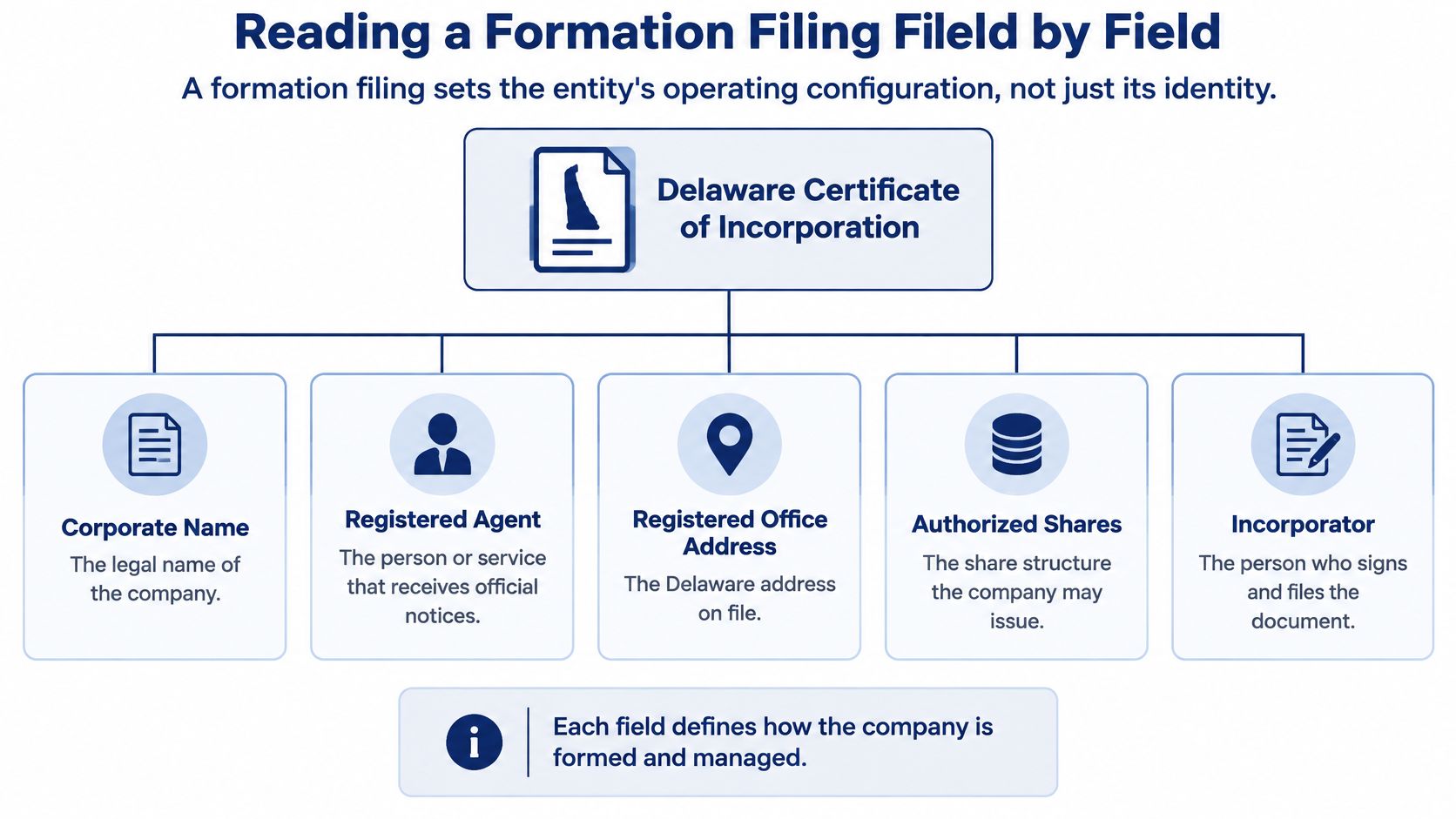
Read each field for its operational consequence
- Corporate name. Capture the complete legal name, including its suffix, so contracts and verification records attach to the correct entity.
- Registered office and agent. Preserve both fields separately because they identify the designated recipient and location for service of process, not necessarily the operating headquarters.
- Business purpose. Read the language rather than inferring an industry from the company name. A broad purpose clause doesn't verify that the company holds an activity-specific license.
- Authorized shares and par value. Record authorization by class, including par-value treatment. These provisions describe permitted capitalization, not the shares issued or their market value.
- Incorporator. Identify the person or entity responsible for incorporation without assuming that the incorporator remains an owner, officer, or authorized signer.
Work through the share provisions
Say a hypothetical Delaware corporation authorizes two stock classes with different par values. Read the total authorized shares first, then the allocation to each class, followed by the par value and class specifications.
Don't flatten those provisions into a single authorized-shares field. Preserve separate class records and any provisions addressing rights, preferences, restrictions, or authority to establish further terms.
If a later amendment changes the allocation, retain the original configuration and the amended configuration with their respective effective dates. Overwriting the first values would prevent a reviewer from reconstructing the charter terms that applied to an earlier transaction.
Article-level parsing is safer than searching raw text for words such as shares or agent. Use the discrete article structure of the certificate or official form to distinguish operative provisions from signatures, instructions, and filing-office endorsements.
For teams structuring business entity data, the useful unit is a field plus its supporting document and location within that document. Keep the original filing alongside normalized values so a reviewer can inspect qualifications that extraction may have missed.
Reading Filing Histories and Current Status
Read a filing history as a sequence of legal and administrative events, not a folder of interchangeable PDFs. Start with the original formation terms, then determine which later filings changed them and when those changes took effect.
The distinction between retrieval and verification matters. The World Bank's work on business-registration systems provides context for treating incorporation, tax identification, permits, and related registration steps as separate evidence rather than a single complete record.
Reconstruct the record in order
- Sort the history from oldest to newest. Use filing dates to organize the entries, but inspect effective dates before deciding when a change applied.
- Mark events that affect your decision. Flag amendments, name changes, registered-agent changes, annual reports, mergers, dissolution, withdrawal, and reinstatement.
- Apply changes to the relevant fields. Update only what the filing supports. A new principal address doesn't automatically change the registered office.
- Review the latest reporting documents. Identify the most recently reported officers, managers, addresses, and agent information where those fields are included.
- Investigate gaps and conflicting entries. A missing report or unexplained status change calls for clarification, not an automatic conclusion that the company has ceased to exist.
Consider a hypothetical older certificate naming agent A and a later annual report naming agent B. The later report supports B as the reported agent at that filing date, provided the registry accepts agent updates through that filing type.
You still need to inspect subsequent entries and the current registry display. Don't mark B as current merely because the report is the newest PDF someone emailed you.
An official document can be authentic and still be too old or too narrow for the decision in front of you.
Preserve evidence for each conclusion
Store the following with each document, preferably in structured fields rather than a reviewer's free-text note:
- Source and identity. Jurisdiction, issuing authority, entity identifier, and source location.
- Dates and classification. Filing timestamp, effective date, retrieval date, and document type.
- Record relationships. Amendment chain, replacement or restatement links, and relevant status record.
- Evidence quality. Certified or uncertified status, inaccessible attachments, and unresolved extraction issues.
For a jurisdiction-specific workflow such as a Vermont Secretary of State business entity search, keep the state's status wording alongside any normalized category. An internal active label shouldn't erase a more qualified source description.
A formation PDF alone doesn't establish good standing, present ownership, or a person's authority to sign. When current state status controls the decision, obtain the appropriate certificate and evaluate its issue date against the receiving party's requirements.
Reconcile tax identity without merging people's roles
Match the legal name and formation jurisdiction on the state record against the EIN application when available. Then identify the responsible party separately: the IRS EIN guidance distinguishes the controlling individual from a nominee and generally requires a natural-person responsible party except for government entities.
An incorporator, registered agent, manager, and tax responsible party can be different people. A mismatch should trigger step-up review and supporting documentation, not an unsupported fraud label.
Retain each person's role, source, and relevant date. Collapsing everyone into an officer field destroys distinctions the reviewer needs.
Pull a Verified Document Trail Before You Rely on It
The approval question isn't whether you've collected enough PDFs. It's whether the available evidence supports the particular onboarding, underwriting, procurement, or legal decision, with any unresolved issues recorded.
A procurement reviewer may need legal identity and current registration evidence. A lender assessing a proposed signer may also need internal governance documents and a specific authorization. Sending both reviewers the same formation certificate leaves different questions unanswered.
Set decision-specific acceptance criteria
Use a short approval checklist that names the evidence required rather than recording that documents were received:
- Identity established. The formation jurisdiction and entity type match the party being reviewed, and the legal name is reconciled across the relevant records.
- Relevant provisions checked. The registered-agent, purpose, and share fields have been reviewed where they matter to the transaction.
- Later changes resolved. Material amendments and status events have been incorporated into the review.
- Official evidence obtained. A good-standing certificate or state-certified copy is present when the recipient requires that specific evidence.
- Private authority documented. The company has supplied current governing documents and any transaction-specific approval needed to establish authority.
Don't order certification for every document by default. Ask the receiving party what must be certified and whether it needs the original filing, a later amendment, a restated document, or a status certificate. That avoids paying for an official copy that answers the wrong question.
Close exceptions explicitly
An inaccessible amendment, unexplained name difference, or missing governance document should have a named owner and a clear resolution requirement. Record whether approval is blocked, conditional, or permitted under your organization's policy.
A missing public field isn't permission to infer the answer. If ownership or signing authority remains unknown, request the relevant private evidence or escalate to legal review.
Approval standard: Another reviewer should be able to reproduce your conclusion from the retained records without relying on your memory.
For broader counterparty review, use these documents as part of checking whether a company is legitimate, not as a substitute for that assessment. Registration establishes a legal record, not the quality of the business or the truth of every representation it makes.
Choose manual registry checks or an aggregation service according to your volume and review needs. Either approach should preserve source access, exceptions, and the evidence behind each approval.
SOSfinder offers normalized state-registry status, registered-agent and officer details, filing histories, and links to state PDFs where available, with alerts for status, agent, or address changes. Visit it to build and monitor your company formation document trail, while obtaining private governance records and required certified copies separately. It isn't affiliated with any government agency and doesn't replace those documents.