Article of Corporation: Fields, States, and Lookup
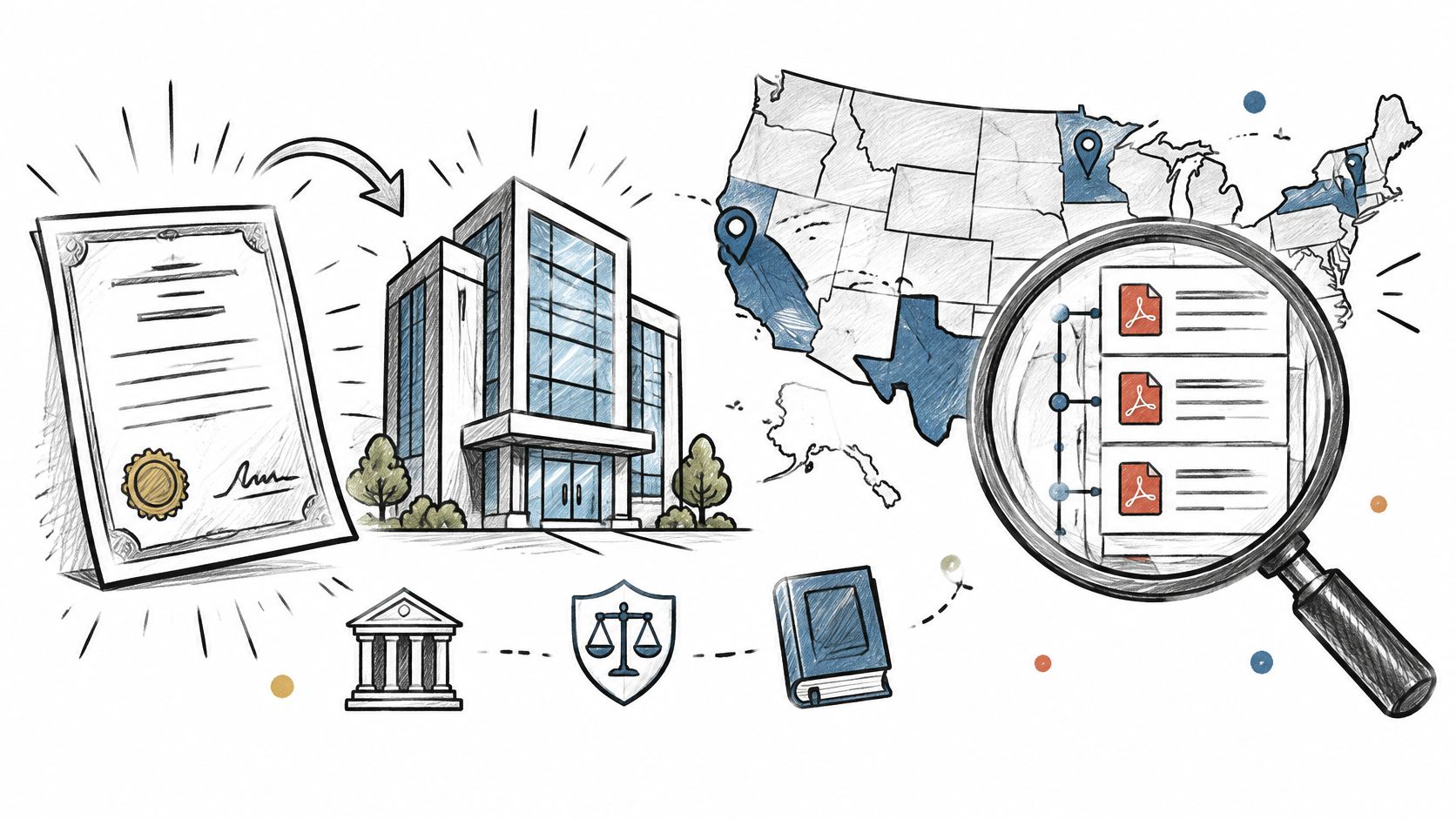
The most popular advice about an article of corporation is also the most misleading. You're told to collect the filed PDF, check the name and date, and treat the company as verified. That document only proves a corporation was created on one day, in one state, under one statute. It doesn't prove the entity is active today, authorized where you plan to pay it, or still using the same name, agent, and share structure.
What an Article of Corporation Creates
People search for article of corporation, but most statutes use a different name. The filing is usually called articles of incorporation, and some states use certificate of incorporation instead. The label changes, the job doesn't. It's the foundational state filing that legally creates the corporation.
Think of it as a birth certificate. A birth certificate proves a person was born, with a name, date, and place on record. It doesn't prove where that person lives now, what name they use today, or whether their license is current. An incorporation filing works the same way. It establishes legal existence at formation, not present status.
What the filing usually contains
Say two founders form a stock corporation to run a software business. They file one document with their chosen state. That document names the corporation, states its purpose, sets how many shares it may issue, and names a registered agent who can receive legal papers. The incorporator, the person who signed and filed it, is identified too.
According to the U.S. Small Business Administration business registration guide, every state requires articles of incorporation, or a certificate of incorporation, when forming a corporation, and the document commonly identifies the legal name, business purpose, authorized shares, share value, directors, and officers. Florida gives a concrete required set, including the corporation's name, the street address of its principal office, the number of authorized shares, the registered office and registered agent, and the name and address of each incorporator.
That national baseline helps, but don't treat it as a universal template. Your formation state decides which blanks are mandatory.
| Field | What it does | How often required |
|---|---|---|
| Legal name | Names the corporation on the state registry | Required |
| Business purpose | States what the corporation is formed to do | Common; sometimes optional |
| Authorized shares | Sets how many shares the corporation may issue | Required for stock corporations |
| Share or par value | States a value per share when the statute asks | State statute sets the rule |
| Principal office address | Gives the street address of the main office | Required in states such as Florida |
| Registered agent and office | Names the official contact for service of process | Required |
| Incorporators | Identifies who signed and filed | Required |
| Initial directors or officers | Names the starting board or officers | Often optional |
| Preemptive rights or liability limits | Adds extra governance terms | Optional |
Optional terms that can ride along
The same filing may add governance choices. It may name initial directors, limit or broaden corporate purposes, set rules for the board and shareholders, state share par value, grant shareholder preemptive rights, or add certain limitations on shareholder liability. Those clauses matter in diligence because a later reviewer may assume a short filing means a simple company. It may only mean the founders kept the public document short.
Practical rule: Read the table as an identity checklist, then confirm which fields the formation state actually required before you call a document incomplete.
Use that distinction when you review a customer file. A missing officer list may be normal for that state. A missing registered agent is not. The filing gives you the starting identity fields, including filing date, entity name, jurisdiction, share authorization, registered agent, and incorporator. You still need the later record to know what those fields look like now.
How States Change the Required Filing
There's no national corporation form. A company files with one state's secretary of state, or an equivalent office, under that state's corporation statute. Two states can create the same kind of corporation with documents that look noticeably different.
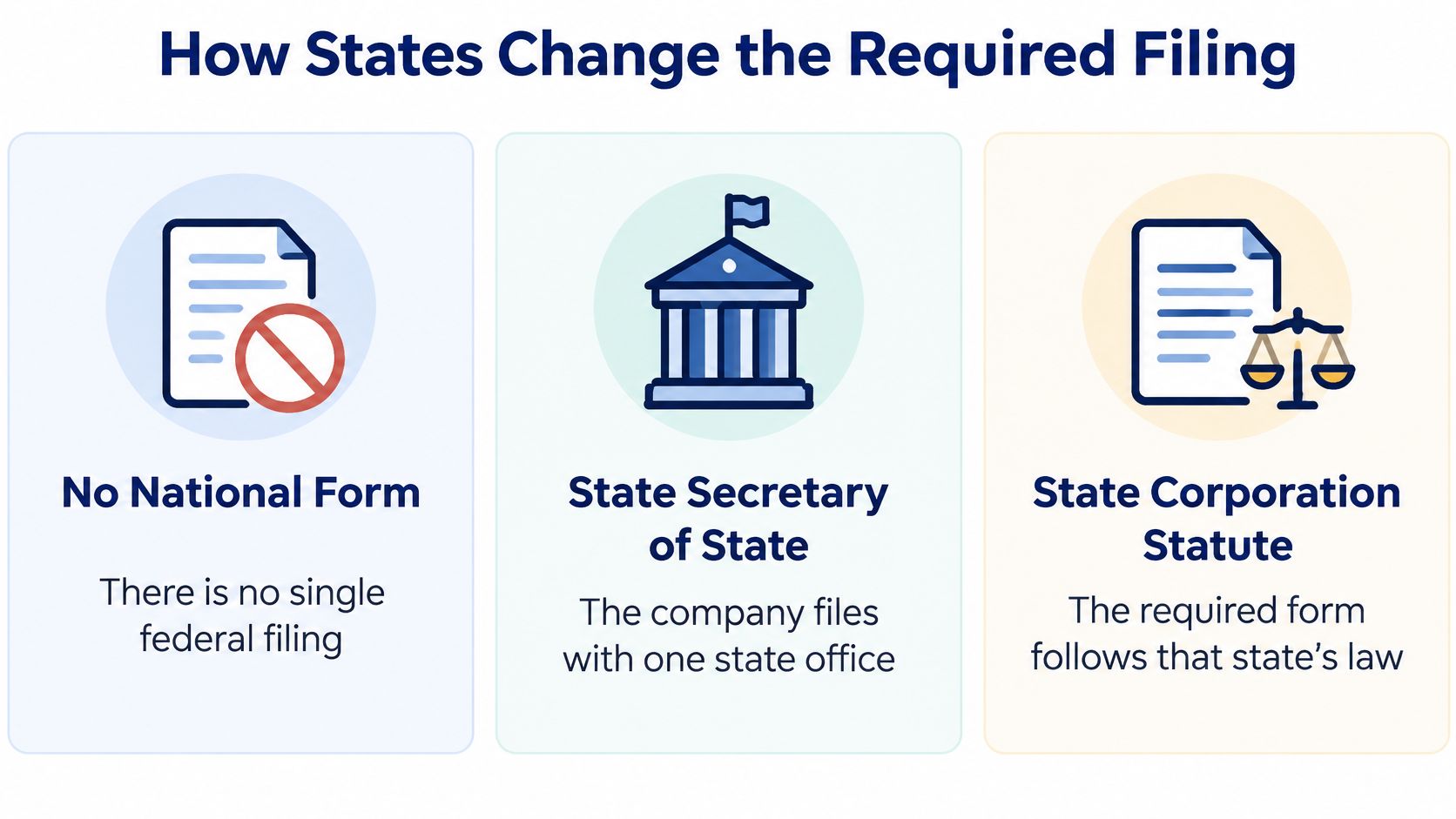
Delaware and Florida show the contrast clearly. Delaware uses a certificate of incorporation under the Delaware General Corporation Law. Florida uses articles of incorporation and spells out required contents in its statute. Many other states follow a broader pattern and add their own blanks for purpose, par value, or directors.
| Topic | Delaware pattern | Florida pattern | What to verify |
|---|---|---|---|
| Document name | Certificate of incorporation | Articles of incorporation | Use the name that state prints |
| Governing law | Delaware General Corporation Law, modern base in the 1967 revision | Florida corporate statute, including the incorporator and share requirements | Read the formation state's statute, not a generic template |
| Core public contents | Name, registered office and agent, authorized stock, and incorporator details set by DGCL | Name, principal-office street address, authorized shares, registered agent and office, incorporators | Compare the image to that state's required list |
| Filing fee and effective date | Set by Delaware and can allow a chosen effective date | Set by Florida and can differ from Delaware | Check the current state fee schedule; do not reuse another state's fee |
| Officers and extra governance | Not always printed on the certificate | Optional terms may be included but are not all mandatory | Missing officers on the PDF are not proof they do not exist |
| Doing business in another state | Foreign qualification is a separate filing | Foreign qualification is a separate filing | Formation in one state does not equal authority in another |
Differences generic templates skip
Operational details shift with the state. Those details include the document title, minimum incorporator rules, filing fee amounts, whether a delayed effective date is allowed, and which fields appear in public. Don't copy a fee or effective date rule from one state into a checklist for another.
Public disclosure is another trap. Officers and detailed share arrangements may exist in internal records even when they don't appear on the public image. A reviewer who expects every state to publish the same fields will reject good files and accept thin ones for the wrong reason.
Formation is not permission everywhere
Forming in Delaware doesn't authorize a corporation to transact business in Florida. That second step is foreign qualification, a separate registration with its own application, agent, date, and status. The word foreign here means out of state, not outside the United States.
Access also differs by registry. Some states post a free PDF of the original articles and amendments. Others show only an index entry or require a certified copy order. Match the row for the formation state before you judge a customer supplied PDF complete, and check foreign qualification separately in every state where the company claims authority.
Why One State's Statute Still Governs
Early American corporations generally needed a special act of the legislature. Founders didn't file a routine form. They asked lawmakers for an individual charter. New York's general incorporation law began the shift toward a prescribed filing that qualifying applicants could use without lobbying for a private law.
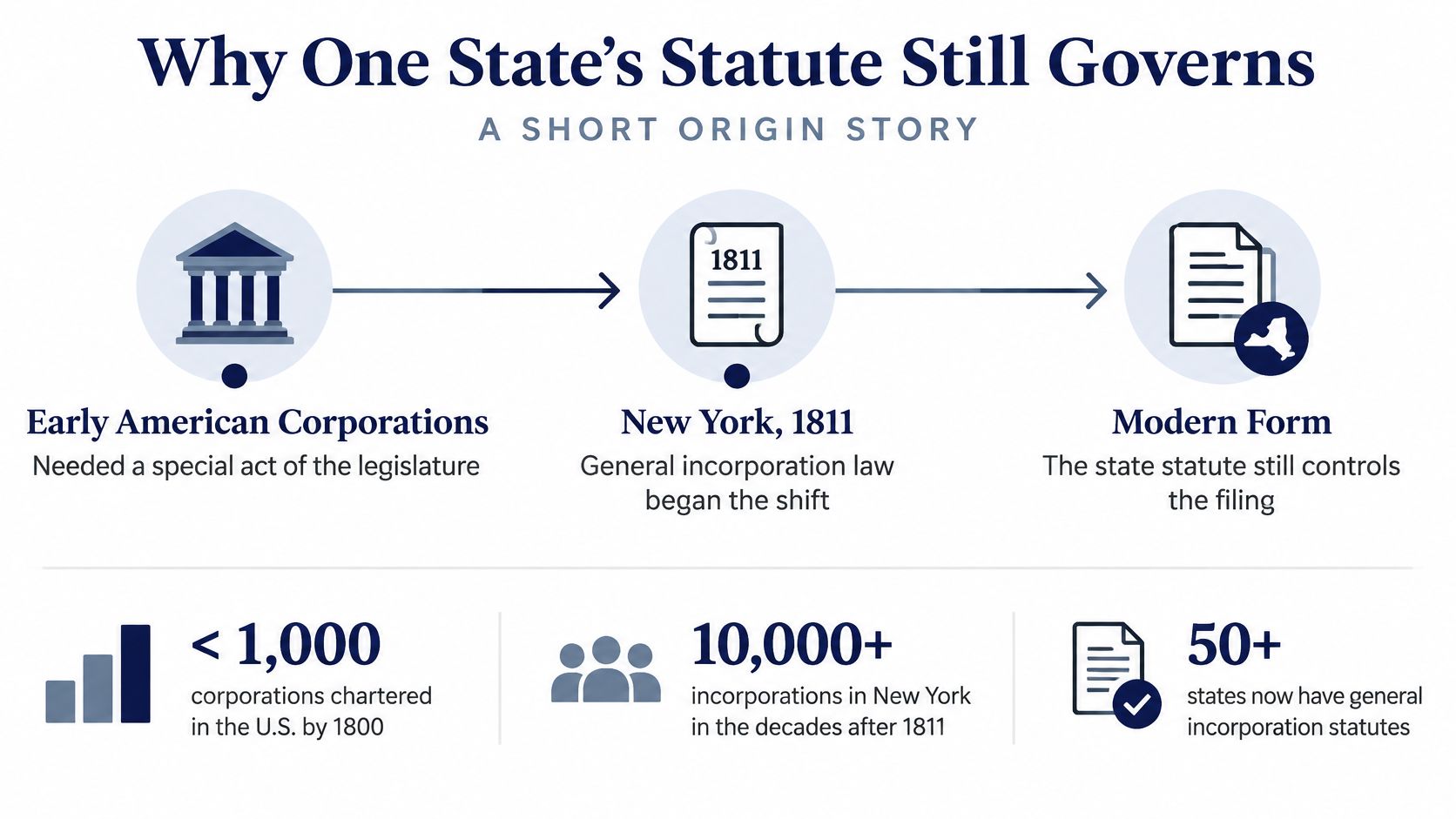
Delaware then built the model many large companies still use. The history summarized in the overview of the Delaware corporation traces the statute from the adoption of its General Corporation Law on March 10, 1899, through approximately biennial revisions beginning in 1901, major revision processes in 1915, 1935, and 1953, and the 1967 revision widely regarded as the modern foundation.
Scale explains the habit
Delaware remains a common choice for large companies, and its registry has grown far beyond the businesses that operate within its borders. That scale explains a practical point, not just a history lesson. A company can sell in every state and still owe its legal existence to one filing office. Its articles or certificate connect it to one statutory regime, one registered office, and one amendment history.
A national customer still has a single formation state. Ask which state created the entity before you compare its form, fee, or fields to any other company's paperwork.
A formation state works like a birthplace. A person can live in several states over a lifetime, but only one office issued the birth certificate. Say you onboard a vendor with customers nationwide, employees in three states, and a Delaware certificate. Delaware law governs the formation document you're reading. Other states may govern its qualification to do business there, its taxes, or its local licenses, but they don't rewrite where the corporation was created. Later amendments and the March 26, 2025 change to federal beneficial-ownership reporting now sit on top of that original filing, yet the formation statute still decides which office holds the record. Start with jurisdiction, then read the document.
Why a Filed Article Is Not Current Status
A customer uploads a clean scan of its original articles. The stamp is legible, the name matches, and your team marks verification complete. That's the mistake this document invites. Existence at filing isn't active status today.
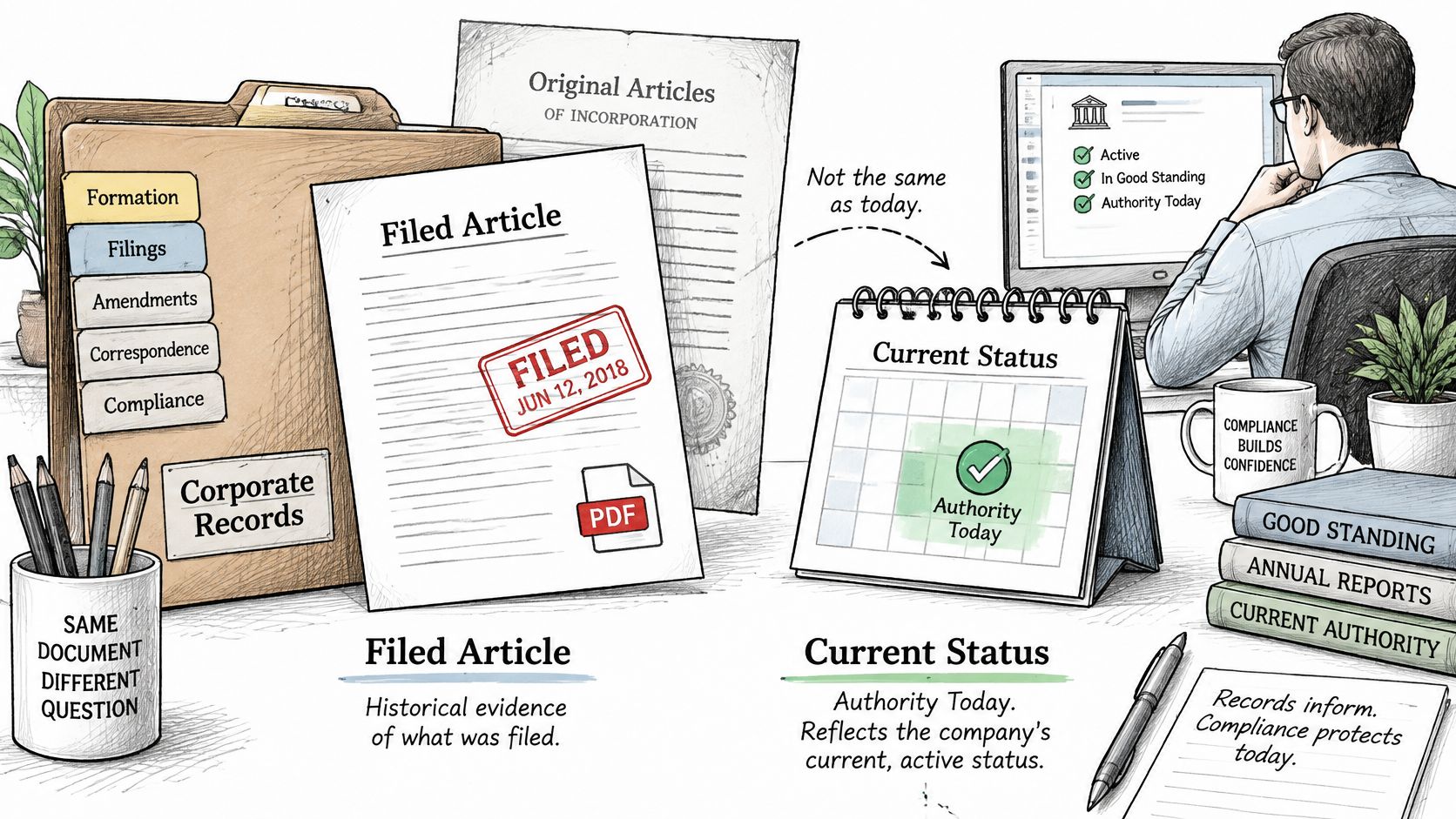
The Florida statute is useful here because it shows what a formation filing must contain, not what the entity's record contains years later. Under Florida's articles of incorporation statute, the required contents, naming rules, incorporator requirements, filing fees, effective date options, and disclosure fields are set by jurisdiction. A filed article therefore answers a formation question. It doesn't prove the entity is active, authorized to transact business elsewhere, or current on subsequent amendments and annual reports.
How the record changes after day one
- Amendments change the original terms: A later filing can change the legal name, authorized shares, registered agent, or purpose, and it can supersede clauses in the first document.
- Reports keep the entity in good standing: Annual reports and franchise tax filings maintain status over time, and a lapse can move an entity to inactive, dissolved, or revoked while the original articles stay on file.
- Foreign qualification creates separate status: Each state where the company registers to transact business keeps its own date, agent, and standing.
Consider a concrete file. A Delaware certificate from 2014 arrives as a user uploaded scan. It doesn't show whether a 2022 amendment increased authorized shares, whether a Florida qualification is active, or whether the registered agent changed last month. All three facts can affect onboarding, underwriting, or payment decisions, and none appears on the first page the customer chose to send.
What to validate instead
For automated onboarding, normalized fields beat a static checklist. Pull entity status, entity type, formation date, registered agent, principal address, and amendment history from the official record. Then compare those fields to the application.
Our guide to an entity search API covers how that lookup fits an onboarding flow. The principle is simple whether you automate it or check manually. Validate the official filing history rather than trusting a certificate or PDF alone. Filed articles are the beginning of corporate identity verification, not definitive evidence of present legal or operational status.
What Must Still Be Disclosed After Filing
Older guides often blur three separate questions. What did the state require at formation? What does the company keep in its own records? What does federal law still require? The March 2025 change makes that confusion risky.
The FinCEN news release on beneficial ownership reporting states that FinCEN's March 26, 2025 interim final rule narrowed the Corporate Transparency Act definition of a reporting company to entities formed under foreign law that register to do business in the United States. Domestic companies created under U.S. state or tribal law were exempted from BOI reporting, including updates or corrections to previously reported BOI under the rule's stated scope.
Read that date. Confirm the rule's effective date and any later amendment before you design a workflow around it. A compliance process built for one scope can be wrong after the scope changes.
| Bucket | Typical contents | Who keeps it | Does the article replace it |
|---|---|---|---|
| State formation record | Name, purpose, incorporator, registered agent, authorized shares | Formation-state filing office | It is this record |
| Ongoing public registry | Status, amendments, annual reports, later agent changes | Same state registry, updated over time | No; later filings can supersede it |
| Internal corporate records | Beneficial owners, stock ledger, bylaws, resolutions | The company | No |
| Federal BOI after March 26, 2025 | Beneficial-ownership reports for foreign-formed entities that register in the U.S.; domestic state or tribal entities exempted in the stated scope | FinCEN, if the entity is still a reporting company | No |
Four buckets, four owners
The state formation record identifies the corporation, purpose, incorporator, registered agent, and authorized shares. The ongoing public registry adds status, amendments, and annual reports over time, and it may still omit officers. Internal records hold beneficial owners, the stock ledger, bylaws, and resolutions. Federal BOI reporting, under the 2025 scope, is a question for foreign formed entities that register in the United States.
That split answers a common confusion. A domestic corporation's exemption from BOI reporting under the stated scope doesn't erase its state filings, and it doesn't mean ownership records stop mattering internally. It also doesn't turn articles into ownership verification. Articles usually don't list every beneficial owner, and they were never designed to.
Our overview of business entity data can help teams separate registry fields from data they must collect elsewhere. Build the workflow for regulatory change, with dated rules and clear buckets. Don't treat incorporation as a one time filing task that settles disclosure forever.
How to Retrieve Filing History and PDFs
You don't need to rebuild fifty state websites to check one corporation. Follow one sequence, and attach a reason to each step so reviewers know why the order matters.
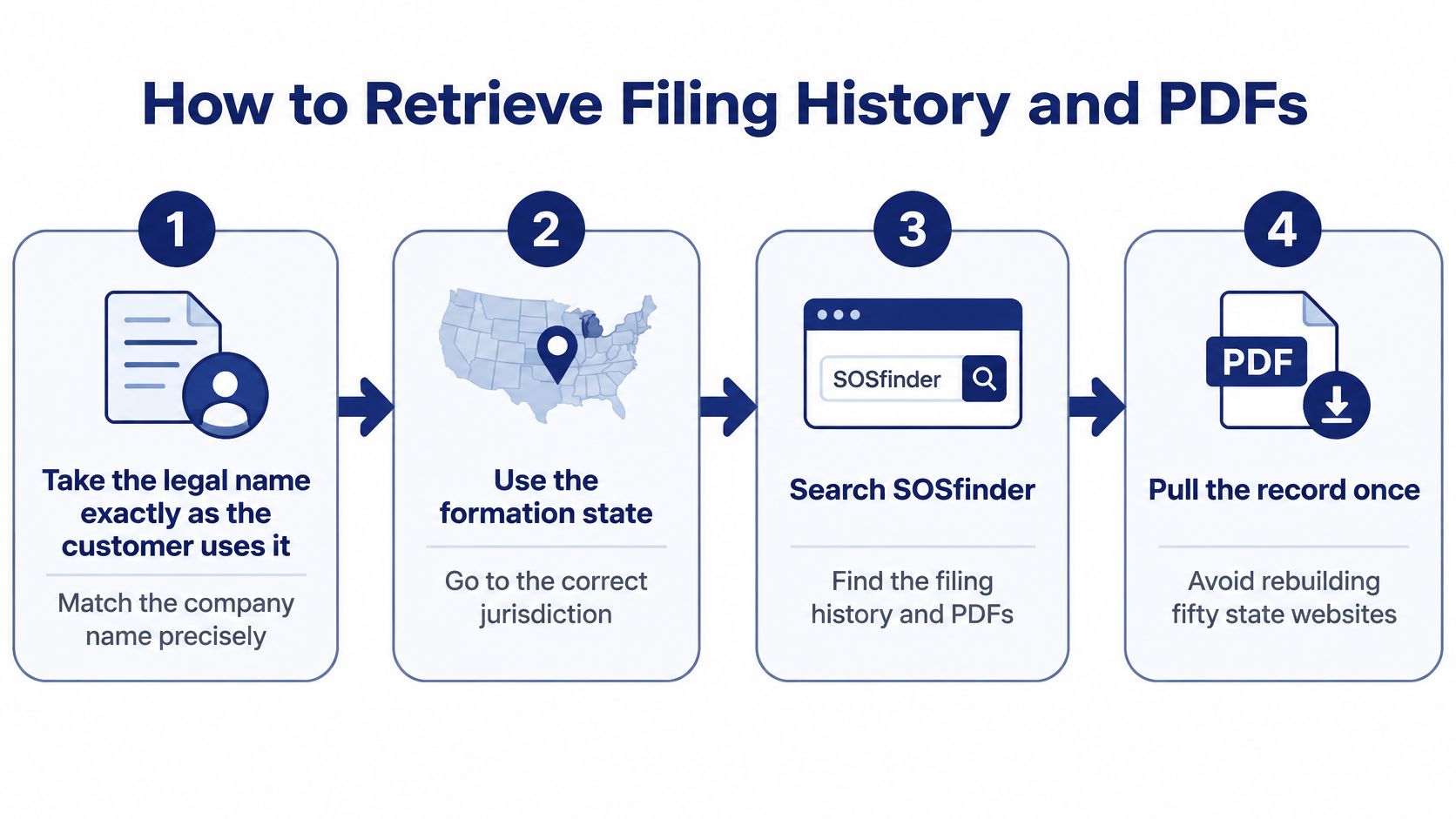
A seven step retrieval path
- Start with the exact legal name and formation state: Take the name as the customer uses it, plus the state as a two-letter code or full state name. Similar names are common, and the state narrows the search to the right registry.
- Run one entity search: We ask that state's official registry for the record and return a best match plus similar filings. You get one schema for every state and the District of Columbia instead of learning a new result page each time.
- Read the normalized record first: Check status, entity type, formation date, registered agent, and principal address before opening PDFs. If a state doesn't publish a field, we return it as null, or as an empty list for officers, filings, and documents, so absence isn't mistaken for a failed search.
- Use a registry ID when you have one: Look up the record directly with the state's own identifier, such as a Delaware file number or a Florida document number. That's faster and safer than guessing among similar names.
- Open the filing history: Follow links to state PDFs where that registry offers them, including the original articles or certificate, amendments, and annual reports. Read them in date order so a later amendment isn't hidden behind the formation document.
- Save the legal fields, not just the image: Record the filing date, jurisdiction, share authorization, agent, incorporator, and each amendment. Those fields drive matching and audit decisions long after someone files the PDF away.
- Send corrections to the state: If a fact on the image is wrong, the state office that maintains the filing must correct it. We can't file, register, or change an official record.
Freshness check: Run a fresh search when a cached image may predate an amendment, especially before a payment, account opening, or contract signature.
Our guide to company formation documents explains how formation papers fit with later filings. In practice, treat the PDF as evidence to inspect, not as the database. The structured record tells you whether you're looking at the right entity. The filing history tells you whether that entity's story changed after formation.
Confirm the Entity Before You Onboard
Before you pay a vendor, open an account, or archive a formation file, make a go or no-go decision in the formation state. Don't let a polished PDF substitute for that check.
The onboarding match
Match five fields to the application. Confirm the legal name, active status, entity type, formation date, and registered agent. Reject a packet whose only evidence is an unsigned scan, and pause when the name on the application differs from the registry name until someone explains the difference with an amendment or assumed name record.
For due diligence and underwriting, read the full filing history. A later amendment can change the facts an underwriter cares about, including authorized shares and legal name. Treat foreign qualification as a separate status in each state where the company claims it can transact business, because home state formation doesn't carry that authority across a border.
Our checklist for how to see if a company is legitimate gives a broader legitimacy check you can pair with this registry review.
Recordkeeping that survives drift
- Keep the chain together: Store the articles, every amendment, and the current agent and address in one file so a reviewer sees the sequence.
- Recheck on a schedule: Status, agent, and address drift after formation, so a one time pull ages quickly.
- Separate lookup from filing: Use a registry lookup to verify and monitor, and use the state office when a record must be created or corrected.
We provide one REST endpoint that looks up any business registered in all 50 states and DC, returning status, registered agent, formation date, and filings. Permitted uses include verifying businesses during onboarding, enriching CRM or lead records, underwriting and diligence, monitoring the standing of entities, and building products on the API. We can't file documents, register entities, or change any official record on a customer's behalf, and we're not a government agency.
Search the formation state, open the filing history PDFs the state provides, and only then store the article of corporation as the start of the file rather than the whole file.
When you're ready to verify a corporation without visiting a different registry for every state, use SOSfinder to pull the entity's current status, registered agent, formation date, and filing history through one lookup. Start with the formation state, review the articles and amendments the registry provides, and onboard only when the live record matches the application.