Business Intelligence API: A Developer's Guide
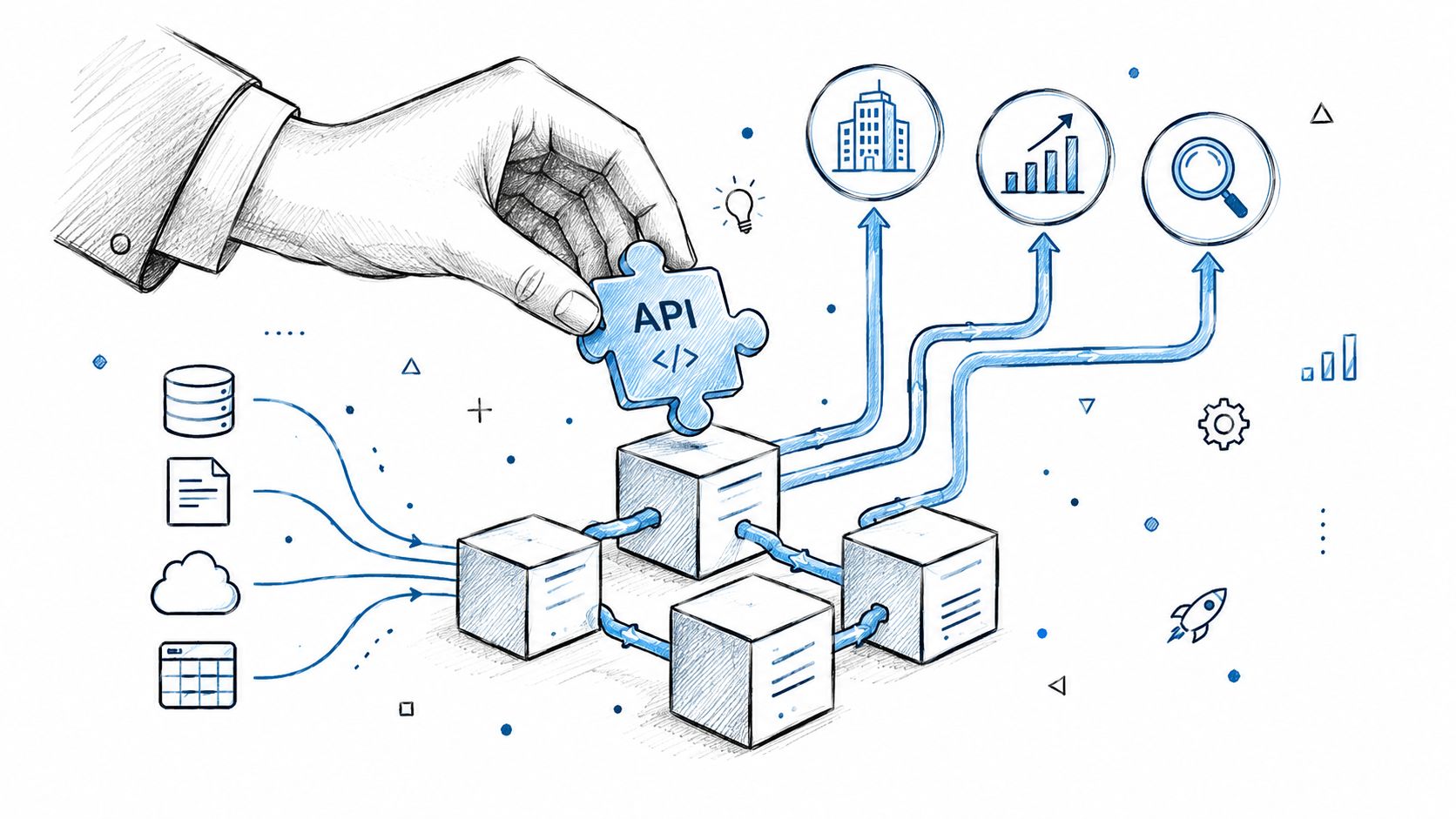
You've been asked to add “business intelligence API” support to a product, but the request is vague. The product manager may mean embedded dashboards for customers, while the compliance team may be asking for company verification, filing history, and status monitoring. Both workflows use APIs, both involve corporate data, and they require very different architectures.
Choosing the wrong category creates expensive rework. A dashboard API won't verify whether a supplier exists in a state registry, and an entity data API won't give your customers interactive revenue charts. The first engineering decision is therefore not which vendor to buy. It's deciding what “business intelligence” means for the workflow you're building.
Understanding the Business Intelligence API Categories
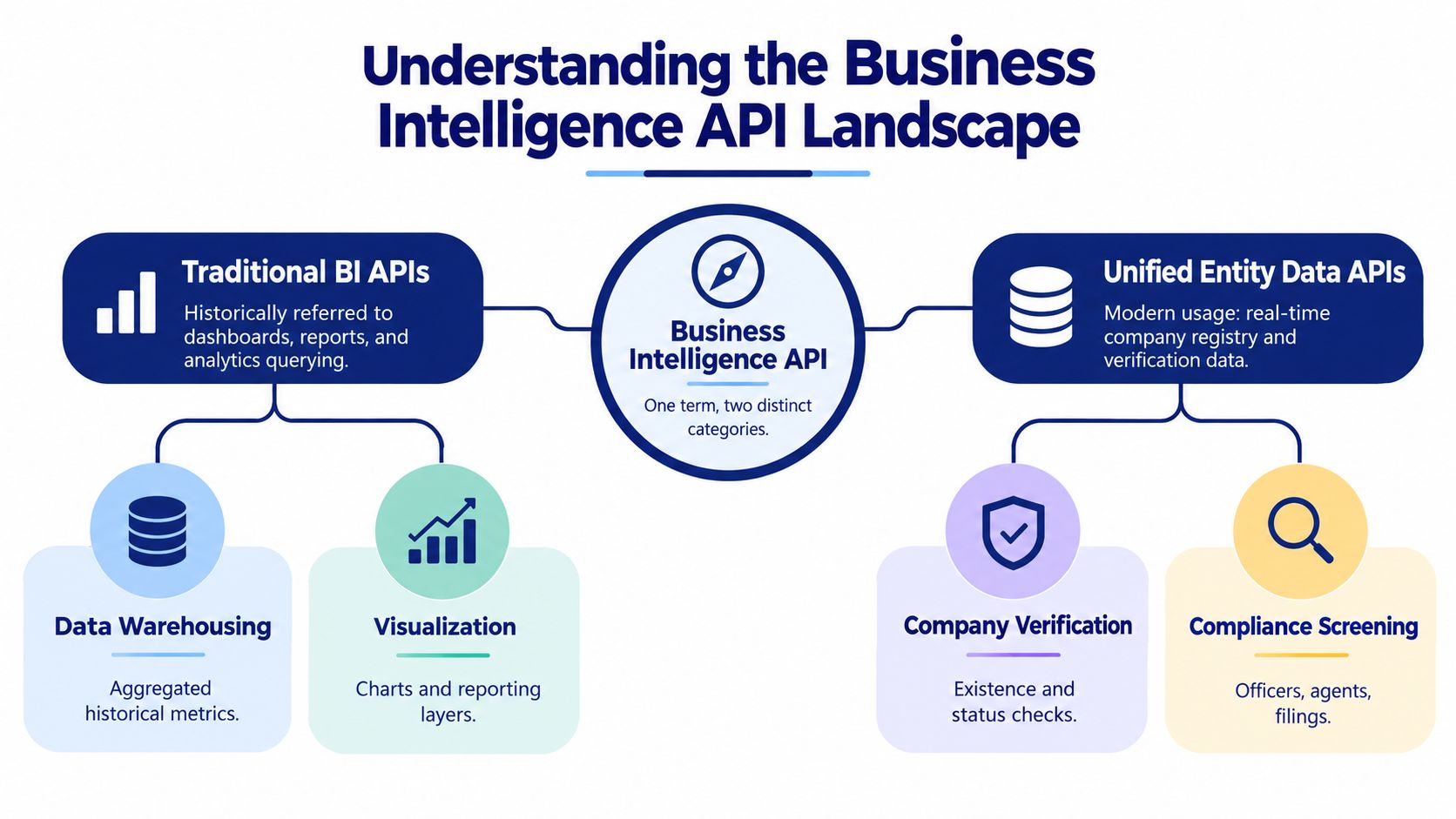
A business intelligence API can refer to two different integration contracts. The older category provides programmatic access to enterprise analytics platforms. Developers use these APIs to embed dashboards, generate reports, query governed semantic models, and connect reporting logic with other applications. Tableau, Microsoft Power BI, Qlik, Looker, and MicroStrategy all published APIs during the 2010s, establishing a common way to use BI functions without requiring users to operate the platform manually. The historical development of business intelligence APIs traces how this model became a standard layer for enterprise analytics.
The second category provides corporate entity data. A developer may search for a company by name, verify its registration status, retrieve its registered agent, or inspect filings before approving an account. The API is then converting fragmented public-record research into structured data for enrichment, verification, and due diligence.
Two workflows, two contracts
Take a procurement application with two separate requirements. Finance users may need a dashboard showing spend by department, supplier category, and period. That workflow depends on dimensions, measures, filters, permissions, and a governed analytical model.
The same application may verify a supplier before onboarding. That workflow needs entity identity resolution, jurisdiction-aware searches, registration status, official identifiers, and document retrieval. Its response must remain traceable to a corporate record rather than being reduced to an aggregate chart.
Practical rule: Choose the API according to the decision your application must support, not the label in a vendor directory.
The distinction also shapes build-versus-buy decisions. An analytics team that already owns a warehouse and semantic layer may reasonably add an embedding API to that stack. A product team building verification features takes on a different burden if it maintains separate parsers, request flows, validation rules, and error handling for each state registry. The contrast is clear in embedding analytics and consolidating corporate records. Embedding exposes logic the organization already governs. A unified entity data API provides a normalized access layer over sources the team may prefer not to integrate individually.
Core Concepts and Architectural Differences
Traditional BI APIs expose an analytical model. Their vocabulary usually includes metrics, dimensions, filters, permissions, report definitions, and export jobs. A request might ask for gross margin grouped by region, filtered to a reporting period and a particular business unit. The API's value depends on semantic consistency. “Revenue” must mean the same thing in a dashboard, scheduled export, and downstream application.
That architecture is powerful, but it can be a poor fit for operational verification. A corporate entity API instead exposes records that describe organizations and their registry relationships. Its central problem is not chart rendering. It's normalization, the process of mapping inconsistent source structures into fields that developers can handle predictably.
Why normalization changes the engineering work
State registries don't present information in a uniform way. Names, identifiers, statuses, filing labels, address fields, and officer information can differ by jurisdiction. A fragmented integration forces your team to write source-specific request logic, parsers, validation rules, retries, and error handling.
A unified entity data API changes the boundary. The application sends a search request and treats jurisdiction as a parameter rather than as a separate integration project. The response can present a consistent shape for fields such as:
- Identity: legal name, registry identifier, and entity type.
- Lifecycle: formation or registration date and current status.
- People and representation: registered agent, officers, or related parties where available.
- Location: principal address and jurisdiction.
- Evidence: filing history and links to available source documents.
That consistency doesn't mean the underlying records are identical. A good integration preserves source nuance instead of pretending every registry uses the same definitions. Your data model should distinguish an absent value from a value that was checked and found empty, and it should retain source context wherever an analyst may need to review the original filing.
Where the two models meet
The categories can work together. A risk platform may use an entity API to verify a supplier, store the result, and then expose approval rates or unresolved records through a BI dashboard. The verification layer needs current, attributable records. The reporting layer needs stable dimensions and metrics built from those records.
The entity search API approach is therefore best understood as an operational data contract, not as a replacement for a warehouse or semantic model. Build the analytics layer when your organization needs custom metrics and internal governance. Buy or integrate the registry access layer when source fragmentation, normalization, and maintenance would distract from your product's core value.
Integrating Unified Entity Data APIs
A reliable integration starts with a narrow workflow. Define what the application must decide, such as whether to approve a vendor, identify a matching company, or notify a user after a status change. Then define the minimum fields needed for that decision. Avoid importing every available attribute just because the endpoint returns it.
A practical integration sequence
Model the search input. Accept a legal name, jurisdiction, registry identifier, or a combination of these. Normalize user-entered whitespace and preserve the original query for audit logs.
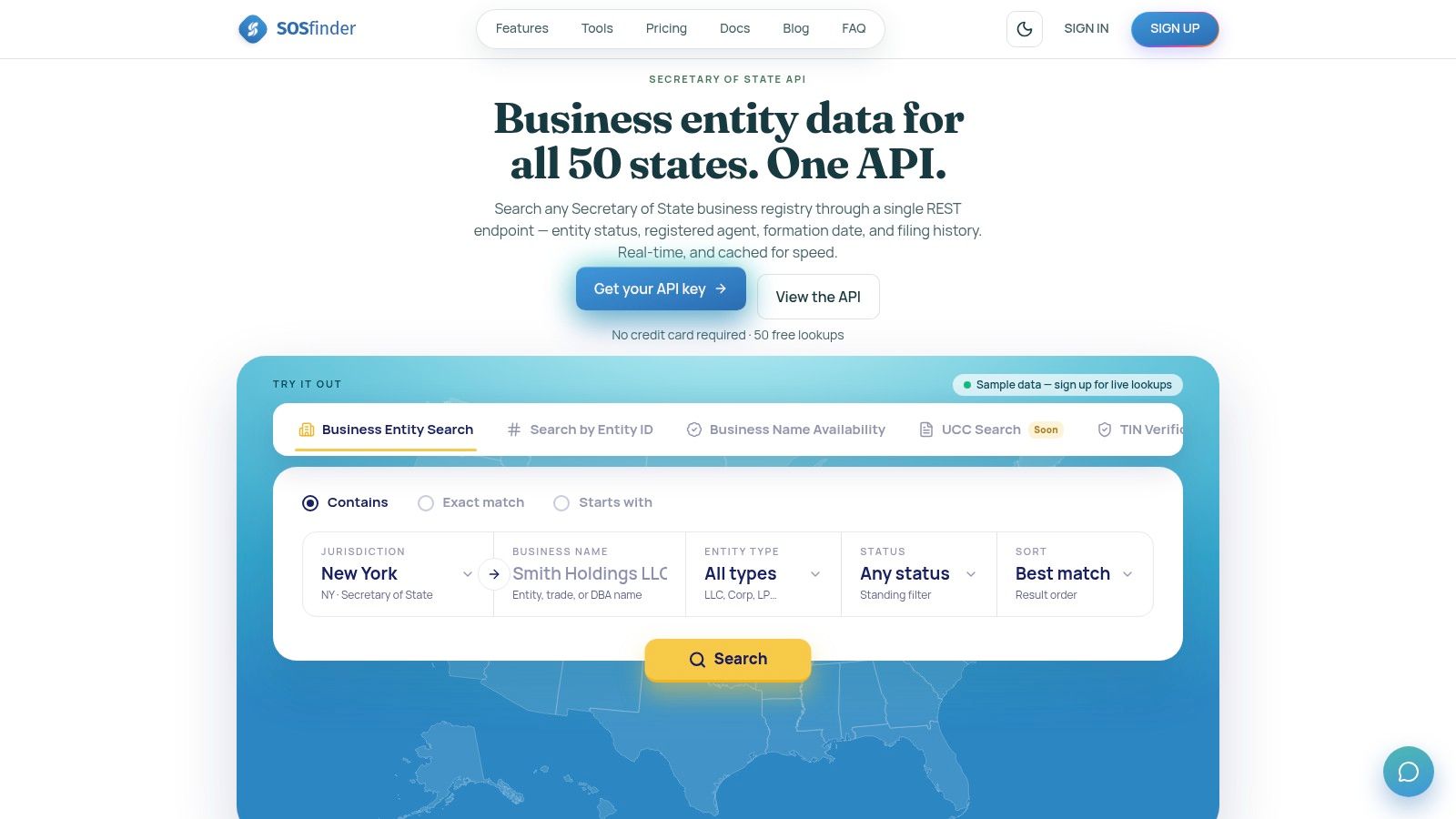
Send one controlled request. A single POST-based search endpoint lets the application pass the jurisdiction as data rather than routing requests through state-specific clients. Keep credentials on the server, validate inputs before sending them, and assign an internal request identifier for troubleshooting.
Resolve matches deliberately. Common names can produce several plausible records. Automatic best-match behavior can help with routine searches, but the interface should expose enough identifying information for a person or downstream rule to review ambiguous results.
Store provenance with the result. Save the source jurisdiction, retrieval time, identifiers, status, and any document references alongside the normalized fields. A normalized response is easier to consume, but provenance is what makes it defensible during an audit.
Separate retrieval from business decisions. The API can return a status. Your application should decide what that status means for onboarding, payment, or escalation. Keep those rules in your own versioned policy layer so a registry update does not rewrite compliance logic.
An API playground and language examples for Python, JavaScript, Go, PHP, and cURL can shorten the first implementation cycle. Predictable JSON is useful, but predictable failure handling matters just as much. Define behavior for no matches, multiple matches, temporary source unavailability, malformed input, and records that need manual review.
Bulk verification belongs in a separate path from interactive search. A CSV workflow can process a portfolio without forcing a user to wait for each lookup, while webhooks can notify your system when monitored information changes. That lets a queue or event handler update internal records without constant polling.
Here's the operational pattern to aim for:
Search synchronously when a user is making a decision. Process portfolios asynchronously when the work is broad. Use notifications when change, rather than the initial lookup, is the event that matters.
The KYB API workflow illustrates why this separation is important. A customer onboarding screen needs a clear response and a controlled review state. A compliance portfolio needs resumable jobs, idempotent updates, and an audit trail.
Operational Advantages of Normalized Data
Fragmented registry integrations create maintenance work before they create search problems. Each source may use different request formats, field names, response structures, retry rules, and definitions for missing data. A unified endpoint places those differences behind a consistent contract, so your application can focus on identity matching, policy decisions, and the user experience.
A unified approach to business entity data also reduces source-specific branching and simplifies validation. The result is not a promise that every record looks identical. Your code handles common fields consistently while preserving exceptions for review, which makes validation logic and test fixtures easier to maintain.
Performance requires a freshness policy
Caching serves two operational purposes. It reduces repeated lookups and controls the latency users experience. The right design depends on whether the request supports an interactive screen or a batch job. Enterprise guidance notes that user-facing dashboard APIs often target responses below 200 milliseconds, while batch integrations can tolerate substantially more latency. Guidance on API governance and performance trade-offs explains why predictable cache behavior matters for REST workloads.
A practical cache design should answer four questions:
- What can be cached? Stable identity fields usually tolerate caching better than frequently changing status information.
- How long is the result trusted? Set the TTL according to the risk of the decision, rather than applying a generic application default.
- What invalidates it? Change notifications, explicit refreshes, or a material event may justify an early recheck.
- What is recorded? Store retrieval time and freshness state so users can distinguish a current lookup from a cached result.
Caching can materially reduce REST response time, but results depend on workload shape, request patterns, and invalidation behavior. Evaluate those conditions instead of treating caching as a universal latency fix.
Short TTLs and explicit invalidation provide a safer default for dynamic records. Research on CRDT web caching found that TTL-based caching can deliver strong performance while creating an inconsistency window. That trade-off makes the approach unsuitable for some fast-changing APIs. The caching research reinforces that stale data is a correctness decision, not only a technical inconvenience.
Real-World Use Cases for Developers
A vendor onboarding flow shows the value of entity data more clearly than a feature checklist. A procurement user enters a supplier name, the application searches across jurisdictions, and the result returns a candidate with its status, entity type, registered agent, and address. The product can approve a clean match, request more information when names collide, or route an uncertain record to an analyst.
The API doesn't replace judgment. It gives the application structured evidence before a payment relationship begins. That distinction matters because a matching name alone isn't proof that the applicant is the same organization the business intends to onboard.

Three workflows worth designing separately
Vendor and customer due diligence should combine identity matching with reviewable evidence. Store the selected entity identifier, status, jurisdiction, retrieval time, and filing references. If the match is uncertain, don't automatically choose the first result. Present alternatives and make the decision observable.
Name clearance belongs earlier in a formation workflow. A legal filing service can check a proposed name before generating documents or sending a submission to a registry. Early feedback helps users correct conflicts before the filing process creates avoidable rework.
Ongoing compliance monitoring turns a one-time lookup into a lifecycle process. If a registered agent, address, or status changes, a webhook or scheduled notification can create a review task. The receiving system should make updates idempotent, because the same event may be delivered again or processed after a temporary failure.
Filing history adds another layer. An underwriting or audit team may need to inspect annual reports, amendments, or other available documents rather than rely only on a current status field. Store links to source PDFs where offered, and keep the normalized record connected to the document that supports it.
A useful product boundary is simple: automate collection and comparison, but preserve a human review path for ambiguous identity matches and consequential decisions.
This same design supports KYC workflows, legal filing products, lender operations, and SaaS onboarding. The implementation differs by domain, but the data contract remains similar. Search, normalize, preserve provenance, apply policy, and monitor for change.
Building Reliable Data Foundations
A dependable business intelligence API integration is less about adding an endpoint than about choosing the right system boundary. For embedded analytics, your organization may need a governed semantic model, access controls, query limits, and export behavior. For corporate entity verification, the difficult work lies in identity resolution, source variation, freshness, provenance, and safe handling of ambiguous matches.
That distinction clarifies when to build and when to buy. Build the policy and user experience that differentiate your product. Buy or integrate the infrastructure that aggregates difficult sources when maintaining every jurisdiction-specific connector would become a permanent operational burden. A purchased data layer still needs testing, monitoring, contract validation, and fallback behavior. It isn't a substitute for engineering ownership.
Designing for AI and real-time decisions
AI-native access raises the standard further. Current API guidance says services are being redesigned to be discoverable, governed, observable, and secure for LLM-driven traffic, not only for conventional application integrations. The discussion of AI-ready API design points to an important implementation detail: an AI client needs more than a natural-language description of an endpoint.
Expose allowed fields, filters, and actions through an explicit contract. Require authorization before returning sensitive records. Validate generated parameters against a schema, log the final request, and reject unsupported combinations rather than trying to interpret them generously. The API should make it difficult for an agent to invent a metric, query an unauthorized jurisdiction, or confuse a company name with a confirmed identity.
Real-time decisioning also needs restraint. Industry coverage increasingly connects APIs with streaming, observability, explainability, and automated decisions, but faster data isn't automatically better data. The API trends analysis highlights why freshness must be paired with lineage and data-quality controls. A slower, well-attributed result can support a better compliance decision than a fast response whose meaning is unclear.
Treat normalized data as a foundation, not a finished product. Define field semantics, retain source context, test unusual registry responses, measure cache freshness, and give operators a clear path to challenge or correct a match. With those controls in place, an API can support both modern SaaS workflows and the analytical systems that measure them.
SOSfinder provides a single REST endpoint for normalized business entity records across U.S. state registries and the District of Columbia, with search, monitoring, bulk verification, filing history, and webhook workflows. If your product needs dependable corporate data without maintaining separate registry integrations, visit SOSfinder to evaluate the API for your onboarding, KYB, or compliance workflow.