Business Name Availability Lookup Workflow
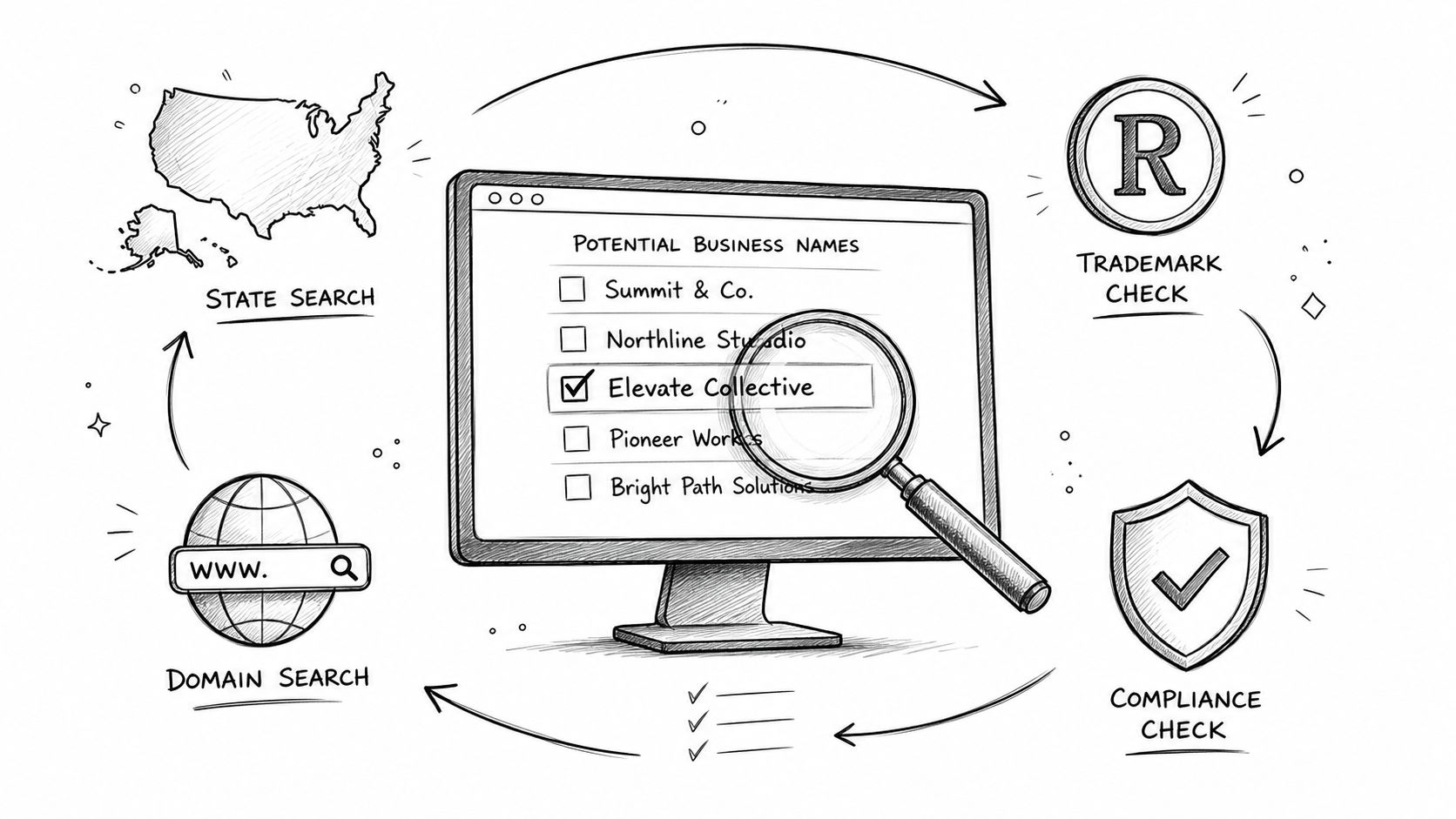
You've found a name that fits the brand, the domain appears promising, and the formation workflow is ready to accept a filing. Then the state rejects the name because a punctuation change was normalized away, a similar entity already exists, or a dissolved company still occupies the relevant naming space. A basic business name availability lookup often tells users only that no exact string appeared. It doesn't tell them whether the name is defensible.
That distinction matters for engineers building formation, KYC, or onboarding products. Name clearance isn't a search-box feature. It's a jurisdiction-aware decision workflow that must account for registry rules, trademark conflicts, digital identity, and unregistered use. The practical objective isn't to promise that a name is “safe.” It's to reduce avoidable filing failures and give users enough context to make the next decision.
The Myth of a National Business Name Database
There isn't one authoritative U.S. database that can answer whether a business name is available everywhere. A state registry determines whether a proposed entity name is distinguishable from records under that state's rules. That approval says little about a federal trademark, a local trade name, a domain, or an organization operating under the same name elsewhere.
A formation product that searches one state and labels the result “available nationwide” creates a dangerous false positive. A name might clear a registry in one jurisdiction and be rejected in another because the second state applies different entity-type filters, normalization rules, or standards for distinguishing names. Business name clearance guidance describes this broader U.S. model as jurisdiction-specific and time-sensitive, with California offering a preliminary search and a 60-day reservation window for a fee.
The problem becomes more obvious in a multi-state onboarding flow. A customer may submit the same proposed name for entities in several states. If the product stores one Boolean field called available, it has already discarded the information needed to explain why the result differs by jurisdiction.
Availability is a local legal decision
State registries generally ask whether the proposed name is distinguishable from existing entities in that state. The test isn't a nationwide brand clearance, and it isn't necessarily a trademark review. California's Secretary of State guidance explicitly treats its Business Search as preliminary rather than formal name clearance, which is an important distinction for both users and product teams. California's name reservation guidance makes clear that a preliminary result shouldn't be presented as a guarantee.
That means the user interface should identify the jurisdiction beside every result. “Available in California” is meaningful. “Available in the United States” usually isn't.
A solid record should preserve:
- Jurisdiction: The state or district whose rules produced the result.
- Entity type: LLC, corporation, partnership, or another supported type.
- Search input: The exact name submitted by the user.
- Normalized input: The comparison string used by the registry or your adapter.
- Matched records: Exact and similar entities, including status.
- Decision state: Clear, possible conflict, unavailable, pending review, or retrieval error.
- Timestamp and source: When the result was obtained and which registry supplied it.
Why exact-match scraping fails
A national aggregator built from scraped search pages can look convincing while missing the events that determine filing outcomes. State sites may expose different search parameters, pagination behaviors, result labels, and status definitions. Some return similar names separately from exact matches. Others may show only a subset of entity types unless the request includes the right filter.
Entity intelligence intersects with KYC. A KYB verification workflow needs authoritative entity context, not merely a string comparison. The same principle applies to name clearance. A search result without jurisdiction, status, entity type, and retrieval context isn't enough to support a filing recommendation.
Practical rule: Never collapse a state-specific registry response into a nationwide “yes” or “no” without retaining the underlying jurisdiction and match evidence.
The correct product behavior is more nuanced. If no conflict appears in a state registry, show that the name passed the registry search for that state. Then route the user through the remaining clearance layers instead of implying that formation approval has solved the entire naming problem.
How State Registries Actually Evaluate Name Availability
A filing can fail even when an exact-string search returns no match. State registries commonly transform the proposed name, compare it with eligible records, and then apply rules based on entity type and status. An API that compares raw input strings alone can therefore produce false positives and false negatives.
Minnesota demonstrates the problem clearly. Its Secretary of State says a business name must differ by at least one letter or numeral from names already on file. The state also replaces ampersands with AND, removes most characters, and evaluates names within a limit of 250 characters. Legal guidance on selecting and protecting a business name explains why a clearance check must model registry rules instead of relying on visible spelling.
Normalize before you compare
Keep the submitted name and its comparison form as separate values. The original supports display, audit logs, filing preparation, and user confirmation. A jurisdiction-specific adapter generates the normalized value for matching.
A practical pipeline includes these stages:
- Validate the input: Reject malformed or unsupported values before making a registry request.
- Preserve the original: Store the exact submitted name, including capitalization and punctuation.
- Apply registry transformations: Process ampersands, punctuation, whitespace, diacritics, legal designators, and character limits according to the target jurisdiction.
- Generate variants: Add spacing, punctuation, phonetic, abbreviation, and partial-string variants where the registry supports them.
- Query eligible records: Filter results by jurisdiction, entity type, and relevant status.
- Classify the result: Distinguish exact matches, similar matches, blocked names, and inconclusive responses.
Version the adapter and record the source version used for each check. Registry behavior and search interfaces can change, so a later recheck should show which normalization logic produced the earlier result.
Entity type and status change the answer
A name may appear clear because the request searched the wrong entity class. Some states compare names only within similar entity types. Others apply broader distinguishability rules. The request model should require the intended entity type rather than treating it as optional context.
Status affects reuse as well. An “inactive” record may still hold a name. Colorado's guidance separates similar entity names from trade names and trademarks, and those categories do not necessarily appear in the same search. Florida guidance also indicates that administratively dissolved or revoked entities may remain held before reuse, while voluntary dissolution can receive different treatment. Colorado's entity-name FAQ shows why the result needs status interpretation, not just a returned name.
See how normalized business entity data preserves status and entity type for clearance decisions.
| Registry result | Product interpretation |
|---|---|
| Exact active match | Treat as unavailable for the selected entity context |
| Similar active match | Require review or suggest a different name |
| Dissolved or revoked record | Display the status and a possible hold warning |
| Trade name or trademark result | Route to a separate clearance layer |
| Empty response after an error | Mark the search inconclusive, not clear |
An empty payload can mean that no records matched. It can also indicate a blocked request, failed parser, incomplete index, or unsupported filter. Preserve the response state and retrieval evidence so the product does not turn a technical failure into a misleading clearance decision.
Designing a Defensible Four-Layer Clearance Workflow
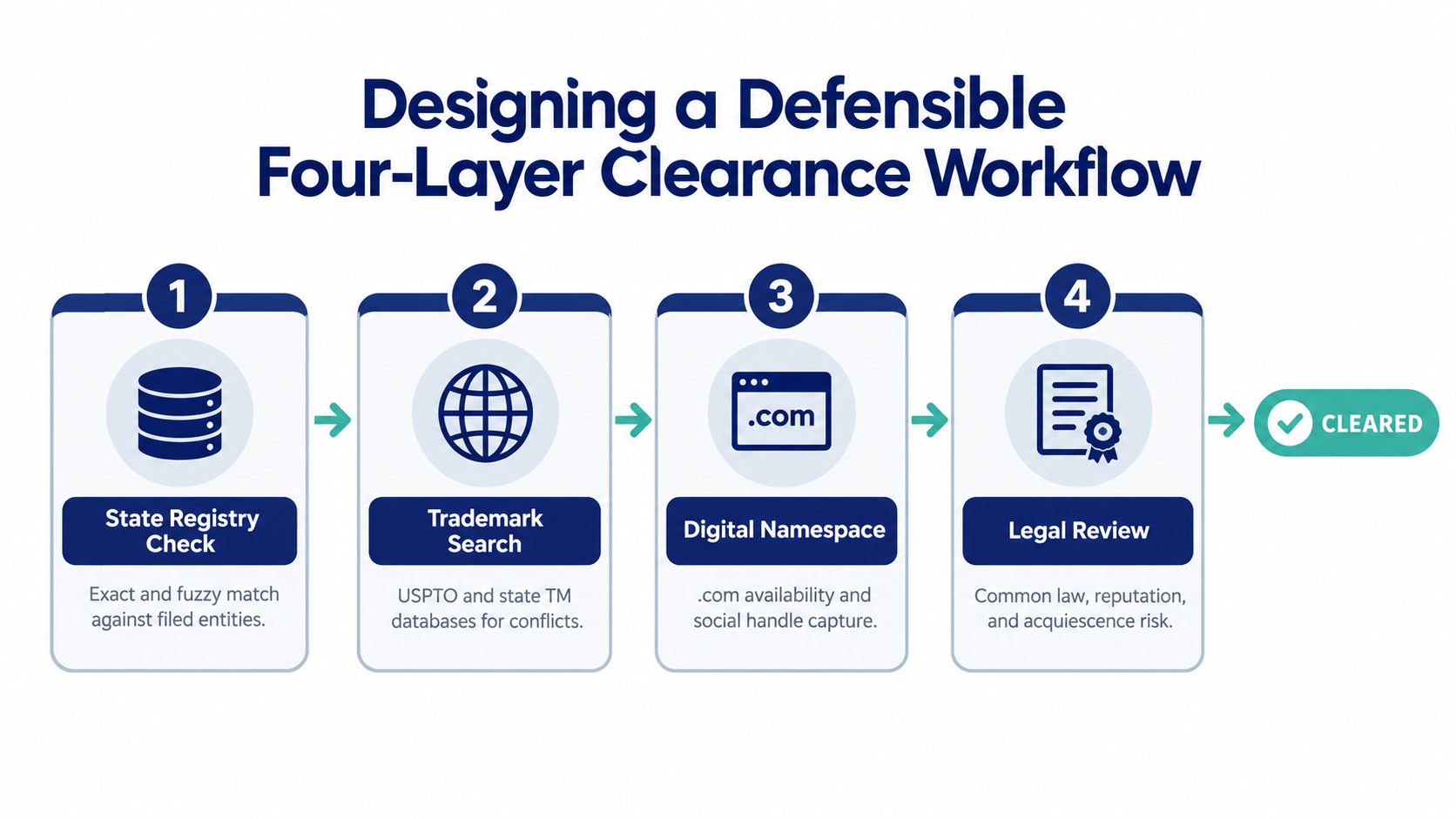
A reliable business name availability lookup should produce a clearance packet, not a single status label. The packet combines four distinct questions. Is the legal entity name distinguishable in the target jurisdiction? Does the name conflict with trademark rights? Can the business secure a workable digital identity? Is someone already using the name without appearing in a registry?
Each layer has a different failure mode, so one cannot substitute for another.
Layer one, state registry search
Start with the Secretary of State or equivalent entity registry for the formation jurisdiction. Search the exact proposed name, then test the normalized and similar forms that the state may treat as indistinguishable. Retain the matched entity names, entity types, statuses, identifiers, and filing context.
This layer answers a narrow question: is the proposed legal entity name likely to satisfy this state's registry rules? It doesn't answer whether the brand can be used commercially.
The search should also support a jurisdiction-specific reservation or filing handoff where available. A reservation can protect timing, but it doesn't replace the underlying availability check or resolve trademark risk.
Layer two, federal trademark screening
Next, search federal trademark records for exact, phonetic, visual, and conceptually similar marks. Compare the proposed name with marks used in related goods or services, not only identical records. A business can receive state approval and still face trademark risk because state entity registration and trademark rights operate under different systems.
The business name clearance checklist from the University of South Carolina School of Law recommends combining entity-registry searching with federal trademark screening, domain checks, and common-law research. That layered approach is more defensible than treating a state filing as brand clearance.
The product shouldn't make a legal conclusion from a search result. It should show potentially relevant marks, the reason for the match, and a review path. A trademark professional may need to assess the goods, services, geography, and likelihood of confusion.
Layer three, digital namespace checks
Check domain availability and the social handles that matter to the customer's launch plan. A domain can be unavailable even when the legal name is clear, and a handle can be occupied by an unrelated organization with an established audience.
Treat these as adoption constraints rather than legal approval signals. A customer may proceed with an alternative domain or handle, but the decision should be explicit. Capture the checked variants and timestamp so the team knows what was available when the customer made the choice.
Layer four, common-law and web research
Finish with web, map, directory, industry, and local search. Look for businesses using the name without a matching state entity record, including sole proprietors, partnerships, DBAs, and local operators. Search exact strings as well as spacing, hyphenation, abbreviations, misspellings, and phonetic equivalents.
This layer catches the records that structured registries don't promise to contain. It also reveals reputation and confusion risks that a clean database result can't expose.
The final decision should be a structured recommendation:
- Proceed to filing: No material registry conflict surfaced, and the other layers returned no obvious blocker.
- Proceed with review: A similar record, mark, local user, or digital conflict needs human assessment.
- Revise the name: The registry or trademark evidence creates a substantial adoption risk.
- Retry later: A source was unavailable, indexing was incomplete, or a filing may be pending.
State approval is one gate in the workflow. It isn't a promise that the brand is available everywhere the customer plans to operate.
Integrating Registry Data via a Unified API
Building direct integrations for every state registry creates a maintenance burden that grows with every change in HTML, authentication flow, result format, and search rule. Scraping also makes error handling inconsistent. One state may return a structured empty result, while another may display a human-readable error page that a parser mistakenly treats as a successful no-match response.
A unified API should hide source-specific transport details while preserving the jurisdictional meaning of each response. The abstraction must normalize data, not flatten it.
Use a request model that keeps jurisdiction explicit
A practical entity-search request should include the state, query, entity type when known, search mode, and whether similar matches are required. The API can expose a single POST operation while routing the request to a state-specific adapter behind the service boundary.
A conceptual request might contain:
jurisdictionqueryentity_typematch_modeinclude_similarinclude_inactiverequest_id
The response should return a stable envelope with source metadata, a normalized list of entities, and a decision summary. Each entity record should retain the state identifier, legal name, status, entity type, formation or registration date, registered agent, principal address, and filing-history references where available.
Don't expose only a Boolean field such as is_available. Return a reason code and evidence collection. A frontend can derive a green, amber, or red presentation from those fields, but the API response should remain useful to compliance, support, and audit teams.
Separate retrieval, normalization, and decisioning
The cleanest architecture has three stages:
- Retrieval: Obtain the current registry response and record source-level errors.
- Normalization: Convert source fields into a consistent schema while preserving raw values.
- Decisioning: Apply the selected jurisdiction's comparison and status rules.
This separation matters when a customer disputes a result. Support staff need to see whether the source returned a similar name, whether the adapter normalized punctuation, and whether the final decision came from a rules engine or a human override.
Real-time retrieval combined with low-latency caching can reduce repeated calls, but cached data needs a visible freshness policy. A cache hit shouldn't be represented as a current confirmation if the product cannot establish when the underlying registry was last checked. Use request and source timestamps, and make stale or partial results distinct from successful current retrieval.
Make failure states first-class
Registry integrations fail in ordinary ways. A source may time out, rate-limit the client, change a response shape, or return a temporary maintenance page. The unified API should expose consistent error semantics and retry transient failures without turning every failure into “name available.”
Useful categories include:
NO_MATCH: The source completed the search and returned no relevant record.SIMILAR_MATCH: The source returned one or more potentially conflicting records.UNAVAILABLE: The registry rules or a matching record block the proposed name.SOURCE_UNAVAILABLE: The state source couldn't be reached or parsed.UNSUPPORTED_FILTER: The requested entity type or search option isn't supported.REVIEW_REQUIRED: The result needs legal or operational interpretation.
A unified entity search service such as the one described in this overview of one API for state data can provide a consistent integration pattern across jurisdictions. The important design principle isn't merely fewer endpoints. It's that the response preserves enough state context for downstream systems to make cautious decisions.
For portfolio workflows, accept CSV input or batch requests, but return one result per proposed name and jurisdiction. Don't fail an entire batch because one state source is unavailable. Queue the failed items for retry and make partial completion visible to the operator.
Handling Edge Cases and Search Ambiguity
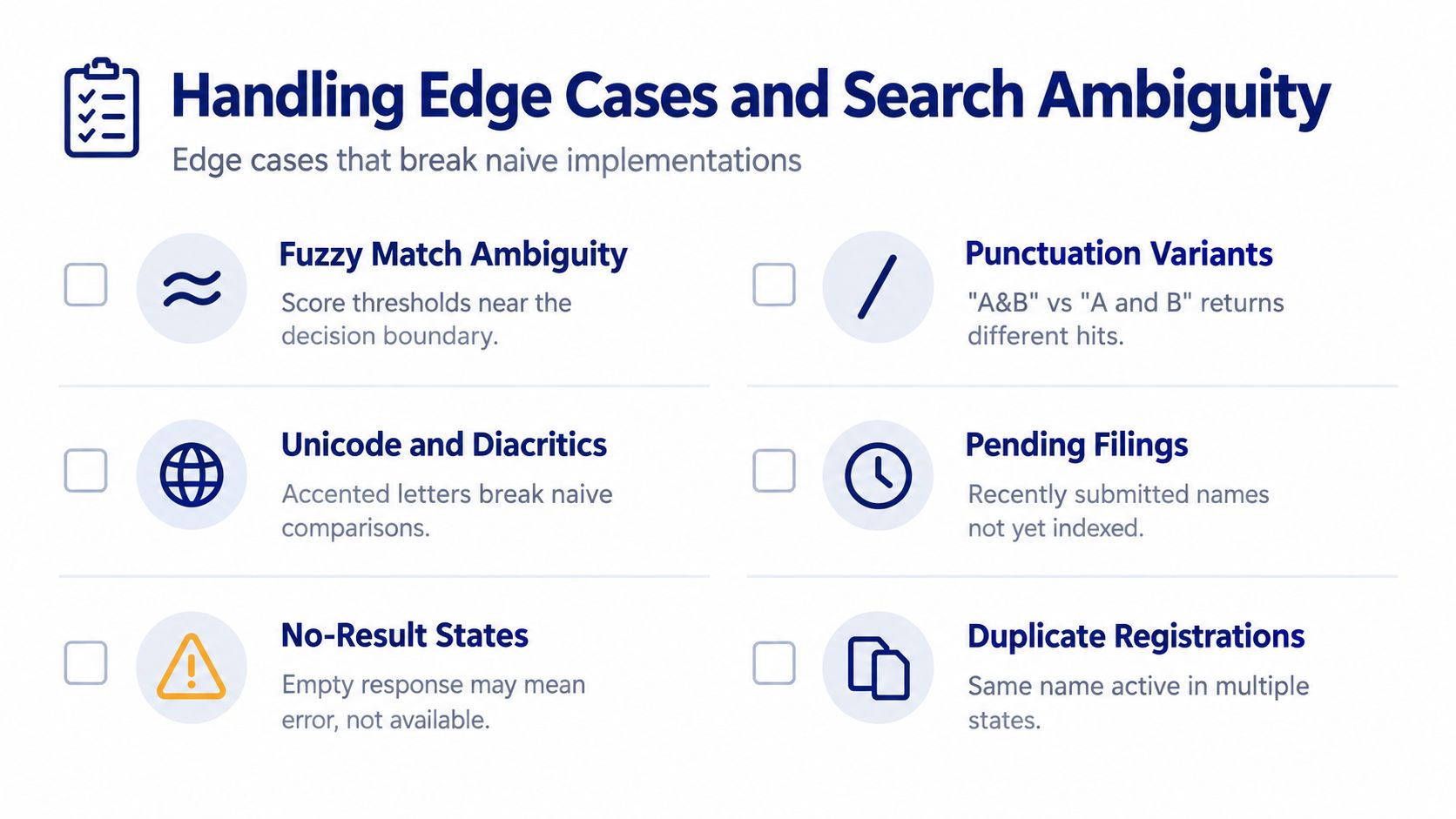
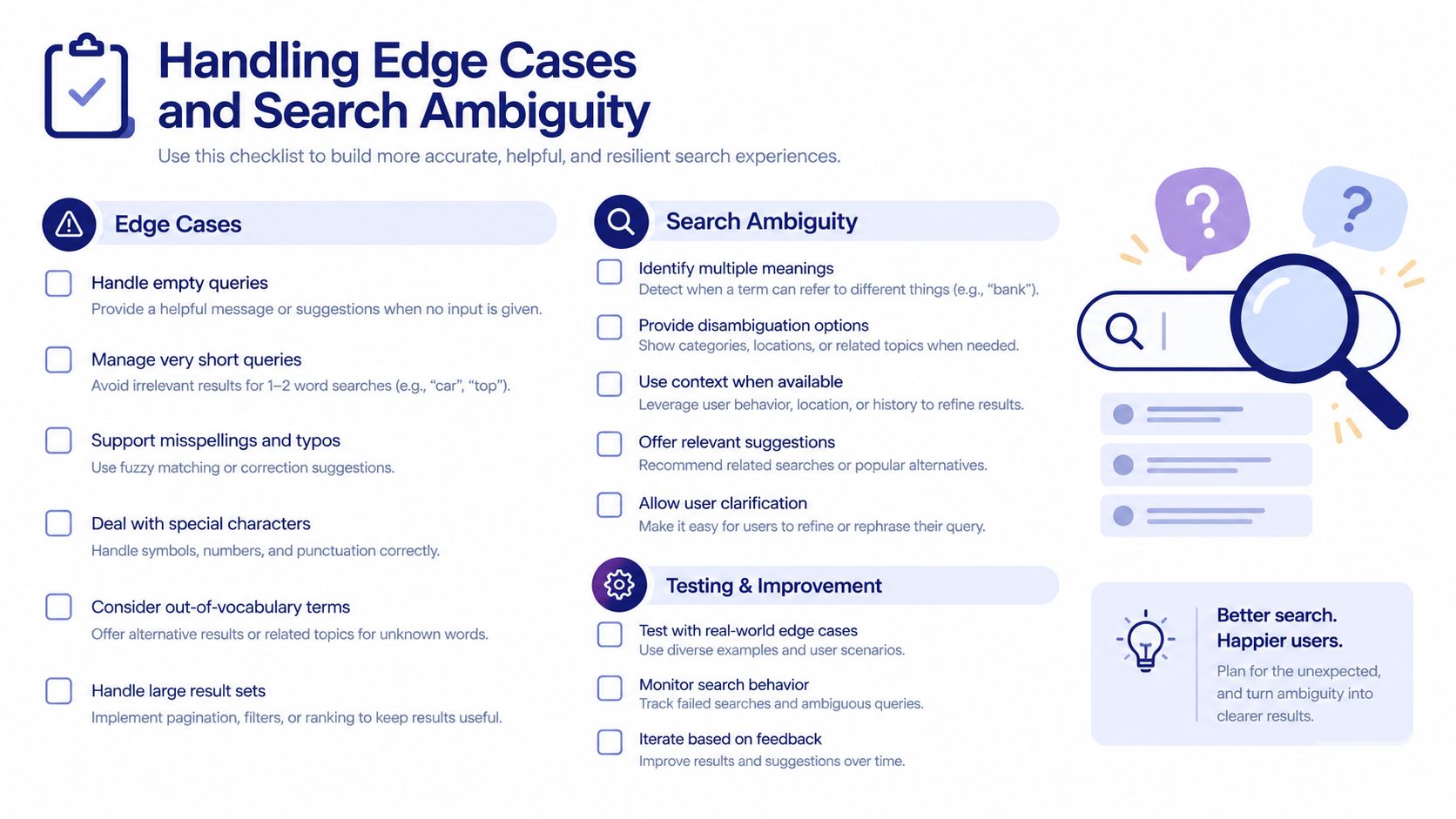
A good interface doesn't hide uncertainty behind a green checkmark. It explains why the result is uncertain and tells the user what action will resolve it. That requires a result model designed around ambiguity rather than around a binary availability field.
Suppose a search returns “Northstar Labs” as a similar record for “North Star Lab.” The user needs to know whether the match is based on normalized punctuation, a phonetic comparison, an entity-type rule, or a source-provided similar-name warning. Without that explanation, users either abandon a potentially viable name or file a name the state later rejects.
Replace red and green with decision context
Use a layered result card rather than a single status badge. The top line can provide a concise recommendation, while the supporting rows show the evidence.
For example:
Review recommended
- Registry match: A similar active entity appears in the target state.
- Comparison basis: Punctuation and spacing were normalized before matching.
- Entity context: The result was evaluated against the selected entity type.
- Next action: Review the filing record and run trademark and web searches.
This approach gives users a path forward. It also reduces support tickets because the product explains why a seemingly unused name still requires attention.
Treat inactive records carefully
An administratively dissolved record may still affect reuse. A revoked or inactive entity can remain within a state's holding period, and the rules can differ depending on how the entity ended. The frontend should therefore avoid language such as “inactive means free.” Show the status, the last available filing context, and a warning that the state may still block the name.
Trade names and trademarks deserve their own labels. They shouldn't be merged into entity results, because the user may interpret an excluded record as evidence of legal clearance. A separate result category can say that the record wasn't part of the entity-name determination but may still matter to brand adoption.
Design for ambiguity in the API
Search ambiguity should be machine-readable. Include a confidence or match classification only if the service can explain how it was produced. Otherwise, use explicit reason codes and matched fields.
The response can include:
- Matched tokens: Words or normalized components that overlap.
- Variant type: Exact, punctuation, spacing, phonetic, abbreviation, or partial.
- Source behavior: Whether the state returned the match or the service generated it.
- Status interpretation: Active, dissolved, revoked, pending, or unknown.
- Action: File, investigate, revise, or retry.
A business entity search API should also distinguish a completed no-result search from an empty response caused by an upstream error. That distinction is essential for automated onboarding. If the system cannot prove that the registry search completed, it should pause the clearance workflow rather than approve the name by default.
Pending filings create another difficult boundary. A name may not appear in an index immediately after submission, and two customers can search before the underlying registry reflects the latest event. Your workflow should timestamp the result, warn that availability is not permanent, and provide a reservation or filing handoff where the jurisdiction supports it.
UI principle: Explain the uncertainty that changes the user's next action. Don't expose every internal diagnostic, but never conceal the reason a result needs review.
Moving Beyond Formation to Ongoing Compliance Monitoring
The name check is the first useful event in an entity's lifecycle, not the last. After formation, the same record can change status, registered agent, principal address, officers, or filing history. A workflow that stores only the initial approval loses the context needed for later KYC reviews, underwriting, and compliance operations.
The monitoring model should begin with the entity identifier returned by the registry, not the business name alone. Names can be similar across entities and can change through amendments, while an authoritative identifier provides a more stable reference for subsequent retrieval.
Monitor the fields that affect risk
A practical monitoring subscription can watch:
- Entity status: Detect inactive, dissolved, revoked, or other status changes.
- Registered agent: Identify changes that may affect service-of-process or control records.
- Principal address: Surface jurisdiction or operational changes.
- Officers and principals: Reconcile changes against customer records where supported.
- Filing history: Track annual reports, amendments, reinstatements, and other documents.
- Source freshness: Record the last successful check and any unresolved retrieval failure.
Webhooks are useful when downstream systems need prompt action. A compliance platform can receive a change notification, retrieve the updated record, compare it with the stored version, and open a review task. A scheduled polling job remains appropriate for teams that prefer controlled batch reconciliation or whose internal systems don't accept inbound events.
Preserve evidence, not just alerts
An alert without the before-and-after values creates another manual investigation. Store the prior record, new record, source timestamp, request identifier, and document references when available. Filing-history links can help an analyst confirm whether a status change came from an amendment, reinstatement, dissolution, or another filing.
This evidence also improves the original name-clearance workflow. If a customer returns months later with a rejected filing, the team can inspect the exact search input, jurisdiction, matched records, and decision state that informed the recommendation. That audit trail is more useful than a screenshot of a search page.
Build the lifecycle into the product model
Product teams should treat clearance, formation, verification, and monitoring as connected states:
- Candidate: The user has proposed a name.
- Registry screened: The target jurisdiction has been searched.
- Cross-layer reviewed: Trademark, domain, and common-law checks are recorded.
- Filed: Formation documents have been submitted.
- Verified: The resulting entity record matches the customer's declared information.
- Monitored: Changes are evaluated against defined risk rules.
This model prevents a common operational gap. The onboarding team may approve a customer based on a current entity record, while a later status or address change remains invisible to the risk team. Monitoring closes that gap and turns a one-time business name availability lookup into an entity intelligence process.
SOSfinder provides a developer-focused API for searching and monitoring official state entity records, with normalized responses, filing-history retrieval, bulk verification, and webhook-based change notifications. If your product needs to replace fragile state-by-state integrations with a consistent registry workflow, visit SOSfinder to evaluate its entity search and monitoring capabilities.