Corporation Name Search: What It Is and How to Do It

You've picked a name you love. You've checked the domain, sketched a logo, and told a few friends. Then you run a quick state search, see no exact match, and assume you're clear to proceed.
That assumption is where many founders get stuck. A corporation name search isn't a simple yes or no lookup, and a clean result in one place doesn't mean the name is safe everywhere, for every purpose. Once you understand what the search tests, and what it leaves out, the process becomes much easier to follow.
Why a Corporation Name Search Matters
Consider a founder we'll call Maya. She searches her home state's registry for her proposed name, finds nothing identical, and files her formation documents. Weeks later, she learns a similar active company operates in a state where she plans to sell, and a separate business already uses a close version of the name as a trademark. Her filing succeeded. Her confidence didn't survive contact with the wider picture.
That gap is common because a corporation name search answers a narrower question than expected. It's a foundational step in formal business registration, used by registries to help determine whether a proposed name conflicts with an existing entity. The World Bank guidance on business registration and name searching describes name searching as either a separate procedure, mandatory or optional, or an information service provided by the registry.
What the search protects you from
Done early, a search helps you avoid spending money on formation paperwork, branding, signage, and bank accounts tied to a name you'll have to abandon. Rejection at filing is disruptive on its own. Discovering a conflict after you've launched is worse, because now customers, contracts, and invoices carry the wrong name.
A search also gives you a record to work from. Businesses are commonly assigned registration numbers during incorporation, and when those numbers function as unique identifiers, they can be used with government agencies, banks, and other businesses. Preserving both the searched name and that jurisdiction specific identifier makes later verification far easier.
Practical rule: Treat a clean registry result as permission to keep investigating, not as final approval to build a brand.
The moment of discovering a conflict late is stressful precisely because it feels avoidable in hindsight.

Why rules vary so much
Requirements vary substantially by jurisdiction. Some registries check only for an identical existing name, while others apply broader tests involving similarity, prohibited terms, or potential intellectual property conflicts. Many registries provide online name search, and jurisdictions requiring a separate name search procedure often don't charge a fee.
That variation is the reason a name can look available in one search and fail in another. You're not misunderstanding the tool. You're seeing different legal tests applied to different record sets. Understanding that distinction before you file saves time, money, and a painful rebrand.
What a Corporation Name Search Actually Checks
Think of a state registry like a city's address book. Checking whether an address exists in that book tells you something useful about that city. It tells you nothing about the next city over, and nothing about who owns the rights to use that name on a product label nationwide.
A corporation name search works the same way. It's a jurisdiction specific legal test, not merely a text match against a national database. State registries generally compare a proposed name against active entities, reserved names, and sometimes foreign entities authorized to transact business in that state.
The diagram below breaks that idea into its working parts.
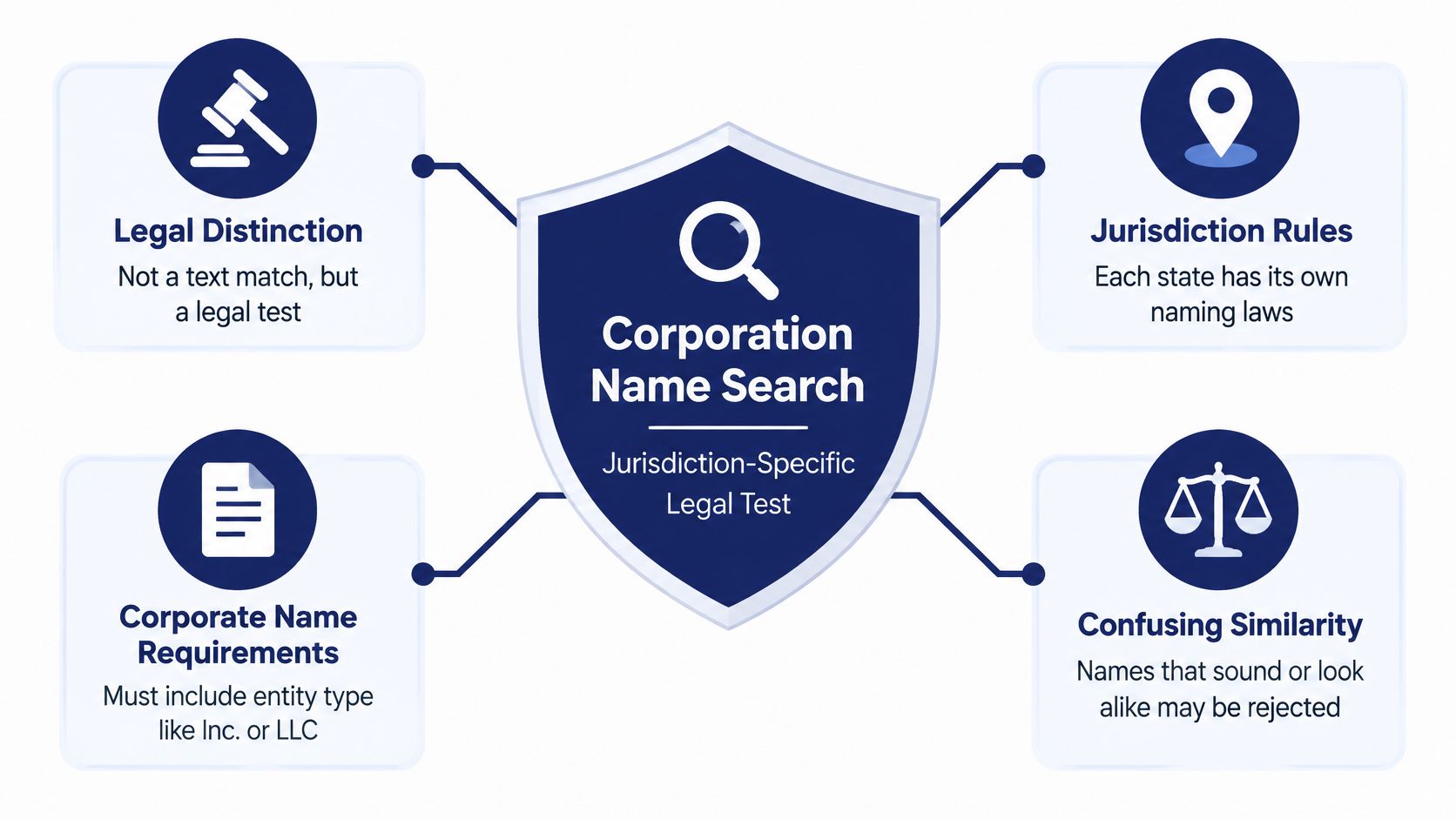
The records being compared
New York offers a clear example. Under the New York Department of State rules and regulations, proposed corporation, LLC, and limited partnership names must be distinguishable from existing and reserved names, and its rules evaluate differences in letters, numerals, key words, and word order. So the comparison isn't only about identical spelling. Word order and key words matter.
Texas applies a broader comparison set. It includes existing filing entities, registered foreign entities, fictitious names, registered LLC series, and name reservations. A name that clears a narrow comparison set can still collide with a fictitious name or a reservation in a state that checks those records.
- Active entities: Companies currently registered and in existence in that state.
- Reserved names: Names someone has claimed for future use, which can block you even though no company operates yet.
- Foreign entities: Businesses formed elsewhere but authorized to transact business in the state you're searching.
Why the result is always relative
Because the record set and the rule differ by state, a result only means something inside that jurisdiction. This is also why good search workflows preserve more than a binary answer. They keep the jurisdiction, entity type, lifecycle status, and the registry's original name so a human can judge the risk. If you're learning how these records fit together, this primer on business entity data and how registries structure it explains the underlying fields.
Near matches deserve your attention too. A name accepted under one state's record based standard can be rejected elsewhere or require consent. Treat close results as candidates for review, not as noise to ignore.
How State Rules Differ in Practice
If you search the same name in five states, you might get five different answers, and all five can be correct. Each state defines distinguishable in its own way, decides which records count, and decides which differences are too small to matter.
Kentucky illustrates the strict end of the spectrum. Its Kentucky business search guidelines state that capitalization and entity designator changes such as Corporation, Company, Inc., and LLC don't make otherwise identical names distinguishable. Swapping Inc. for LLC won't rescue a name that's otherwise the same.
Normalization is where states diverge
Search systems normalize names by stripping superficial variation so similar names surface together. Oregon disregards punctuation, spacing, capitalization, and entity type words, and in many cases articles, conjunctions, and pluralization. Kansas may treat singular and plural forms, or numerals and spelled out numbers, as distinguishable.
That is a material difference. A plural ending that Oregon ignores could be the very thing that separates two names in Kansas. A single universal normalization algorithm cannot capture both rules accurately.
Normalization improves discovery, but it can hide legal differences unless each match keeps its state specific context.
California adds another wrinkle. It limits comparison to like entity types, meaning a proposed corporation may be checked only against corporation names rather than every business identifier. A conflicting LLC with the same name might not appear in that comparison at all.
State Name Search Rules at a Glance
| State | What Is Ignored | What Is Compared | Notable Rule |
|---|---|---|---|
| Kentucky | Capitalization, entity designators like Inc. and LLC | Existing entity names | Designator changes don't create distinction |
| Oregon | Punctuation, spacing, articles, often pluralization | Active businesses | Final decision happens at filing |
| Kansas | Varies by rule | Existing entity names | Singular and plural may be distinguishable |
| New York | Minor letter and numeral differences may not suffice | Existing and reserved names | Key words and word order are evaluated |
| Texas | Narrow differences alone may not suffice | Filing entities, foreign entities, fictitious names, reservations | Unusually broad comparison set |
The practical lesson is simple. Preserve the raw name and a jurisdiction specific version of it, rather than collapsing every result into one conclusion. Exact matches carry the highest risk. Token order changes, phonetic similarity, and small spelling edits should be ranked as review candidates, not automatically rejected or approved.
How to Perform a Manual State Registry Search
A manual search is the right starting point if you're forming one entity in one state. It's free in many cases, it uses the authoritative source, and it teaches you how that registry behaves.
The flow below shows the sequence from choosing a registry to documenting what you found.
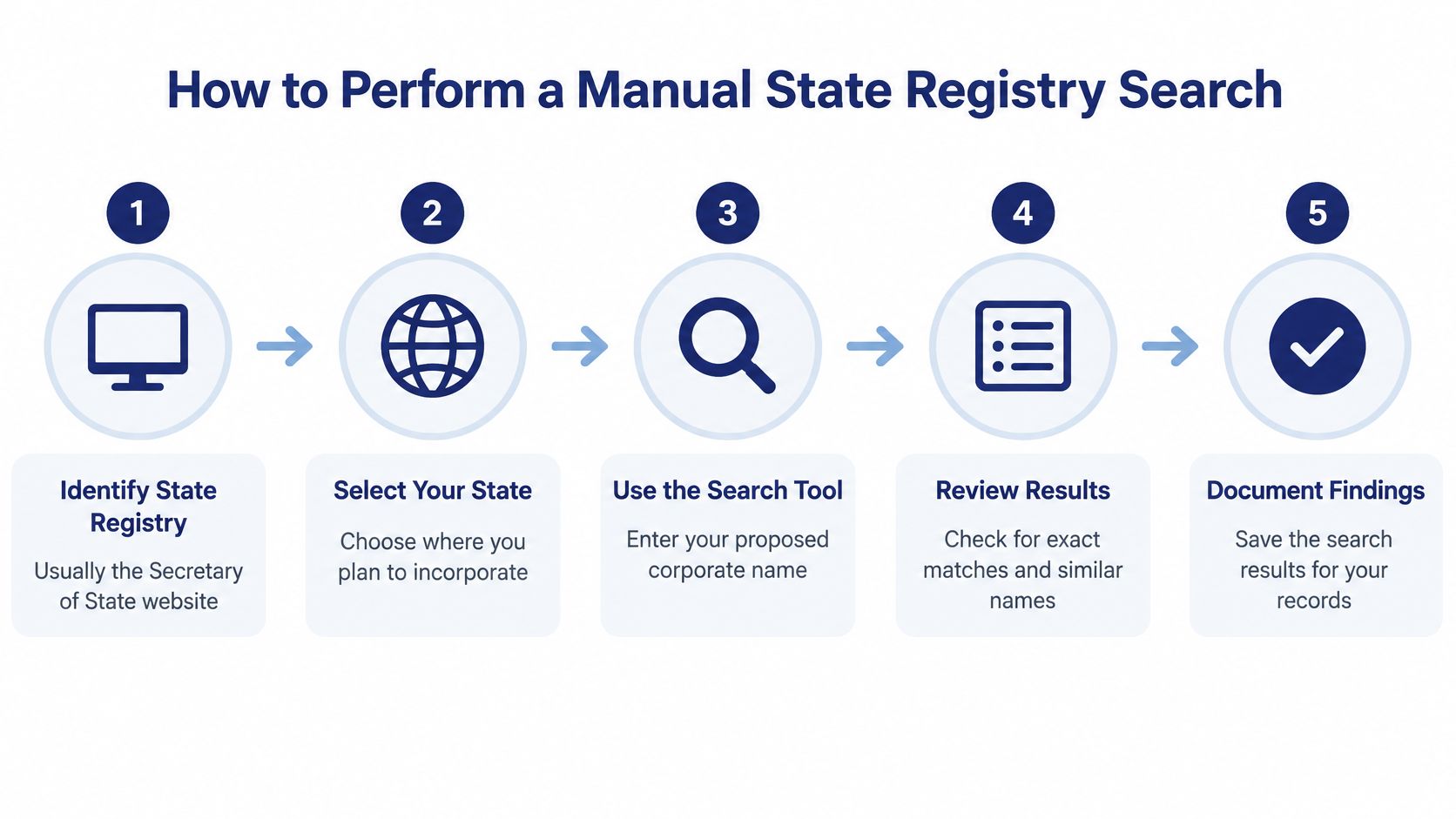
Running the search step by step
- Identify the correct registry: In most states that's the Secretary of State website. Look for a business entity search or name availability tool.
- Enter your proposed name without the designator: Search the distinctive portion first, since words like Inc. or LLC are often ignored. Then try variations in word order.
- Search likely variations: Try singular and plural forms, numerals and spelled out numbers, and common misspellings. You're hunting for near matches, not just identical ones.
- Open each promising result: Note the entity type, status, and whether the record is active, reserved, or a foreign entity authorized in that state.
- Document everything: Record the date, the registry, the exact terms you searched, and what came back. Screenshots or saved result pages help later.
For a state specific walkthrough, this guide to a Tennessee Secretary of State business entity search shows how one registry presents its records.
Reading results with appropriate caution
Don't treat a preliminary result as a promise. Oregon compares a proposed name with active businesses and makes the final decision at filing, and its Oregon name availability help page reflects that preliminary nature. Rhode Island says its preliminary search is nonbinding and separately evaluates corporate and local trade name databases, while New Jersey warns that exact spacing and punctuation can affect results.
That nonbinding quality isn't a flaw. Filing examiners apply the full rule set, and someone else may file a similar name between your search and your submission.
The short video below walks through a registry search so you can see the screens before you try your own.
If you find a close match, don't guess. Note why it concerns you, consider an alternate name, and ask the filing office or a qualified attorney before you invest further.
Why Registry Availability Is Not Legal Clearance
Here's the question founders ask most often, and it's a fair one. If the Secretary of State says my name is available, can I safely use it nationwide?
The answer is no. State registries generally determine availability only within their own entity records. They often exclude federal trademarks, service marks, fictitious names, and commercial use conflicts entirely.
What registries explicitly leave out
California says so directly. Its California guidance on name reservations and preliminary searches explains that a preliminary search doesn't check trademarks or fictitious business names. Colorado states that its availability search excludes trade names and trademarks. Virginia warns that an entity filing doesn't protect the name in commercial use because trademark filings are handled separately.
Those aren't fine print tricks. They're a description of what the tool was built to do. A registry manages entity records. Trademark rights live in a different system, with different owners and different rules.
The comparison below separates what a successful filing gives you from what it doesn't.
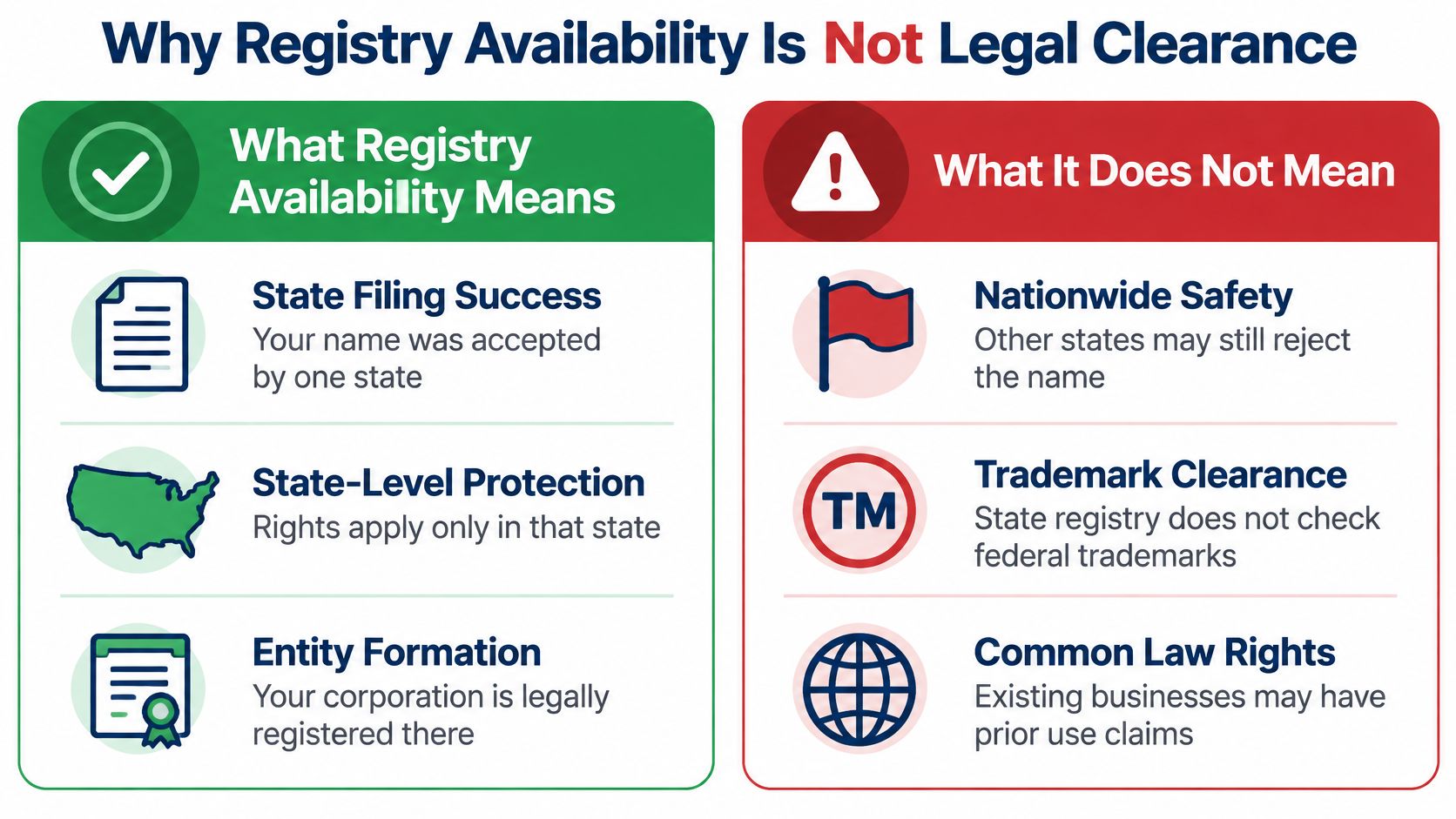
Four separate questions to answer
A reliable workflow keeps these layers distinct instead of merging them into one green checkmark.
- Legal entity availability: Can this name be registered as an entity in this state?
- State trade name conflicts: Is someone already operating under this or a similar name locally?
- Federal trademark conflicts: Does a prior trademark owner have rights that reach your goods or services?
- Operating state exposure: Where will you sell, hire, or advertise, and who is already there?
A successful state filing can increase risk by creating confidence in a name that remains vulnerable to a prior trademark owner.
This matters beyond formation. Lenders, marketplaces, and verification teams that onboard entities across jurisdictions face the same trap when they treat registration as proof of safe commercial use. If you're evaluating an existing company rather than naming a new one, this overview of how to see if a company is legitimate covers the complementary checks. Registry search is your initial screening layer, and it's a valuable one, as long as you don't ask it to do a trademark attorney's job.
Searching Across All States with an API
Manual searching works well for one formation. It breaks down when you're checking names in many states, qualifying a company to operate in new jurisdictions, or building onboarding and verification into a product. Fifty different registry interfaces mean fifty different search forms, result layouts, and quirks.
Registry digitization is what makes an alternative possible. Earlier World Bank research documented that, in a survey of 92 economies, 83 reported online name search functionality, while 68 reported exchanging data with other government agencies and 68 reported disseminating company information through a registry website, as described in the World Bank review of business registration systems. Structured, searchable registry data now underpins statistical reporting, due diligence, and automated incorporation.
Comparing the two approaches
| Dimension | Manual multi state searching | Consolidated API searching |
|---|---|---|
| Coverage | One registry at a time | Many jurisdictions through one endpoint |
| Consistency | Each site formats results differently | Normalized fields in a predictable structure |
| Audit trail | Screenshots and manual notes | Timestamped responses you can store |
| Scale | Practical for a handful of checks | Practical for portfolios and product workflows |
SOSfinder is one example of this approach. It aggregates business entity records from all 50 U.S. Secretary of State registries and the District of Columbia through a single REST endpoint, returning normalized details such as status, entity type, formation dates, registered agents, officers, and filing histories. It also supports best match selection for common name queries and built in retries when a registry temporarily blocks a request. Developers evaluating that model can review this explanation of a company data API for multi state entity records.
What to insist on from any API
Consolidation shouldn't mean flattening. A useful result preserves jurisdiction, entity type, status, and the registry's original name, rather than returning only available or unavailable. You also want similar filings included for human review, because near matches are where judgment matters most.
Real time retrieval layered over caching helps with speed, and bulk verification helps when you're checking a portfolio rather than a single name. Monitoring for status, agent, or address changes extends the value past formation, since a name and entity that checked out today can change later.
The decision rule is straightforward. Search manually when the question is narrow and one time. Use an API when the question repeats, spans states, or needs to live inside software your team relies on.
Key Takeaways for a Reliable Name Search
You've now got the pieces. Pulling them together, a corporation name search is best understood as a two stage workflow rather than a single lookup. First you retrieve candidates, meaning exact and near matches from the relevant registries. Then you interpret those candidates under each state's specific availability rules and confirm the outcome through the filing jurisdiction.
A checklist you can reuse
- Start with the filing state: Search the Secretary of State registry where you'll form, and search the distinctive part of the name.
- Hunt for near matches: Try word order changes, plurals, numerals, and common misspellings. Don't stop at identical results.
- Keep the context: Save the searched name, jurisdiction, entity identifier, status, date, and search terms for every result you rely on.
- Separate the legal questions: Entity availability, trade names, and federal trademarks are different checks with different answers.
- Expect preliminary results to shift: The final decision happens at filing, so hold branding spend until your name is accepted.
- Match the tool to the scope: Manual search suits a single formation. Multi state or automated work calls for an API that preserves jurisdiction specific detail.
Remember this: A registry result is evidence about one record set under one state's rules, and that's exactly what makes it useful.
If you keep that framing, the search stops feeling like a bureaucratic hurdle and starts working as it should. It's an early, inexpensive way to catch conflicts while changing your name is still easy. Whether you're forming one company or building a verification system that checks thousands, the same discipline applies. Retrieve carefully, interpret locally, and never mistake availability for clearance.
If you're checking names across multiple states or building name clearance into your product, SOSfinder gives you one REST endpoint for business entity records from all 50 Secretary of State registries and the District of Columbia, with normalized status, entity type, registered agent, and filing details for each result. Visit the site to try a search, explore the API playground, and see how a consolidated workflow handles the jurisdiction specific detail this guide describes.