IL Sec of State Search: A Practical Workflow for 2026

You've probably got a vendor, borrower, or new LLC sitting in review right now, and the question is the same one every ops team runs into first: does this entity really exist in Illinois, and does the record match what the counterparty sent? An il sec of state search is the fastest public-record check for that first pass, but it only works if you treat it as a registry signal, not a full decision.

The practical mistake is to start with the interface instead of the workflow. Illinois can confirm existence, status, registered agent, and filing history, but it won't tell you whether the company is solvent, licensed, litigating, or controlled by the people on the application. For that reason, the search belongs early in the pipeline, right after jurisdiction and legal name normalization, before you spend analyst time on deeper checks. Related KYC and due-diligence patterns fit best after that first registry pass.
Where an Illinois Entity Search Fits in a Real Workflow
A clean Illinois lookup usually shows up at the front door of onboarding. A fintech team gets a signed W-9, a procurement team gets a vendor packet, or a filing service gets a new name and needs to know whether that name is already taken in the state. The search is useful because it turns a handwritten or self-reported entity name into a state-backed record that can be compared against the rest of the packet.
That first comparison matters because public registry data is legally authoritative for existence and status, but it's not a full profile of the counterparty. Historical registry systems in Massachusetts and Colorado show why these records matter, they were built to establish corporate existence and preserve filing history over time, not to prove ownership or financial strength. The same logic still applies in Illinois, where the registry is one input among several.
Practical rule: if the registry row and the onboarding packet disagree on name, status, agent, or filing history, stop and reconcile before approval.
A good workflow also avoids asking the registry to answer questions it can't answer. Illinois can help confirm whether a legal entity exists and whether the state currently shows it as active or not, but ownership, tax compliance, litigation exposure, and licensing still need separate sources. That's why the search should feed a broader review, not replace it. Illinois LLC name search guidance is most useful when the goal is quick existence and naming validation, not final risk clearance.
Navigating the Illinois Business Search Portal
A clean onboarding packet still runs into messy registry data, so the Illinois portal needs to be treated as a controlled lookup step, not a final verdict. Business Search is the default path for existence checks, Name Availability is the formation path, Agent lookup helps when you only have a registered agent, and file-number lookup is the fastest route when the state identifier is already in hand. If the name is common or inconsistent, switching entry points usually saves time. For a formation-focused variant of this workflow, see Illinois LLC name search guidance.
The portal accepts more search inputs than many teams expect. You can search by business name, registered agent, president, secretary, manager, file number, keyword, or partial word. That flexibility helps when the packet is incomplete, but it also creates false positives, especially when an officer or agent name appears across unrelated entities.
I normalize punctuation and suffixes before I search, then check the result row against the legal name instead of the marketing name. LLC, Inc., and Corporation often show up in different forms across submitted documents, so the search term needs to match the registry format closely enough to find the record without losing the jurisdiction-specific wording that belongs in the legal name. The result row usually gives you the status, entity type, formation date, file number, and agent, which is enough for a first-pass match but not enough to prove ownership.
Capture the result URL and the timestamp of the lookup every time. If the record changes later, you'll want a reproducible snapshot of what the state showed at decision time.
Illinois also separates existence checks from name-availability reservations. A name can be available for formation even when no current entity record exists, and a business search result can confirm that a record is already on file without telling you whether that name can be reserved for a new filing. That distinction matters when formation teams want availability, while compliance teams need the existing record and its filing history.
Exact Match vs Partial Match vs File Number Lookups
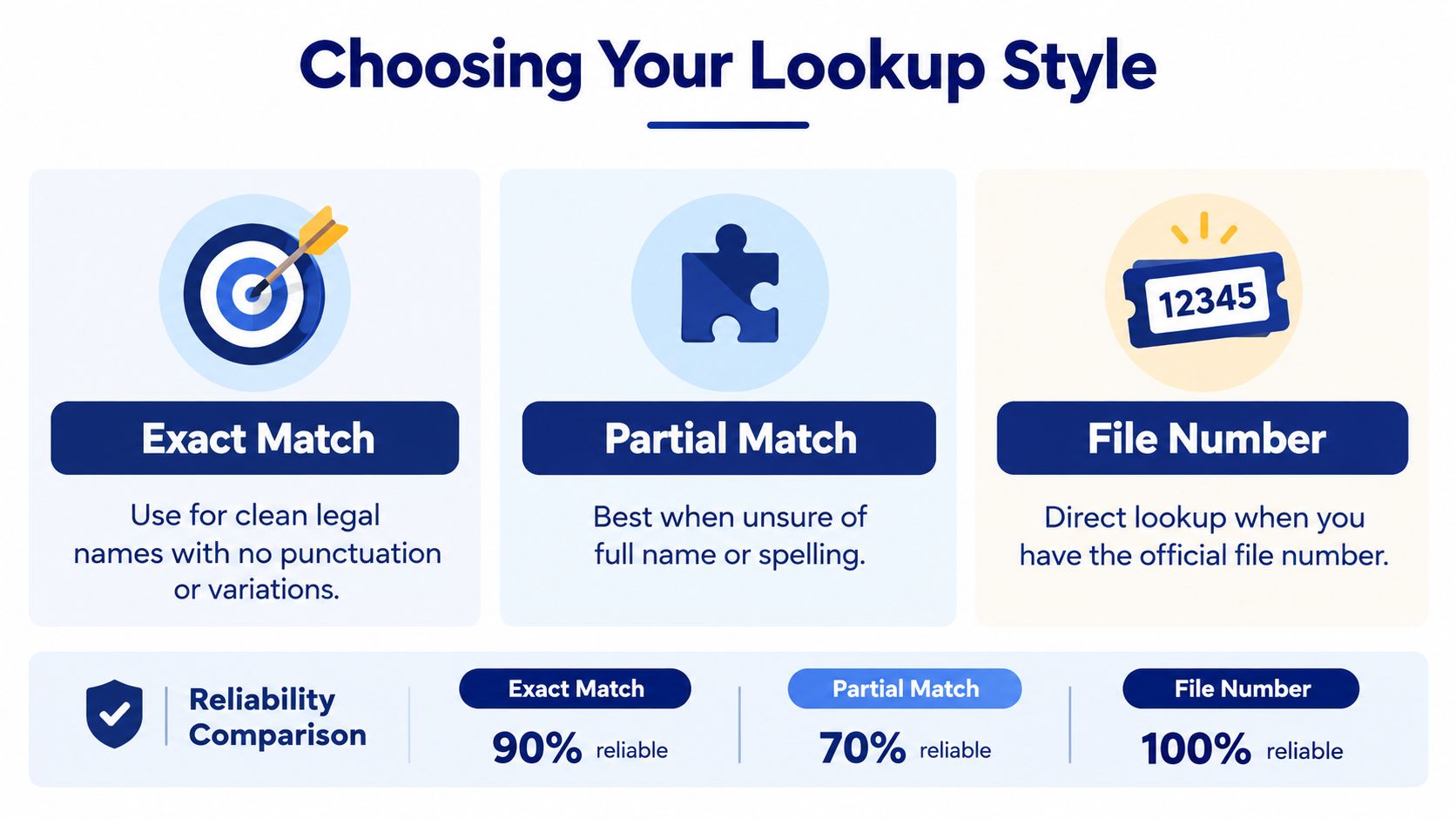
Pick the lookup style by risk, not habit
Exact name search is the right first move when the legal name is clean and the formation state is known. It works well when the packet uses the registered name, the suffix is consistent, and you don't need to guess at punctuation or abbreviations. If you already have the state file number, use that instead, because the state identifier removes most ambiguity.
Partial name or keyword search is better when the input is imperfect. Typographical errors, abbreviated names, and older trade-name references can hide the correct record from an exact search, so a looser query helps surface candidates for review. The trade-off is obvious, more candidate rows mean more manual reconciliation, and more room for common-name collisions.
Registered-agent and officer searches are situational. They can help when you're tracing a holding structure, but they're also a trap if you treat them like identity proof, because one person can appear across many unrelated entities. In production, those lookups belong in the review queue, not in auto-approval logic.
A file-number match is the only lookup style that should feel safe enough for straight-through processing. Even then, the downstream system should still confirm that the entity number, legal name, and status align with the rest of the packet before it finalizes the record. Entity search implementation guidance is most useful when you're building those controls into software rather than into a manual checklist.
Decision rule: if you have the file number, start there. If you don't, search exact legal name in the formation state, then escalate partial and officer matches to human review.
Reading the Result Row and Filing History Differently
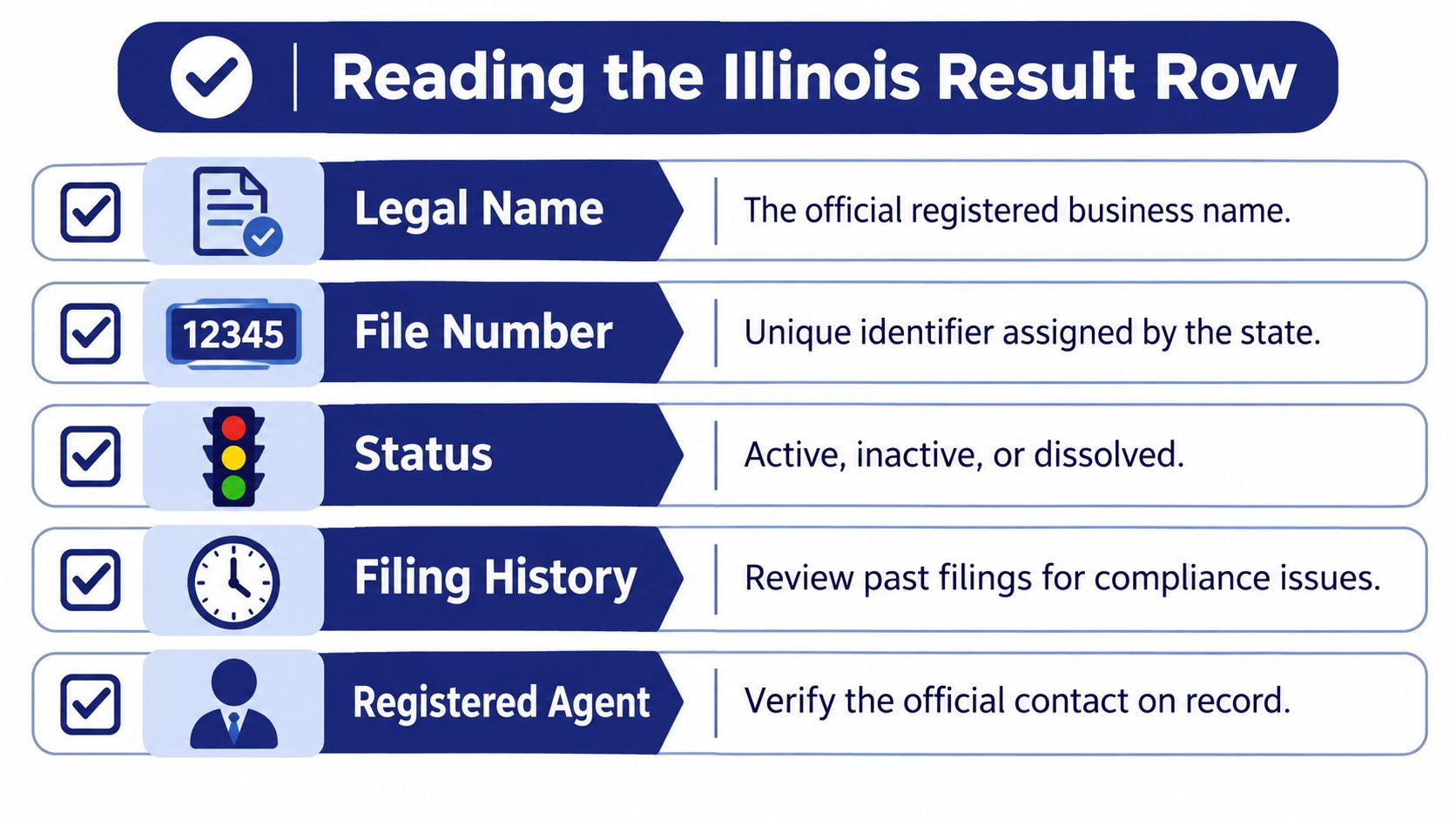
Read each field as evidence, not as proof of everything
The result row is a compact summary, and it's easy to overread it. Legal name tells you what the registry recognizes, file number gives you the state identifier, status tells you how the entity is standing in the registry, and formation date gives you the historical anchor. The registered agent and principal address are useful contact and routing fields, but they don't prove operational control or current occupancy.
Annual-report markers need more caution than teams typically give them. A filed annual report shows activity in the registry, but a marker without a recent filing date is a signal to investigate, not a clean bill of health. The same goes for agent changes, because a change between filings can reflect a legitimate update, a transfer of control, or an attempted impersonation.
Illinois filing history is especially useful when you compare the latest filing against the previous one. That comparison can surface status transitions, address changes, or amendments that don't show up in a static snapshot. If the state record and your onboarding data diverge, don't guess which one is right.
A fast reconciliation checklist usually looks like this:
- Validate the file number first. If it doesn't line up, stop.
- Compare legal name exactly. Don't assume a close spelling is enough.
- Review status and formation date together. A current-looking name with an inactive status is a red flag.
- Check filing history for changes. Agent and address edits deserve attention.
- Store the source snapshot. Analysts need to reproduce the review later.
Business entity data patterns become much easier to operationalize when the row is treated this way, as a set of clues that need corroboration rather than a final answer.
Plugging Illinois into a Multi-State Entity API Pipeline
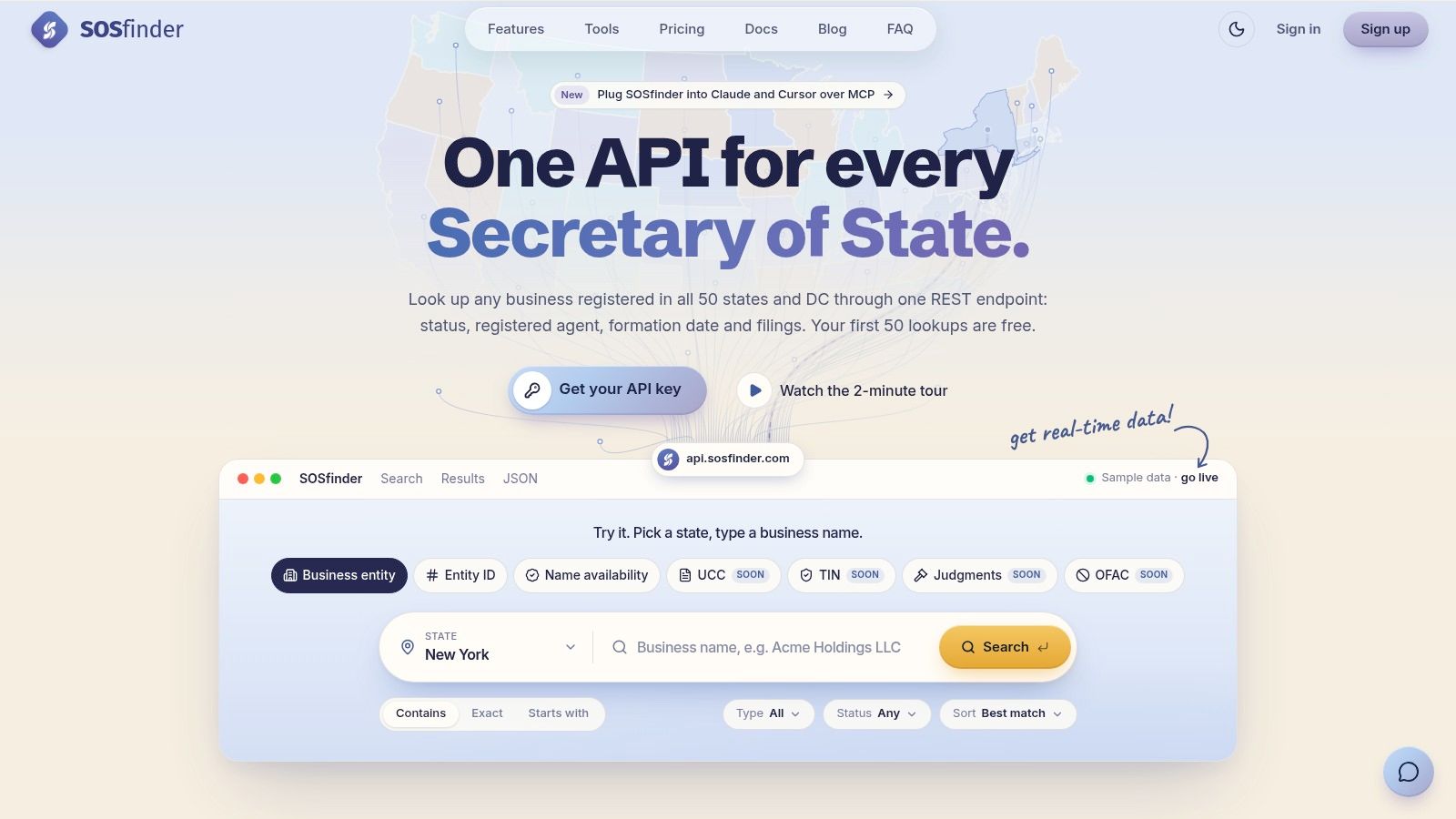
A single-state portal breaks down fast once you are onboarding across several jurisdictions. The practical pattern is to put Illinois inside a shared entity pipeline where jurisdiction is one parameter and the output shape stays consistent from state to state. SOSfinder exposes 50 states plus DC through one consistent schema where jurisdiction is a parameter, with real-time lookups backed by caching, so Illinois behaves like every other state in the stack.
The engineering move that matters most is staged matching. Start with jurisdiction partitioning when the formation state is known, then generate candidates from exact legal name, normalized-token similarity, former names, and entity ID. After that, score the candidates with weighted fields such as identifier equality, jurisdiction match, status, address similarity, registered-agent overlap, and filing-date consistency.
Query the Registry, Then Verify Independently
Here is the shape that tends to work in production:
- Submit the strongest identifier first. Entity ID wins over name when you have it.
- Fall back to normalized legal name. Strip punctuation, standardize suffixes, and keep jurisdiction terms intact.
- Pull the raw state payload. Do not flatten everything before you have logged the source.
- Compare against prior filings. Status, agent, and address changes often matter more than the first hit.
- Route near matches to analysts. Similar names can belong to unrelated entities, affiliates, or successor organizations.
The main control is to require corroboration before merging records across state systems. A name that looks right in Illinois can still belong to a different entity elsewhere, so an entity number match or multiple independent fields should be the threshold for automation. Monitoring should also be event-driven, because public records can change, and exposed filings can be abused for fraudulent updates or impersonation.
Store both the normalized result and the source document reference. That keeps the decision auditable and makes it easier to separate stale cache data from a live registry response.
Why an Active Status Is Not the Same as Verified Identity
An Illinois record can be active and still leave major risk unanswered. Active status tells you the registry currently recognizes the entity, but it does not verify beneficial ownership, operating activity, solvency, licensing, litigation exposure, or whether the address still works in practice. That gap matters in KYC, procurement, and lending, where a clean registry row can still hide a weak counterparty.
FinCEN's Customer Due Diligence Rule makes that gap concrete. Covered institutions must identify and verify individuals who own 25% or more of a legal entity and one controlling individual, per FinCEN's beneficial ownership rule, so the state registry cannot be the final word on identity.
The layered workflow is straightforward. Use the Illinois search to confirm existence and standing, then pair it with sanctions screening, license checks, and independent identity evidence. After onboarding, keep watching for status, agent, and address changes so the record does not drift away from reality.
Ship-Ready Checklist and Common Pitfalls
A production-ready Illinois lookup should always capture jurisdiction, query type, and timestamp before it makes a decision. It should also keep live results separate from cached responses, because analysts need to know whether they're looking at a fresh registry pull or an earlier snapshot. Close matches should never auto-approve, especially when the search came from an officer, agent, or partial-name query.
The common failures are predictable. Teams merge across states on name alone, treat active status as proof of identity, ignore filing-history gaps, or trust a common officer name as a unique match. The controls are just as predictable, file-number equality when available, corroborating-field checks when it isn't, and manual review for anything that looks close but not exact.
SOSfinder gives product and compliance teams a single way to query Secretary of State records across jurisdictions without stitching together separate state workflows. If you're building an Illinois entity check into onboarding, monitoring, or due diligence, visit SOSfinder and see how the same pipeline can handle exact matches, fallbacks, and review routing in one place.