CDD and KYC Workflows for Entity Verification

Your onboarding team approved a company after confirming its legal name, registration record, and current status. A few months later, the registered agent changes, an officer disappears from the latest filing, and the entity's status no longer matches the snapshot stored in your customer profile. Nothing in the original checklist tells you whether to approve, pause, or re-verify the relationship.
That's the operational gap between a CDD and KYC program that works at signup and one that remains defensible throughout the customer lifecycle. Entity records change asynchronously across state registries, filing formats differ, and a clean result on one date doesn't prove that the customer's ownership, control, or expected activity still looks the same later.
Defining the Boundary Between Identity and Risk
KYC and CDD are often treated as interchangeable terms. They aren't. KYC is commonly the identity-verification component, while customer due diligence is the wider risk-control framework used to identify a customer, understand the purpose and expected nature of the relationship, assess risk, and monitor the relationship over time. The distinction matters because an identity match answers only one question: does the person or entity appear to be who it claims to be?
CDD asks harder questions. Why does this customer need the product? What activity should the business expect? Who owns or controls the entity? What changes would make the original risk assessment unreliable? The UN Office on Drugs and Crime overview of money laundering estimates that money laundering represents approximately 2%–5% of global gross domestic product each year, or roughly $800 billion–$2 trillion in current U.S. dollars. UNODC also cautions that this isn't a precise measurement because laundering is concealed and internationally comparable data is limited.
Identity evidence is an input, not a verdict
For an individual, KYC may involve identity documents, database evidence, address information, and sanctions screening. For a legal entity, baseline identity evidence includes the registered name, jurisdiction, entity type, formation date, current status, principal address, registered agent, officers, and filing history. These records establish corporate existence and provide useful signals about control, but they don't automatically establish the complete ownership chain or explain the customer's intended activity.
That's why a business verification flow should pass KYC outputs into a broader customer profile rather than mark the customer permanently approved. A successful lookup can support a low-risk path, but a mismatch in an officer record, an unexpected address, or an unexplained amendment should change the decision path.
Practical rule: Treat identity verification as evidence collection. Treat CDD as the decision system that interprets the evidence over time.
Teams designing business onboarding should also keep the business and individual concepts separate. A company can be active in a registry while the natural persons behind it remain unclear, and an individual can pass identity verification while the company's expected activity remains unexplained. The distinction is explored in this guide to KYB versus KYC, where entity verification and customer verification meet without becoming the same control.
How Regulatory Frameworks Shaped Modern Data Requirements
A company can pass onboarding on Monday and show different facts by Friday. Its registered agent may change, an officer may resign, or a filing may amend the entity record. Across fifty state jurisdictions, those updates arrive on different schedules and through different systems. Modern KYC requirements therefore shape an operational data problem, not just an intake checklist.
In the United States, a major milestone came in 2003, when FinCEN finalized Customer Identification Program requirements implementing Section 326 of the USA PATRIOT Act. The final rule was published on May 9, 2003, became effective on June 9, 2003, and required covered banks to comply by October 1, 2003, according to the FinCEN Customer Identification Program notice.
The rule required each bank to maintain a written, board-approved CIP within its Bank Secrecy Act and AML program. That turned regulatory intent into system requirements: defined fields, verification methods, discrepancy handling, approval logic, and reviewable records. A spreadsheet with a final “verified” label cannot show which evidence supported that decision or whether the underlying record later changed.
Design the record before designing the screen
For an individual customer, preserve the submitted information, evidence used, verification result, check time, and reviewer or system decision. A business customer needs separate layers because the entity record, its related people, and its expected activity can change independently.
A durable customer record should separate:
- Submitted data: Information supplied by the applicant, including names, addresses, ownership declarations, and intended use.
- Registry evidence: Normalized values retrieved from official corporate records, including status, formation details, registered agent, officers, and filings.
- Decision data: Risk tier, approval state, exception reason, escalation path, and reviewer notes.
- Historical state: Prior values, timestamps, source documents, and the event that caused a record to change.
This separation matters when state registries update asynchronously. Store the source jurisdiction and retrieval timestamp with each observation. A later registry response should become a new evidence event, not silently overwrite the value used at approval.
FinCEN's CIP framework generally required banks to collect a customer's name, address, identification number, and, for individuals, date of birth. It also required risk-based verification procedures, documentation of information and verification results, resolution of substantive discrepancies, and a response when the institution could not form a reasonable belief that it knew the customer's true identity. Records generally had to be retained for five years after an account was closed under the 2003 CIP rule.
Make auditability a native property
Retention should exist in the workflow from the start. Store immutable verification events rather than overwriting a customer row. Each event should identify the source, retrieval time, normalized value, raw document reference where available, comparison result, and resulting workflow action.
A reviewer should be able to answer practical questions without reconstructing history from email threads: What did the registry show when the account was approved? Which declaration supported the decision? Who resolved the discrepancy? What changed afterward? A status field saying “complete” cannot answer them.
Mapping Entity Data to Beneficial Ownership Rules
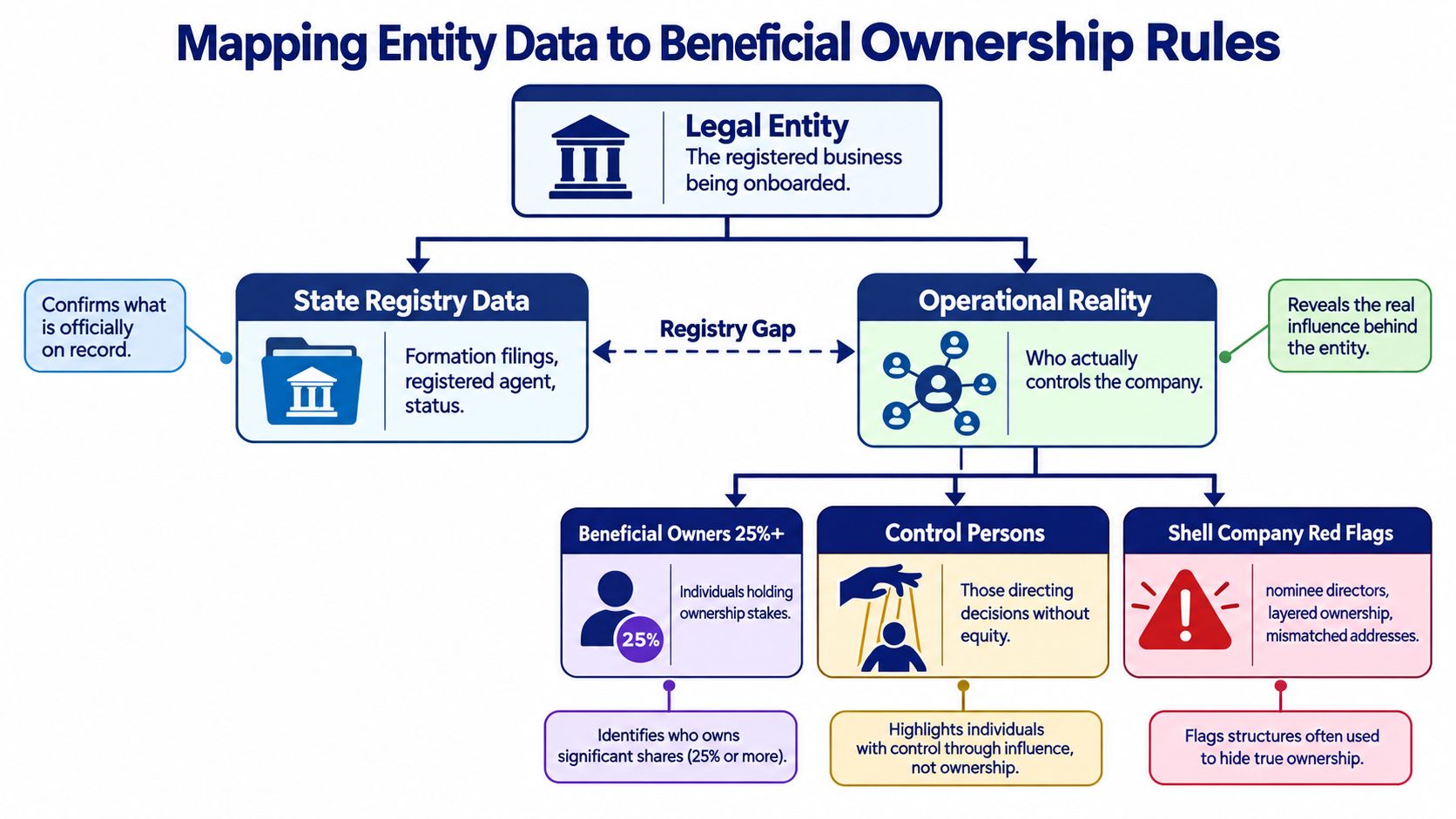
A legal entity record proves that a business exists in a registry. It doesn't necessarily reveal every natural person who owns or controls it. That distinction causes many business KYC failures because teams accept formation data, officer names, or registered-agent information as if those fields were a complete beneficial-ownership record.
The FinCEN CDD final rule requires covered financial institutions to identify and verify the legal-entity customer and its beneficial owners, understand the nature and purpose of the relationship, construct a customer risk profile, and update customer information through ongoing, risk-based monitoring.
Apply both beneficial-owner tests
FinCEN's framework uses two independent tests. The ownership prong covers every natural person who directly or indirectly owns 25% or more of the entity. The control prong covers at least one individual with significant responsibility to control, manage, or direct the entity. Passing one test doesn't eliminate the other.
Your data model should therefore represent ownership as a graph, not a flat list. Preserve each person's direct ownership, indirect ownership path, percentage, intermediary entity, verification method, verification timestamp, and supporting document. Separately record the designated control person, the basis for control, and the evidence used to verify that role.
A practical entity profile might contain:
| Data layer | What to preserve | Why it matters |
|---|---|---|
| Entity identity | Legal name, entity type, status, formation data, identifiers | Establishes the business being onboarded |
| Registry structure | Registered agent, principal address, officers, filings | Shows what the relevant registry currently reports |
| Ownership | Direct and indirect ownership percentages, paths, attestations | Supports the ownership-prong analysis |
| Control | Control person, role, authority, verification evidence | Captures control independent of equity |
| Change history | Previous values, filing dates, source documents, decisions | Makes re-KYC and audit review explainable |
Reconcile rather than blindly trust
State registries are valuable evidence, but they may not contain the complete natural-person ownership chain. Compare registry information with customer-provided beneficial-owner attestations and corporate documents. A mismatch shouldn't automatically mean rejection, and it shouldn't pass unnoticed either.
For example, an entity can remain active while its officer list changes, its registered agent is replaced, or an amendment introduces a new controlling person. Route those cases to an exception workflow that identifies the affected field, requests targeted evidence, reruns relevant screening, and records the final rationale. A structured business entity data model proves more useful than a collection of unconnected search results in these instances.
Building a Risk-Based Verification Architecture
Applying the strongest possible check to every applicant sounds cautious, but it often produces avoidable friction and a review queue that obscures genuinely difficult cases. A defensible architecture uses baseline verification for ordinary cases and reserves enhanced controls for signals that justify them.
FATF Recommendation 10 requires institutions to identify and take reasonable measures to verify beneficial owners, understand a legal person's ownership and control structure, and apply controls proportionately to risk. The FATF Recommendation 10 guidance supports a risk-based approach rather than a uniform process for every relationship.
Separate the baseline path from escalation
A low-complexity entity with consistent name, status, formation data, address, officers, and customer declarations can usually enter a baseline workflow. The system should still capture evidence and run required screening, but it needn't force the same manual process used for an opaque structure.
A higher-risk path should activate when the evidence creates uncertainty or the relationship carries greater exposure. Relevant triggers can include:
- Opaque ownership: The customer can't provide a clear chain from the entity to natural persons.
- Structural inconsistency: Registry officers, addresses, formation data, or filings conflict with submitted information.
- Unusual jurisdictional exposure: The entity's structure or activity creates a risk that warrants deeper review.
- Rapid changes: Status, registered agent, address, officers, or filings change soon after onboarding.
- Unexplained activity: The intended purpose or expected use doesn't align with the information supplied.
Enhanced due diligence can then request deeper beneficial-owner verification, additional corporate documents, and information about the source and use of funds where relevant. FinCEN states that heightened-risk accounts may require this type of deeper review. The system should record not just that EDD occurred, but why it was triggered and which risk hypothesis the reviewer tested.
Keep decision logic explainable
Avoid a single opaque score that sends cases into unexplained outcomes. Store the signals that contributed to the tier, the rule version used, the evidence considered, and the human override if one occurred. This makes the workflow easier to tune and gives compliance teams a defensible explanation when a customer challenges a delay.
A useful design principle is to automate evidence collection and deterministic comparisons, while keeping judgment-heavy decisions visible to trained reviewers. Automation should reduce repetitive work, not conceal the reasoning behind an approval.
Managing Compliance Drift Across Fifty Jurisdictions
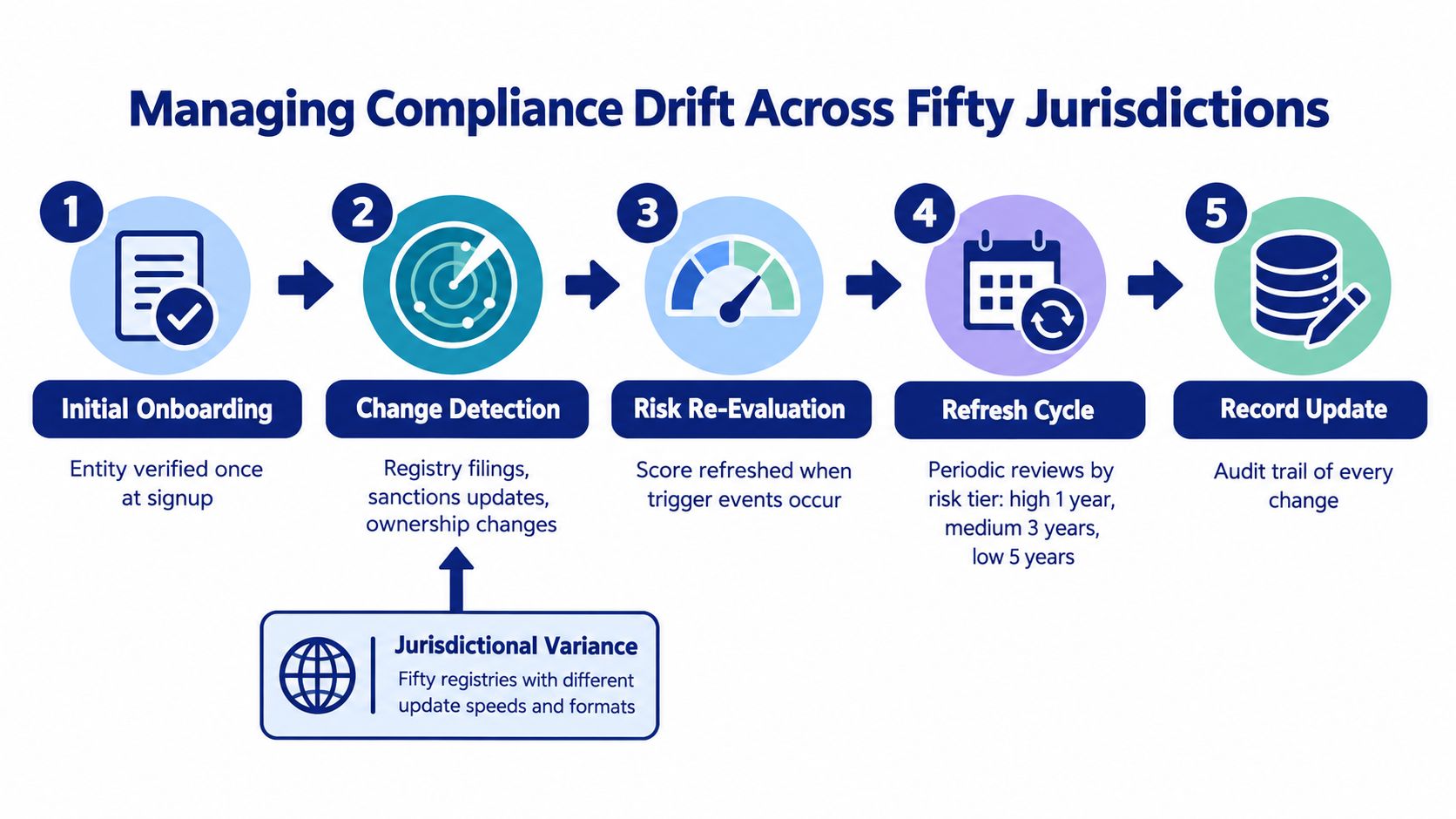
The first verification is a snapshot, not a permanent truth. Across 50 U.S. state registries and the District of Columbia, entity records can update on different schedules and expose different filing details. A customer may be reviewed in one jurisdiction while a meaningful change is still waiting to appear, being processed, or represented through a filing format your system handles differently.
The FATF recommendations state that CDD information should remain up to date and relevant, with particular attention to higher-risk customers. That doesn't mean checking everything indiscriminately. It means defining which changes invalidate assumptions and what the team does next.
Monitor events, not just calendar dates
Blanket periodic refreshes are easy to explain and often poor at finding the change that matters. They can generate repetitive alerts for stable customers while missing a material filing event between scheduled reviews. A better model combines risk-tiered reviews with event-driven triggers.
Treat these changes as candidates for re-verification:
- Status movement: An inactive, dissolved, revoked, or otherwise changed status may affect whether the customer can legitimately operate.
- Registered-agent replacement: The change may be routine, but it can also accompany a broader structural update.
- Principal-address move: Compare the old and new address, related entities, and customer-provided information.
- Officer change: Determine whether the change affects the recorded control person or beneficial-owner analysis.
- Merger or amendment: Review whether the filing changes ownership, authority, legal identity, or expected activity.
- Annual-report update: Compare the new filing with the prior normalized record rather than treating it as a fresh, isolated document.
Operational insight: More alerts don't create better compliance unless someone can classify, investigate, and close them.
Preserve the before-and-after state
When a trigger fires, retain the previous normalized record, the new value, the filing or source document, and the timestamp of detection. Then calculate the difference at the field level. “Address changed” is less useful than showing the prior address, current address, filing reference, affected officers, and customer response.
The right response depends on materiality. A routine registered-agent update may require documentation and continued monitoring. A changed control person should typically prompt renewed beneficial-owner verification and relevant sanctions or PEP screening. The workflow should support targeted re-KYC rather than forcing the team to reprocess every customer field each time one attribute changes.
Integrating Multi-State Registry APIs into Your Pipeline
Engineering teams usually don't want to maintain separate integrations for every state registry. Interfaces, response formats, access behavior, filing terminology, and temporary availability can differ, so a direct integration strategy creates a permanent maintenance surface before the compliance workflow itself is even complete.
A unified API layer should sit between registry sources and your onboarding system. Your application sends a jurisdiction parameter and search input to one endpoint, receives a normalized response, and stores both the normalized fields and source references needed for review.
Build the integration around evidence
Start with a canonical entity schema. Include legal name, entity type, jurisdiction, status, formation or registration date, identifiers, registered agent, principal address, officers, filing history, retrieval time, and source-document references. Keep raw source payloads or durable document links where permitted, because normalization makes data usable but can hide the original representation.
The pipeline should then perform four distinct operations:
- Resolve the entity: Match the customer's submitted information against registry results and retain similar filings when the match isn't conclusive.
- Compare fields: Identify differences in status, addresses, agents, officers, identifiers, and dates.
- Classify the event: Decide whether the difference is informational, requires documentation, or should open a compliance case.
- Publish the decision: Send a structured result to onboarding, case management, audit storage, and downstream screening services.
The SOSfinder KYB API is one example of a unified registry approach. SOSfinder aggregates official business-entity records from all 50 U.S. states and the District of Columbia through a normalized API, with capabilities including entity search, filing-history access, bulk verification, monitoring, and webhooks. It can provide registry evidence for the business-verification layer, but it doesn't replace beneficial-owner attestations, sanctions screening, transaction monitoring, or risk-based review.
Make failures visible
Registry calls fail for ordinary technical reasons. Your integration needs retries for temporary source issues, explicit error states, idempotent processing, and a queue for cases that couldn't be resolved. Don't turn “source unavailable” into “entity not found,” and don't turn “no change detected” into “verified forever.”
Webhooks can notify downstream systems when monitored fields change. Use them to open or update a case, not to auto-reject a customer. A change event should carry the entity identifier, affected field, previous value, new value, source reference, detection time, and workflow status.
For testing, use an API playground or mocked registry responses to exercise name mismatches, duplicate candidates, status changes, missing fields, delayed source responses, and amended filings. Engineers can then validate the full decision path before connecting the integration to live onboarding.
Moving From Static Checks to Dynamic Monitoring
A resilient program changes the unit of compliance from a completed checklist to a maintained customer record. KYC verifies identity evidence, CDD interprets the relationship and risk, and monitoring tests whether the original assumptions still hold.
The transition usually requires four practical changes:
- Automate registry monitoring: Detect changes in status, registered agent, address, officers, and filings across supported sources.
- Tier the refresh cadence: Match review frequency to customer risk rather than applying one calendar rule to everyone.
- Centralize the audit trail: Log submitted data, source evidence, comparisons, decisions, overrides, and historical snapshots.
- Alert on ownership shifts: Route possible control changes to beneficial-owner verification and relevant screening.
Track operational measures that explain whether the workflow works, such as unresolved alerts, time to triage, exception aging, false-positive patterns, evidence completeness, and the proportion of changes that receive a documented disposition. These aren't substitutes for compliance judgment. They show where the process is losing information or overwhelming reviewers.
A spreadsheet can support a small review exercise, but it becomes fragile when records change asynchronously and several teams need the same history. Teams evaluating compliance monitoring software should look for event handling, historical comparisons, configurable escalation, source-document access, and integrations that fit the existing case-management system.
The final test is simple. Can your team explain who the customer was, what evidence supported approval, what changed afterward, and why the response was proportionate? If the answer depends on searching inboxes or trusting an overwritten status field, the workflow needs a stronger data foundation.
SOSfinder provides a unified API for official business-entity records across all 50 U.S. states and the District of Columbia, including normalized status, formation details, registered agents, officers, addresses, and filing histories. Use its search, bulk verification, monitoring, and webhook capabilities to connect entity changes to your CDD and KYC review process, then visit SOSfinder to evaluate the integration for your onboarding pipeline.