Missouri Secretary of State Entity Search Guide

You're mid-onboarding when a Missouri vendor hands you a legal name that almost matches the contract, the invoice, and the account application. One record shows an active corporation, another shows a dissolved entity with a nearly identical name. Your team doesn't need a casual lookup. You need a repeatable Missouri Secretary of State entity search workflow that tells you which record is real, which fields you can trust, and what you still need to verify elsewhere.
What You Will Get From This Missouri Entity Search Workflow
That near-match moment is where most onboarding, KYB, and vendor-screening reviews either slow down or go wrong. An analyst finds a name, sees a status field, and treats the result as approval. A production workflow treats the same result as a candidate that needs confirmation against independent registry attributes.
You'll leave with four concrete tools for that job.
Outcomes You Can Apply Immediately
- Normalized search process: A way to clean a submitted legal name for querying while preserving the original input for audit review.
- Field interpretation guide: A clear read on charter number, entity type, status, registered agent, formation date, and prior names.
- Production checklist: Decision rules for labeling candidates, confirming identity, and routing exceptions to manual review.
- Gap map: A plain view of the ownership, licensing, tax, and litigation questions the registry doesn't answer.
This approach is built for engineers, compliance operators, procurement analysts, and legal-ops teams who run this search inside a system, not once in a browser. If you're clearing names during formation, screening vendors before payment, or verifying a borrower before funding, the search has to produce evidence your team can store, recheck, and defend later.
Working rule: Treat the Missouri registry as an identity anchor. It pins down which legal entity you're dealing with, then other checks decide whether that entity is acceptable for your risk policy.
That distinction changes how you design the flow. A name match becomes the start of verification, not the end. Status becomes one field in a record, not a pass or fail stamp. Filing history becomes a timeline you inspect for drift, amendments, and missed obligations.
Use the early sections if you need the mechanics of searching and reading a record. Jump to the integration discussion if you're wiring the workflow into onboarding or monitoring. Either way, you'll end with the same principle. Confirm identity with registry identifiers first, then make your risk decision with evidence the registry was never designed to provide.
What the Missouri Secretary of State Corporations Unit Actually Exposes
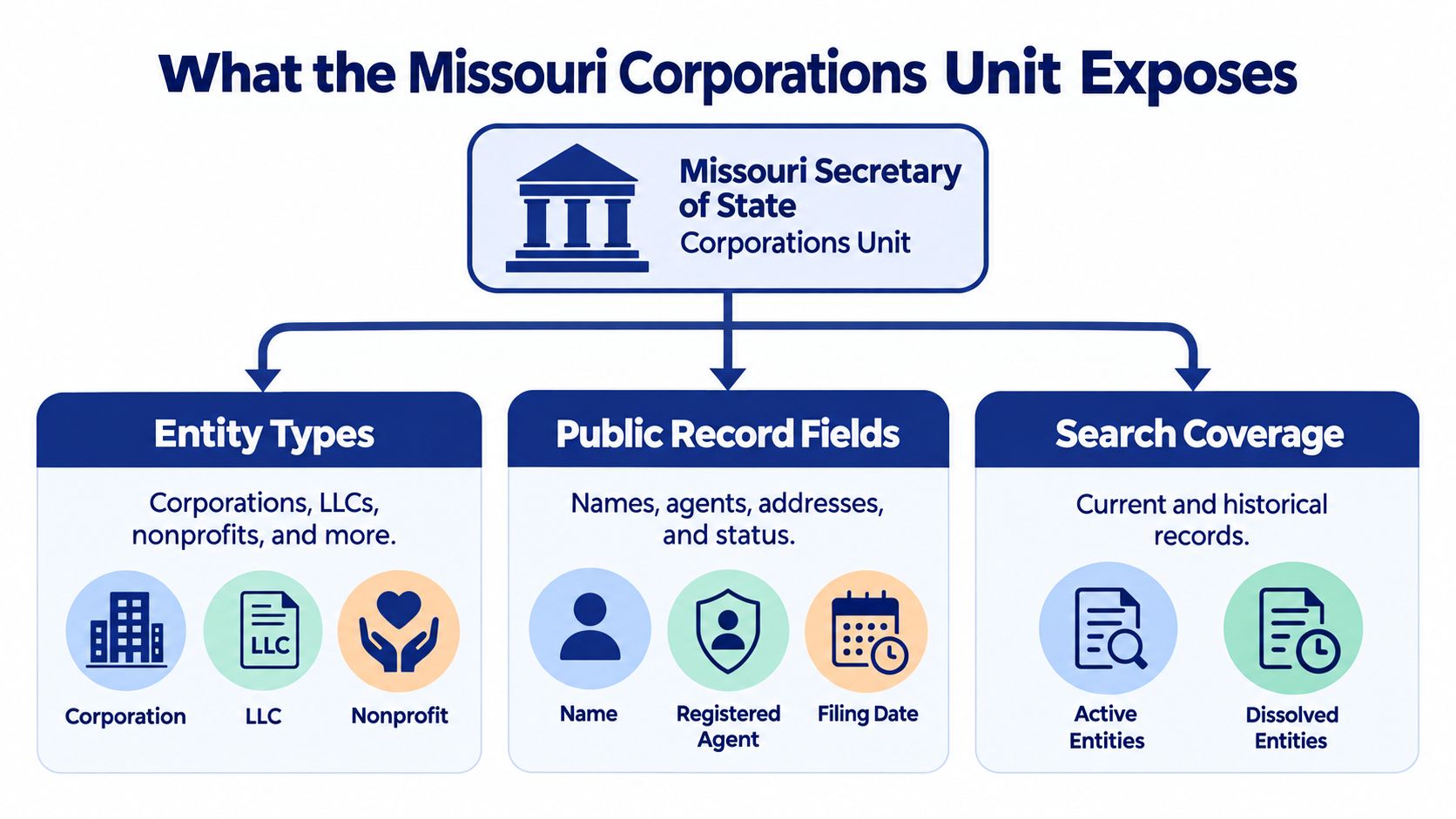
Missouri's Secretary of State Corporations Unit isn't a business directory. It's the state's central administrative authority for creating and maintaining domestic and foreign entities authorized to operate in Missouri, and it's the custodian of the records those entities are required to file. That status matters when you're deciding how much weight to give a result.
Entity Coverage
The unit covers for-profit and nonprofit corporations, professional and close corporations, agricultural cooperatives, mutual associations, limited liability companies, and limited partnerships, along with other specialized entities, as described in the Missouri Corporations Unit overview. For an engineer building search logic, that breadth means entity type can't be an afterthought. Two similar names can belong to different entity forms with different filing obligations.
It also means domestic or foreign classification is a core field, not metadata. A foreign entity qualified in Missouri exists legally elsewhere, so a Missouri record answers whether it's authorized there. It doesn't replace a home-state check when your policy requires both.
Fields You Should Expect
A Missouri record exposes foundational identifiers that support legal-entity verification.
- Business name and charter number: The primary label and the stable registry identifier you'll use for confirmation.
- Entity type and classification: The legal form plus domestic or foreign status.
- Incorporation or organization date: The creation point for comparing age, amendments, and report timing.
- Registered agent and address: The official party and location for service, which may differ from where the business operates.
- Previous names and current status: Name history plus a status such as active, dissolved, or terminated.
The historical record adds depth a simple lookup misses. Post-formation filings can include amended or restated articles, mergers, dissolutions, rescissions of administrative dissolution, annual reports, and registered-agent changes. Those filings turn a static profile into a timeline.
Read those fields together. Charter number and exact legal name anchor identity. Status, filing history, and agent maintenance tell you whether the public record still reflects continuing authority to transact business. A name alone does none of that work reliably.
A Two-Stage Search Strategy That Holds Up in Production
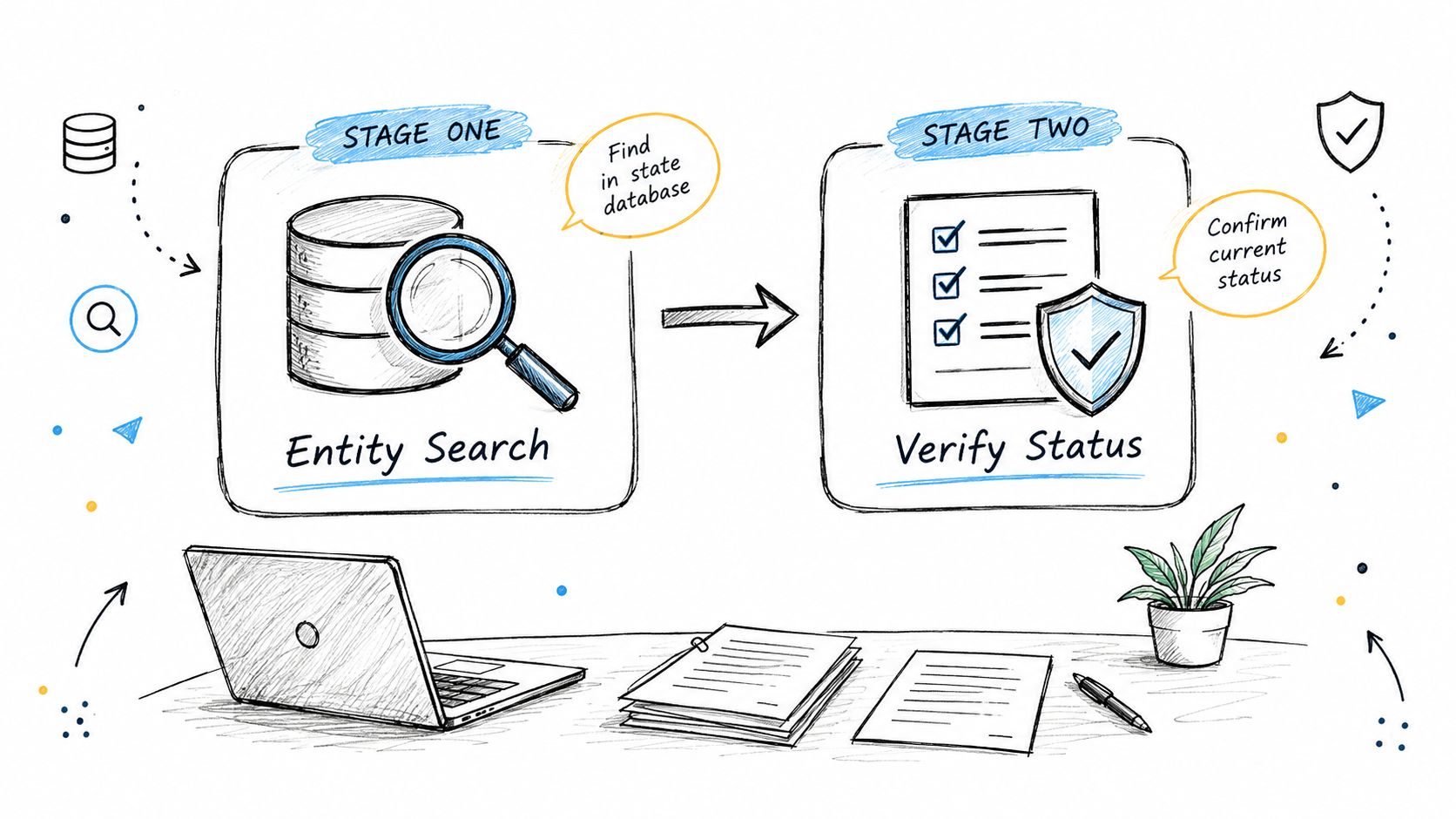
Name search is useful for discovery. It's weak as confirmation. A two-stage identifier strategy fixes that weakness by separating the job of finding candidates from the job of proving you've found the right entity.
Stage One Search by Normalized Legal Name
Normalize the submitted name before you query. Lowercase it, clean punctuation and extra whitespace, and handle common legal suffixes consistently. Keep the original submitted name untouched in your audit record so reviewers can see exactly what the applicant provided.
The Missouri interface supports name-based queries, and result rows expose business name, charter number, entity type, status, creation date, and registered-agent name, as outlined in this Missouri entity search identifier guide. Use those rows to build a candidate set. Don't auto-confirm the first plausible match, especially with common names.
This is also where name-clearance work needs careful language. Missouri treats availability checks as preliminary, and a preliminary result doesn't guarantee a proposed name can be registered. If your product includes a formation flow, a business name availability lookup guide can help your team separate availability screening from legal identity confirmation.
Stage Two Confirm by Charter Number
Once you have a candidate, switch identifiers. Look the entity up directly by Charter Number and open the entity-detail page. That page is your reconciliation source before onboarding, payment, or funding moves forward.
Validate at least two independent attributes before you accept the match.
- Charter Number plus registered agent: Confirm the registry identifier matches the agent your counterparty or supporting documents show.
- Charter Number plus principal address: Use address as corroboration, while remembering a registered office isn't necessarily an operating location.
- Exact legal name plus creation date: Check that formation timing fits the documents and history you've been given.
Label every name-search result honestly in your system. Use candidate, likely match, or availability indication until Charter Number confirmation is complete.
That labeling prevents a subtle production failure. Similarity matching can conflate similarly named entities, foreign entities qualified in Missouri, and inactive records. If your interface says confirmed legal identity at the candidate stage, downstream teams will trust a result your search never proved.
Store the normalized query, original input, selected charter number, and detail-page fields together. When an auditor asks why your team chose one Missouri entity over another with a similar name, that bundle is your answer.
What a Missouri Entity Search Cannot Prove
An active result feels reassuring. It shouldn't carry more weight than the record behind it can support.
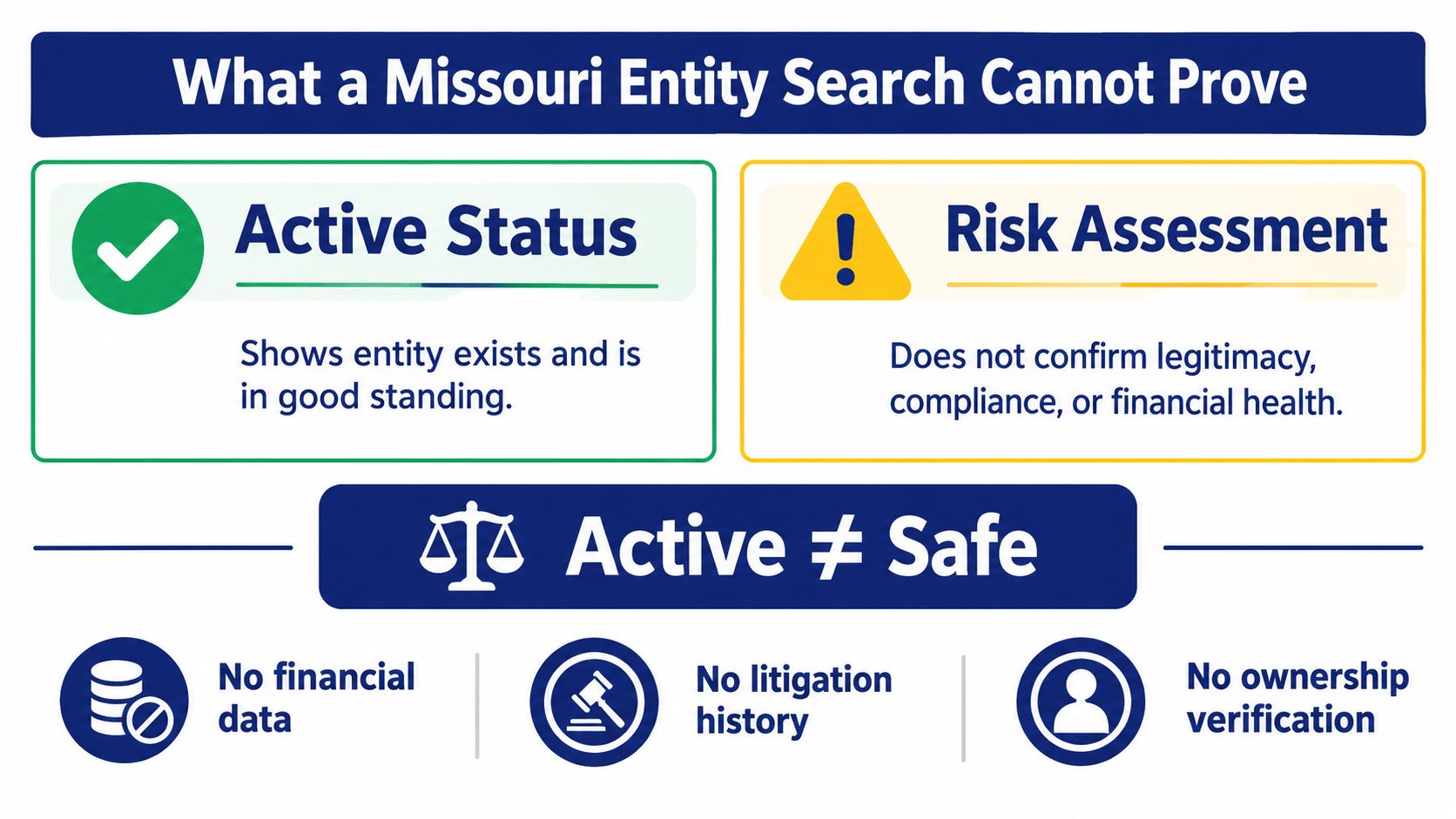
Active status doesn't prove financial health. It doesn't prove good standing with every regulator, verify ownership, or show that a business is currently operating at the address you have on file. The registry provides core public-record fields such as entity name, registered agent and address, formation date, previous names, entity type, and current status, as described in the Missouri Corporations Unit background information. Those fields anchor identity. They don't settle risk.
Where Teams Overread the Record
The common mistake is collapsing several questions into one status check. Is this the right legal entity? Is it compliant everywhere that matters? Who owns it? Is it licensed for this activity? Is it safe to pay or fund?
Missouri's search helps most with the first question. It can also inform the second when you inspect filing history and agent maintenance. It doesn't supply beneficial-owner data, tax compliance information, licenses, litigation history, or evidence that a listed address is operational. Teams assessing counterparty legitimacy need other authoritative sources, and this overview of how to see if a company is legitimate is a useful frame for layering those checks.
Entity type adds another trap. Domestic and foreign corporations have annual registration-report obligations, while separate guidance emphasizes registered-agent maintenance for corporations, LLCs, limited partnerships, and limited liability partnerships. If you apply one compliance expectation to every entity form, you'll misread otherwise valid records.
A Record Interpretation Workflow
- Confirm identity: Match exact legal name and charter number first.
- Inspect continuity: Review status, filing history, dates, and amendments for gaps or abrupt changes.
- Separate addresses: Distinguish registered office from principal office before using either in screening.
- Name the gaps: Route ownership, tax, licensing, and litigation questions to sources built for those questions.
That's the honest trade-off. The free state lookup is a strong, authoritative starting point. Used alone as a risk decision, it's thinner than it looks.
Annual Reports, Filing Deadlines, and Time-Sensitive Compliance Signals
A Missouri record isn't a snapshot you can file away forever. For corporations, recurring reports can change what the record means, and a search that looked clean during onboarding may need a different read later.
Missouri requires corporations doing business in the state to file an annual registration report, and failure to file can lead to administrative dissolution of a domestic corporation's charter or revocation of a foreign corporation's certificate of authority, according to the Missouri annual registration report guidance. That enforcement link is why report history belongs in your review, not in a footnote.
Missouri Annual Registration Report Deadlines at a Glance
| Entity Cohort | Annual Report Due Date | Online Filing Savings |
|---|---|---|
| Incorporated or qualified on or after July 1, 2003 | End of the month in which the corporation incorporated or qualified | $25 savings per report for for-profit corporations filing online rather than by paper |
| Existing before July 1, 2003 | Month shown on the last annual report | $25 savings per report for for-profit corporations filing online rather than by paper |
The deadline structure gives compliance teams a practical reading rule. Start with creation or qualification timing, then inspect whether the filing history fits the expected reporting rhythm. Look at the latest report, amendments, and agent changes together instead of treating current status as a standalone answer.
A name and charter number prove you found a record. Current status, filing history, registered-agent information, and report compliance tell you whether that record still supports continuing authority.
That is also why one-time verification decays. Entities amend articles, change agents, miss reports, dissolve, or cure an administrative problem after your first check. If Missouri entities sit in a live vendor, borrower, or customer portfolio, pair the initial search with the kind of recurring review described in this compliance monitoring software overview. Your team doesn't need to reread every record manually. It does need a trigger when status, agent, or filing posture changes.
For manual reviewers, note the report month in the entity file. For automated systems, store it as a compliance date. Either way, timing is part of the evidence.
Plugging the Workflow Into SOSfinder
Manual searching works until volume, audit pressure, or multi-state coverage makes browser lookups the bottleneck. At that point, the workflow needs the same two-stage logic, delivered through an interface your product can call consistently.
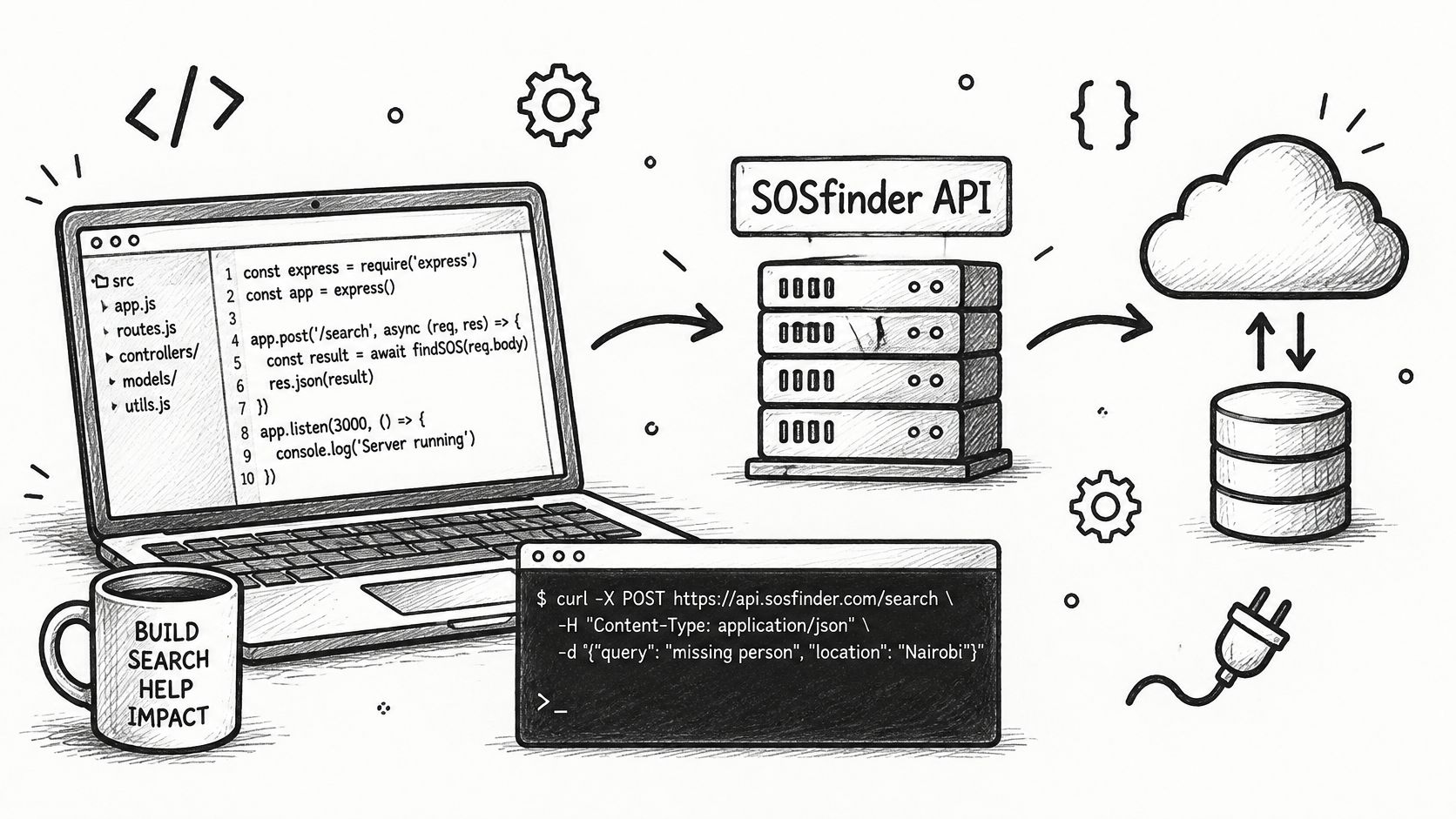
SOSfinder exposes entity search through a single POST endpoint with a normalized schema across all 50 states and DC. Missouri becomes a jurisdiction parameter rather than a separate integration, while the response keeps the fields your workflow depends on, including status, entity type, formation date, registered agent, principal address, identifiers, and filings. Teams comparing integration shapes can use this company data API overview to map those fields against their existing onboarding model.
Translating the Two Stages Into Requests
Send the normalized legal name and Missouri jurisdiction for candidate discovery. Review the returned candidates and similar filings, then confirm the selected entity through its registry identifier before you write a verified status into your system. Keep your labels disciplined in code and in the analyst interface. Candidate data shouldn't become confirmed identity because an API returned a best match.
Name-availability checks fit the same pattern during formation. Run them early to reduce rejected submissions, but present the result as an availability indication. Your filing logic still needs the state's final acceptance.
Layers Beyond the First Lookup
- Monitoring and webhooks: Route status, registered-agent, or address changes into your compliance queue instead of waiting for a periodic manual review.
- Bulk verification: Use CSV upload when you're screening a Missouri portfolio or remediating vendor records in batches.
- Filing history: Retrieve filing history with links to state PDFs where offered, so amendments and annual reports support audits and case review.
- Hosted MCP server: Let AI coding tools query entity data in plain language while your engineers build and test the integration.
Design observability around retrieval as well. Real-time lookups are layered over caching, so log when a record came from a fresh call versus a cache hit. That detail helps your team explain billing, latency, and the freshness of evidence during review. Store the full normalized response with your decision, not just the final pass or fail.
Checklist and Next Steps for Your Missouri Compliance Workflow
- Normalize: Clean the submitted legal name and retain the original for auditability.
- Search: Run the Missouri Secretary of State entity search and treat results as candidates.
- Confirm: Validate Charter Number plus at least one other independent attribute on the detail record.
- Interpret: Review status, filing history, amendments, and annual-report timing together.
- Bound the decision: Use active status as an identity anchor, then verify ownership, tax, licensing, or litigation elsewhere.
- Monitor: Watch for status and agent changes, and route webhooks into your compliance system.
Test that sequence against one live Missouri onboarding case before rolling it into your wider multi-state flow.
Build your Missouri check once and reuse the same normalized workflow across your onboarding, KYB, and vendor-screening stack with SOSfinder. Run a Missouri entity through the playground, inspect the returned charter details and filing history, and compare the result with your current manual process.