How to Run a Nebraska Business Name Search Correctly

You've picked a name, checked the domain, maybe sketched a logo, and now you need to know whether Nebraska will accept it. That order is exactly how teams get burned. A quick Nebraska Business Name Search that returns no identical hit feels like clearance, but it's only a first screen. Treat it as the start of a documented lifecycle, not the answer, and you cut the odds of a rejection after you've already spent money on branding.
Why a Nebraska Name Search Is More Than an Exact Match
A founder runs one Nebraska Business Name Search late at night, types the full proposed name including LLC, and sees nothing identical. The next morning the team orders signage and tells a bank the name is settled. Days later the filing stalls because another record, not spelled exactly the same way, is close enough to block it. Nothing about the search was dishonest. The test applied to it was wrong.
I've seen product teams make the same mistake in code. Their workflow normalizes punctuation, strips the entity suffix, compares strings, and returns a green badge when no exact match exists. That logic works for a username check. It doesn't describe Nebraska name law.
The Deceptively Similar Standard
Nebraska uses a deceptively similar standard, not an identical string test. Under Nebraska Revised Statute §21-1931 on deceptively similar corporate names, a corporation generally may not use a name that is the same as or deceptively similar to an existing nonprofit or business corporation, a reserved or registered corporate name, a foreign corporation's fictitious name, a registered trade name, or another business entity name filed with the Secretary of State. That one sentence changes how you should search.
First, similarity matters without identity. A different suffix, a small spelling change, or a word rearrangement doesn't automatically make two names safely distinct. Second, the comparison pool is wider than active domestic corporations. Reserved names count. Registered names count. Trade names count. A foreign corporation's fictitious name can matter even if no Nebraska formed company uses the phrase.
So a useful search asks two questions, not one. Is there an identical record, and is there any record a reviewer could reasonably view as deceptively similar? If your process only answers the first, you're reporting false confidence.
When Similarity Does Not End the Matter
The statute also creates formal exceptions. An applicant may pursue a deceptively similar name with written consent from the other entity or by submitting a certified final court judgment establishing the right to use it. Those are legal routes, not search tricks. You won't fix a conflict by changing capitalization or hoping a reviewer misses it.
That distinction is useful before you abandon a name. A close hit ruled by consent is different from a close hit owned by an unrelated business that will never agree. Your notes should therefore identify who controls the conflicting record, what type of record it is, and whether consent is even plausible. Don't ask for consent casually before you've documented the match, because that conversation can shape negotiations and timelines.
Practical rule: Zero identical results means only that you haven't found an identical result. It does not prove the name is available.
The same discipline applies when you widen the work beyond one state or entity type. A broader corporation name search workflow still needs jurisdiction specific standards underneath it. Nebraska's standard is similarity across multiple record categories, and that's the benchmark your preliminary work should meet.
Running a Preliminary Nebraska Name Search
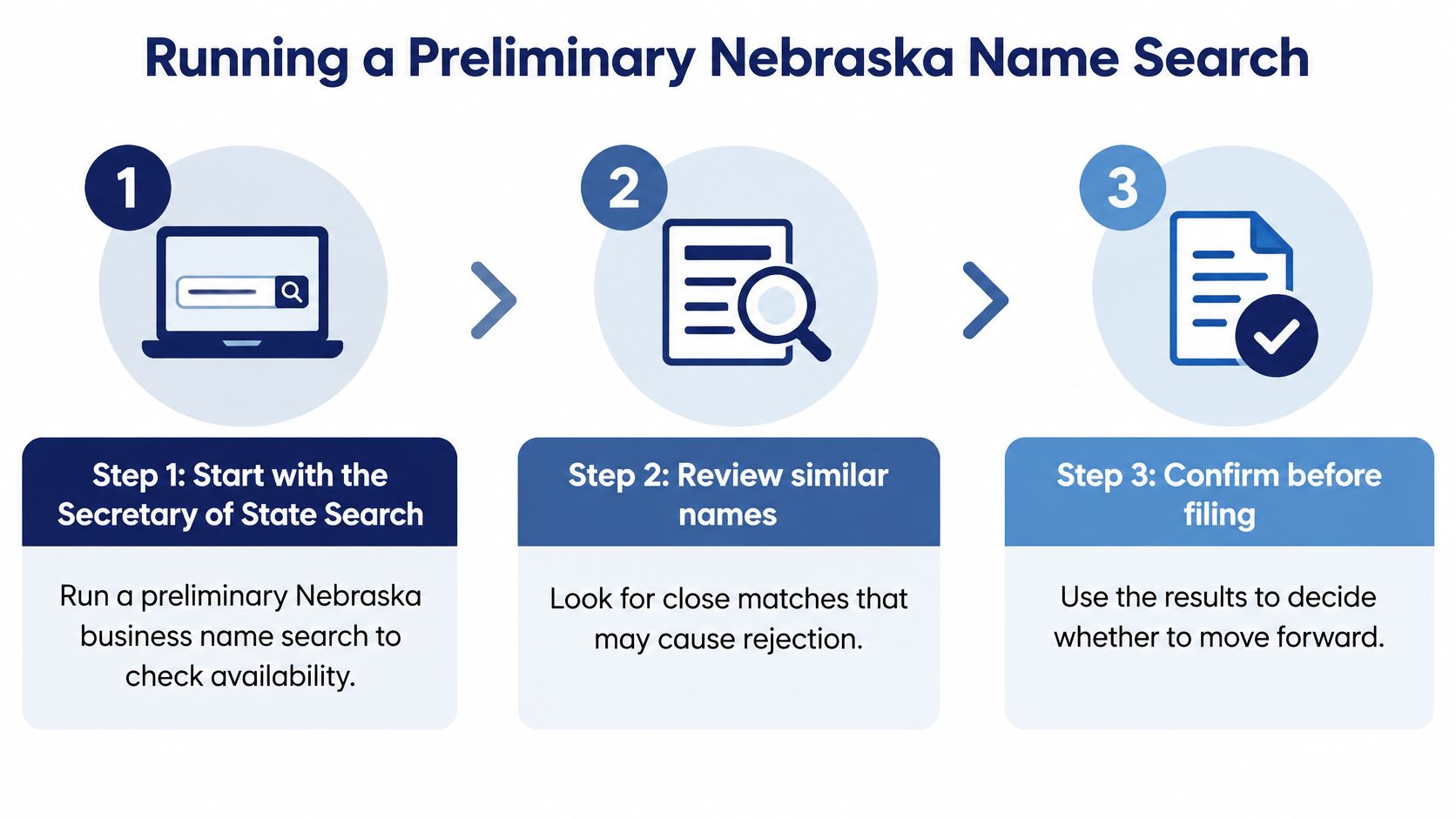
Start with the state's public database, but don't stop there. Nebraska clearance works best as a two stage process. Stage one is your own preliminary research. Stage two is written state review when you need an availability determination, especially if anything close appears.
The Secretary of State provides a free Corporate and Business Search covering entities, trade names, trademarks, and service marks, and separately describes written availability inquiries to the Business Services Division by email, fax, or mail on its Nebraska Corporate and Business Search guidance. That breadth is exactly why this database is your starting point. You're not just checking formed companies.
Step 1 Search the Full Name and Its Distinctive Core
Run the complete proposed legal name first, exactly as you intend to file it. Then remove the entity designator and search again. A conflict rarely depends on whether one name ends in LLC and another ends in Inc., so the distinctive words carry most of the risk.
Next, isolate the distinctive keyword or phrase. If the name combines a coined word with a generic descriptor, search the coined word alone and with likely alternative descriptors. Generic words can create noise, but the distinctive element tells you whether someone else already occupies the memorable part of the name.
Keep every query in a log. Record the date and time, the exact string entered, the search mode if applicable, and every returned name that deserves review with its entity or record identifier, type, and status. A screenshot without the query string is weak evidence because nobody can reconstruct what you tested.
Step 2 Test Variants a Reviewer Might Compare
Don't rely on your preferred spelling. Search meaningful variants that sound alike, look alike, or could be confused in speech. That includes phonetic forms, close spellings, singular and plural shifts, abbreviated words, and versions where spaces or punctuation move. You're simulating legal similarity, not trying to defeat a database filter.
For each candidate name, use a consistent variant set:
- Exact legal form: Search the complete name with the intended entity designator.
- Designator removed: Search the distinctive wording without LLC, Inc., or similar endings.
- Keyword search: Search the rarest or most distinctive word alone to surface partial overlaps.
- Phonetic forms: Search spellings that would sound the same when spoken to a customer, bank, or regulator.
- Close spellings: Search plausible misspellings and alternative spellings that preserve the same impression.
Consistency matters if you're comparing three or four candidates. If you test one name thoroughly and another casually, your ranking is meaningless. Apply the same passes to each and record unresolved flags beside the results, not in someone's memory.
Step 3 Ask the State in Writing
After the database passes, submit a written availability inquiry to the Business Services Division when you need staff to assess similarity. Include the exact proposed name and entity type, and retain the response with your search log. Nebraska staff make the acceptability determination when similarities exist, and that's a human legal review your internal scoring can't replace.
Manage expectations about that response. A preliminary availability response is a courtesy, not a guarantee, and the final decision is made when the filing is submitted. That's not bureaucratic hedging. New filings and reservations can change the picture, and the reviewer at filing applies the standard to the records then on file.
Until formation is accepted, keep spending reversible. Don't print permanent signage, emboss checks, or make public commitments that assume the name is yours. A documented search, staff inquiry, and short list of backup names cost far less than unwinding a launch.
Interpreting Results and Similarity Flags
Reading results is where good searches fall apart. Teams either panic at every returned record or dismiss anything that isn't identical. Both reactions waste time. Your job is to classify each hit by record type, status, and resemblance to the distinctive element, then decide whether to document it, investigate it, or escalate it.
Start with resemblance. An unrelated phrase that merely shares a common generic word is different from a record sharing your coined term, your key two word combination, or a phonetically equivalent spelling. The closer the distinctive core, the less comfort you should take from a different suffix or an extra descriptive word.
Preserve the Exact Name While Normalizing for Comparison
Nebraska formation documents must contain the complete exact legal entity name, and the online filing system doesn't automatically perform a name check during entity creation, according to Nebraska eDelivery guidance on filing and name checks. Build your workflow around that gap. Submission is not validation.
Store two versions of every candidate. Keep the user's original string untouched, including whitespace, punctuation, suffixes, and abbreviations. Then create a normalized comparison form for searching. If you overwrite the original, you can't prove what the founder approved, what staff reviewed, or what should appear on formation documents.
Status also changes the conversation. An active record with a close name is an immediate escalation. An inactive or historical record still belongs in the log, because staff may view its significance differently from your team. Don't delete it from the results and report a clean search. Mark the status, preserve the identifier, and state your reasoning.
If your report cannot show which similar records you found and why you dismissed or escalated them, it isn't an audit trail. It's an opinion.
Watch for Restricted or Special Review Words
Some names raise issues beyond similarity. Terms that may require specialized review or may be restricted include Bank, Geologist, Trust, Olympic, Engineer, Architect, land surveying terms, Cooperative, and Barber or Barber Shop. A database search won't tell you whether your business qualifies to use a regulated term. Flag the word, identify the likely approving authority or licensing issue, and resolve it before filing.
Automated labels need restraint. Call the output preliminary unless it's backed by state confirmation or an accepted filing. A binary available or unavailable badge hides the middle category that causes most trouble: names with plausible similarity or regulated wording that need human judgment.
If you work in several states, don't import another state's tolerance for similarity into Nebraska. Even a familiar process such as an Illinois Secretary of State search sits inside different state records and procedures. Use common logging fields, but keep the legal assessment state specific.
| Record type | Why it matters for similarity | Recommended action |
|---|---|---|
| Active business entity | It's an existing name on file and may block a same or deceptively similar filing. | Escalate close matches for written state review. |
| Reserved or registered name | Someone has already claimed priority through a state record even if no entity is operating yet. | Document the record and treat close resemblance as a conflict risk. |
| Registered trade name | Trade names are part of the comparison pool, not a separate branding universe. | Compare the distinctive wording and escalate plausible similarity. |
| Foreign fictitious name | An out of state corporation's Nebraska name can affect availability. | Don't dismiss it because formation occurred elsewhere. Escalate close hits. |
| Trademark or service mark record | It appears in the same broad search environment and signals an existing claimed identifier. | Document it and obtain legal advice before relying on branding use. |
| Inactive entity record | Status may affect risk, but your search alone doesn't settle how staff will treat it. | Preserve the status and identifier, then ask the state if the resemblance is material. |
Sort hits into those categories before you brief a founder. The decision becomes calmer and more defensible because everyone sees the record, the reason it matters, and the next action.
Managing the 120-Day Reservation Window
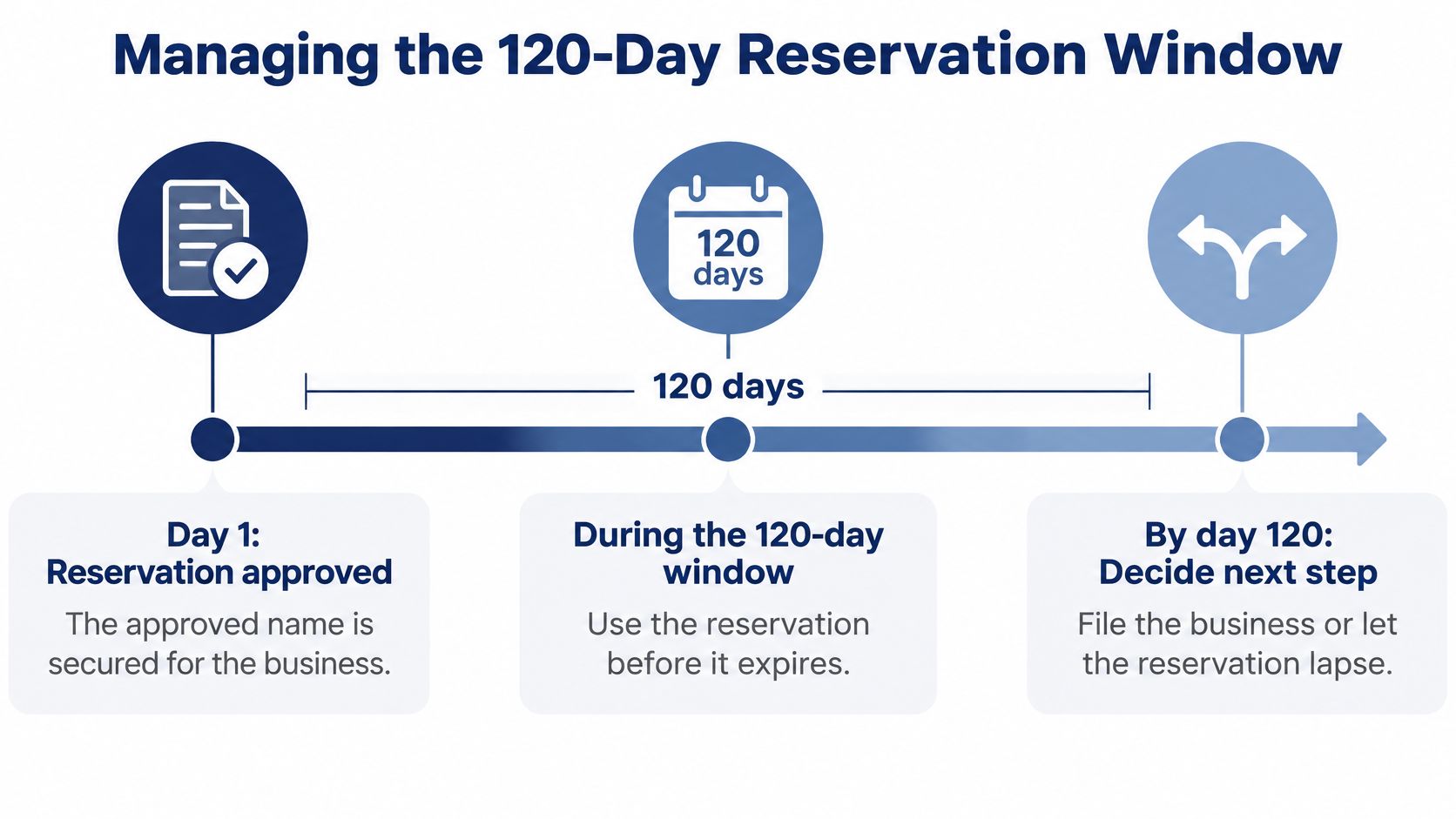
A clean Nebraska search can turn stale before a filing is ready. A reservation gives a name a limited period of protection for filing entity documents, so manage it as a lifecycle with an approval date, a deadline, and a recorded outcome.
Nebraska requires a written reservation request and the applicable fee. If the request is approved, the name is reserved for filing entity documents during the 120-day reservation period described in the Secretary of State name procedures for Nebraska. The approval date starts the clock. A submitted request is not an approval, and a clean database search does not reserve a name.
Build the Lifecycle Before You Reserve
Reserving too early can leave the window running while founders settle ownership, tax treatment, or financing. Waiting too long can leave the name available for another applicant to claim. Tie the request to a realistic formation plan, not to a promising search result.
Track the decision points in one record:
- Preliminary search completed: Save query variants, returned records, and similarity flags.
- Written confirmation requested: Record the submission date, exact name, entity type, and state response.
- Reservation approved: Save the approval and calculate the deadline immediately.
- Formation filed: Record submission and acceptance status against the complete exact legal name.
- Transferred or expired: Close the record with the transfer notice or expiration outcome, so no one treats the name as secured later.
Assign an owner, reminders, and an escalation path well before the deadline. A calendar entry tied only to the requester can be missed when that person changes roles. Keep the deadline with the formation documents, registered agent information, and filing status.
Nonrenewal and Transfer Change the Plan
For corporate names, the reservation period is nonrenewable. Nebraska law allows a reservation to be transferred to another person through a signed notice filed with the Secretary of State, as set out in the Nebraska corporate name reservation statute. The nonrenewal rule and transfer process determine how to handle a change in plans.
If a project moves from a founder to a holding company, investor vehicle, or another organizer, document the transfer rather than assuming the reservation follows the deal. File the required signed notice and retain it with the original approval. If the reservation expires, treat the earlier search clearance as stale and search again before reviving the name. The records available may have changed.
Keep reservation acknowledgments, timestamps, entity-type context, deadline calculations, transfer notices, and filing references in a durable location accessible to the team. A reservation record should remain usable when systems, vendors, or staff change. Relying on one person's inbox makes it harder to establish what was approved and when.
In API and compliance workflows, record expiration as a status, not just a date. If the deadline passes without an accepted filing or documented transfer, return the name to research status. Downstream onboarding systems should not continue to display it as secured.
Adding Nebraska Checks to Multi-State Workflows
A name can clear an initial Nebraska search and still be rejected at filing. In a multi-state workflow, teams need consistent records without treating one state's search result as another state's approval. Nebraska's review can turn on similarity, so the useful unit of work is not a pass-or-fail result. It is a documented decision tied to the search, the reservation, and any later change in ownership or filing plans.
The system choice affects how that evidence is gathered and maintained. A Nebraska-specific process gives reviewers control over search variants and escalation. An aggregated API can reduce repeated integration work across jurisdictions, but the normalized output must not hide the details Nebraska reviewers need.
Build In House or Aggregate
An in-house process lets a team define query variants, classify matches, and route uncertain results for review. It also makes that team responsible for tracking changes to state interfaces, recovering interrupted searches, preserving logs, and updating procedures. For occasional Nebraska filings, a documented manual process may be practical. Repeated onboarding, vendor checks, or formation work can make manual searches inconsistent.
An aggregated API can accept jurisdiction as a parameter and return normalized records across states. That helps operations compare results, but normalization can erase useful distinctions. Before adopting one, check whether similar filings remain visible, whether the original query is retained, and what happens when a registry blocks or interrupts a request. Standardize how records are collected, not how every state's legal standard is interpreted.
One option is SOSfinder, which offers a single POST endpoint for entity searches across all 50 states and DC, business name availability checks, bulk CSV verification, filing history retrieval, monitoring alerts for status, registered agent, or address changes, and webhooks for downstream systems. It is not affiliated with any government agency, and a preliminary availability result does not replace confirmation from the Secretary of State. Use the service as a data and workflow layer, then send ambiguous Nebraska names for written state review. The case for one API across fifty states is strongest when jurisdiction-specific decision rules remain above the normalized data.
Audit Fields That Should Travel With Every Result
Keep a usable record for each search:
- Query time and source jurisdiction: Shows when the records were checked and which state supplied them.
- Original and normalized strings: Preserves the proposed filing name and the comparison form used in the search.
- Variants tested: Records whether exact, keyword, prefix, and phonetic searches were run.
- Returned records: Captures names, identifiers, entity types, and statuses for material matches.
- Similarity and restricted word flags: Keeps unresolved issues visible instead of turning them into a false pass.
- Reviewer disposition: Identifies who escalated, dismissed, or approved the result for filing preparation, and why.
Connect those records to the reservation lifecycle. Keep the initial search evidence with the reservation approval, then update the record if the reservation is transferred, expires, or leads to a filing. That gives the next reviewer context for interpreting an older result and avoids treating a stale search as current clearance.
Monitoring has a separate role after formation. A name search does not keep entity status, registered agent, or address information current. If the same system supports customer due diligence, link clearance records to later entity monitoring rather than treating formation as the end of data quality.

The trade-off is concrete. In-house control requires ongoing maintenance. Aggregation creates dependence on the vendor's match presentation and update practices. Either approach can work if the workflow preserves raw matches, routes Nebraska-specific ambiguity for review, and labels search results as preliminary.
Your Next Step for Multi-State Name Checks
A candidate name clears the first screen, then gets rejected when the filing reaches state review. That outcome is avoidable if teams treat a Nebraska search as one stage in a reservation lifecycle, not as permission to file. The search can surface conflicts and help compare candidates, but Nebraska makes the final determination when formation documents are submitted.
Use the search to expose uncertainty while changing the name is still inexpensive. A late change can affect contracts, signage, bank paperwork, and investor materials. The practical trade-off is between spending time on review now and risking rework after others have adopted the name.
Put Three Candidates Through the Same Test
Start with a short list rather than committing to the first candidate that looks clear. Apply the same search approach to each, review returned records for similarity and status, and flag restricted words. Compare the evidence and unresolved issues, not just which result screen appears emptiest.
Choose the next step based on the findings. If a candidate has no material flags, seek the confirmation or reservation that fits your filing timeline. If a returned name could be considered similar, escalate the question or switch to a backup before investing further. A clean preliminary result is not a filing decision.
A reservation adds its own clock and transfer decision. Once approved, record the 120-day window, assign an owner, and decide whether to file, transfer the reservation, or let it expire. Set that control when the reservation begins, not when the deadline is near.
For multi-state work, apply a consistent recordkeeping approach while leaving the legal conclusion to each jurisdiction. A company data API for entity records can support shared workflows, but reviewers still need to see which state supplied a result and what remains unresolved. Keep the search labeled preliminary until the state accepts the filing or provides the confirmation your process requires.
Before automating, run the workflow manually on the candidate list. If assessing an integration, test example requests and compare returned similar records with the Nebraska search results. Check whether the output supports the evidence your review process needs. A reassuring status badge alone does not establish that a name is available.
Your next step is concrete: assemble three candidates, compare their search results, choose the lowest-risk option, and set a reservation deadline control before requesting the reservation. This keeps the name decision usable across state checks and through filing, rather than relying on a single search screen.