Secretary of State Business Name Availability by State

You've settled on a business name, checked the domain, and started filling out formation documents. The state registry returns no obvious match, so you're ready to order signage or approve a customer's application. But what did that search establish, and which records did it leave out?
Secretary of State business name availability is a state-specific filing question. To use the answer responsibly, you need the state's matching rule, the competing records reviewed, and the date of the check. That evidence matters whether you're naming your own company or building name screening into an onboarding workflow.
State Name Rules at a Glance
A Secretary of State name check tests distinguishability under that state's rules, not nationwide rights to a brand. For example, the California business entity name regulations recognize a different letter or numeral, or a plainly recognizable different sequence, while making final availability subject to review of the formation document.
Use the comparison below as a reading guide, not a filing approval. Read left to right: the test explains which differences matter, the records checked identify potential conflicts, and the notable rule shows where an ordinary exact-name search can mislead.
Name distinguishability rules by state
| State | Distinguishability test | Records checked | Notable rule |
|---|---|---|---|
| California | Different letter or numeral, or a different sequence plainly recognizable to the Secretary of State | Existing entity names and reservations | Search results are advisory; final decision comes at filing review |
| North Carolina | Distinguishable from every other entity on the business registry | All registry entities | Entity suffixes such as Inc. or LLC don't establish distinguishability |
| Oregon | Changed letters or numerals, different key word, reordered key words, unusual spelling, or different number representation | Active organized entities, reserved names, and registered names | Inactive registrations don't affect availability |
| Georgia | Entity type, abbreviations, phonetic spelling, punctuation, and pluralization disregarded | Entity names and reservations | Cosmetic changes may not distinguish a name |
| Minnesota | State-specific character normalization | Business names; assumed names aren't checked against other assumed names | Assumed-name matching differs from entity matching |
| Vermont | Name rights depend on record status | Active, terminated, expiration-pending, reserved, and hold records | Status determines which records retain rights |
| Texas | Same as, deceptively similar to, or similar to an existing filing | Domestic entities, registered foreign entities, foreign fictitious names, series LLCs, reservations, and registrations | A domestic-entity-only search is incomplete |
| Louisiana | Preliminary screening followed by fuller review at filing | Registry entities | Availability doesn't guarantee filing approval |
Read the rule before changing the name
A suffix identifies an entity's legal form. It doesn't necessarily make the underlying name different for registry purposes. Likewise, punctuation that looks distinctive in a logo may contribute nothing to a state's administrative comparison.
Start with your intended jurisdiction rather than borrowing another state's result. If you're forming there, a Massachusetts LLC name search is a relevant starting point, but another state's matching assumptions aren't a substitute for Massachusetts review.
Practical rule: Identify what the state compares before deciding that your proposed spelling is different enough.
The useful question isn't whether the proposed name appears verbatim. It's whether the state considers it distinguishable from the records that retain name rights.
Why One State Clears a Name Another Rejects
Think of library catalogues that contain overlapping books but group editions differently. A search might show separate entries in one catalogue and combine them in another. State business registries create a similar problem: both the records included and the comparison rules can change the answer.
There are two separate causes of a split result. A state may treat your proposed wording differently, or it may compare that wording against a different set of records. Changing the search interface won't resolve either issue unless you understand the underlying rule.
Different matching rules produce different answers
The Minnesota Secretary of State's name-availability guidelines state that assumed names aren't checked against other assumed names. That means an assumed-name search shouldn't be interpreted as proof that no other operator uses the wording.
Compare that approach with a jurisdiction that disregards punctuation, abbreviations, phonetic spelling, or pluralization. A founder might see Harbor Works and Harbour Work as different brand choices, while the relevant state comparison treats the differences as insufficient. Test those variants rather than relying on how distinct they look on a screen.
Status creates another source of confusion. A record that doesn't describe a currently operating business may still matter to name rights. Don't discard terminated, reserved, or hold records because your onboarding system normally filters for active companies.
Different record scopes change the result
The Georgia Business Division FAQ describes distinguishability and reservation procedures that make both the matching rule and reservation status relevant to a name check. Across jurisdictions, a search limited to formed domestic companies can miss records that matter, including foreign registrations and reserved names.
Here, foreign generally refers to an entity formed outside the state, not necessarily outside the country. A business formed elsewhere can therefore create a relevant registry conflict in the state you're searching.
Use this checklist when the same name receives different answers:
- Entity categories: Did the search include corporations, LLCs, and other relevant entity types?
- Record statuses: Which statuses were included, and which were excluded?
- Foreign registrations: Were entities formed elsewhere included in the comparison?
- Alternate names: Were assumed names and foreign fictitious names searched under the applicable rules?
- Reservations: Could an unexpired reservation explain the conflict?
- Outside use: Could an unregistered operator be using similar wording without appearing in the registry?
Ask for the record that explains the difference, not just the final label. A useful result identifies the competing name, registry identifier, entity category, status, and rule applied.
For engineers, retain both the submitted name and the normalized search variants. If your system removes punctuation or expands abbreviations, document that transformation. Reviewers need to distinguish what the applicant entered from what the system searched.
How to Run a Name Check Step by Step
Prepare a search record before opening the registry. It can be a spreadsheet for a single formation or a structured review object in a filing platform. Keep the original name unchanged, then record variants separately so another reviewer can reproduce the check.
Begin with the filing name and jurisdiction.
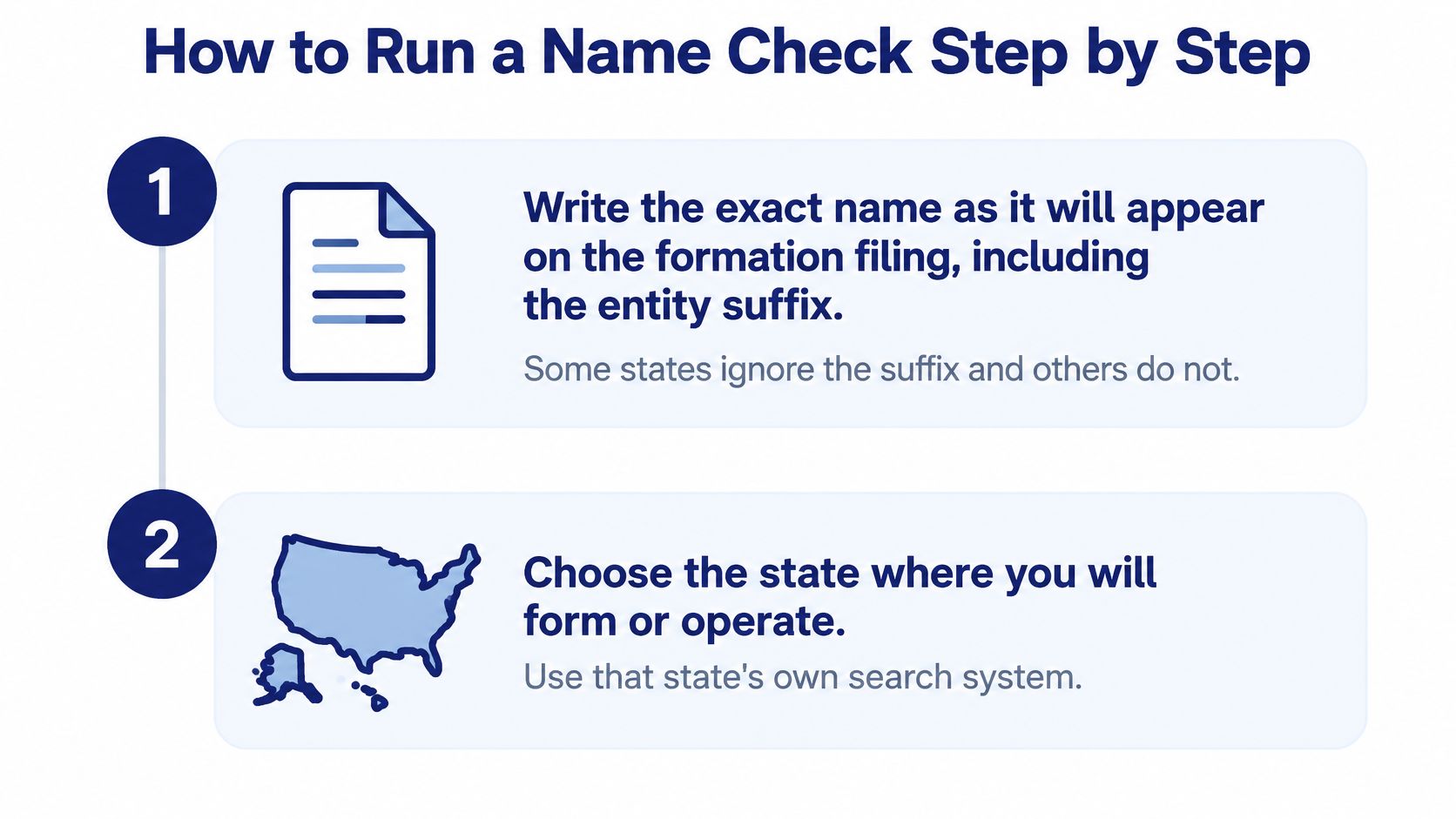
Prepare, search, and preserve the evidence
Write the exact proposed filing name, including the entity suffix. Preserve the wording you intend to submit because the search record should correspond to the formation document, even when the state disregards the suffix during comparison.
Choose the formation state and relevant operating jurisdictions. Use each jurisdiction's own registry and requirements, and determine where foreign registration will be necessary rather than assuming every customer location requires registration.
Build a deliberate variant list. Remove punctuation, test singular and plural forms, expand abbreviations, and consider likely spelling changes so an exact-match search doesn't become your only test.
Search exact wording and near matches. Keep inactive and terminated results available for review until you've established whether their statuses affect name rights.
Review the additional record categories. Check reservations, assumed or fictitious names, and foreign registrations through the appropriate state search options because a general entity search may not expose every relevant category.
Save the state, search date, search terms, and similar records. Record the registry identifier and your reason for including or excluding each candidate so a later reviewer can understand the decision.
Choose the next action before calling the name secured. Decide whether to reserve, revise, investigate trademark risk, or submit the formation filing, while leaving final administrative acceptance to the state.
Turn search results into a reviewable decision
A common slip is searching only the full proposed name. Say you enter Cedar Lantern Design LLC and receive no exact result. Searching Cedar Lantern and the distinctive key words separately can reveal a relevant candidate that the full-name query didn't surface.
For an integration, use the entity-search documentation to plan how your application handles state selection and returned records. Keep the reviewer's conclusion separate from the raw response rather than replacing the evidence with an availability flag.
Save what you searched, what you found, and why you decided the result was acceptable.
Don't postpone trademark investigation until after filing merely because it appears last in an internal checklist. Schedule broader clearance before spending on packaging, signage, or a public launch.
How Long a Reserved Name Stays Locked
A reservation works like a library hold slip. It keeps one specific title on a shelf for one borrower for a short period, then it expires and the title returns to general circulation. The Georgia business-name reservation guide describes a 30-day hold that ends on filing or expiration, and continuation requires a new application and fee.
Reservation length, renewal and fees by state
| State | Reservation period | Renewal or extension |
|---|---|---|
| Georgia | 30 days from approval, or until the formation filing is submitted, whichever comes first | New application and fee required to continue |
| California | 60 days | No consecutive 60-day renewals without at least one intervening day |
| Texas | 120 days | Renewal available during the 30 days before expiration |
| Colorado | 120 days | Treat as a single 120-day hold and file inside that window |
| Missouri | 60 days | Two additional 60-day periods, up to 180 days total; no reservation of that name after the third period |
The continuation column decides many filing calendars. A team can circle the right expiration date and still lose the name by requesting renewal outside the eligibility window, by assuming a second hold starts without a gap, or by assuming refiling guarantees continuous coverage.
Read each row as a state rule plus the record that proves it. Save the approval notice, the exact start and end dates, and the renewal condition from that notice. Hold periods are short and jurisdiction specific, so a Texas timetable says nothing about how California or Missouri will handle the same request.
Keep a reservation ledger
Keep the reservation file apart from the search file. The search file shows what the registry returned on a date. The ledger shows what hold you hold, where, and for how long.
- Jurisdiction and identifier: Save the state and reservation reference.
- Effective and expiration dates: Use the dates on the approval rather than an estimate based on submission.
- Renewal eligibility: Record when continuation can be requested and whether an interruption is required.
- Applicant or beneficiary: Identify who holds the reservation and who will file the entity.
- Responsible person: Assign someone to act on reminders, not merely receive them.
Set one reminder to prepare the filing before the deadline. Set a second reminder to confirm acceptance. An application waiting in an internal queue is not state action.
If your next filing is in Nebraska, use the Nebraska business-name search guide to organize that jurisdiction's check rather than importing another state's timetable.
A reservation has a geographic and procedural scope. It does not protect the name nationwide or across every entity category. Describe exactly what was reserved and where, and let the ledger show the limit.
Why a Clear Search Is Not Legal Clearance
A fast green result can increase risk if it encourages someone to stop investigating. The problem isn't speed itself. It's presenting a limited registry finding as permission to use a brand without qualification.
Think of the distinction between a building permit and a deed. Administrative permission for a particular purpose doesn't establish every underlying right or resolve every possible objection. Name screening has a similarly limited role.
Keep that distinction visible when reviewing a search result.
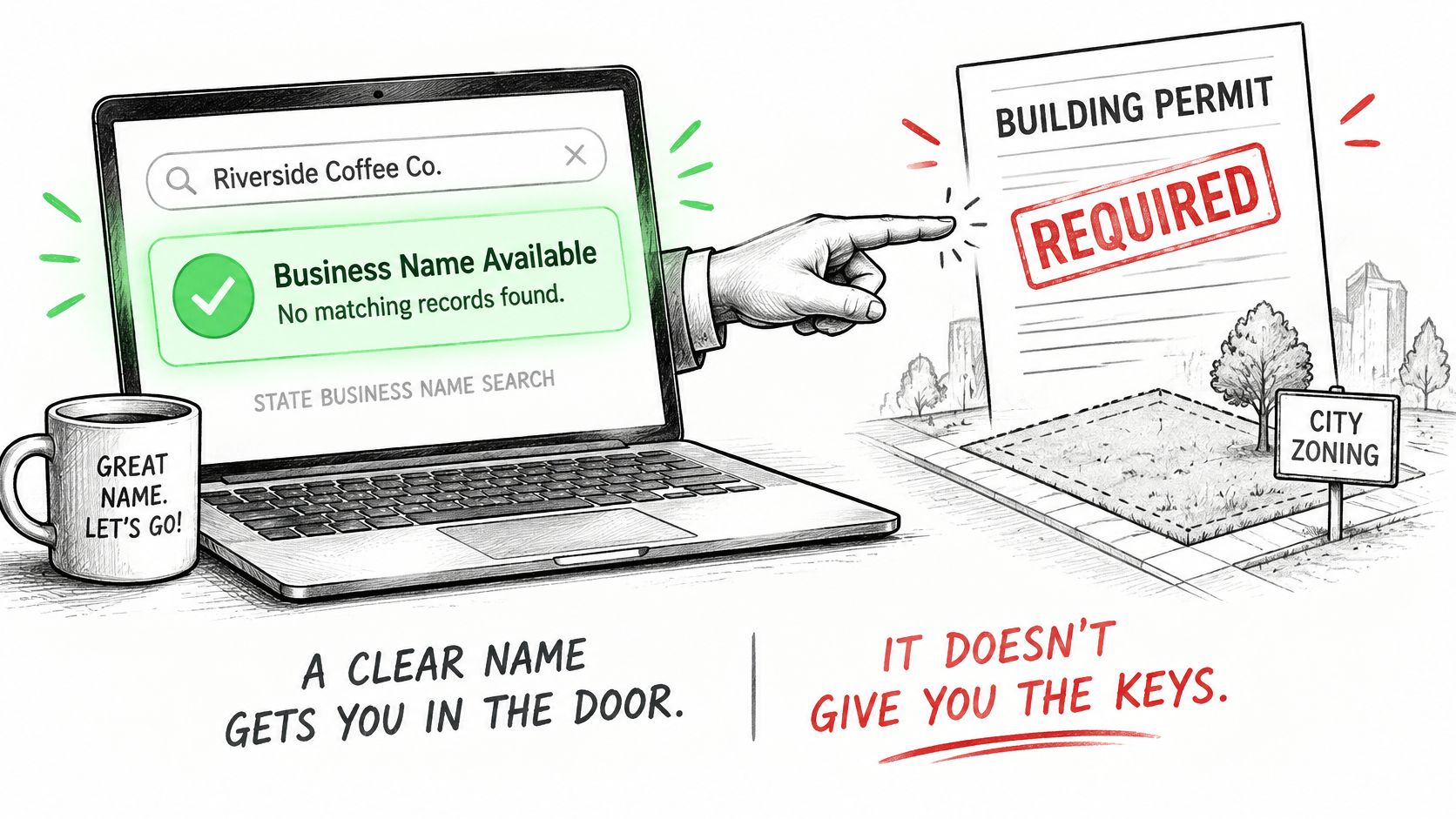
Replace reassurance with evidence
The Louisiana Secretary of State's business-services FAQ describes availability findings as preliminary, with fuller review when formation documents are filed. Administrative acceptance also doesn't answer whether customers could confuse your business with another operator or whether someone else holds relevant trademark rights.
An honest clearance report should include:
- Screening confidence: Explain the completeness of the registry review, not a made-up probability of legal safety.
- Competing records: Preserve exact and similar candidates, including reasons for excluding them.
- Final-decision rule: State which official review remains outstanding.
- Escalation triggers: Flag similar branding, related goods or services, planned geographic expansion, and unresolved record categories for further investigation.
A no-match result should lead to a bounded conclusion about the search performed. It shouldn't become a legal opinion.
Use the following video as supplementary context, not as a replacement for the relevant state instructions.
Know who is making the decision
SOSfinder is an independent commercial service. We aren't affiliated with, endorsed by, or acting on behalf of any Secretary of State, state agency, or other government body.
Our results aren't a substitute for an official certificate of good standing or a certified copy. Those documents serve different evidentiary purposes, and neither should be confused with trademark clearance.
For a nationally marketed product, investigate trademark records, domain use, and common-law business use before committing to the name. Ask qualified counsel to assess unresolved conflicts rather than asking a registry search to answer a different legal question.
Real Cases Where the Registry Result Mattered
The Minnesota Secretary of State recorded 1,043 name-reservation filings in 2024 in its annual filing statistics and 874 in 2025 in its subsequent filing statistics. Those are reservation filings, not counts of unique founders or successful formations.
The following are illustrative scenarios, not reported disputes. Each shows how the evidence behind a registry result changes the next action.
A suffix-only revision
A founder proposes Juniper Workshop LLC in North Carolina and finds Juniper Workshop Inc. The founder expects the legal-form difference to resolve the conflict, but the core wording remains unchanged under the applicable comparison.
The founder chooses a distinctive alternative and reruns the search. Lesson: check the matching rule before revising the name.
A trade name meets a foreign registration
A team searches an assumed name in Minnesota, then prepares a Texas expansion. Its Texas review surfaces a registered foreign entity using the same core wording, which requires a separate conflict assessment before the team proceeds.
The Minnesota result doesn't resolve that Texas record. Lesson: check the record category, not just the wording.
An expired reservation changes the plan
A founder obtains a California reservation but delays formation while negotiating ownership terms. After the reservation expires, another filing creates a conflict that wasn't present during the original search.
The founder must reassess the name instead of relying on the old approval. Lesson: track the expiration and verify the position before filing.
Portfolio lesson: A reusable review process is more valuable than a folder of unexplained green results.
Registration volumes also need their proper scope. Montana reported more than 5,200 new business registrations in July 2024 in its Secretary of State announcement, while West Virginia reported more than 13,500 in 2024 in its annual announcement. A monthly total and an annual total aren't a direct comparison, but both reinforce the need to recheck changing registries.
Confirm the Name Before You File
Treat a clear result as permission to continue the review, not permission to stop. Before submitting formation documents, resolve the similar records, confirm the applicable state requirements, and make sure any reservation remains effective.
Use a filing checklist that connects the search evidence to an owner and a next action.
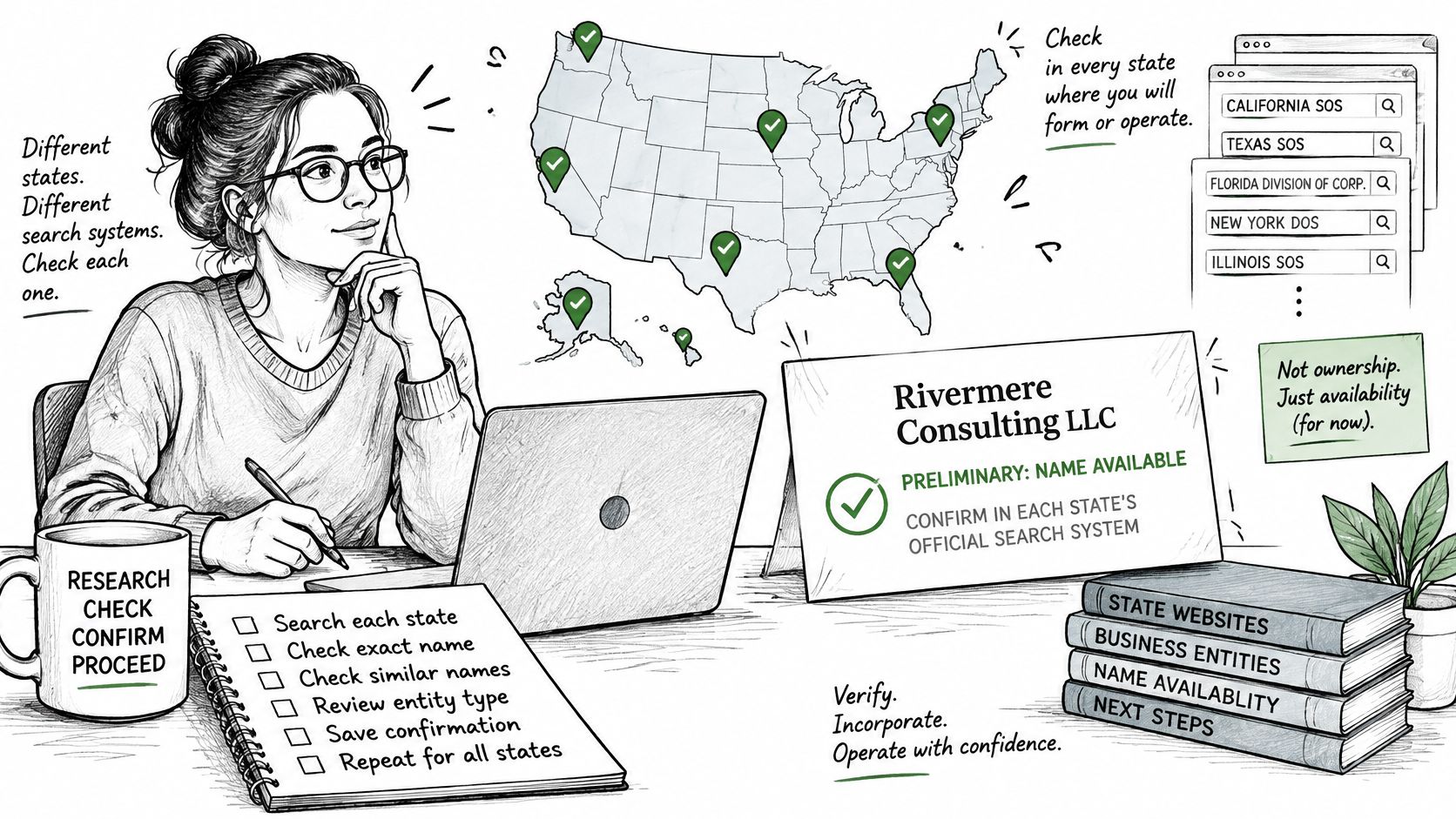
Make the decision in the right order
First, identify the states where formation or foreign registration is required. Resolve administrative name questions in those jurisdictions rather than assuming the formation-state result covers the rollout.
Next, compare your document-preparation schedule with any reservation deadline. If the schedule won't fit, investigate the available continuation procedure or adjust the filing plan before the hold expires.
If a competing record blocks the name, change a meaningful element and rerun the variants. Complete trademark, domain, and common-law review before authorizing brand assets that would be expensive to replace.
For teams, use a repeatable query with the jurisdiction recorded as a parameter, then require a person to review uncertain candidates. With SOSfinder, users can check whether a company name is already taken in a state before filing, and we ask that state's official registry for the record when a business name is searched.
Final filing checklist
- State rules confirmed: The reviewer identified the applicable comparison and record scope.
- Reservation dates recorded: The owner knows the expiration and any continuation requirements.
- Similar records reviewed: Each material candidate has a documented disposition.
- Trademark decision documented: Broader clearance is completed or assigned for escalation.
- Filing responsibility assigned: Someone owns submission and confirmation of acceptance.
We can't file documents, register entities, or change an official record on your behalf. Keep the state's acceptance documentation alongside your search evidence so the final file distinguishes preliminary screening from completed official action.
Visit SOSfinder to search a proposed business name by state and review the best match alongside similar filings. Use those records to document your preliminary name check, then resolve uncertain matches and confirm the filing requirements with the relevant state.