State of Utah Business Entity Search: A Complete Guide

Most Utah business name guides tell you to run a search, glance at the result, and move on. That's lazy advice. A Utah registry lookup is useful, but it is not legal clearance, and if you treat it that way, you'll miss conflicts the screen was never meant to catch.
The state of Utah business entity search is the Division of Corporations and Commercial Code's public window into registered entities, principal individuals, and filing activity. Used correctly, it answers a narrow set of questions well. Used badly, it gives people false confidence.
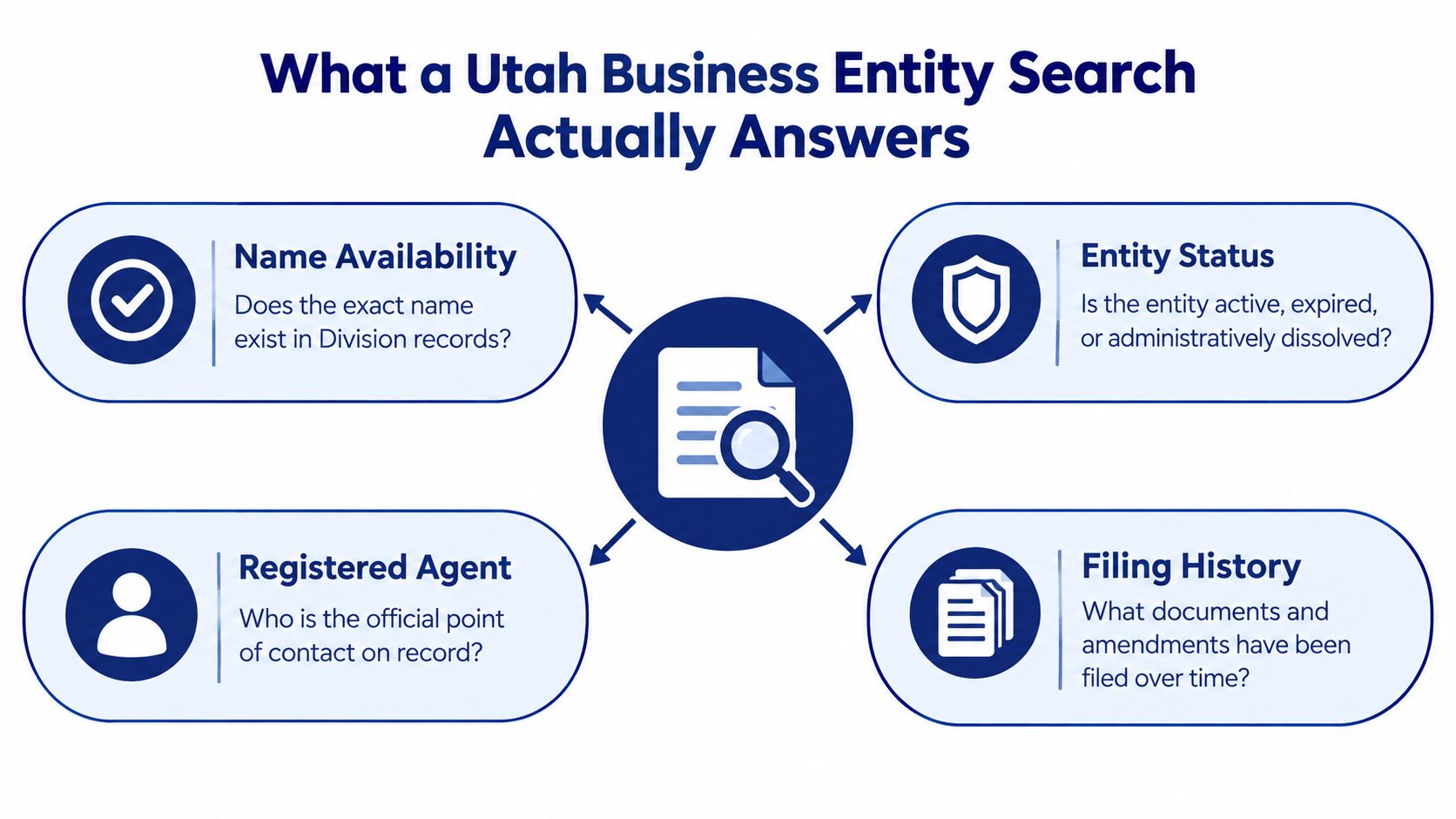
What a Utah Business Entity Search Can Tell You
A clean Utah result does not mean the name is safe to use. It means the Division's records did not surface a conflict for the query you ran, within the limits of that search.
The four questions people keep collapsing into one
The registry can help answer whether a conflicting entity exists in Utah's records, whether the proposed name is acceptable for filing, whether an assumed name is still active, and who the principal individuals are on file. Those are related questions, but they are not the same question. A vendor onboarding team cares about identity verification. A filing team cares about name acceptance. A compliance team cares about current status and relationships.
Utah's Division of Corporations and Commercial Code is the state agency responsible for registering statutory business entities, and its official business-entity search supports exactly that kind of records-based review. It also offers Certificates of Existence, which matter when a screen result is not strong enough evidence for a bank, counterparty, or auditor (Utah business-entity searches and certificates).
Practical rule: If the decision depends on proof, do not stop at the results page. Pull the official record or certificate.
The public search also supports queries by entity name or entity number, and Utah's own search documentation extends that to principal name and registered-agent name searches. That is why the tool is more than a directory. It supports relationship-based research, status confirmation, and identity checks, not just name lookup.
What the screen means in practice
A Utah search result is best treated as one input in a wider verification workflow. It tells you what the registry currently shows, not what a court, trademark database, or marketplace would conclude. That distinction matters because people often read “no match” as permission. It is not.
Use the result to narrow the field, then verify the record that matters. If you need state-issued evidence, use the official certificate. If you need to understand who is tied to a filing, read the registered names and relationship fields carefully. If you need clearance, keep going. The search screen alone does not give it.
The right mental model is simple, if uncomfortable. The search is for registry facts, not brand clearance, not nationwide conflict analysis, and not legal sign-off. Once you see it that way, the rest of the workflow starts making sense.
Running a Search the Right Way
Most bad Utah lookups start with a narrow search. Someone types one exact name, accepts the first hit, and acts like the record is settled. That is how false comfort gets into a workflow.
Pick the input that matches the risk
Use entity name for formation work and name-clearance checks. Use entity number when you already know the record and want to avoid ambiguity. If you need to see what else is tied to a person, search by principal name or registered-agent name, both of which Utah's public guidance supports, because they can surface related entities a plain name search misses.
The search mode matters just as much as the input. Exact match works when you are validating a known record. Contains and starts-with work better when you are sweeping for similar names or a family of related filings. For formation work, start broad enough to catch near matches, then narrow. For due diligence, start wider and keep the related records in view.
Use the official entity search when you need current registry facts. Use an official Certificate of Existence when the recipient wants state-issued evidence instead of a screen capture. One checks. The other proves.
Save the query string, the timestamp, and the jurisdiction every time. If you cannot reproduce the lookup later, it was not evidence, it was a glance.
For teams building workflows, Utah's search also belongs at the front of filing prep. Run the likely spelling variants, punctuation variants, and shortened forms that could produce a materially different result. Keep that set tight and practical. The goal is to avoid a preventable filing rejection, not to build an endless list.
Utah entity search workflow reference is useful if you want to map those lookup steps into a product flow without inventing your own registry logic.
Reading the Results Like a Compliance Team
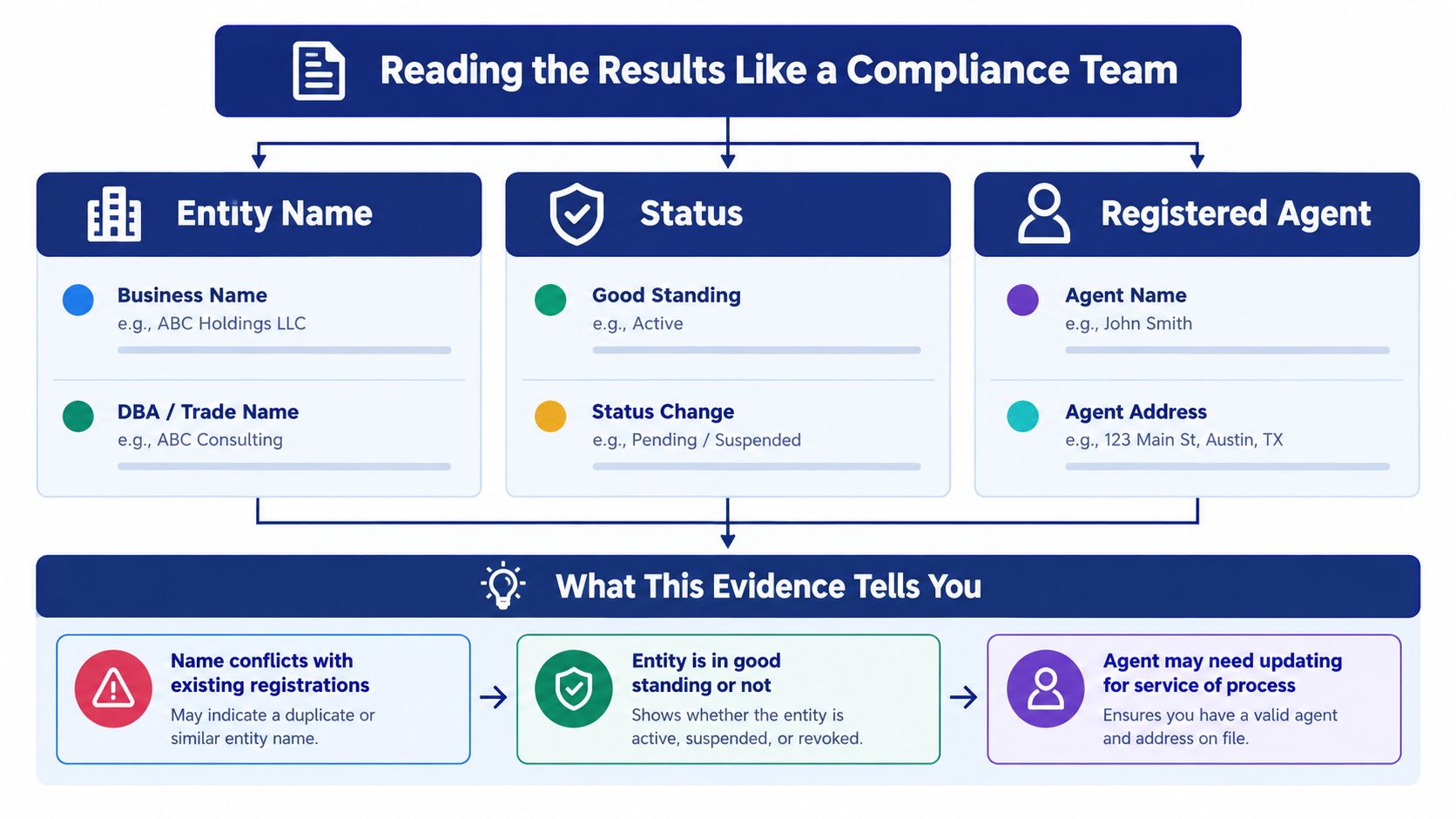
Most result pages look simple until you have to defend them. A compliance reviewer doesn't read a Utah record as a database row. They read it as evidence about identity, status, serviceability, and change history.
Status tells you relationship risk, not just existence
A status field helps answer whether the entity looks current, delinquent, expired, or otherwise not in a normal operating state. That matters for onboarding, lending, procurement, and ongoing vendor review because a live entity isn't the same as a healthy counterparty. A status page does not prove good standing by itself, and it doesn't replace a certificate when a third party wants official evidence.
Registered agent and principal address are operational signals
The registered agent tells you where service of process goes on paper. The principal address tells you where the registry says the business is anchored. Both are things you re-check over time, because they are common change points and often the first signs that a record drifted from reality.
Filing history is the audit trail
The filing history is the part many teams ignore, and that's a mistake. It shows when changes were filed, not just what the current record looks like. If an address changed, an agent changed, or the entity updated its structure, filing history is what lets you prove the sequence.
Don't trust a single field in isolation. A clean status with stale agent data can still create service problems.
Utah's annual report shows why this matters operationally. The state recorded 97,221 total new business registrations, 382,251 total business renewal registrations, and 375,954 online filings in the reported fiscal-year period (Utah Department of Commerce 2024 annual report). That volume means entity records change constantly, so a static snapshot ages quickly. For teams doing monitoring, those fields are not decorative. They are the signals that tell you when a relationship should be re-reviewed.
The cleanest way to think about the result page is this: name tells you who, status tells you whether it's current, agent tells you how to reach it, and filing history tells you what changed. If you can't explain each field in that language, you're reading the page too casually.
Why a Clean Result Is Not Clearance
Utah is explicit about the limits of its own comparison. The Division says its name comparison covers names registered in its records, but it does not reveal conflicts involving foreign corporations doing business in Utah without authorization or assumed names that were used but are no longer registered. That's the gap that gets people into trouble.
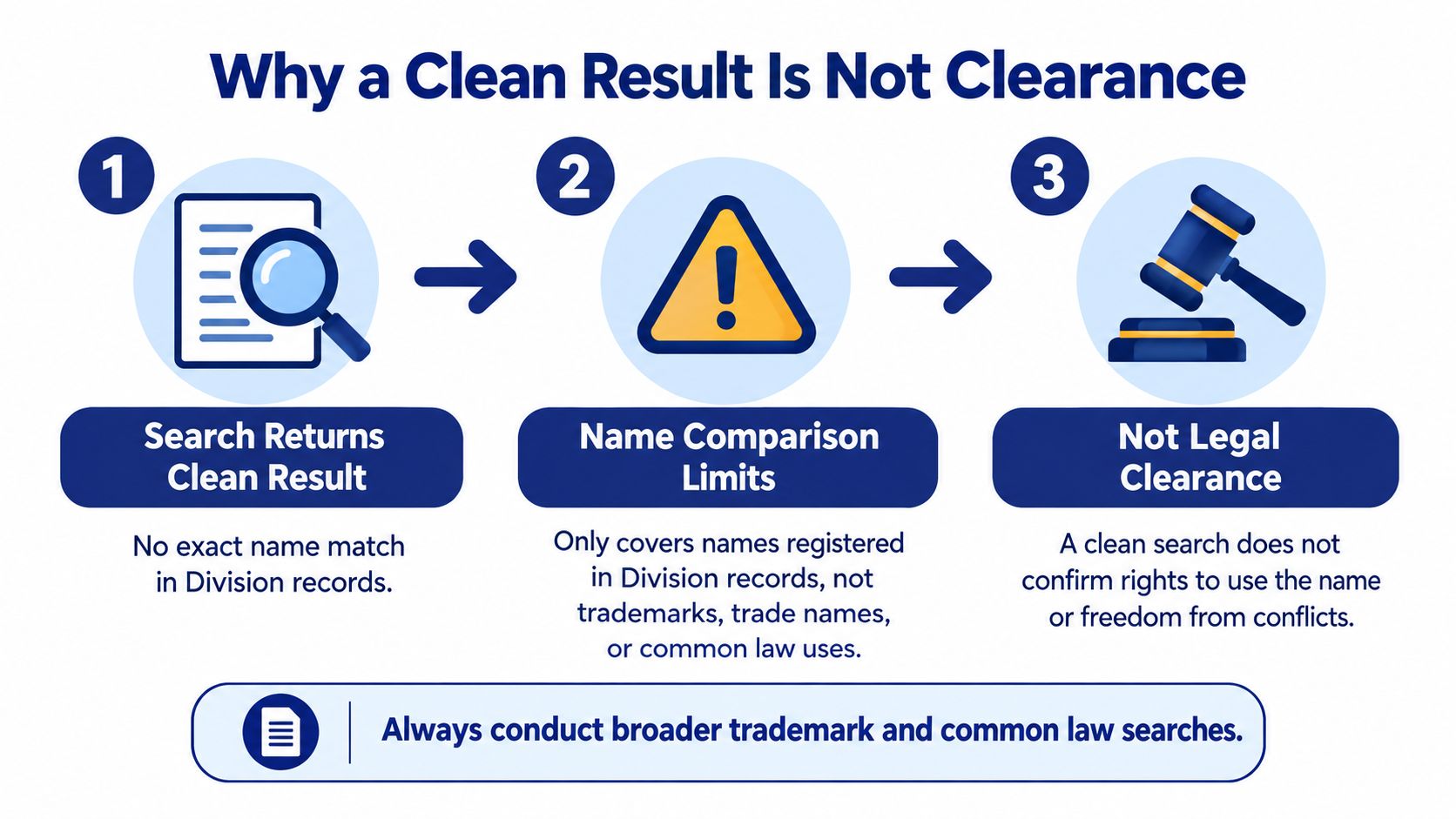
The false negatives Utah itself warns you about
A “no match” result can still miss a conflict if the business is operating in Utah without the state's authorization path you searched, or if a prior assumed name is no longer active in the records you're comparing against. That means the search can be accurate and still incomplete for brand-clearance purposes. Those are different standards.
Utah also recommends using both the availability search and the broader business-registration search for similar existing businesses, and it says approval is not final just because an online result appears available (Utah name availability policies). That is the part people skip. They treat a screen result as a decision. Utah doesn't.
The sequence that actually works
Run the candidate names first. Then use the dedicated name-availability search. After that, run the broader registration search for similar names. Inspect records that look confusing, including assumed names and close variants. Only then treat the result as preliminary support for filing.
A stronger workflow separates four questions instead of one. Is there a conflicting Utah entity? Is the name acceptable for filing? Is an assumed name active? Are there broader trademark or marketplace conflicts outside the registry? If you mash those into one yes-or-no answer, you'll miss something important.
A clean registry lookup is a starting point, not a legal conclusion.
For teams doing real clearance work, a broader search stack matters. Utah's database can be reliable for what it covers and still be insufficient for commercial use rights, trademark conflict review, or common-law exposure. That's why a multi-state sweep and human review still belong in the process. A screen result should support judgment, not replace it.
Turning a Search Into Auditable Evidence
A lookup becomes evidence only when someone else can reproduce it later. That means you need more than a screenshot and a hope.
Capture the record, not just the answer
Store the search timestamp, query string, jurisdiction, candidate-name variants, and the full result set. Tag the lookup with a status like preliminary_available, conflict_review, or approval_required so downstream teams know what they're looking at. If a reviewer can't tell whether the search was preliminary or final, the record is too weak to use.
The official entity record should be preserved as retrieved, not paraphrased into a note that says “looked fine.” If the original evidence disappears, the chain of review gets shaky fast. When a bank, filing authority, or counterparty needs formal proof, pull the official certificate or document instead of relying on a screen image.
Match the artifact to the risk question
A current status page may answer whether the record looks live. A filing-history document may be needed to validate an agent change or address update. A Certificate of Existence is the right artifact when someone outside your team needs state-issued proof. Each artifact solves a different problem, and using the wrong one creates avoidable back-and-forth.
The business-entity records page also notes that plain copies of previously filed documents can currently be obtained online for free, while principal searches are expected to carry fees once the new platform is fully built (Utah ordering in-house documents). That transition matters operationally because static internal playbooks age badly when the platform changes underneath them.
Utah filing-history and document retrieval guidance is useful if you need to turn registry output into a clean audit trail without inventing a local document taxonomy.
Wiring Utah Lookups Into Verification and Monitoring Flows
A Utah lookup shouldn't sit in a separate tab like a one-time chore. It should feed the same pipeline you use for onboarding, monitoring, and document retrieval.
Put the search where the decision happens
For onboarding and KYC, run Utah as part of a multi-state sweep when the counterparty has any Utah footprint, or when a Utah registered agent, address, or principal shows up. That keeps the search tied to the actual risk signal instead of a random checklist item. For procurement, it belongs before payment approval or vendor activation. For lending, it belongs before underwriting decisions that depend on legal identity.
For ongoing monitoring, the useful triggers are status, registered-agent, and address changes. Those are the records most likely to affect service of process, contactability, or relationship validity. Don't wait for a quarterly review if the registry changes in the meantime.
Use one workflow, not fifty state habits
The operational win is consistency. A unified API or registry layer lets teams handle Utah the same way they handle other states, while still respecting Utah's specific search behavior, name rules, and document artifacts. SOSfinder is one option in that category, because it aggregates business-entity records across all 50 states and the District of Columbia through a single endpoint and returns normalized entity data, filing histories, and monitoring-friendly outputs.
That matters for filing services and registered-agent providers too. The same lookup can support name clearance, annual report tracking, and document retrieval without forcing everyone back into a manual browser session. If your workflow depends on a human remembering which state portal to check, you'll miss changes.
Company data API guidance for multi-state workflows is the right reference when you're deciding how to wire Utah searches into a broader compliance or product stack.
Build the lookup once, then reuse the evidence everywhere it matters. That's cheaper than teaching every team a different state portal.
Common Pitfalls and a Practical Utah Search Checklist
A startup I've seen more than once picks a Utah-clean name, checks the exact spelling, skips assumed names, and files anyway. The search looks fine until the filing gets challenged because a close variant was already sitting in the records they never reviewed. The failure wasn't the registry. The failure was the search scope.
Utah business name availability lookup guidance is a good reminder that name work starts with search discipline, not optimism.
The mistakes that cost the most time
- Search assumed names too. A legal entity name is not the whole picture if a DBA or assumed name is the point of confusion.
- Search by principal or registered agent when relevant. Those fields can surface related records that a name-only search misses.
- Never treat the screen as final approval. Utah's own guidance says availability on screen is not the same as filing approval.
- Pull the certificate when someone else will rely on it. A counterparty wants state-issued evidence, not your screenshot.
A checklist worth using today
- Capture the exact query you ran and the timestamp.
- Save the jurisdiction and any name variants you tested.
- Review status, agent, and filing history, not just the entity name.
- Label the outcome as preliminary, review-needed, or approved for filing.
- Schedule a re-check if the record will matter after onboarding, not just at formation.
That's the practical version of Utah business lookup work. Search broadly, read the record as evidence, and use the right artifact for the risk.
If you need Utah entity checks that fit into onboarding, monitoring, or filing workflows, SOSfinder can plug the registry lookup into a single API-based process instead of forcing your team through separate state portals. Visit SOSfinder to see how its business entity search, filing history retrieval, and monitoring tools can support the way you verify Utah records today.