Arkansas Certificate of Good Standing: Fees and Steps

An Arkansas certificate of good standing is an official statement from the Arkansas Secretary of State confirming that a specific business entity has the authority to transact business in the state. Ordering one is inexpensive, and buying it online costs slightly more than ordering by mail because of the processing charge.
That's the whole transaction. Which raises a question worth settling before you order: if the document takes minutes and costs less than lunch, why do lenders, procurement teams and out-of-state filing clerks keep rejecting the copies people send them?
The certificate is narrower than its name suggests. It works like a dated snapshot of one fact: an entity's authority to operate, captured on the day the state issues it. A snapshot frozen on Tuesday says nothing about Wednesday, so a certificate printed months ago can fail a review even when the company itself is perfectly compliant. Ordering becomes a five-minute task once you see the document this way. Skip that framing and you'll buy the same certificate twice, or hand a counterparty a document that fails their review.
What follows covers how the document works, what each version costs, and what to verify before you send one anywhere.
What an Arkansas Certificate of Good Standing Confirms
The Arkansas Secretary of State's guidance defines the document tightly: it's an official statement confirming that a specific business entity has the authority to transact business in Arkansas. The same guidance says the certificate indicates the entity has complied with requirements administered by the Business and Commercial Services Division.
Read both clauses together and you have the full scope. Authority to transact business. Compliance with the division's requirements. Nothing wider.
A driver's licence is the closest everyday comparison, though it isn't exact. It proves you're licensed to drive on the day it's issued. It says nothing about next month's inspection, an unpaid ticket in another county, or whether an insurer likes your risk profile. The certificate behaves the same way: it's a dated snapshot of a company's right to operate, not a permanent licence and not an endorsement.
A certificate of good standing is a receipt for one day's authority to do business, not a warranty on the company holding it.
That distinction explains the usual request list. The document shows up in lending, vendor onboarding, corporate transactions, foreign qualification and legal due diligence, which is why it tends to arrive with a deadline attached. Arkansas also lets businesses buy and download certificates online through the Secretary of State's corporate-records system, so a paper request isn't required. If you want the wider context on how the status differs from the paperwork that records it, the explainer on what in-good-standing status means covers the underlying idea.
One naming caution before anything else. Arkansas uses related but not interchangeable certificate terms, and the type you pick changes both the price and what the document can be used for. That confusion causes more rejected submissions than any other part of this process.
Before you order, be able to say two things out loud: which recipient asked for the certificate, and the exact legal name of the entity as it appears in state records. Every step downstream depends on those two facts being right.
Fees and Turnaround for Each Certificate Type
Four options, three prices and two timelines. Read the table before you click anything.
| Document or channel | State fee | Extra charge | Turnaround |
|---|---|---|---|
| Certificate of good standing, bought online | $25 | $3 online processing fee | Printable immediately |
| Certificate of good standing, by records request | $25 | No separate charge listed in the records-request instructions | Processed in the order received; cannot be expedited |
| Certificate of existence | $15 | No separate charge listed for the document itself | Set by the channel you use; confirm before the deadline |
| Certified certificate order | $25 certificate fee | Certification charge not listed in the state materials; confirm at order | Generally 24 to 48 hours after payment |
Start with the row many applicants need. The records-request instructions list certificates generally at $25, and the online purchase adds a $3 processing fee on top. You can print the online certificate immediately, so a vendor onboarding file that needs one this afternoon costs $28 in total.
Step down one row and the price doesn't move but the clock does. The same instructions state that applications cannot be expedited and are processed in the order received, with no published queue length. Treat the request route as schedule-by-queue: fine when you have a week of slack, risky when the closing is Friday. The $3 you saved by mailing a form is the cheapest part of the process and the most expensive to get wrong.
The third row is where people improvise and regret it. A certificate of existence is a different document with a different evidentiary use, and it costs $15 rather than $25. When a recipient's checklist names a good standing certificate, swapping in the existence version is a rejection waiting to happen. Order what was named.
Certified orders move on their own clock. Where a counterparty wants an authenticated copy rather than a printout, plan for the certification order to be processed within roughly 24 to 48 hours after payment, and add that window to the deadline before you promise anyone a date.
One fee that belongs nowhere near this table: the $300.00 filing fee an out-of-state corporation pays for an Arkansas application for a certificate of authority, per the Secretary of State business services FAQ. It's a registration filing, not a certificate purchase, so it doesn't change any of the figures above.
Who Asks for One and How Recent It Must Be
The requester, not the state, decides how old a certificate can be. Five types turn up most often.

A lender typically wants one at loan closing, attached to the credit file. A marketplace or procurement team wants one before a vendor record goes live, often alongside insurance certificates and a W-9. A company expanding into another state needs one to attach to its foreign qualification filing, because the destination state wants proof the home state still recognises the entity. An investor or counterparty in a corporate transaction wants it in the data room. And a lawyer running diligence wants it as one exhibit among many.
Say a contractor applies for a credit line and the bank asks for a certificate dated within the last month. The contractor's printed copy is four months old because nothing about it looks expired. The bank's rule decides the outcome, not the paper's appearance.
That's the confusion worth clearing up: Arkansas materials define the document and describe how to get it, but they don't set a universal expiration period. Acceptance belongs to the requesting institution or the destination jurisdiction. A certificate doesn't come with a shelf life printed on it.
Working rule: ask the requester for their age limit in writing before you order. No stated limit means ordering a fresh certificate close to the signing date.
Save the retrieval date, not just the file. A PDF sitting in a shared drive looks current until someone reads the issue date, and the gap between "when it was downloaded" and "when it was issued" is where disputes start.
Three questions to send the requester, in one short email: which document they need (good standing, existence, or another type), whether a certified copy is required or a plain printout will do, and how recent the issue date must be. Their answers set your entire order.
How to Request and Download Your Certificate
The sequence is short, and each step has one failure mode worth knowing before you hit it.
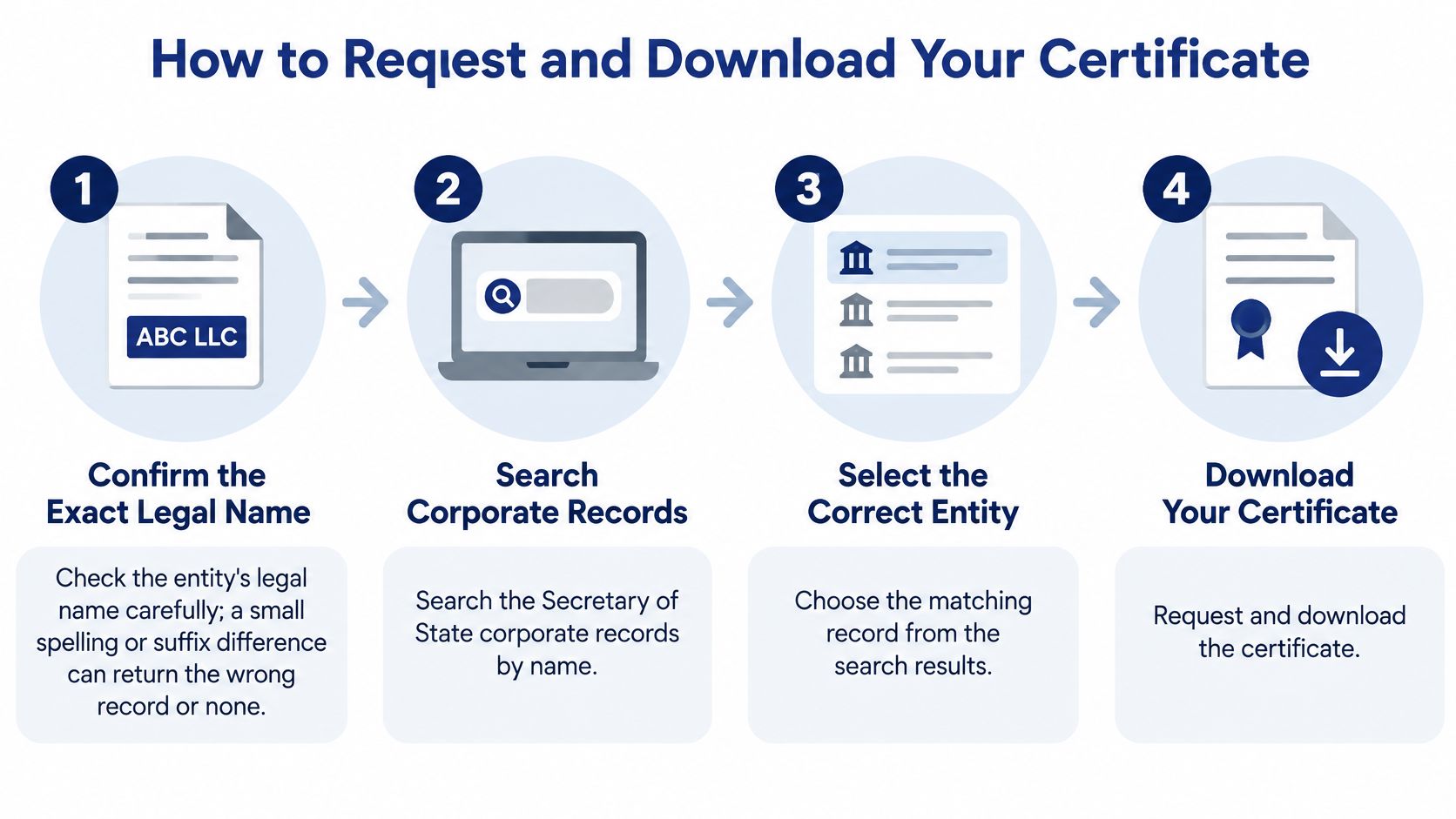
- Confirm the exact legal name. Check the spelling, punctuation and suffix exactly as filed, because "Co." versus "Company" or a missing "LLC" can return the wrong record or no record. Running the name through the Arkansas LLC name search tool first shows you the spelling the registry holds. The common slip is trusting the name on your own letterhead.
- Search the Secretary of State corporate records and confirm you've found the right entity, not a similarly named one in another county. Compare the filing number and formation date, not just the name. Skipping this check is how people end up certifying a dissolved predecessor with a nearly identical name.
- Decide between the good standing certificate and the certificate of existence based on what the recipient named, not on which is cheaper or faster. If the request is ambiguous, ask. Guessing wrong costs a second order and a delayed file.
- Choose the channel that matches your deadline. Online purchase if the document is needed today; a records request only if you have real slack, since it moves in the order received. Picking the slower channel to save a small processing charge is the most common self-inflicted delay.
- Pay and keep the receipt. The online checkout takes the state fee plus its processing charge, and the record of that payment belongs in the same folder as the certificate. Finance teams ask for it later.
- Download, print, and rename the file with the retrieval date. A filename like
entity-legal-name-good-standing-2026-03-14.pdftells the next person in the chain exactly what they're looking at. Untitled downloads get mistaken for current documents months later. - Place a certification order if the recipient requires an authenticated copy, and allow the stated processing window after payment before you promise delivery. Certification runs on a slower track than a self-printed copy, and nobody can compress it.
When the file lands, check three things on the printout: the entity name, the issue date, and the wording confirming authority to transact business in Arkansas. Then verify it against the source. Re-run the entity search in the Secretary of State's records and confirm the legal name, the status and the issue date all match what you downloaded. Resolve any mismatch, including a suffix difference, before the file leaves your desk. A certificate that can't be matched back to the record shouldn't go to a recipient, because their first check is the same one.
What Good Standing Does and Does Not Prove
A good standing certificate is a point-in-time registry-status document, not a clean bill of health.
The Secretary of State's FAQ draws the line explicitly: the certificate states that a specific entity has authority to transact business in Arkansas. It does not state that the entity has paid every tax, met licensing requirements, or stayed free of litigation and regulatory problems.
That gap matters most to the people most likely to over-read the document. Lenders, marketplaces, procurement teams and KYC systems all like a binary field, and "good standing" reads like a pass. Treated as a full risk signal, it hides exactly the problems a transaction cares about.
The obligation that most often breaks standing
Arkansas ties standing to a recurring payment that owners meet once a year and then forget. The Secretary of State's franchise tax pages explain that the Arkansas Corporate Franchise Tax Act of 1979, codified at Arkansas Code § 26-54-101 and following, requires all corporations, LLCs, banks and insurance companies registered in Arkansas to pay an annual franchise tax. The 2026 FAQ materials list the minimum charges as $150 for stock corporations and $300 for corporations without stock, and filing online adds a $5 processing fee on top of the entity's minimum.
| Entity type | Minimum annual franchise tax | Notes |
|---|---|---|
| Stock corporation | $150 | Annual minimum under Arkansas Code § 26-54-101 and following |
| LLC or PLLC | $150 | Same annual minimum as a stock corporation |
| Corporation without stock | $300 | Higher annual minimum |
Because standing reflects compliance with the requirements the state's business services division administers, those annual filings are the leading indicator to check before you order. If the record shows an unfiled year, treat the status as unreliable for the transaction rather than assuming a certificate will paper over it.
What the certificate leaves out
Run these separately, and keep the results in the same diligence file rather than treating the certificate as their substitute.
- Professional licences. A contractor's state licence, a clinic's health permits, an insurance producer's appointment. The registry doesn't publish them.
- UCC records. Secured lending and prior liens live in a different index entirely.
- Litigation and regulatory history. Court dockets and agency actions say things a certificate never will.
- Beneficial ownership. Who controls the entity, which the certificate doesn't address.
The onboarding failure to plan around
A procurement team accepts a certificate as its only proof of standing, awards the contract, and later discovers an unpaid annual franchise tax sitting behind it. The paperwork was genuine when issued. It just answered a narrower question than the team assumed.
The lesson is to store the evidence together. Keep the certificate type, issue date, retrieval channel and annual-compliance indicators in one record, and the discrepancy surfaces in review instead of in an audit. A certificate issued in January says nothing about a franchise tax payment that lapsed in May, so the file has to carry both halves of the picture.
One correction to keep straight: if a state record itself is wrong, the fix has to come from the Secretary of State office that maintains the filing. A data provider can't amend it, and neither can you.
The record and its supporting paperwork belong in one place, so keep the governing documents that established the entity alongside the certificate. The guide to company formation documents shows what a diligence file usually holds beside it, from the articles that created the entity to the amendments that changed it.
Plan Your Deadline and Next Step
Run a short pre-send check instead of re-reading the steps.
First, confirm the printout matches what the recipient asked for: the document name they specified, whether a certified copy is needed, and whether the issue date clears their freshness rule. Second, work backwards from the deadline. An online certificate prints immediately, a certification order needs its processing window after payment, and a correction at the state takes time on top of both. Third, if the record shows an error or a missing annual filing, fix it with the Secretary of State before ordering, so the certificate doesn't carry the defect into the file. A missed filing can eventually cost the entity its authority altogether, and the explainer on what administratively dissolved means is worth reading before you order against a status you don't recognise.
Then complete the checks the certificate can't do for you: licences, UCC filings, litigation and beneficial ownership.
For teams verifying many entities across states, our developer API returns normalised registry status, registered agent, officers and filing history with change monitoring. SOSfinder results are not a substitute for an official certificate of good standing or a certified copy, so use them to decide what to order and when, not to replace the document itself.
Order the certificate the recipient named, then run the checks.
If you're building onboarding, KYC or vendor-verification workflows, SOSfinder returns normalised Arkansas entity records, including status, registered agent, formation date and filing history, through a single endpoint that covers all 50 states and DC. Use it to screen entities and watch for status changes between certificate orders, then pull the official Arkansas certificate of good standing from the Secretary of State when a counterparty requires one. Start with a lookup on a live entity to see the fields you'd get back before wiring it into your process.