What Does Administratively Dissolved Mean? Causes and Fixes

Administratively dissolved means a state has ended a business entity's active legal status because it failed a recurring requirement, such as an annual report, taxes or fees, or a registered agent, and the owners didn't choose it.
You might discover the label while checking your own LLC, reviewing a vendor, or onboarding a business customer. The company may still have a website, employees, and unpaid invoices, which makes the registry result confusing. The useful question isn't whether the business is dead. It's what caused the status, what restrictions apply, and whether the business can still fix it.
What Administrative Dissolution Means in Plain Terms
Administrative dissolution is a state filing action, not necessarily evidence that the owners closed the doors. The state has identified an unmet requirement and changed the entity's legal status through its administrative process.
Think of a driver's license that lapses because someone missed the renewal. The lapse doesn't mean the car was wrecked or the driver disappeared. It means the permission attached to that license is no longer current. The analogy helps explain the status, although business reinstatement rules are more complicated than renewing a license.
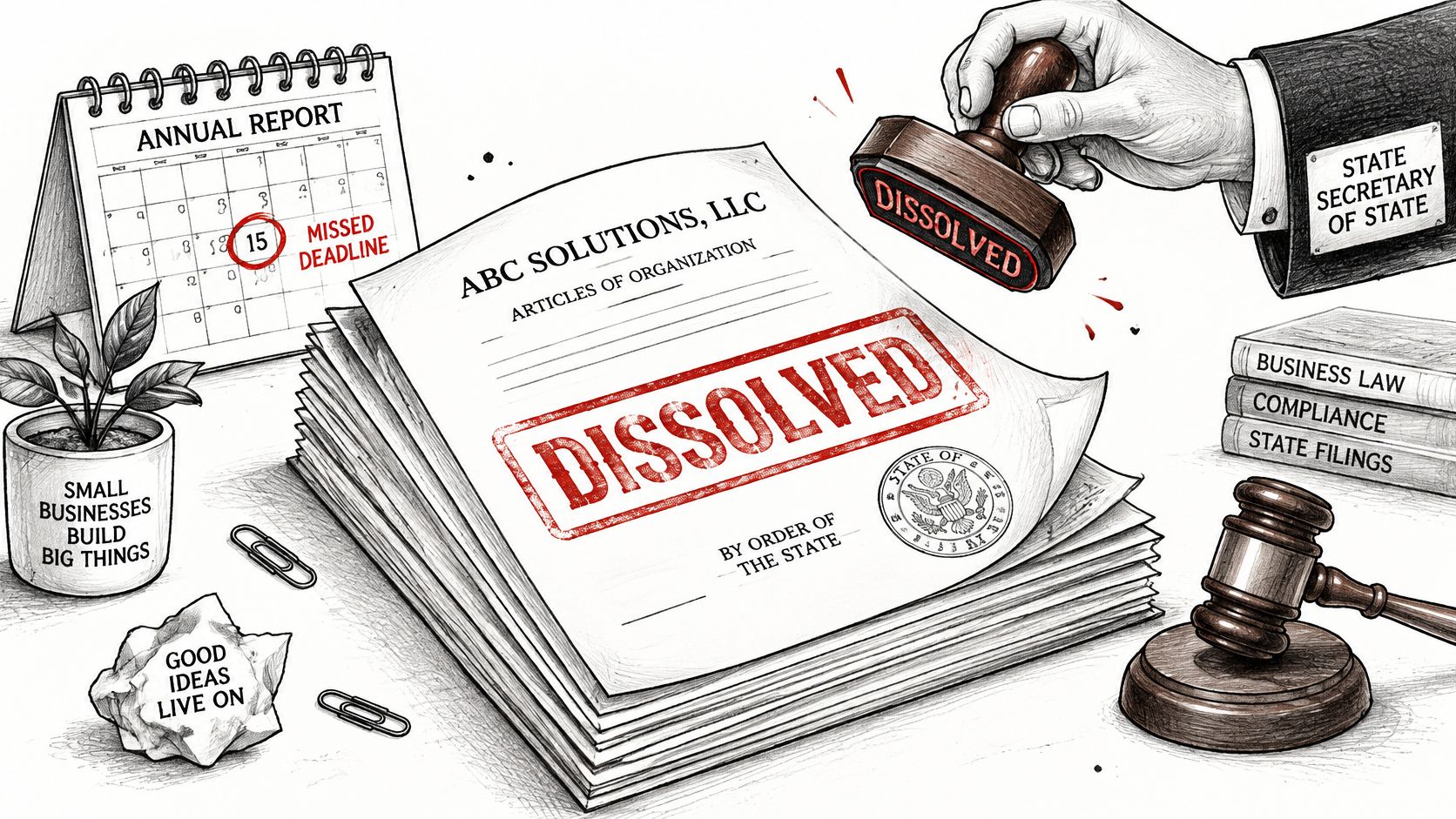
Who initiated the change matters
Voluntary dissolution means the owners chose to wind up the entity. Judicial dissolution results from a court order. Administrative dissolution is different from both: the state acted because the entity didn't meet a statutory obligation.
The usual categories are:
- Missing reports: An annual or biennial filing wasn't submitted.
- Unpaid amounts: Required state taxes or fees remain outstanding.
- Agent problems: Required registered-agent information wasn't maintained.
- Filing defects: A document or required correction didn't satisfy state requirements.
Don't treat administrative dissolution as interchangeable with every other status that falls short of being in good standing. Read the state's actual label and filing history rather than translating every unfavorable result into the same conclusion.
Practical rule: Identify the entity, the jurisdiction, and the effective date before deciding what the status means.
An LLC and a corporation may face different rules even within the same state. A recently dissolved entity may also have different options from one whose owners ignored the record for a prolonged period.
Start with the official registry record. Save the entity identifier, exact status wording, effective date, and stated reason. If the record doesn't explain the reason, obtain the notice or contact the state filing office instead of guessing from the label.
Common Causes and What the State Checks
Use this lookup to distinguish the filing problem from the business risk. An ignored notice is generally an escalation of an unresolved defect, not a separate filing obligation.
| Trigger | What the State Checks | Why It Matters |
|---|---|---|
| Missed annual or biennial report | Report not filed by the deadline | A company may still owe reports despite having no profit or meaningful activity |
| Unpaid franchise tax or state fees | Balance owed to the state | Outstanding amounts can include interest and penalties |
| No registered agent or address | Required agent or address missing from the record | Delivery of legal papers and official notices can be disrupted |
| Defective or incorrect filing | Filing contains a statutory deficiency | The record remains out of compliance until the defect is corrected |
| Ignored state notice | The stated cure deadline has passed without correction | An unresolved deficiency can proceed to dissolution |
North Carolina's administrative dissolution guidance explains that annual reports remain due regardless of whether a corporation earned a profit or conducted meaningful activity. No revenue doesn't mean no filing obligation. Owners who stopped trading may mistakenly assume they also stopped owing administrative filings.
Separate paperwork gaps from operating concerns
A missed report can reflect a calendar mistake. Repeated unanswered notices, an unreachable agent, and an outdated address deserve a broader inquiry because they may indicate that nobody is maintaining the entity.
Check the registered agent address separately from the business's storefront or mailing address. The agent's role includes receiving legal documents, so a functioning sales office doesn't prove that the required legal contact is current.
Tax filings and entity reports also serve different purposes. Don't accept a tax-return receipt as proof that the Secretary of State received an overdue annual report.
Ask for the document that resolves the stated defect, not merely a document showing that the business filed something.
For onboarding teams, the distinction changes the follow-up. A missing report calls for evidence of the accepted report and restored status. A record with multiple unresolved defects calls for a fuller review of the entity's filing history and present operations.
Dissolution as a Lifecycle, Not a Final Verdict
Administrative dissolution often sits within a longer compliance lifecycle. Treating it as an irreversible endpoint can lead an owner to abandon a recoverable entity or a reviewer to reject a counterparty without examining the available remedy.
A useful working sequence is:
- Delinquency or notice: The state identifies a missing requirement and may provide an opportunity to correct it.
- Effective dissolution: The state changes the entity's status.
- Restricted activity: Applicable law determines what the entity can do while dissolved.
- Reinstatement eligibility: The entity may be able to cure its defaults and request restoration.
- Resolution: The state accepts reinstatement, or the entity must pursue another available route.
The clock changes the options
Some jurisdictions limit how long an entity can seek reinstatement. Name availability and additional filing requirements may also affect whether the original entity can return to active status.
That's why the dissolution date belongs next to the current status in a review record. A statement that the owners intend to reinstate tells you little without confirmation that the remedy remains available.
Say a consulting company discovers its dissolved status while preparing to sign a customer agreement. Its first decision shouldn't be to create a replacement company immediately. It should establish whether it can restore the existing entity, what must be corrected, and whether the pending transaction can wait.
Starting over involves a separate company registration process in the USA, not changing the status on the old record. Don't assume a new formation resolves the original entity's outstanding obligations.
For engineers, preserve status events, not just the latest status string. A record that becomes active again may still need a historical dissolved interval in an audit trail. Timing determines both the available remedy and the questions a reviewer should ask.
What an Administratively Dissolved Business Can Still Do
The state's law determines the operating limits. There isn't a nationwide permission slip allowing every dissolved business to continue ordinary work while its owners prepare paperwork.
Utah provides a clear example: its LLC administrative dissolution statute says a dissolved LLC continues to exist but may conduct only activities needed to wind up its affairs or seek reinstatement, and its registered agent's authority continues.
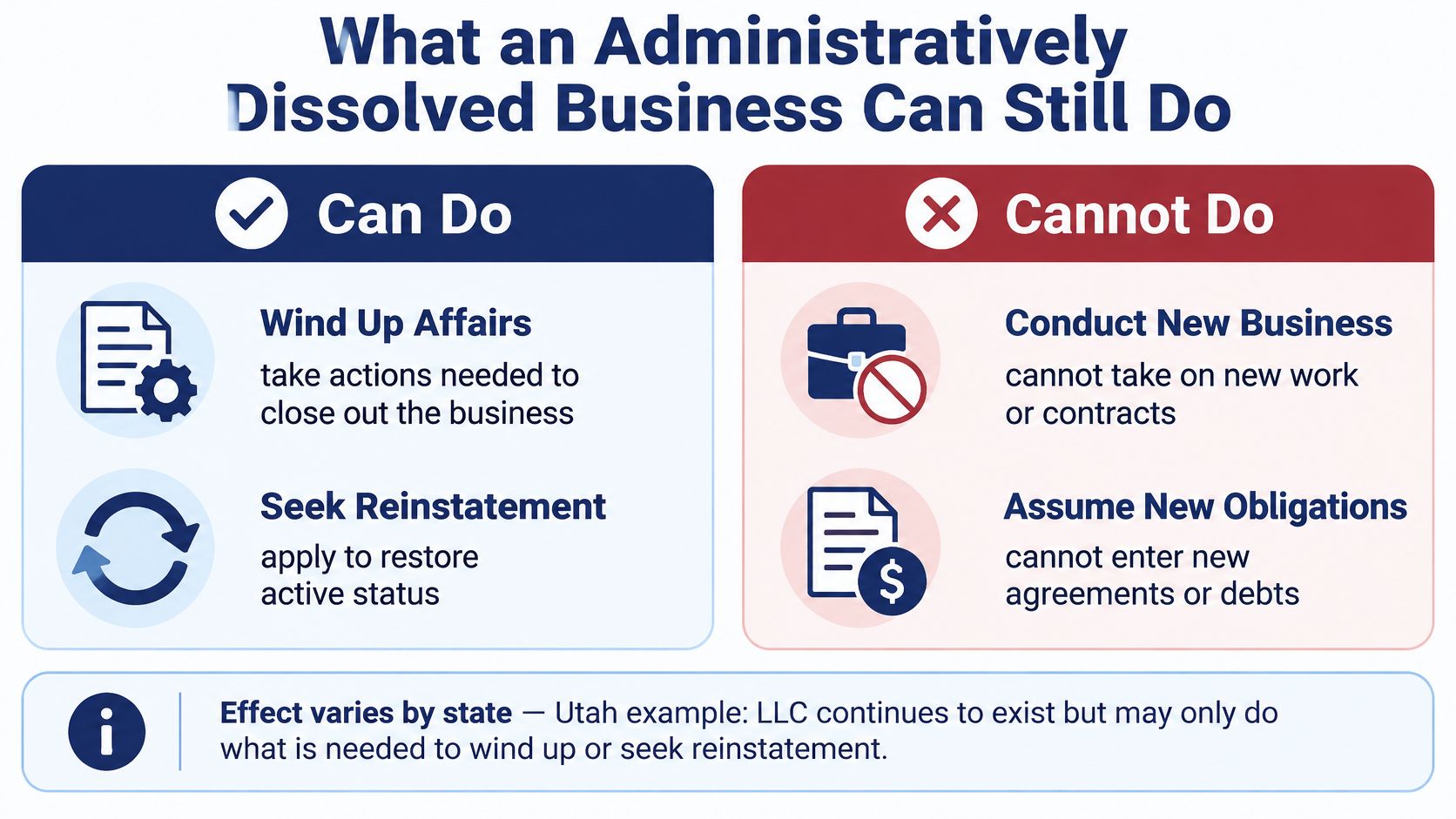
Continued existence isn't unrestricted authority
The positive side is that dissolution doesn't necessarily prevent every action. An entity may retain the ability to close out affairs and pursue the process that restores its status.
The restriction is equally important. Winding up isn't the same as taking on new work. Signing a new client contract, borrowing to expand, or opening an account for ongoing operations can raise authority questions under a restrictive state rule.
The infographic illustrates that restrictive approach, not a universal rule for every entity. Check the governing statute before applying its “cannot do” column to a particular business.
Check the transaction, not just the company
An existing contract doesn't become automatically meaningless merely because a registry displays a dissolved status. Nor should a counterparty assume that every new agreement is safe because the company still answers email. Contract terms, applicable law, and the circumstances of the transaction require separate review.
Before proceeding, check:
- Permitted activity: Does the state authorize the action during dissolution?
- Contract authority: Does the pending agreement require current entity authority or good standing?
- Banking requirements: Does the lender or bank require a current certificate?
- Existing commitments: Which payments, deliveries, or other obligations still need attention?
For a material transaction already signed during the dissolved period, ask a qualified business attorney to assess the consequences. Don't infer personal liability, contract invalidity, or complete protection from the registry label alone.
Reinstatement Rules Across Key States
The comparison below highlights different reinstatement conditions. Where an operating restriction isn't established here, the table directs you to verify it rather than assume permission.
| State | Effect While Dissolved | Reinstatement Rule |
|---|---|---|
| Utah | Restricted to winding up or seeking reinstatement | The Utah reinstatement statute requires payment of amounts due at dissolution and amounts that would have become due while dissolved |
| Florida | Verify operating authority before undertaking new activity | Reinstatement relates back to the dissolution date |
| Illinois | Continuity is restored upon qualifying reinstatement | The Illinois LLC statute deems existence continuous from the dissolution notice and ratifies qualifying acts during the dissolved period |
| Georgia | Confirm the applicable corporation or LLC restrictions | Reinstatement is subject to a statutory application window |
| North Carolina | Confirm authority for the proposed transaction | A non-distinguishable name must be changed, statutory problems corrected, and required fees paid |
Retroactive restoration has limits
Relation back means the law gives reinstatement an effect tied to the earlier dissolution date. It can be important when assessing entity continuity and actions taken during the dissolved period.
It doesn't justify ignoring the dissolved status while it remains unresolved. A business still needs to satisfy the reinstatement requirements, and separate tax, licensing, employment, or contractual problems may require their own remedies.
Florida's treatment also preserves certain third-party rights formed in reliance on dissolution. A business shouldn't assume that reinstatement allows it to undo every consequence experienced by someone else.
Confirm the rule that controls your entity
Contact the state office that maintains the filing and identify the entity type before requesting instructions. Ask about eligibility, name conflicts, missing reports, tax clearance, and the effect of approval.
Use the state's current forms and instructions rather than another company's old reinstatement packet. A checklist that worked for a corporation in one jurisdiction may omit a requirement for an LLC elsewhere.
For review systems, keep the reinstatement filing and its effective date alongside the status change. A green active-status badge is useful, but it isn't a substitute for evidence of how the entity returned to that status.
How to Reinstate a Dissolved Business Step by Step
Build the application around the state's stated defaults. Paying a balance or submitting a form alone may not resolve every defect.
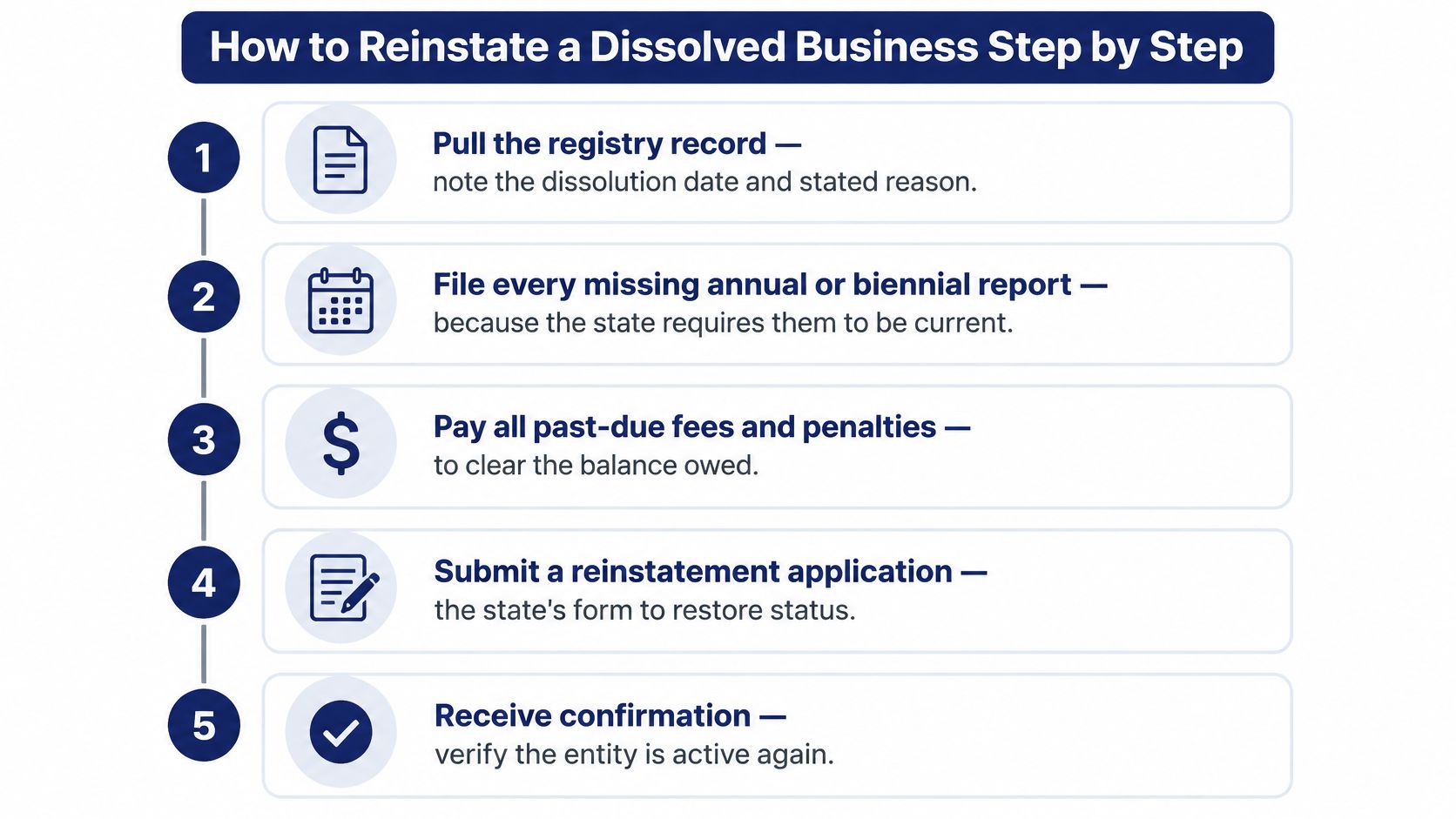
Prepare the cure
Pull the registry record and dissolution notice. Match the legal name and entity identifier, then record the effective date and stated cause. Don't prepare paperwork for a similarly named company or rely on a search-engine snippet.
Identify and file every required missing report. Ask the filing office which reporting periods remain outstanding. A recent report may not satisfy earlier missing filings, and inactivity isn't a reason to omit a required period.
Obtain the full balance and payment instructions. Confirm overdue taxes, filing fees, interest, penalties, and any charges that became due during dissolution. An overlooked balance can prevent approval even after the main payment clears.
Confirm the registered agent and current addresses. Check that the agent is properly appointed and that the required address information is accurate. Don't assume an address change in your accounting software updated the state registry.
Submit and verify
Correct defective filings with the state office. Corrections to an incorrect official record must go to the office that maintains it. We can't file documents, register entities, or change official records on a customer's behalf.
Resolve any name conflict before final submission. Confirm whether the existing name remains acceptable for reinstatement and submit a required name change in the state's prescribed sequence. Discovering a conflict at the end can stall an otherwise complete application.
Submit the reinstatement application and required fee. Follow the state's instructions for supporting documents and any separate clearance requirements. Keep the submitted packet, payment receipts, and acceptance confirmation together.
Check the registry after approval. Verify the resulting status and effective date rather than treating a submission receipt as approval. If the accepted filing and public record disagree, ask the state office to resolve the discrepancy.
Before resuming ordinary operations: Confirm approval, then separately check any licenses, permits, or registrations relevant to the business.
Keep this evidence in the entity's compliance file. Assign someone to maintain the report calendar, review agent information, and respond to future notices so that reinstatement doesn't become a recurring repair task.
Confirm the Status Before You Rely on a Business
For a lender, vendor manager, or onboarding team, administratively dissolved should trigger review, not an automatic acceptance or rejection. The decision should follow the proposed activity and the evidence available.
Record the facts that explain the result:
- Identity and jurisdiction: Legal name, entity identifier, entity type, and filing state.
- Status history: Exact status, effective date, stated reason, and last report date.
- Outstanding requirements: Published tax or fee delinquency indicators and missing filings.
- Available remedy: Reinstatement eligibility, any applicable deadline, and later accepted filings.
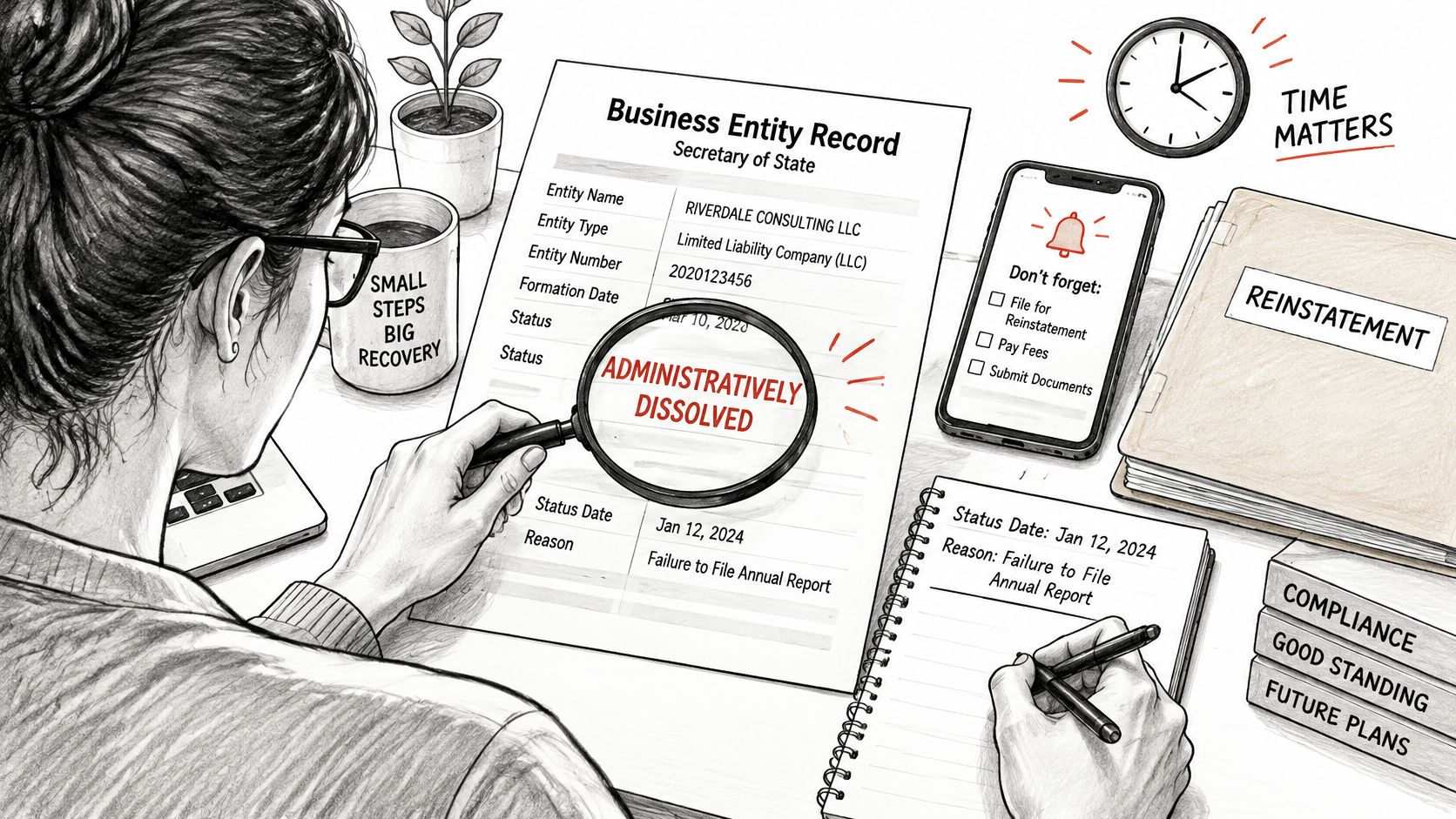
Match the evidence to the decision
If the business must sign a contract, borrow, or open an account, make proof of restored authority a condition of proceeding where appropriate. Request an accepted reinstatement filing or a current good-standing certificate, not just the owner's promise that paperwork is underway.
For a Minnesota entity, a Minnesota Secretary of State business search can help locate the relevant state record. Use the corresponding filing office for entities formed elsewhere.
A blank field is missing evidence, not proof of compliance. We return fields a state doesn't publish as null, or as an empty list for officers, filings, and documents. Route missing information to a follow-up task instead of converting it into a favorable result.
Our SOSfinder records normalize status, entity type, formation date, registered agent, and principal address into a consistent format and support filing-history checks, but we can't file or change records for you.
Keep the decision current
Monitor relevant changes after the initial review, especially when approval and payment occur at different times. Save the checked record and the supporting documents so another reviewer can understand why the transaction proceeded.
Verify the status with the state filing office, establish whether reinstatement remains available for the proposed deal, and recheck the registry before payment or signature. That gives you a defensible decision rather than a guess based on a status label.
Visit SOSfinder to search normalized business entity records and review available filing histories for your next onboarding or vendor check. Use the status, jurisdiction, and filing evidence to identify dissolved entities that need follow-up before you approve a transaction.