Articles of Corporation Michigan: Fields, Fees and Filing
If you have a Michigan corporation's original Articles of Incorporation, do you know what the company looks like today? Not necessarily. The Articles establish its formation, but later filings may change its name, share authorization, resident agent, or registered office.
People searching for “articles of corporation Michigan” generally mean Articles of Incorporation, the formation document for a corporation. Getting that document right requires more than filling every blank. You need to distinguish required fields from optional provisions, calculate the correct fees, and preserve a record you can reconcile with later registry filings.
Required Fields in Michigan Articles
| Field | Requirement | Notes |
|---|---|---|
| Corporate name | Required | Must carry an accepted ending; see name endings |
| Purpose | Required | All-purpose clause generally accepted for profit corporations |
| Resident agent and registered office | Required | Michigan address; post office box not accepted |
| Authorized shares | Required | Total shares; class or series rights when more than one class |
| Incorporators | Required | Names and addresses; each incorporator signs |
| Duration | Only if not perpetual | Perpetual duration is presumed |
| Optional provisions | Optional | Examples include dissolution and distribution of assets |
The Michigan LARA corporation formation guidance identifies the required information, signature requirements, and distinction between perpetual duration and optional provisions. Use the checklist for a domestic profit corporation, not as a substitute for the form applicable to another entity category.
Separate the agent from the office
The resident agent is the named person or entity serving that role. The registered office is the Michigan location listed for it. Don't combine these into an ambiguous entry such as an agent's name followed by a mailing box.
Use a Michigan street address for the registered office. If the form separately asks for a mailing address, enter that information in its designated field rather than substituting it for the street location.
Make the share and signature entries complete
A share count alone won't fully describe a structure with different classes or series. Those entries also need the applicable rights, preferences, and limitations. Complex capitalization deserves careful drafting before submission, not an improvised attachment.
The incorporator list and signature block should also agree. An incorporator's printed name shouldn't change between the identification field and the signature page.
Drafting check: Read the completed document as a stranger would. Can someone identify the corporation, its agent, its registered office, its share authorization, and everyone responsible for signing?
For a hypothetical Lakeshore Analytics Inc., the draft might use an all-purpose clause, a single common-stock class, and a resident agent at [EXAMPLE LANSING STREET ADDRESS]. Replace every placeholder with confirmed information. Before filing, compare the draft against every row in the table, including conditional fields you've intentionally left unused.
Corporate Name Endings and Purpose Clauses
| Full ending | Accepted abbreviation |
|---|---|
| Corporation | Corp. |
| Company | Co. |
| Incorporated | Inc. |
| Limited | Ltd. |
Harbor Works Inc. and Northwind Supply Company illustrate names with corporate endings. Harbor Works alone omits that element. An otherwise suitable name can still require correction when the corporate designation is missing.
Check the registry before drafting the entire document. A business name availability check helps you identify potential conflicts early, but a search result isn't permission to disregard the state's naming requirements.
Choose a purpose that fits the corporation
An ordinary profit corporation can generally use an all-purpose clause. A professional service corporation needs purpose language tied to its profession instead of an unrestricted business description.
For an ordinary profit corporation, illustrative wording is:
The purpose of the corporation is to engage in any lawful activity for which a profit corporation may be organized under the Business Corporation Act.
Keep the legal name consistent throughout the document. Switching between Company and Co. may seem harmless, but it creates avoidable uncertainty about the exact name being adopted. Use the filed legal name when identifying the corporation on contracts and bank records.
Before approving the draft, check:
- Ending: The name contains an accepted corporate designation.
- Consistency: Every occurrence uses the same spelling and ending.
- Purpose: The clause matches the corporation's legal category.
- Availability: You've reviewed potential name conflicts before submission.
Authorized Shares and the Organization Fee
The official Michigan profit-corporation Articles form sets the organization-fee schedule shown below.
| Authorized shares | Organization fee |
|---|---|
| 1 to 60,000 | $50 |
| 60,001 to 1,000,000 | $100 |
| 1,000,001 to 5,000,000 | $300 |
| 5,000,001 to 10,000,000 | $500 |
| More than 10,000,000 | $500 for the first 10 million, plus $1,000 per additional 10 million or portion |
A separate $10 nonrefundable filing fee applies under LARA's domestic profit and professional corporation fee schedule, making the minimum combined formation charge $60, calculated using the lowest organization-fee tier above.
Calculate from authorized shares
Authorized shares means the shares the corporation is permitted to issue under its Articles. Don't calculate the organization fee from the shares founders intend to issue immediately or from the number of shareholders.
For a hypothetical corporation authorizing shares within the second tier, add that tier's organization fee to the separate filing fee. The calculation is straightforward, but choosing the wrong share-count input produces the wrong payment.
A larger authorization may serve a legitimate financing or ownership plan. It can also increase formation costs when it crosses a fee threshold. Choose the capitalization deliberately rather than copying a share count from an unrelated company's template.
Check the payment and form together
The current form's payment instructions direct payment to the State of Michigan and identify unpaid or incomplete fees as a filing problem.
Keep the fee calculation with the draft so the reviewer can verify both the share count and payment. Confirm the current form revision before submitting. Nonprofit Articles use a separate schedule, so don't apply this profit-corporation table to a nonprofit filing.
Sample Articles of Incorporation Text
Use the following as a drafting worksheet, not a filing-ready replacement for the state form. The labels organize the information by topic; the current form controls the actual numbering, sequence, wording, and layout.
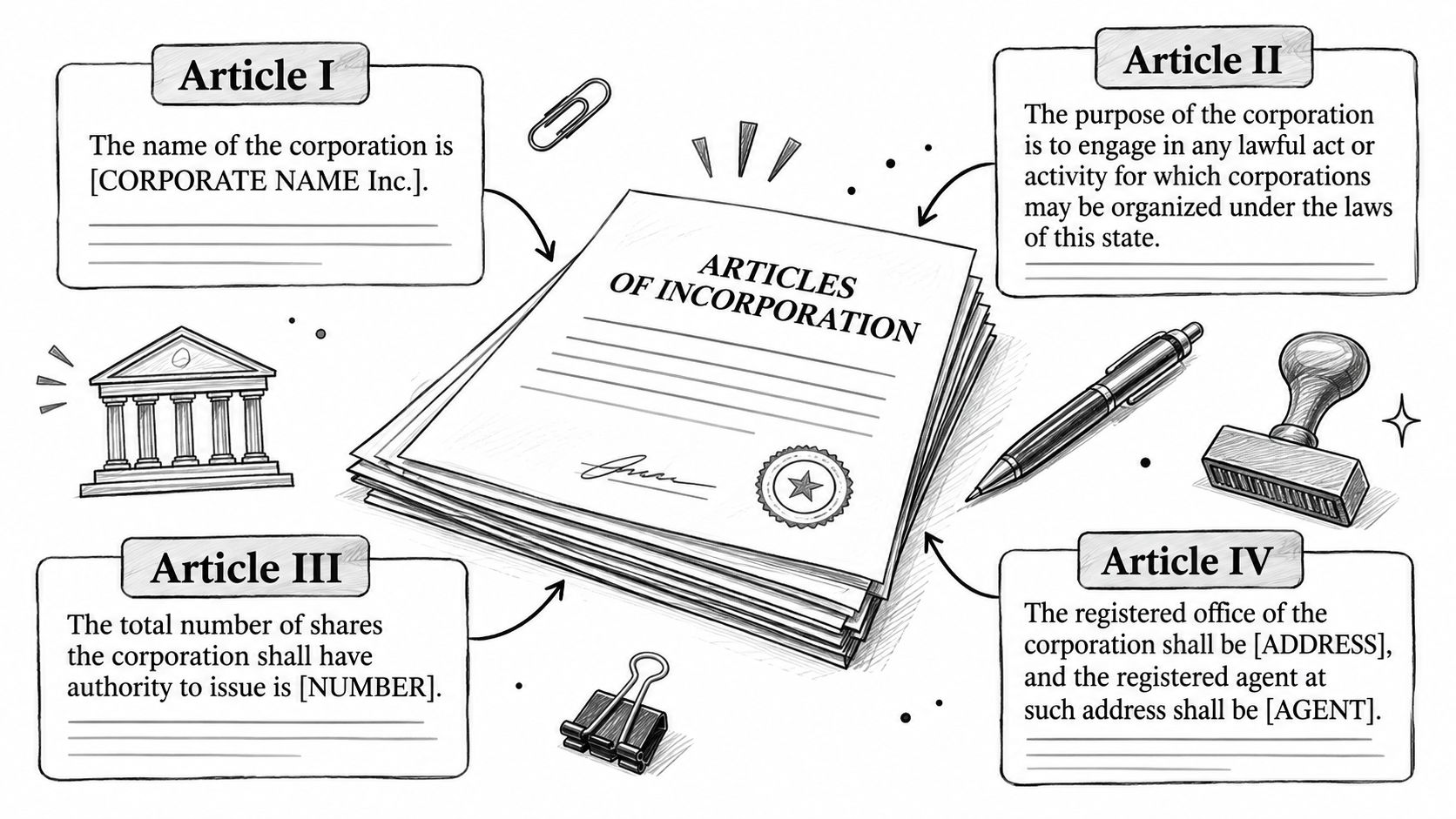
The illustration below represents the document package you'll prepare and retain.
Name and purpose
Article I, corporate name
The name of the corporation is [CORPORATE NAME WITH ACCEPTED ENDING].
Insert the complete legal name, not a marketing name or an unfinished name reservation idea.
Article II, purpose
The purpose of the corporation is [PURPOSE CLAUSE APPROPRIATE TO THIS CORPORATION].
Choose wording appropriate to an ordinary profit corporation or a professional service corporation, rather than treating those categories as interchangeable.
Agent, capitalization, and incorporators
Article III, resident agent and registered office
The name of the resident agent is [AGENT NAME]. The registered office address is [MICHIGAN STREET ADDRESS, CITY, MI ZIP].
Confirm that the agent's identity and office location are accurate before copying them into the form's separate fields.
Article IV, authorized shares
The total number of shares the corporation is authorized to issue is [TOTAL AUTHORIZED SHARES], consisting of [CLASS OR SERIES DESCRIPTION AND APPLICABLE TERMS].
For a simple common-stock structure, identify that class clearly. Don't add preferred-stock language or par-value terms merely because another template contains them.
Article V, incorporators
The names and addresses of the incorporators are [EACH INCORPORATOR'S FULL NAME AND ADDRESS].
Provide a complete entry for each incorporator.
Article VI, optional provisions, if used
[OPTIONAL PROVISIONS REVIEWED FOR THIS CORPORATION].
Don't insert dissolution or asset-distribution language without understanding its effect.
Signatures and final review
Use a signature block for each incorporator:
Signature: [INCORPORATOR SIGNATURE]
Printed name: [NAME MATCHING THE INCORPORATOR LIST]
Date: [SIGNATURE DATE]
This sample illustrates structure and isn't legal advice. Compare every bracketed entry with the current state form, remove unused drafting instructions, and review any custom provisions before submission.
How to File the Articles Step by Step
Michigan's Business Corporation Act, enacted as 1972 Public Act 284, permits one or more persons to become incorporators by signing and filing Articles of Incorporation. Under that statute, corporate existence begins on the Articles' effective date, not when the founders agree to start a business.
The visual summarizes the filing workflow; the checklist below adds the document-control steps.
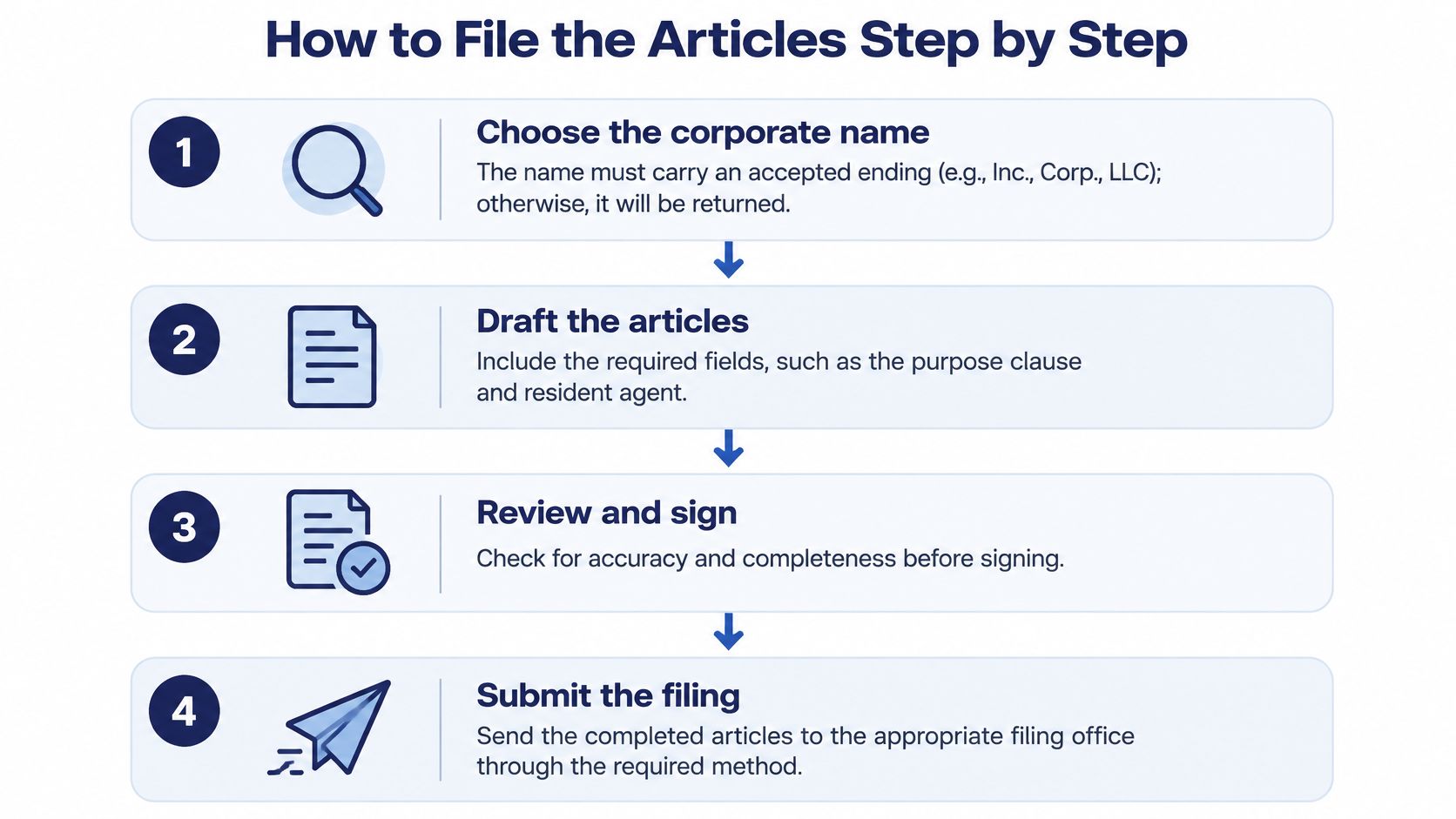
Confirm the corporate name. Review the complete proposed name, including its corporate ending, against the registry search. Resolve potential conflicts before preparing signatures.
Complete the formation fields. Enter the purpose, resident agent, registered office, authorized shares, and incorporator information. Review attachments alongside the form so they don't contradict the main entries.
Prepare the fee calculation. Use the authorized-share total to select the organization-fee tier, then include the separate filing charge. Keep the calculation with the payment record.
Review the form and language. Confirm you're using the appropriate form revision and filing in English. The statute permits a corporate name in another language when written using English letters or Arabic or Roman numerals.
Collect every incorporator's signature. Compare the signed names with the incorporator entries. An unsigned draft isn't the same document as an executed filing.
Submit to the Corporations Division. Use the available online option, mail, or in-person submission route and include the required payment. Retain the submission confirmation rather than relying on an internal note that someone sent it.
Capture the filed result. Obtain the filed Articles and record their effective date. Use that date when documenting the corporation's legal beginning for contracting, ownership administration, and diligence.
Preserve evidence of completion
Keep the submitted version separate from the accepted, filed version. A payment receipt or submission confirmation helps track the transaction, but it shouldn't replace the filed document in the corporate records folder.
This video provides an additional filing walkthrough.
Verifying Records and Post-Formation Changes
| Fact to confirm | Authoritative document | What to check |
|---|---|---|
| Existence and formation date | Filed Articles | Effective date on the filing |
| Name and entity type | Filed Articles and amendments | Amendment history |
| Authorized shares | Articles and amendments | Any later change to share counts |
| Registered office and resident agent | Most recent applicable registry record and annual filing | Changes made after formation |
| Annual report status | Annual filing history in the MiBusiness portal | Applicable reports or statements submitted online |
| Current standing | Certificate issued by the registry | Date of issue |
Michigan launched the MiBusiness Registry Portal on June 23, 2025, enabling online filings, searches, and certificate and copy requests while requiring annual reports and annual statements to be submitted online, according to LARA's Corporations Division.
The practical distinction is between formation evidence and current evidence. Original Articles answer questions about the corporation at formation. They don't necessarily identify its current agent, current name, or present standing.
Retrieve the record without losing its context
Start with a name search in the portal, then open the matching entity record. Record the entity identifier so a later name change doesn't break your connection to the same corporation.
Review the formation information and the effective date on the filed Articles. If the interface displays dates with different labels, preserve those labels rather than assuming every date means the same thing.
Request the filed Articles when you need the underlying formation document. Request a registry certificate when you need evidence of current standing. These are different company formation documents and supporting records, not interchangeable attachments.
Follow the document that changes the fact
A name change or revision to authorized shares belongs in the Articles amendment history. An agent or registered-office change should be checked against the applicable change filing and the current registry entry.
Agent changes matter for service of process, but they don't create a new corporation. Likewise, an annual report is part of the ongoing record, not a replacement for the original Articles. Use the filing terminology applicable to the entity category rather than assuming annual reports and annual statements are identical.
Dissolution or withdrawal requires the state procedure appropriate to the entity and action. Don't infer either event merely because an old address appears in a document.
An old document can be authentic and still be the wrong document for a current fact.
Resolve discrepancies by subject and effective date
Suppose the Articles identify the original resident agent, but a later filed change names someone else. That isn't necessarily an error. Read the filing type and effective date before deciding which entry governs the question.
Don't automatically prefer the newest document for every fact. A recent agent change doesn't alter authorized shares, and a recent certificate doesn't reproduce all the formation terms.
For a defensible record, retain:
- Identity: Entity identifier and legal name.
- Document context: Filing type, filing timestamp, and effective date where shown.
- History: Relevant amendments and agent or office changes.
- Retrieval evidence: Copies and the date you obtained them.
A missing downloadable PDF doesn't prove no filing exists. Request a copy, and confirm current state deadlines and fees before relying on older instructions.
Retrieving Michigan Filings Through an API
A repeatable retrieval process should preserve the difference between a normalized record and the underlying state filing. Our entity-search API workflow supports registry verification across all states and the District of Columbia.
Build the lookup procedure
Create a secret key and authenticate server-side. Keep the key out of front-end code so users can't extract your credentials.
Call
GET /searchwith the business name and state. UseMIor Michigan for the jurisdiction, which keeps similarly named out-of-state entities outside the intended search.Review the best match and similar filings. A common name can identify several candidates, so don't accept a match solely because its spelling looks familiar.
Inspect the normalized fields. Compare status, entity type, formation date, registered agent, principal address, and published officers with the identity you're trying to verify.
Handle unpublished information explicitly. We return unpublished fields as
null, or empty lists for officers, filings, and documents; don't convert those values into affirmative claims that no such information exists.Retrieve supporting filings where available. Examine filing history, annual reports, amendments, and state PDF links when the decision requires documentary evidence.
Store the identifier and retrieval timestamp. Those details let your team compare later results without relying on name matching alone.
Integration boundary: We retrieve and verify registry records. We can't file documents, register entities, or change an official record on a customer's behalf.
Fixing Common Records Problems
| Symptom | Likely cause | Fix |
|---|---|---|
| Name rejected | Name lacks an accepted ending | Add Corporation, Company, Incorporated, Limited, or an allowed abbreviation, then refile |
| Articles returned as incomplete | Fee not calculated from shares or not paid | Recalculate the organization fee, include the separate filing fee, and resubmit |
| Registered office rejected | Post office box given | Use a Michigan street address |
| Registry shows an old resident agent | Later change never filed | Check annual filing history and submit the applicable change |
| Field blank in API response | State may not publish the field | Treat as unpublished and confirm against the registry |
| Wrong detail on state record | Error at the source | Correct with the state office that maintains the filing |
A returned filing and an inaccurate accepted record require different responses. For a returned filing, read the state's explanation and correct the identified defect before submitting again. For an accepted record, first establish whether the problem is an actual error or a later change that hasn't been filed.
Diagnose before submitting a correction
Compare the draft, submitted copy, accepted copy, and registry display. If the accepted Articles match your submission but contain a typo you supplied, the issue differs from a registry display that doesn't match the accepted document.
For agent problems, inspect the filing history before assuming the original Articles are wrong. The corporation may have changed agents operationally without completing the state filing.
For a blank API field, check whether the state publishes the information at all. Don't invent a value, copy it from an unrelated company, or treat an empty officer list as proof that the corporation has no officers.
Correct the source, not the downstream copy
Corrections to an official record must go through the state office that maintains the filing. A third-party provider can't amend Michigan's record on your behalf.
Keep an issue file containing the entity identifier, disputed field, supporting document, submission confirmation, and fee receipt. This gives the state a concrete discrepancy to investigate and gives your team a record of what it requested.
After the state processes a correction or change, retrieve the record again. Save the updated evidence rather than closing the issue solely because someone submitted a request.
Confirm a Michigan Entity Before You Rely on It
When you're evaluating a corporation you didn't form, start with its identity and work toward current evidence. A familiar name on a contract isn't enough to connect the counterparty to the right registry record.
Use a reliance checklist
Match the entity identifier. Search the MiBusiness registry by name, then confirm the identifier against the documents the counterparty supplied. Similar names shouldn't be treated as equivalent entities.
Read the formation evidence. Record the formation information displayed by the registry and the effective date on the filed Articles, preserving the state's labels.
Check the current contact and status record. Compare the resident agent and registered office with the latest applicable filings. Investigate inconsistencies rather than silently choosing the most convenient address.
Review amendments relevant to your decision. A lender may need the current share authorization, while a contracting team may primarily need to establish a name change. Read the document that addresses the fact you're relying on.
Obtain suitable evidence for the risk. Request filed Articles or a current registry certificate when the decision has financial or legal consequences. Understanding what good standing means helps prevent a formation document from being used as current-status evidence.
Retain the verification package. Save copies, retrieval dates, certificate issue dates, and unresolved discrepancies with the counterparty file. Assign responsibility for any follow-up rather than leaving an unexplained mismatch in a notes field.
Match the review to the decision
Don't treat a successful registry match as approval of every aspect of the business. Document what you confirmed, which records support it, and what remains outside the review.
For repeated checks, an API-based process is an optional next step, starting with a Michigan record you can compare manually.
SOSfinder offers business-entity lookups, filing-history access, and monitoring for changes to status, registered agent, or address. Visit SOSfinder to test a Michigan entity lookup and build a verification workflow that keeps the Articles connected to the corporation's current registry record.