How to File Articles of Incorporation in Colorado

You're staring at a Colorado formation screen with a name you already like, a co-founder in another state, and a mental list of officers, vesting, and voting rules you expect the state form to capture. It won't. Articles of incorporation in Colorado create a public corporation. They don't write the private rulebook, the tax file, or the record you'll still trust after an agent resigns.
A first-time filer wants acceptance today. A compliance engineer wants a name, an entity ID, and an agent that still match the live record later. Those are different jobs, and mixing them is how a legally sufficient filing becomes a commercially thin one.
What Colorado Articles of Incorporation Actually Cover
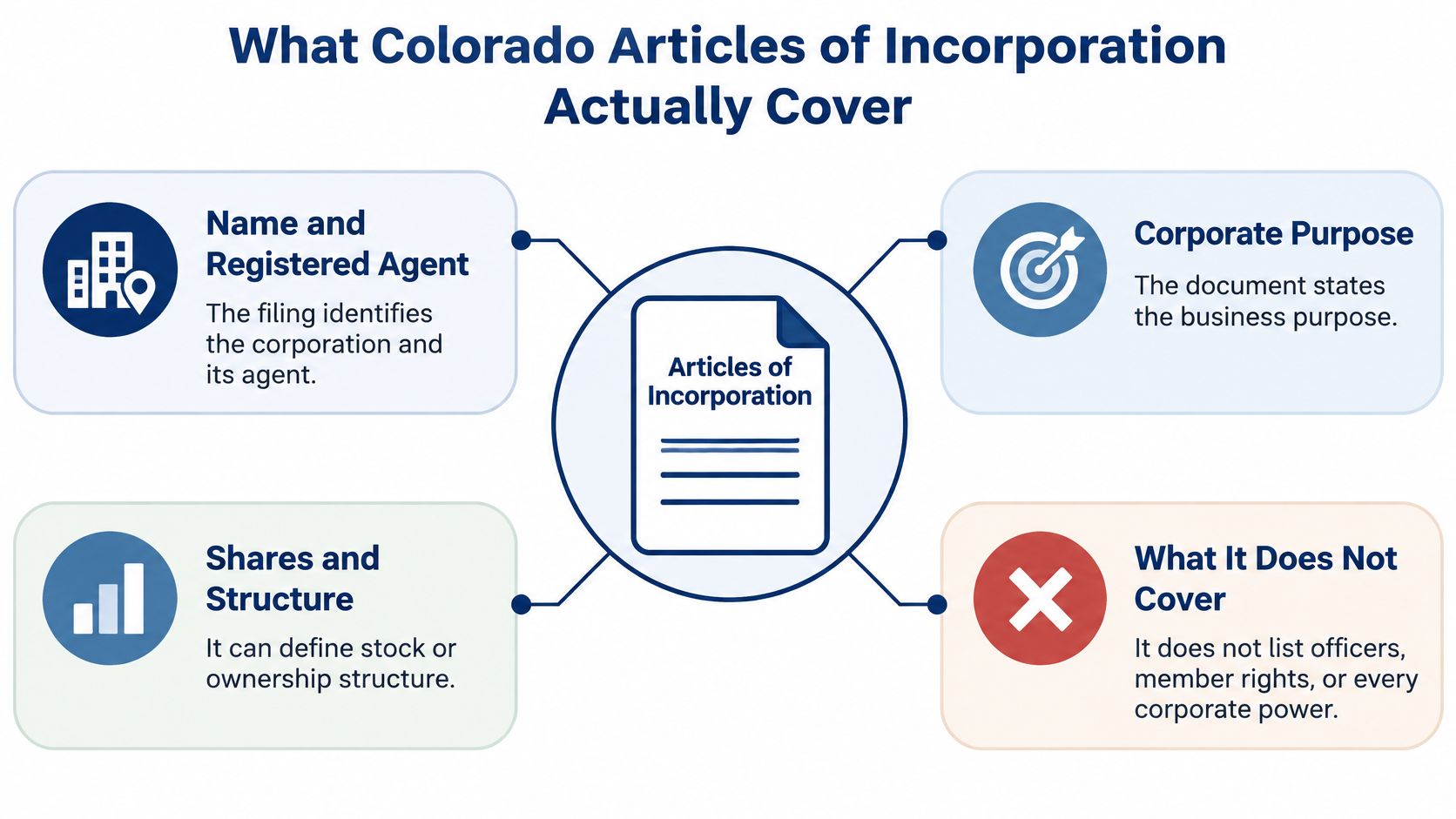
Founders often treat the articles as the whole charter. They expect officers, share-class deals, member rights, and every corporate power on the public form. Colorado doesn't work that way. The filing establishes the corporation's public identity: the name, the initial registered agent and that agent's address, the principal office, and, on a profit form, the share structure plus incorporator information where the form asks for it.
Current corporation law sits in the Colorado Business Corporation Act, principally title 7, articles 101 through 117 of the Colorado Revised Statutes. Incorporation rules live in article 102, sections 7-102-101 through 7-102-108. Older records can still cite former title 7, article 2. Those provisions were repealed effective July 1, 1994, when the state moved the rules into the modern act, a history the Colorado Secretary of State business information market sits alongside in its long-running entity data.
A sufficient filing is not a complete company file
Nonprofit practice makes the split obvious. Colorado's nonprofit statute requires the name, the initial registered agent and address, and the principal-office address. It expressly lets many governance details, including member qualifications and rights, live somewhere else, and it says corporate powers generally need not be listed in the articles. That reading comes straight from CRS 7-122-102.
A minimal profit filing can be legally enough to exist and still be thin for fundraising, diligence, or tax-exemption planning. A missing officer, purpose sentence, or voting term is not automatically an error. It may never have belonged on the form, or it may have moved later by amendment.
Practical rule: If a reviewer can't find a fact in the articles, ask which document was supposed to hold it before calling the filing defective.
Map the decision before you type:
- Name, agent, and office: These belong in the articles. They're the public coordinates of the corporation.
- Authorized shares and incorporator: These belong on the profit articles when the form calls for them. Who receives shares is a later issuance record.
- Officers, meetings, and removal: Put these in bylaws. The state doesn't review that private rulebook.
- Founder economics: A shareholder agreement is the home for vesting, drag rights, and buy-sell terms.
- Tax status: An IRS election or exemption application is a tax filing, not an articles clause.
- A fact that must change on the public record: File an amendment instead of hoping internal minutes will satisfy a later reader.
People who pull official filings for onboarding hit this gap constantly. A blank purpose or a missing officer on a Colorado PDF often means the fact lives in business entity data outside the original articles, not that formation failed. Profit and nonprofit forms are not one workflow. Copying nonprofit member language into a stock corporation, or skipping share structure on a profit form, creates the wrong kind of record.
Clear the Name and Appoint a Valid Registered Agent
Two checks stop more Colorado filings than fancy optional clauses ever will. Clear the name before you pay, and appoint an agent the state will accept.

Name clearance is a gate, not a cleanup
Search the Secretary of State database and confirm the proposed name is distinguishable. Use a legal designator: Corporation, Incorporated, Company, Limited, or the matching abbreviation. Colorado's online system checks availability before the articles form advances, so a collision is not a post-submission edit. A corporation name search done only in your head, or only against your own portfolio, is how two similar names collide at the payment screen.
The principal office and the registered-agent address are different fields. The office is where you say the company works. The agent is the Colorado presence that receives legal process. The agent is not automatically the owner or a director. Formation documents that omit a physical Colorado agent presence get rejected, and the state expects agent consent.
Why remote founders get stuck
Generic guides stop at "you need a Colorado registered agent." The operational test is stricter, and Colorado's nonprofit articles help is a useful mirror even when you're forming a stock corporation, because the agent problem is the same. Since July 1, 2025, an individual agent must be at least 18, keep a Colorado residence or usual place of business, hold a current Colorado driver's license or ID card, and supply identity details that match that ID. An entity agent must be registered in Colorado, in good standing, and keep a usual Colorado business location.
A founder in another state can't list a home address and hope. A virtual office that isn't a real Colorado street presence fails the same test. A commercial filing service can supply the agent, which protects a personal address, but only if that service is itself eligible and has consented. An ineligible agent delays formation and can publish the wrong address if you scramble for a substitute at the last minute.
If the agent later becomes ineligible, you replace the agent. You don't dissolve the corporation to fix it.
Watch the name and agent fields the way a clerk will, not the way a pitch deck reads them. These failures are avoidable:
- Non-distinguishable name: The database already has something too close.
- Missing designator: "Northline" alone isn't a corporate name.
- Invalid agent address: A mailbox or an out-of-state street won't do.
- No consent: Listing someone who never agreed is a rejection, not a courtesy.
- Identity mismatch: The name or details don't match the Colorado ID or the entity's good-standing record.
File the Articles Online and Keep the Confirmation
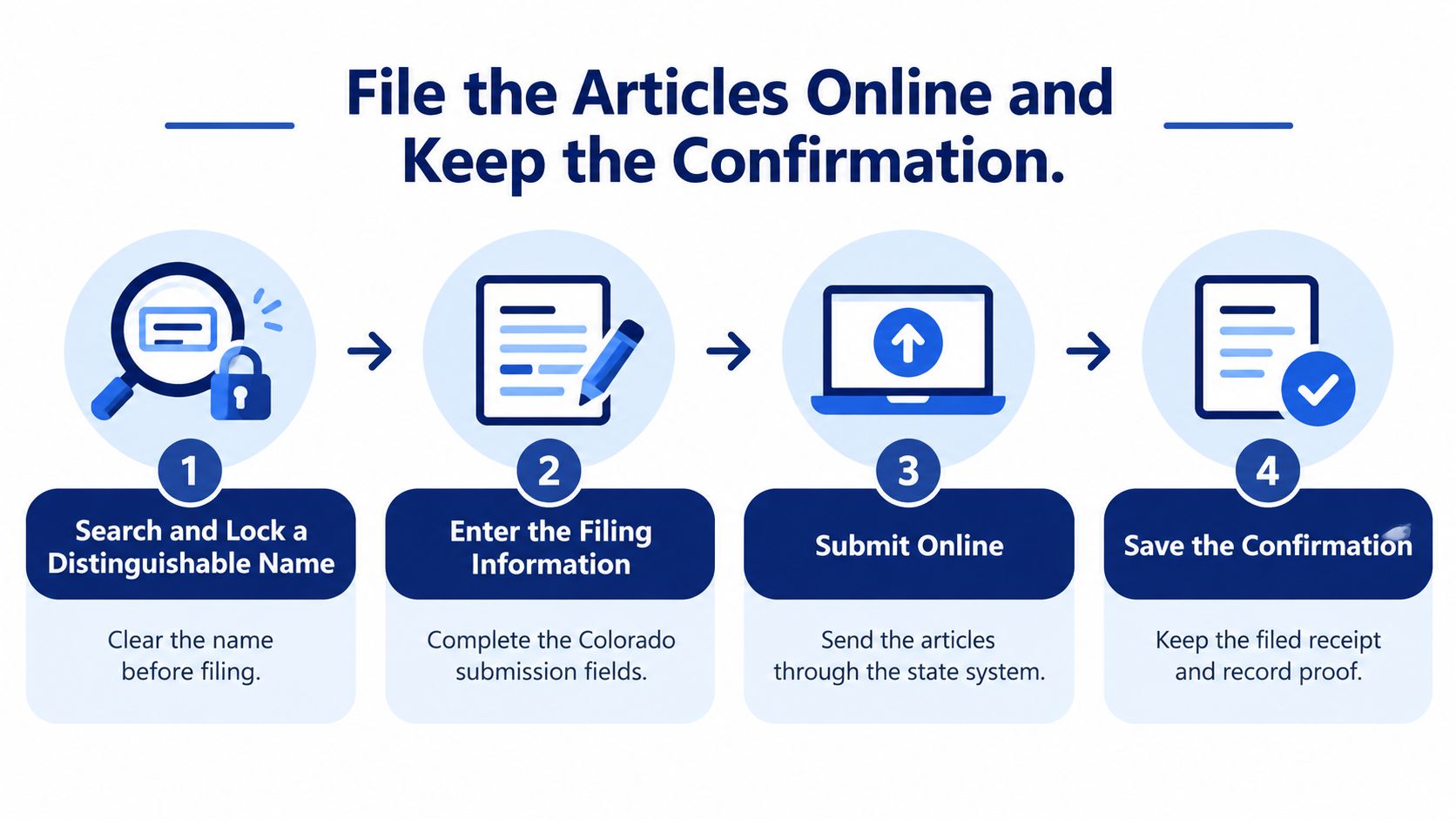
Once the name is clear and the agent is eligible, the submission itself is a short path. Don't number it like a ritual. Search, lock a distinguishable name with a compliant designator, identify the principal office, appoint the initial registered agent, state the share structure and incorporator information where the profit form requires them, submit electronically, and save both the confirmation and the filed articles.
Colorado's online system is built so name availability is settled before that form moves forward. Treat the approved spelling as frozen. A tweak between clearance and payment is how a "locked" name stops being the name on the receipt.
Real time versus a packet on a desk
Online articles are processed in real time after payment confirmation. Ordinary office processing is typically 7 to 10 business days. Expedited filings are processed within three business days for an additional fee. A founder who pays online at lunch can hold an accepted record the same day. A mailed packet sits in ordinary processing while bank applications and vendor onboarding wait on an entity ID that doesn't exist yet.
Paper submissions may carry a $125 document-processing fee. The practical online path, including what the profit form expects, is laid out in the articles of incorporation help for profit corporations. The online charge itself is a separate schedule item, covered in the fee reading below. Don't copy another entity type's price onto this form.
What to keep the moment it accepts
Acceptance is not a finished compliance file. Before you close the browser, store:
- Approved name: Exact spelling, designator included.
- Entity ID: The identifier later searches should use, not a nickname.
- Filing timestamp: So a later date mismatch is obvious.
- Status: Active at acceptance is the baseline, not a lifetime promise.
- Document link: The filed articles, saved as a PDF when the system offers one.
A same-day confirmation proves the state took the filing. It doesn't prove the agent will still qualify when the first periodic report is due.
That's the handoff. The next job is reading the fee in context, then checking that the public record matches what you just stored.
Read the $50 Fee Against Other Colorado Filings
The number people quote is small, and that's why they misread it. Colorado's current Secretary of State fee schedule lists the filing fee for articles of incorporation at $50. That charge is for profit corporations, shown as an online filing, with no paper option listed on the schedule. The business fee schedule is the place to confirm it before you budget from an LLC blog post.
Other entities got a different price
Beginning July 1, 2022, LLC filing fees fell from $50 to $1, and trade-name fees fell from $20 to $1. Those cuts were for other entity types. They explain why total new-entity volume and corporation volume tell different stories. Most new filings are LLCs because a dollar is an easy experiment. A corporation is still a major category, but it isn't priced like that experiment.
The Secretary of State's Q4 2024 economic-indicators report, cited with that fee schedule, recorded 40,855 new entity filings in Q4 2024. That was a 0.4% year-over-year decrease and a 1.9% decline from the prior quarter. Annual filings totaled 170,669. Domestic corporations were the second-most popular business filing, while most new filings were LLCs.
Earlier, Q1 2023 produced a record 55,787 new entity filings, up 27.6% year over year and 14.3% quarter over quarter, after the broader reduction in certain business filing fees. Volume moved with fee policy. Corporation articles did not become a one-dollar product.
| Item | Figure | What it applies to |
|---|---|---|
| Articles of incorporation | $50 online | Profit corporations; no paper option on the current schedule |
| LLC filing fee since July 1, 2022 | $1 (down from $50) | Limited liability companies, not corporations |
| Trade-name fee since July 1, 2022 | $1 (down from $20) | Trade names, not articles |
| Q4 2024 new entity filings | 40,855 | All new entities; down 0.4% year over year and 1.9% from the prior quarter |
| 2024 annual filings | 170,669 | Full-year new entity filings |
| Q1 2023 new entity filings | 55,787 | Record quarter; up 27.6% year over year and 14.3% quarter over quarter |
What to budget
Plan on $50 for the online articles, plus any expedite charge. The amount of that extra fee isn't published in these figures, so don't invent it from another state's menu. Don't treat the $1 LLC fee as the corporation price. Corporations remain a major Colorado formation category, and total formation counts swing with the cheaper LLC option and with fee policy, not with how complete your bylaws are.
Verify the Filing with the SOS or an API
A confirmation email answers "did we pay?" It doesn't answer "does the public record match?" For one corporation, go back to Colorado's official entity search. Confirm the exact approved name, entity ID, active status, formation date, registered agent, principal address, and document URL. That browser check is enough when you have a single company and time to read the page.
It doesn't scale. The Secretary of State has reported an average of 2,737 filings per day and nearly 800,000 businesses in good standing, figures from its 2021 business and licensing summary. That volume is why a portfolio can't rely on someone reopening the search page once a quarter.
What a control should store
A technically sound check doesn't replace the state. It reads the state twice and keeps the evidence.
- Normalize the legal name and query the official record before submission.
- Validate the agent against Colorado's eligibility rules, including the 2025 identity and Colorado-presence tests, before you pay.
- Re-query after filing and store the approved name, entity ID, filing timestamp, status, and document URL.
- Flag exceptions: a name that changed between clearance and filing, a status that isn't active, a missing agent address, a formation date that doesn't match the PDF, or an agent that fails those 2025 rules.
Keep structured fields for matching and the original filing PDF for provenance. Normalized fields help a KYC system. The PDF is what a lawyer or a bank can hold up.
When a product sits in front of the registry
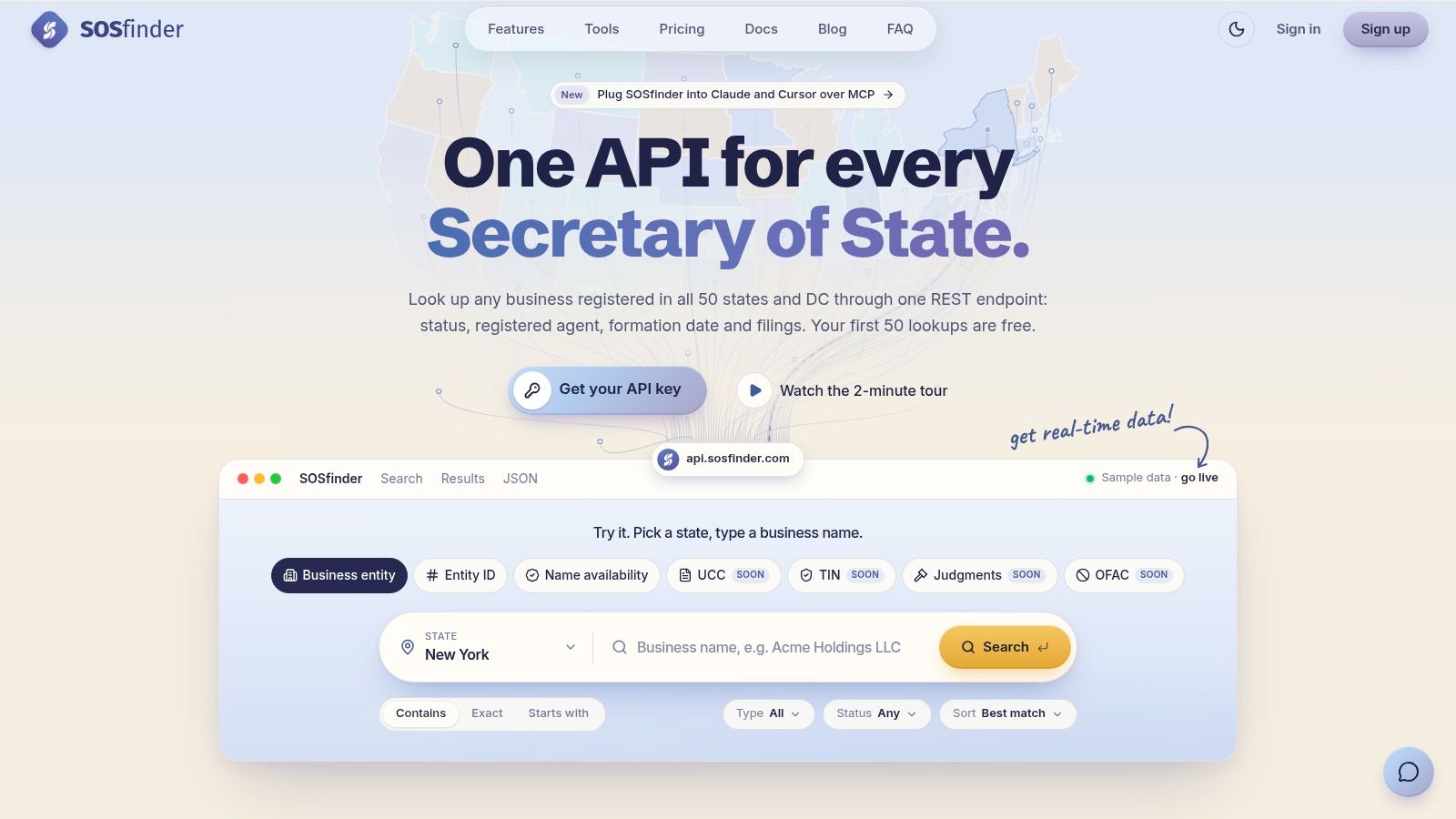
If the same confirmation has to run across many entities, a manual lookup becomes the bottleneck. SOSfinder is one option for that job, not a government agency. A single POST search can take Colorado as a jurisdiction parameter and return normalized status, entity type, formation date, registered agent, address, and identifiers, with filing-history links to state PDFs where the registry offers them. Name checks, entity-ID search, monitoring, and webhooks sit on the same idea. Teams comparing that pattern with a homegrown scraper usually start from a company data API design rather than fifty separate portal logins.
Use the browser when you have one corporation. Use a normalized lookup when the same check has to run every time a customer is onboarded.
Real-time online processing means you can confirm almost immediately after payment. The daily filing volume is the reason to poll on events, or to take a webhook, instead of reviewing the record by hand twice a year.
Keep the Corporation Record Accurate After Filing
An accepted filing is day one. Colorado's business-registration dataset reaches back to the 1800s and holds more than 1 million records. Its corporate-transactions dataset holds millions of historical filing transactions, including creation dates, entity types, statuses, identifiers, and histories of amendments, mergers, name changes, dissolutions, and reinstatements, as described in the Secretary of State's information-market materials cited earlier. That history is why a stale PDF in a shared drive isn't the corporation.
The record drifts in ordinary ways. The agent resigns, loses good standing, changes address, or no longer meets the individual-agent rules. The filing can stay on the books and still be noncompliant. Colorado requires the current registered agent on the periodic report, so watching that report is part of staying in good standing, not an optional extra. Business monitoring software is built for that drift. A principal-office move is not the same event as an agent change. Amend the articles only when the changed fact belongs there. Bylaws and shareholder agreements can change without a new public charter.
After payment, pull the live Colorado record, save the entity ID and the filed PDF, and set a check for agent, address, and status changes. Do it by hand for a single company. Run the same confirmation through a normalized search and monitoring workflow when the portfolio is larger than one receipt.
SOSfinder gives product and compliance teams one search across Secretary of State registries, including Colorado, for status, formation date, registered agent, and filing-history links where the state offers PDFs. That is the practical way to confirm articles of incorporation in Colorado after the $50 filing, and to notice when the agent or status changes later. Visit SOSfinder when a one-time confirmation has to stay trustworthy.