10 Business Monitoring Software Tools Compared for 2026

A compliance lead needs to confirm that a new vendor is still active, that its registered agent hasn't changed, and that its officers remain on file before the first payment goes out. Checking fifty state registries by hand is where manual monitoring falls behind. The useful question isn't whether a platform has a dashboard. It's what the platform alerts on, how quickly changes reach your systems, how often records refresh, and what happens to cost as the monitored portfolio grows.
This list compares ten platforms in three groups: registry-level APIs, U.S. KYB onboarding tools, and global screening and ownership intelligence. Each entry is judged against real onboarding and compliance workflows, including alert scope, delivery method, refresh behavior, integrations, data provenance, and pricing friction. The result isn't a universal winner. A fintech screening counterparties needs different machinery from a product team that needs normalized Secretary of State records in a production API.
1. SOSfinder
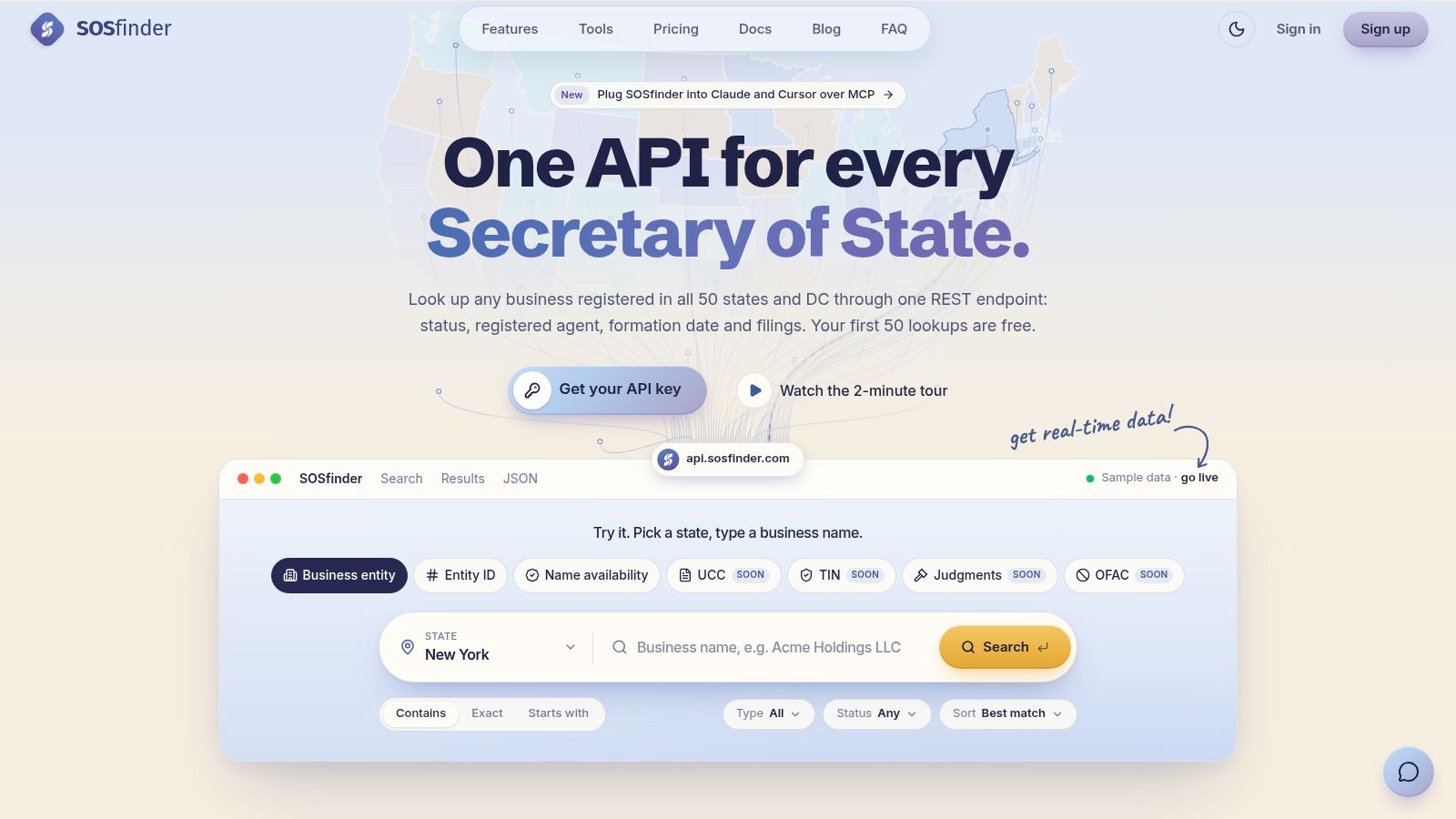
A vendor is ready to onboard. Finance wants to pay. Compliance still needs to confirm the company is active, the registered agent on file has not changed, and the state record matches what the applicant submitted. SOSfinder fits that job well because it starts at the registry level and gets official U.S. business records into an application or review queue without forcing a team to wire up each state one by one.
The product covers all fifty states and the District of Columbia through one API endpoint. That matters in production. Engineers get a consistent JSON schema for entity status, entity type, formation or registration dates, registered agents, principal addresses, filing histories, and related identifiers, instead of handling different registry formats and failure patterns by jurisdiction.
Its appeal is not just search. Teams can look up entities, pull linked filing documents where available, run name availability checks, verify a CSV portfolio, and monitor changes inside the same system. For monitoring, the useful question is what triggers downstream work. Here, alerts can track changes to status, registered agent, or address, and those updates can move into your stack through webhooks or scheduled notifications.
What reaches your systems
SOSfinder combines real-time lookups with low-latency caching. That helps keep common requests responsive and reduces repeat charges on the same record. Built-in retries also help when a state registry blocks or stalls, and the error handling is more consistent than what teams usually get from direct state-by-state integrations.
Practical rule: Treat a registry change as a workflow event, not as a final risk decision. A new registered agent should create a review task, not automatically label a supplier fraudulent.
The developer setup is straightforward. The API playground includes cURL, Python, JavaScript, PHP, and Go examples. There is also a hosted MCP server for tools such as Claude and Cursor, which can query entity data in plain language. UCC filings and officer or person search are in beta, so teams should test state coverage and output quality before they make those features central to onboarding or monitoring controls.
Pricing and fit
Pricing scales by lookup volume. The free tier includes the first 50 lookups. Paid plans include $49 per month for 1,000 lookups, $99 per month for 2,500, and $449 per month for 15,000, with lower per-lookup rates on larger plans. Non-expiring credit packs and custom enterprise pricing are available, and higher tiers include a 99.9% uptime SLA.
SOSfinder suits product teams, compliance operations, legal filing services, procurement groups, and vendor platforms that need authoritative U.S. corporate records without building fifty integrations. The trade-off is the usual one with registry-dependent tools. Document availability and temporary access issues still vary by state.
2. OpenCorporates
OpenCorporates is a sensible choice when the monitored portfolio crosses borders or needs a broad company-data layer beyond U.S. state registries. Its REST API supports company search, filings, and reconciliation workflows, while bulk delivery supports teams that want to process changes outside a request-by-request application flow.
The platform's strength is provenance. It presents data from primary public sources and provides a way to connect company records with filings and historical changes. That makes it useful for research, supplier discovery, and global counterparty enrichment. It can also complement a registry-level API when a U.S. workflow needs wider jurisdictional context.
Alert delivery and coverage
Monitoring isn't push-first in the same way as a webhook-centered registry product. Teams may poll endpoints or consume bulk Corporate Signals, then build their own comparison and routing logic. That approach gives engineering teams control, but it also means the customer owns more of the freshness, deduplication, and alert-delivery design.
Coverage depth varies by country and registry. A global search result shouldn't be treated as proof that every field has the same authority or update cadence. Store the source, retrieval time, filing reference, and prior value alongside the normalized record.
A broad company database is valuable only when your review team can see where each material field came from.
OpenCorporates offers self-serve plans and enterprise bulk delivery, including SFTP patterns. Self-serve quotas can become a constraint for high-volume polling, so model requests against the actual monitoring cadence rather than the initial onboarding batch. Teams evaluating business entity data should decide whether they need broad discovery, authoritative state-level records, or both.
3. Enigma
Enigma is built around U.S. business identity and activity data, with APIs and a GraphQL platform for KYB, enrichment, segmentation, and portfolio work. Its graph model connects businesses with brands, locations, and owners, which can be more useful than a flat company record when an onboarding team needs context around a long-tail business.
The console supports segments, lists, and batch enrichment. That gives operations teams a practical path to test a portfolio before engineers commit to a deeper integration. The GraphQL interface also helps product teams request specific attributes instead of pulling a fixed, oversized response.
Where it fits
Enigma's monitoring pattern is generally periodic refresh or batch-based rather than a dedicated stream of registry events. That can work for scheduled portfolio reviews, but it requires careful handling of stale values and missed changes. If a status change must create an immediate case, confirm the refresh and delivery behavior during the pilot.
The credit model is a clear advantage for planning. Per-attribute pricing makes it easier to see which enrichment fields drive consumption, although a workflow that expands from verification into segmentation can use credits faster than the first estimate suggests. U.S. coverage is the natural starting point, while international registry depth needs separate validation.
A useful implementation pattern is to use Enigma for business identity resolution and enrichment, then pass selected entities into a dedicated monitoring workflow. Keep the original identifier and the last observed values so a changed attribute can be reviewed rather than overwritten without notice.
See Enigma's business data platform
4. Middesk
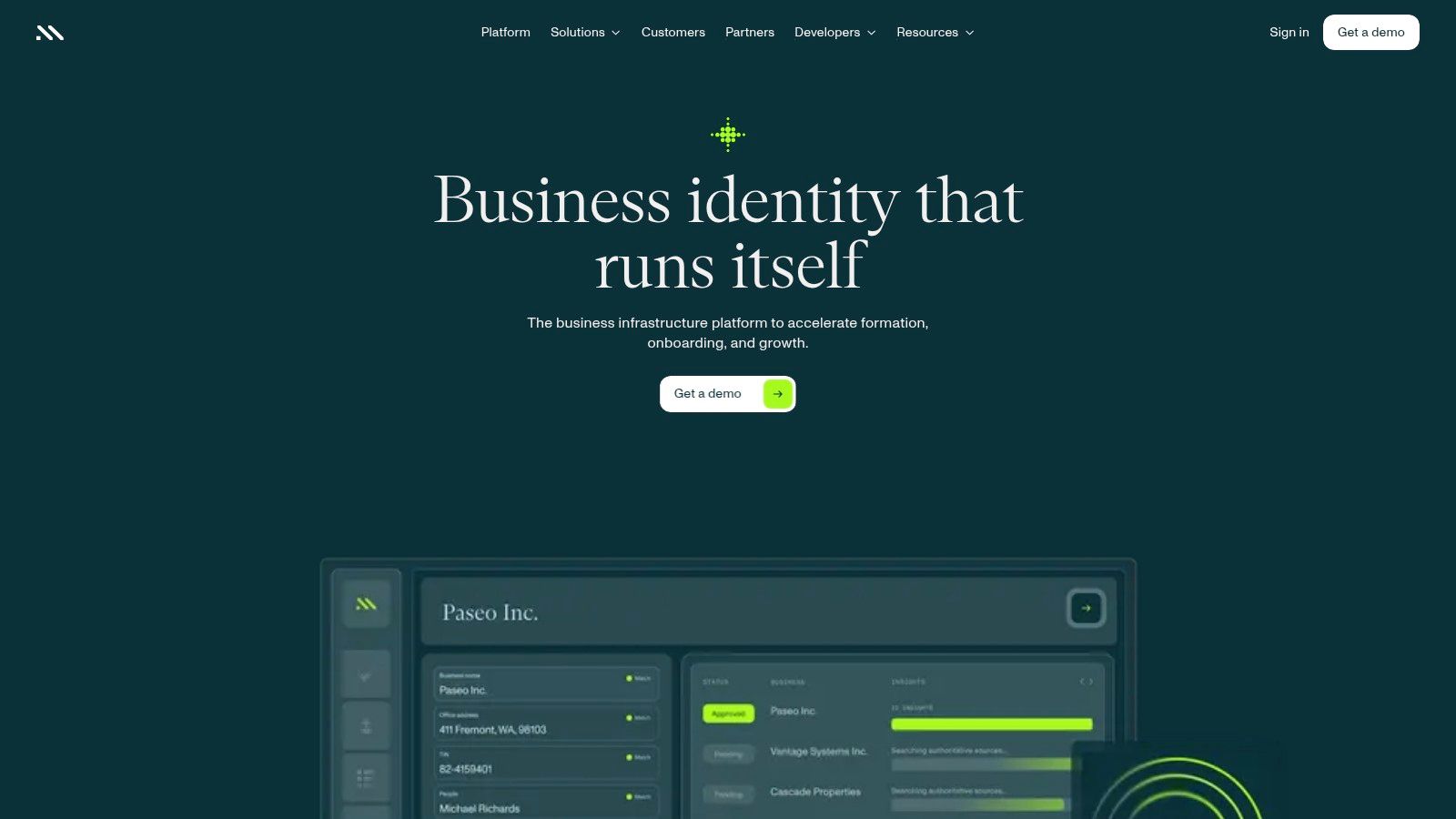
Middesk is designed for U.S.-centric KYB onboarding rather than general-purpose company search. It combines business verification with monitoring for registrations, addresses, officers, watchlists, bankruptcies, and liens. That makes it a strong candidate for fintech, lending, and vendor-diligence teams that need to move from initial verification into ongoing review.
Its event webhooks are the important operational feature. A registration or attribute change can enter an existing case queue or trigger a review in an internal risk service. That is more useful than a dashboard that someone must remember to open, especially when the compliance team already manages decisions in another system.
Strengths and friction
Middesk has developer-focused documentation and implementation guidance, which helps teams get a proof of concept moving. It also supports TIN, name, and address checks, sanctions and PEP screening, and some international business verification. The center of gravity remains the U.S., so don't assume international behavior matches domestic coverage.
Pricing isn't publicly listed and requires sales engagement. That isn't automatically a problem for enterprise procurement, but it makes early comparison harder. Ask for a written price model that separates verification, monitoring, screening, document work, and any minimum commitments.
The platform is a good fit when the main question is, “Can this business be verified and monitored inside our onboarding process?” Teams comparing business verification software should test the exact attributes that create a case, the webhook payload, retry behavior, and whether a reviewer can reconstruct the reason for the alert.
5. Trulioo
Trulioo takes a global KYB approach and makes ongoing business monitoring an explicit part of the product. It can rescreen or alert on business status, ownership, locations, and incorporation details, while combining business verification with identity, adverse media, and screening workflows.
That breadth is useful for regulated organizations with international portfolios. A single program can enroll an entity for verification, add it to monitoring, and connect changes to an AML or compliance process. The portfolio approach also helps teams avoid building separate country-specific control paths.
Monitoring in practice
Trulioo provides programmatic monitoring endpoints and portfolio options. Confirm how each event is generated, how a changed field is represented, and whether the service distinguishes a source update from a resolved risk match. Those details determine whether your system can create a precise task or must send the case to manual triage.
The trade-off is procurement friction. Pricing is quote-based and isn't publicly listed, which is common for enterprise KYB platforms but makes cost modeling difficult before a sales process. Request pricing by monitored entity, screening type, review volume, document requirements, and delivery method.
Document-based enhanced due diligence may still require manual work. A monitoring alert tells you that something changed. It doesn't by itself establish beneficial ownership, solvency, sanctions exposure, or operational legitimacy. Use the platform as a continuous control within a documented review process, not as a substitute for evidence assessment.
For a wider comparison of KYB tools, check whether each option exposes the source and timestamp for a material change, supports historical review, and lets engineering teams consume the result without a proprietary interface.
Explore Trulioo business verification
6. ComplyAdvantage
A typical failure point looks like this. Your onboarding stack catches a business, but the ongoing risk sits outside the registry record. A sanctions update, a PEP match, or adverse media mention appears later, and the change needs to reach your case queue fast. That is where ComplyAdvantage fits.
ComplyAdvantage works best in a monitoring stack focused on sanctions, PEP, and adverse media rather than corporate filing changes. Its API-first setup supports customer and entity screening, ongoing monitoring, webhooks, alert and case management, tags, and audit trails. For fintech and SaaS teams already routing decisions through APIs, that matters. Alerts can move into a tracked workflow with notes and history instead of getting lost in email or spreadsheets.
What to test before rollout
The main trade-off is tuning. Screening quality depends on how the platform handles names, aliases, locations, and false positives across your actual customer mix. Test representative entities before broad rollout. Include known benign matches, edge-case names, and cases your analysts already resolved manually.
ComplyAdvantage markets starter packaging for monitoring up to 2,000 entities Review ComplyAdvantage. Pricing beyond that usually goes through enterprise sales, so ask how cost scales with monitored entities, rescreening frequency, alert volume, and case users.
This is not the first tool to buy if the only job is tracking whether a U.S. company changed its registered agent. It gets more useful when registry-level changes need to be correlated with sanctions, PEP, or adverse-media screening, and pushed into a review workflow your team already uses. For more on recurring review design, see this guide to compliance monitoring software.
7. LSEG World-Check One
LSEG World-Check One is built for continuous screening of customers and counterparties against sanctions, PEP, and adverse-media intelligence. It offers ongoing screening and rescreening cycles, list management, case workflows, audit trails, and delivery through API or data files in the LSEG developer ecosystem.
Its value is control depth. Regulated programs often need documented review decisions, configurable risk handling, and evidence that an alert was investigated. World-Check One is designed for that environment rather than for a lightweight entity-status lookup.
Trade-offs for compliance teams
The data and workflow are enterprise-grade, but the implementation isn't a set-and-forget exercise. Configuration and tuning are required to reduce false positives, especially when names are common or records span jurisdictions. A compliance team should define escalation rules before enabling broad monitoring.
Pricing is premium and typically contract-based. That can work for a large regulated program with procurement support, but it isn't easy to compare against usage-based APIs from a public rate card. Request an estimate that covers data delivery, screening frequency, users, case management, and retention.
The platform is strongest when the question is whether a counterparty presents a continuing sanctions or politically exposed person risk. It is less direct for a product team that needs normalized filings, registered-agent changes, or links to state documents. Those are different monitoring problems and shouldn't be conflated.
8. Dun & Bradstreet D&B Direct+ Monitoring
Dun & Bradstreet offers monitoring through the D&B Data Cloud, with change notices for attributes such as ownership, addresses, ratings, and executives. The Direct+ API supports high-scale commercial and government programs, while file-based delivery can suit teams that already operate batch data pipelines.
The platform brings several datasets together. Linkage, UBO information, credit risk, compliance content, and news can sit within one vendor relationship. That is useful for procurement and portfolio teams that need more than a legal-status check.
The entitlement model matters
D&B uses monitoring profiles and levels, with deeper triggers available through different products or SKUs. This gives enterprise customers control over scope, but it also creates pricing and implementation complexity. Some content is metered separately and requires its own entitlement.
Before signing, map every required signal to a product code. Ask whether ownership, executive changes, news, compliance, and delivery are included or priced independently. A broad catalog can look efficient until the workflow needs several add-ons.
API and SFTP or pull-based delivery patterns support different operating models. Use API notices when cases need near-immediate routing, and batch delivery when the portfolio is reconciled on a scheduled cycle. In either case, retain the old value and the notice metadata so reviewers can explain what changed.
Explore D&B Direct+ Monitoring
9. Moody's Orbis
Moody's Orbis, formerly Bureau van Dijk, is aimed at global private-company research, ownership analysis, financial information, and monitoring of data changes and news. Its company profiles use standard identifiers, including BvD IDs, which helps teams maintain continuity when names or corporate structures vary across sources.
The ownership explorer is the main differentiator for third-party risk and due diligence. A compliance analyst can move beyond the legal entity and inspect corporate relationships, ownership structures, and connected organizations. That is more useful than a simple status monitor when a supplier's risk depends on control or group exposure.
Where it can slow teams down
Orbis supports flexible alerts on data changes and news, with search and visualization tools for investigation. API and reporting add-ons are available through the Moody's ecosystem, but the product remains enterprise-oriented. Licensing is premium, and teams should clarify which interfaces, exports, identifiers, and alert types their contract includes.
Regional data can be delayed or constrained by local disclosure rules. Don't present an ownership view as complete merely because it appears in a polished profile. Record the jurisdiction, source, date, and confidence or review state for material ownership findings.
Orbis fits portfolio monitoring, global due diligence, and ownership-heavy investigations. It may be more platform than a U.S.-only onboarding workflow needs, especially when the required signals are limited to status, registered agent, address, and filings.
10. Sayari
Sayari focuses on complex ownership, corporate networks, and primary-source evidence across global jurisdictions. Its graph platform resolves entities and maps relationships, while screening and portfolio monitoring can cover news, litigation, and regulatory actions. REST API, bulk files, and named-user SaaS access give teams several ways to consume the data.
This is an investigation platform first. It makes sense when a vendor's risk is hidden in ownership chains, related entities, trade relationships, or cross-border structures. The emphasis on source provenance and evidence preservation also supports review teams that need to defend conclusions during an audit or investigation.
Evidence over volume
Sayari's strongest feature is context. A flagged relationship can be examined through the network rather than handled as an isolated name match. That helps analysts distinguish a meaningful ownership connection from a superficial similarity, although it also demands more trained review than a basic verification tool.
Pricing skews toward enterprise and government tiers. That makes it harder to justify for purely U.S.-only monitoring where official state records already answer the operational question. It can be overkill if you only need to detect a status, registered-agent, or address change.
For global vendor risk, preserve the source document or reference, retrieval timestamp, historical snapshot, and analyst decision. Registry information can be incomplete, delayed, inaccessible, contradictory, or limited by local disclosure rules. A monitoring platform should expose those limitations rather than turn uncertainty into a clean-looking score.
Top 10 Business Monitoring Software Comparison
| Provider | Core coverage & data | Monitoring & webhooks | Developer experience & unique features | Pricing & target audience |
|---|---|---|---|---|
| SOSfinder 🏆 | US 50 states + DC official records; normalized entity fields; filings & PDF links ★★★★☆ | Real-time lookups + low-latency cache; configurable monitoring & webhooks; bulk CSV verification | API playground, SDK examples (cURL/Py/JS/PHP/Go); hosted MCP for AI queries ✨; automatic best-match & retry logic | 💰 Free tier (50); Starter $49/mo, Pro $99, Scale $449; credit packs; enterprise · 👥 Engineers, product & compliance teams |
| OpenCorporates | Global company registry coverage; filings & provenance from public sources ★★★★☆ | Bulk "Corporate Signals" & change tracking; mostly pull/bulk workflows | REST API + reconciliation endpoints; bulk SFTP delivery ✨ | 💰 Self‑serve + enterprise bulk · 👥 Researchers, global due diligence teams |
| Enigma | US business identity + graph-modeled data; enrichment & linkage ★★★★☆ | Portfolio monitoring via periodic refreshes / batch lists | GraphQL platform, console for segments & batch enrichment; transparent credit model ✨ | 💰 Credit-based pricing; public rate card · 👥 Data teams, KYB/enrichment use cases |
| Middesk | US KYB: registrations, addresses, officers, liens & screening ★★★☆☆ | Monitoring webhooks for registration/attribute changes | Developer-friendly docs & implementation guides | 💰 Quote-based / sales engagement · 👥 Fintech onboarding, vendor diligence |
| Trulioo (KYB) | Global KYB + identity, adverse media & business enrollment ★★★★☆ | Programmatic monitoring endpoints; portfolio rescreening | Enterprise APIs with broad international coverage | 💰 Quote-based enterprise pricing · 👥 Regulated enterprises, global compliance teams |
| ComplyAdvantage | Sanctions, PEP & adverse‑media screening with ongoing monitoring ★★★★☆ | Continuous monitoring, webhooks, alert & case management | Modular screening components; strong developer tooling | 💰 Starter pack (up to ~2k entities); enterprise quotes · 👥 Fintechs, KYC/KYB stacks |
| LSEG World‑Check One | Sanctions/PEP/adverse‑media risk intelligence; rich list management ★★★★★ | Ongoing screening & rescreen cycles; list management | Case workflows, audit trails; API & file delivery | 💰 Premium enterprise pricing · 👥 Large regulated institutions, banks |
| Dun & Bradstreet (Direct+) | 500M+ entity coverage; linkage, ratings, ownership datasets ★★★★☆ | Change notices, level‑based monitoring triggers | Direct+ API; entitlement/quota model for scale | 💰 Complex SKU/entitlement pricing · 👥 Enterprise, government, commercial risk teams |
| Moody's Orbis | Global private-company financials, ownership & identifiers ★★★★★ | Alerts on data changes & news; monitoring add-ons | Ownership/structure analytics; API/reporting integrations | 💰 Premium licensing · 👥 M&A, risk/compliance teams, auditors |
| Sayari | Primary-source global registries & trade data with provenance ★★★★☆ | Screening & portfolio monitoring for news, litigation, regulatory events | Graph analytics for ownership mapping; evidence preservation ✨ | 💰 Enterprise/government pricing · 👥 Investigations, supply-chain & corruption risk teams |
Choosing the Monitoring Platform That Fits Your Workflow
Start with the event you need to catch. If the trigger is a U.S. entity becoming inactive, changing its registered agent, or moving its principal address, a registry-level API is usually the cleanest foundation. If the trigger is a sanctions, PEP, or adverse-media match, choose a screening platform with rescreening, case management, and auditable decisions. If the trigger is a complicated ownership relationship across jurisdictions, prioritize graph resolution, provenance, and historical evidence.
Shortlist two or three platforms that match your coverage needs, then run a pilot on a sample of entities you already track. Check how each platform delivers change notices, whether through webhooks, batch refresh, or polling, and confirm that the refresh cadence matches the risk you need to catch. Model cost per monitored entity at realistic volumes before signing, and request written pricing for your tier, since several platforms on this list are quote-based.
The pilot should test failure handling as seriously as the happy path. Send duplicate events, unavailable records, changed names, missing fields, and temporary source errors through the workflow. Confirm that the system distinguishes “not found” from “not publicly available,” preserves prior values, and tells reviewers which source and retrieval time support the alert.
Match the tool to the system you already operate
A developer team may prefer normalized JSON, predictable errors, SDK examples, and webhooks. A compliance operations team may care more about case queues, analyst notes, audit trails, and escalation rules. Procurement may focus on total cost, minimum commitments, data rights, and whether the vendor charges separately for monitoring, documents, screening, and exports.
Enterprise monitoring is moving toward centralized SaaS delivery. In Grafana Labs' 2025 global observability survey of 1,255 respondents, 37% of organizations said they used observability tools mostly or only as SaaS, a 42% year-over-year increase. The same survey reported an average of eight observability technologies, while 73% were investigating or using service-level objectives, and 85% were using or evaluating unified application and infrastructure observability. Those figures support a practical design choice for business monitoring: expose measurable delivery objectives such as alert-generation latency, webhook success, detection coverage, and duplicate-alert suppression. Grafana Labs' survey provides the source for these findings.
Make data quality part of the product decision
An official registry is authoritative for the facts it publishes. It doesn't automatically verify beneficial ownership, control, solvency, sanctions exposure, or operational legitimacy. Recent beneficial-ownership research covering 38 Latin American and Caribbean jurisdictions found that access is often restricted and that unverified data has limited value for oversight, while separate transparency guidance recommends machine-readable access through search, bulk files, and APIs, recurring confirmation of ownership data, and historical retention. The FinCEN beneficial ownership information resource is the supplied reference for this data-quality and access context.
That limitation changes how alerts should work. A sudden dissolution filing, agent change, or address move should prompt ownership review, payment-control checks, and confirmation that the contracting entity remains valid. It shouldn't automatically be treated as fraud. The best monitoring system connects an authoritative event to a documented business decision.
For most U.S. onboarding workflows, SOSfinder is the practical starting point because it exposes all states and DC through one schema, supports monitoring and webhooks, and keeps the workflow close to official registry records. Middesk is better when KYB verification and event-driven onboarding are the center of the process. Global teams may need Trulioo, ComplyAdvantage, LSEG, Moody's Orbis, Sayari, or D&B alongside a registry source, because screening, ownership intelligence, credit data, and legal-record monitoring answer different questions.
SOSfinder gives product and compliance teams one API for official business records across all fifty states and the District of Columbia, with normalized entity data, filing access, monitoring, and webhook delivery. Use it to replace manual multi-state checks with a reviewable workflow that catches status, registered-agent, and address changes. Visit SOSfinder to test the API and plan a monitoring integration.