Business Entity Search USA: How to Check Any State

You're about to approve a supplier, open a business account, or sign a contract. The company has a website and an address, but the name on its paperwork doesn't quite match the name you've been using. Before you proceed, you need to know which legal entity you're dealing with.
A business entity search in the USA starts with state registry records. Those records can help establish legal existence, recorded status, and the registered agent, but they aren't a complete background check. The useful result isn't a matching name. It's a matching entity, supported by evidence you can date and keep.
What Each State Entity Record Contains
Start with the legal name, not the company's logo or trading name. It tells you the exact name filed with the state. Next, find the entity ID or file number, the identifier that lets you return to that particular record without sorting through similar names.
The entity type identifies the legal form, such as a corporation, LLC, or limited partnership. Read the status alongside it, but don't assume that active means the business is trading, financially sound, or authorized for every activity. Each state defines its own status labels.
Core fields in a state entity record
| Field | What it tells you | Why it matters |
|---|---|---|
| Legal name | Exact name on the public filing | Must match the name on the contract or application |
| Entity ID or file number | The state's own identifier for the record | The most reliable key inside one state |
| Entity type | Corporation, LLC, limited partnership, or similar | Helps identify which filings and duties apply |
| Status | Active, inactive, dissolved, or another state-defined label | Flags recorded standing or restrictions that need interpretation under that state's rules |
| Formation date | Date the state recorded the entity's formation | Anchors age checks and filing history |
| Registered agent | Person or service designated to accept legal papers | Identifies the recorded recipient for service of process |
| Principal address | Address filed with the state | May differ from the operating address |
| Officers or managers | People named in filings, where published | Identifies reported roles, not necessarily ownership |
| Filing history | Annual reports, amendments, mergers, and dissolutions | Provides an evidence trail for changes |
The formation date needs context. On an out-of-state registration record, the date displayed might concern registration in that jurisdiction rather than the company's original creation. When age matters, use the underlying formation document and distinguish the date of incorporation of a company from later registrations.
Read addresses and people's names as filed information. A principal address needn't be a shop, warehouse, or office you can visit, and a registered agent may be a professional service rather than someone who runs the business.
Finally, compare the record with the transaction paperwork. If the legal name, identifier, status, and agent align with the counterparty's information, you have a consistent starting point. An unexplained discrepancy deserves investigation before you rely on the record.
Searching Across All 50 States Without Gaps
There's no single federal corporate registry that replaces state business-entity records. A nationwide search means checking the relevant jurisdictions, not assuming that an empty result in one state settles the question.
The scale helps explain why careful searching matters. The U.S. Census Bureau's Business Formation Statistics recorded 457,544 seasonally adjusted business applications in December 2024 and projected 28,834 formations within four quarters from that application cohort. Those measures aren't interchangeable: the projection concerns businesses expected to develop payroll-tax liabilities, not every entity recorded in a state registry.
Follow the company's geographic trail
Use a deliberate search order:
- Claimed home state: Start where the company says it was formed, using its formation paperwork if available.
- Operating-state evidence: Follow addresses, contracts, offices, and licenses to other relevant registries.
- Other formation possibilities: If the trail remains empty, investigate plausible formation jurisdictions rather than repeatedly searching the office state.
- Washington addresses: Include the District of Columbia when the business's information points there.
A company formed in Delaware and registered to operate in another state may leave records in both places. In the operating state, foreign registration generally means the entity was formed outside that state. It doesn't necessarily mean the company was formed outside the United States.
Search boundary: Not found means you didn't locate a record using that jurisdiction, query, and search method. It doesn't establish nationwide nonexistence.
Maintain a search log with the jurisdiction, query, retrieval time, and outcome. Separate a completed search with no matching result from a registry outage or an unsuccessful request.
Once a record matches the supplied state, entity ID, legal name, and supporting details, stop broad discovery. Continue targeted checks only where the transaction requires them, such as confirming registration in an operating state.
How to Run One State Search Step by Step
Before typing a name, gather the company's contract, application, or formation paperwork. Keep the claimed legal name, state, registry number, and address beside you. That prevents you from choosing a plausible-looking result because it appears first.
The initial routing decision is straightforward.
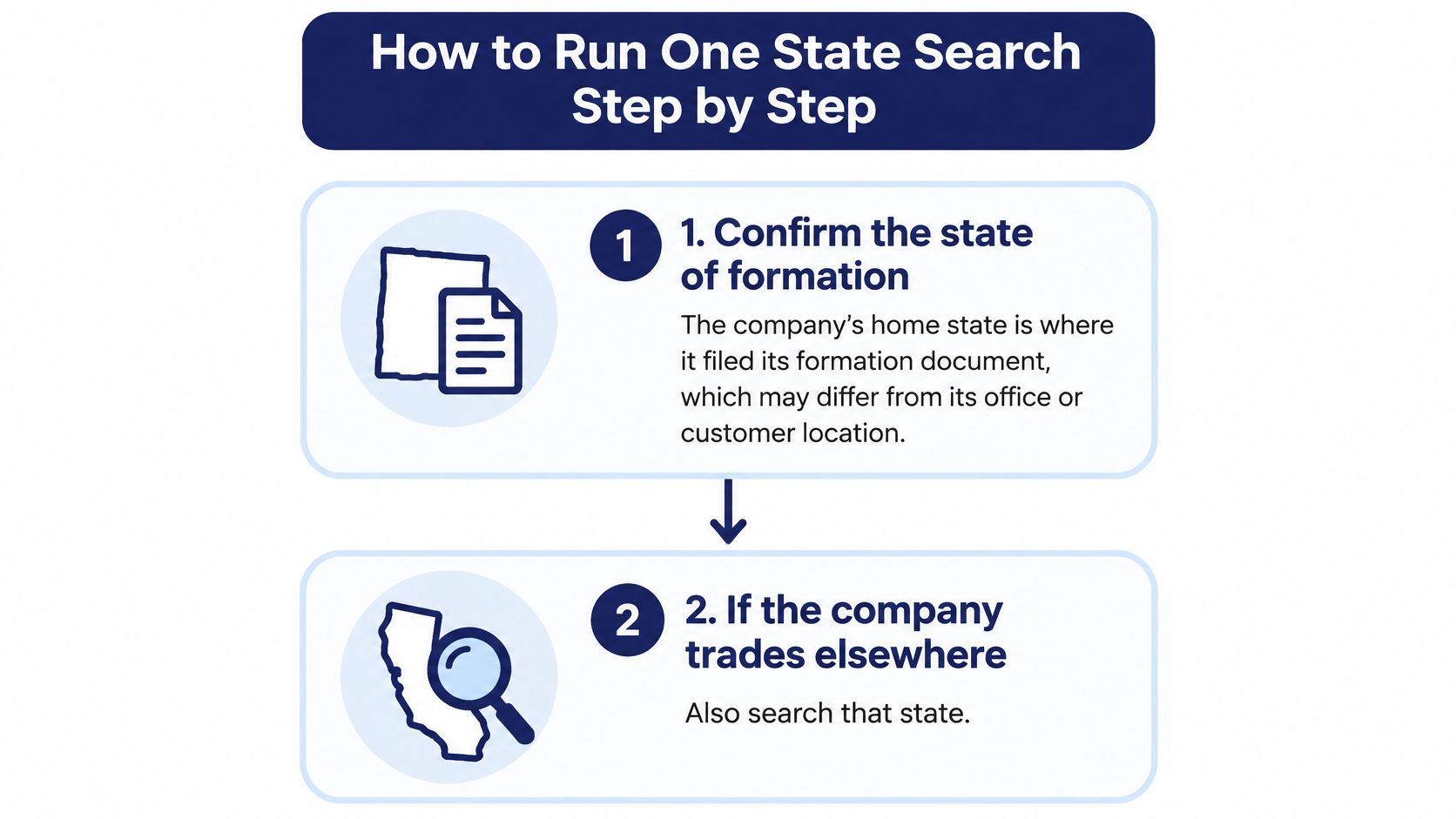
Work through the record deliberately
Confirm the state of formation. Use the jurisdiction on the formation document, which may differ from the office or customer location. If the company operates elsewhere, also check the relevant out-of-state registration record.
Enter the exact legal name. Include the suffix, such as LLC or Inc., then try punctuation and spacing variants if the exact search fails. Broaden the query gradually so you can explain why each candidate appeared.
Open the record and inspect its status and type. Don't rely on the search-results summary alone. Confirm that you're looking at the expected legal form and investigate any inactive, dissolved, or unfamiliar status before proceeding.
Save the entity ID or file number. Copy it exactly, including any leading zeros or letters. Use that key for subsequent lookups rather than repeating a broad name search.
Read the filing history. Open the latest annual report where applicable, then inspect amendments, name changes, or other relevant filings. Compare document dates and contents rather than treating the newest item as automatically sufficient.
Preserve the result. Record the search date and time, then save the record as a PDF or screenshot and retain relevant filing documents. Include the source reference so another reviewer can trace the evidence.
For an interface-specific example, the Michigan entity search guide helps translate this workflow into a particular state's search process. Registry layouts differ, so look for the underlying fields rather than expecting identical menus.
Recognize a usable result
A straightforward result has the expected entity type, a satisfactory state-defined status, a named registered agent, and an identifier that matches the counterparty's paperwork. Its filing history should also make sense for that entity's reporting obligations.
A missing annual report isn't automatically a defect if that entity doesn't have that reporting requirement. Conversely, an active label doesn't resolve a conflicting name or unexplained amendment. Record what you confirmed and leave unresolved questions visible for the person making the decision.
Telling Apart Similar and Common Names
Say your supplier calls itself Summit Holdings. A search returns Summit Holdings LLC, Summit Holdings Inc., and a dissolved entity with a nearly identical name. Choosing the first active result could attach another company's history to your supplier.
A name match is a candidate, not identity proof. Subsidiaries may resemble their parent companies, and unrelated entities can use the same legal name in different jurisdictions. Capitalization, punctuation, and corporate suffixes can also make the same entity appear different across systems.
Match confidence by type of match
| Match tier | Key used | How to treat the result |
|---|---|---|
| 1. Exact state plus registry ID | Entity ID, file number, or document number | Strongest match; confirm against the counterparty's details |
| 2. Normalized legal name plus state | Name with case, punctuation, and suffix standardized | Probable match; confirm agent, address, or formation date |
| 3. Similar or partial names | Fuzzy or partial name similarity | Review only; never accept automatically |
For engineers, normalization should improve discovery without destroying source information. Store a standardized name for comparison, but retain the exact filed name and original identifier. Don't merge records because their cleaned-up names look alike.
Registry-specific query fields can include entityId for New York and California, documentNumber for Florida, fileNumber for Delaware, filingNumber for Arkansas, and controlNumber for Georgia. Treat the jurisdiction and identifier together as the lookup key, not the identifier alone.
A strong match explains why the record belongs to this counterparty. A similarity score alone doesn't explain that relationship.
FinCEN's Customer Due Diligence Rule FAQs describe beneficial-owner identification and verification obligations for covered financial institutions. Matching the legal entity therefore supports, but doesn't replace, a separate ownership-verification process.
Before accepting a candidate, compare another detail supplied by the counterparty, such as its registered agent, principal address, or formation date. If nothing fits, investigate the possible reasons for no match found rather than accepting the nearest name.
Where a Registry Record Stops
A Secretary of State result doesn't establish who ultimately owns or controls a company. It usually provides formation, status, address, agent, and filing information. Even when officers or managers appear, their listed roles aren't a complete ownership statement.
Keep the questions separate. Legal existence, good standing, management, authority to sign, and beneficial ownership require different evidence.
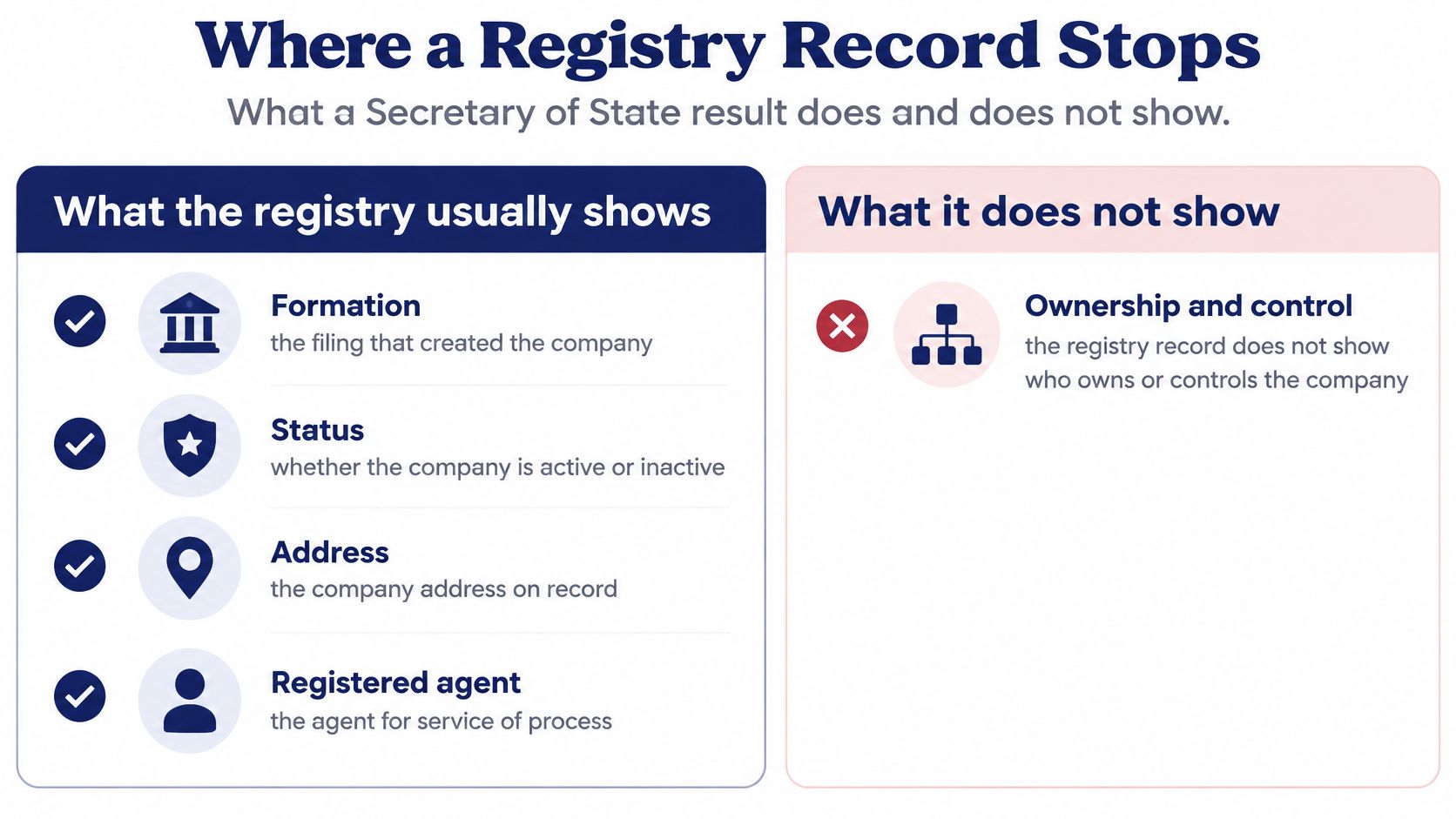
What a state record answers and what needs more evidence
| Question | Does the state record answer it? | Evidence needed beyond the record |
|---|---|---|
| Does the entity legally exist in the state? | Usually yes, for the recorded entity | None for basic recorded existence |
| Is its status active? | Yes, as that state defines it | Filing history to investigate recent changes |
| Is it in good standing? | Not always shown explicitly | A current state certificate of good standing |
| Who is the registered agent? | Yes, where published | Agent confirmation when service of papers matters |
| Who are the officers or managers? | Often, where published | Operating agreement or board resolution to establish relevant roles or authority |
| Who are the beneficial owners? | Not conclusively | Ownership certification, shareholder or member register, or signed customer declaration |
Request evidence for the unanswered question
The federal reporting context also matters. Under FinCEN's March 2025 interim final rule, U.S.-formed companies and U.S. persons were exempted from federal beneficial-ownership reporting under the Corporate Transparency Act, while qualifying foreign-formed entities registered in the United States remained within the reporting framework, subject to applicable exemptions. Don't assume that every domestic company must have a federal ownership filing available for your review.
If ownership matters to onboarding or lending, request an operating agreement, a shareholder or member register, and a signed beneficial-ownership certification suited to the review. Check that the documents identify the same legal entity and explain any intermediate holding companies.
If signing authority matters, ask for evidence addressing that authority, such as a relevant board resolution or authorization. A person's appearance in a public filing doesn't automatically answer whether they can approve this particular transaction.
Licensing and litigation checks may answer additional questions about permitted activities or disputes. They should complement the entity record, not be treated as substitutes for ownership evidence. For consequential legal questions, have qualified counsel assess the documents and applicable rules.
Keeping Dated Evidence and Deciding Before You Sign
Consider a hypothetical supplier that signs a contract in early March. Later that month, it changes its registered agent, and a notice is then sent to the old agent. A current summary record alone won't establish which agent was recorded at each relevant moment.
The filing history, effective dates, and preserved documents become important. Whether the notice was legally effective is a separate question for counsel, not something a current registry lookup can decide.
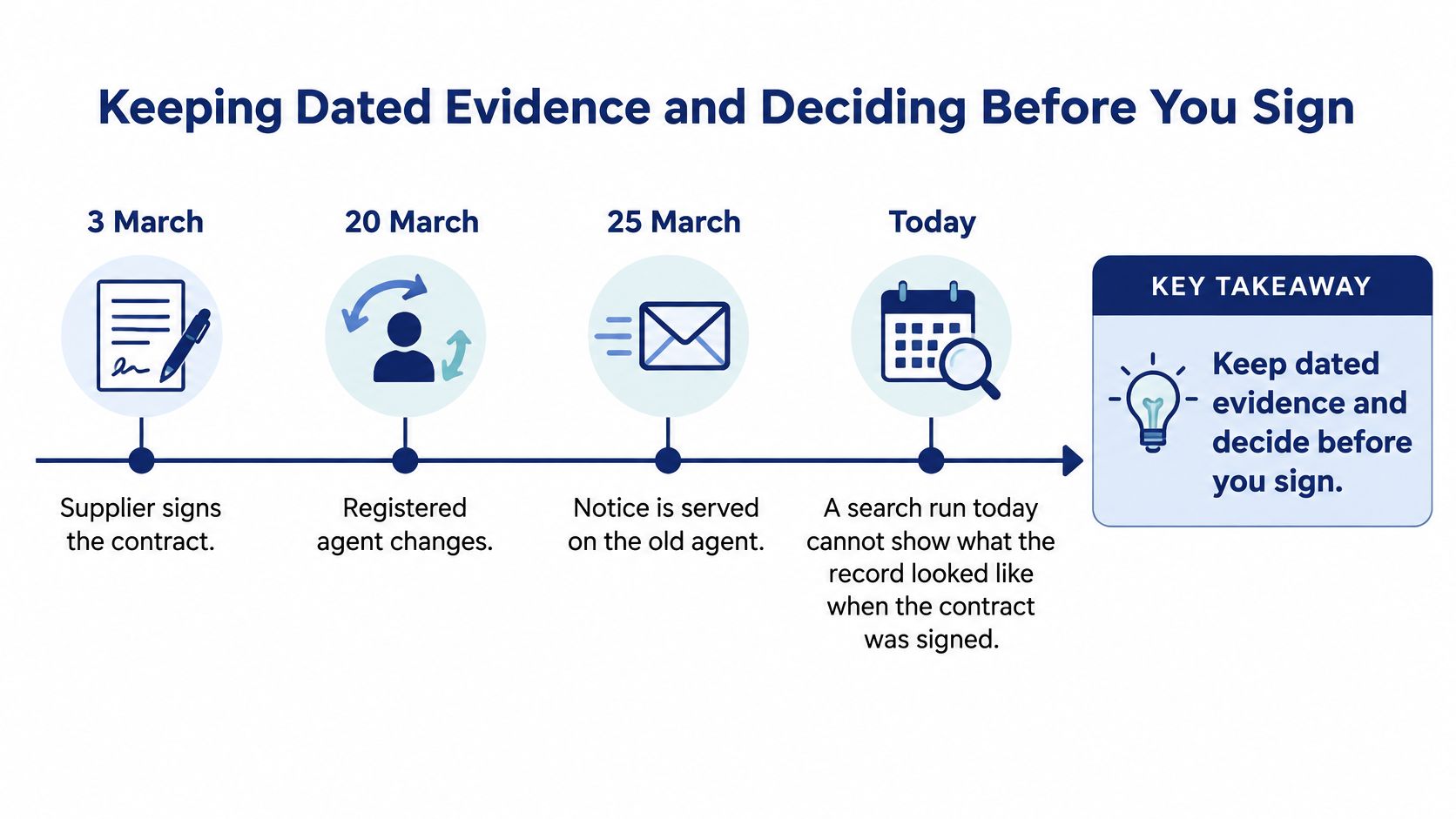
Keep an evidence packet, not just a status
Save enough information to reconstruct the check:
- Query context: Search time, jurisdiction, query terms, and entity identifier.
- Source evidence: Registry record, filing dates, and available PDFs or screenshots.
- Decision context: Reviewer, unresolved discrepancies, and the transaction being assessed.
- Change history: Previous observations and subsequent changes to status, agent, or address.
The Federal Register document on beneficial-ownership reporting revisions concerns a separate federal reporting framework. Keep regulatory materials distinct from the state filings that establish what a particular entity's record showed at a relevant time.
Before approval: Date the evidence, identify its source, and state exactly which question it answers.
Before signing or paying, compare the counterparty's supplied identifier with the saved record, resolve material inconsistencies, and obtain any missing ownership or authority documents. Recheck when the decision occurs substantially later than the original search or when new information creates doubt. A broader company-legitimacy assessment should document those additional checks separately.
Our Free plan's business entity search covers all 50 states and DC, and searches can target a record directly using its state-specific registry ID field. We're an independent commercial service, not affiliated with any Secretary of State, and we can't file documents or change official records on your behalf.
SOSfinder offers business-name and registry-ID searches that help teams identify the correct entity and review its recorded details. Visit SOSfinder to check your next counterparty, then preserve the dated result alongside the documents supporting your decision.