Date of Incorporation of a Company Explained

A company's date of incorporation is the moment it becomes a legal entity under the corporate law of its jurisdiction. In most cases, that's the day the state registry accepts the formation filing, though a filing can specify a later effective date.
What a Company's Incorporation Date Actually Means
If you only take one thing from this guide, make it the summary below.
Quick Answer Summary of the Incorporation Date
| Question | Short Answer | Where It Comes From |
|---|---|---|
| What does the date represent? | The moment the company begins to exist legally | The accepted formation filing |
| Which authority sets it? | The state filing office, usually the Secretary of State | The corporate registry |
| Where is it recorded? | In the formation documents and the entity's registry profile | Articles of incorporation and state records |
| What is it commonly confused with? | Tax registration dates, trading start dates, amendment dates | Separate administrative filings |
| Why do compliance teams rely on it? | It anchors the entity's legal chronology | The verified formation history |
The short version: the incorporation date marks when a business became a legal person, and every other milestone in its timeline hangs off that anchor.
A useful way to picture it: the formation document works like a birth certificate for the corporation. The company's legal birthday isn't the day founders picked a name, signed a lease, or rang up their first sale. It's the day the state agreed the entity exists.
Filings that come later add chapters to that story without moving the starting point. A name change or routine amendment leaves the birthday alone. A restructuring is different, since you have to confirm whether the original entity carried on or a genuinely new one appeared.
The incorporation date anchors a company's legal identity, not the start of every business activity.

Why the Original Formation Date Matters
Picture a supplier incorporated in March that didn't start selling until September. A good verification workflow keeps March as the legal starting point and logs September separately as the operational one.
Once you hold those apart, a few routine checks get much easier.
- Calculate entity age from the formation date rather than from a recent amendment.
- Check the chronology whenever a merchant's claimed business history doesn't line up with its corporate record.
- Trace continuity before assuming a renamed or restructured business is a newly formed corporation.
For consistent comparisons, SOSfinder entity records include status, entity type, formation date, registered agent, and principal address, normalized into one format. Explore SOSfinder's entity records.
It's also worth storing the original filing next to whatever date you extract. When something looks off, reviewers can dig into the discrepancy instead of quietly overwriting historical data.
Start with a single company you need to verify and work outward from there. Three questions tend to come up next: where the date lives, which dates people mix up with it, and how to pull it reliably across many entities.
A company’s formation date matters because incorporation eventually became a recorded administrative act, not a personal favor handed out by lawmakers.
How Incorporation Became a Standard Administrative Process
On March 10, 1899, Delaware adopted a general corporation law that changed how businesses entered its corporate system. Before that, companies usually had to petition the General Assembly for a special charter, a slower and less predictable path that depended on individual legislative approval.
The new statute drew heavily on New Jersey's corporate legislation and aimed to attract businesses looking for more flexible rules. Applicants no longer had to ask lawmakers to create each corporation one at a time; they could file under published requirements.
Incorporation shifted from a legislative privilege to an administrative filing under established rules.
Picture the difference between asking for special permission to build a road and applying for a permit under an existing building code. Both rely on government authority, yet published requirements make the process repeatable and the outcome easier to document.
- Before the change, getting a charter generally meant securing individual legislative action.
- Under general incorporation rules, formation followed an established administrative framework.
Connect Historical Filings to Modern Verification
That shift explains why a company's date of incorporation belongs in a verification workflow. The dated record shows when the entity entered a particular jurisdiction's corporate framework, not merely when someone typed its name into a database.
Say you are reviewing an older corporation that later went through restructuring. Treating the restructuring date as the formation date could wipe out earlier legal history before you have confirmed whether the original entity continued.
A practical chronology check should follow this order:
- Identify the entity and its jurisdiction.
- Locate its original formation record.
- Review later filings for continuity or replacement.
Handled this way, a mismatch becomes something to investigate, not a reason to overwrite an existing date. For broader context, see our guide to company registration in the USA.
Normalize the format, not the legal meaning. Keep the source jurisdiction and original date beside a consistent date field.
Start with your next verification batch and preserve those details before comparing entity ages. Normalizing dates across jurisdictions lets teams compare companies formed under very different state regimes without flattening their distinct legal histories.
Finding the date of incorporation of a company starts with its state registry record, then checking the underlying filing rather than trusting a search preview.
Finding the Incorporation Date in Official State Records
Think of the entity detail page as the cover sheet and the filing history as the supporting folder. The date might show up on the profile, inside the original formation document, or next to that document in the filing list.
State portals don't share one layout. Labels and document access shift from state to state, so learning one registry doesn't mean the next one will look the same.

Here’s a simple order to follow:
- Search the state portal. Use the incorporation jurisdiction and the registry identifier when you have it.
- Open the entity record. Confirm the legal name and identifying details before you pull anything.
- Read the formation field. Keep its exact label alongside the date.
- Check the earliest formation filing. Look for a stated effective date and reconcile any mismatch.
Annual reports and amendments help fill out the timeline. But they’re no substitute for the original formation record.
Use Registry Identifiers for Precise Lookups
A name search is like looking for someone in a crowded directory. A registry ID points to one record inside the selected state, which helps you avoid mix-ups between businesses with similar names.
Say onboarding paperwork gives you a Florida document number. Use that identifier instead of picking whichever “Acme Services” shows up first. Always pair the identifier with its jurisdiction.
The table below shows which ID field to use where, so you can skip fuzzy name matching.
Registry Identifier Fields for Direct Entity Lookups
SOSfinder supports these registry-specific fields for direct entity queries:
| State | Registry ID Field | Lookup Use Case |
|---|---|---|
| New York | entityId | Select one entity |
| California | entityId | Select one entity |
| Florida | documentNumber | Retrieve the identified record |
| Delaware | fileNumber | Avoid similar names |
| Arkansas | filingNumber | Target one registry record |
| Georgia | controlNumber | Resolve a specific entity |
Use the exact field for each state when you build a lookup. That one habit saves a lot of cleanup later.
- Keep identifiers as supplied, including any leading zeros.
- Store the jurisdiction separately, because identifiers aren’t universal company numbers.
For help interpreting the underlying paperwork, read our guide to company formation documents.
Match the entity first, then verify the date against its formation evidence.
Retrieve Formation Dates Programmatically
For repeated checks, SOSfinder's single REST endpoint queries official registries and returns the formation date alongside status, registered agent, and filings. That gives engineers one integration instead of separate retrieval logic for every state.
A normalized response doesn’t remove the need to interpret the source, though. Keep the registry identifier, jurisdiction, retrieval date, and supporting filing reference with your extracted value.
If the underlying record is wrong, request correction from the state office maintaining the filing, not a downstream provider.
Start with one company today. Verify its identifier and earliest formation filing, then save that evidence before you add its date to your workflow.
The date of incorporation of a company answers one specific legal question: when did this business come into existence? Every other date tells a different story — taxes, expansion, hiring, or later updates to the record.
Separating Incorporation From Other Important Business Dates
Picture a corporation formed in January. It requests an EIN in February, registers in another state in March, and runs its first payroll in April.
Those are four real milestones for one business. But they don’t mean the same thing, and they shouldn’t be filed under one date.
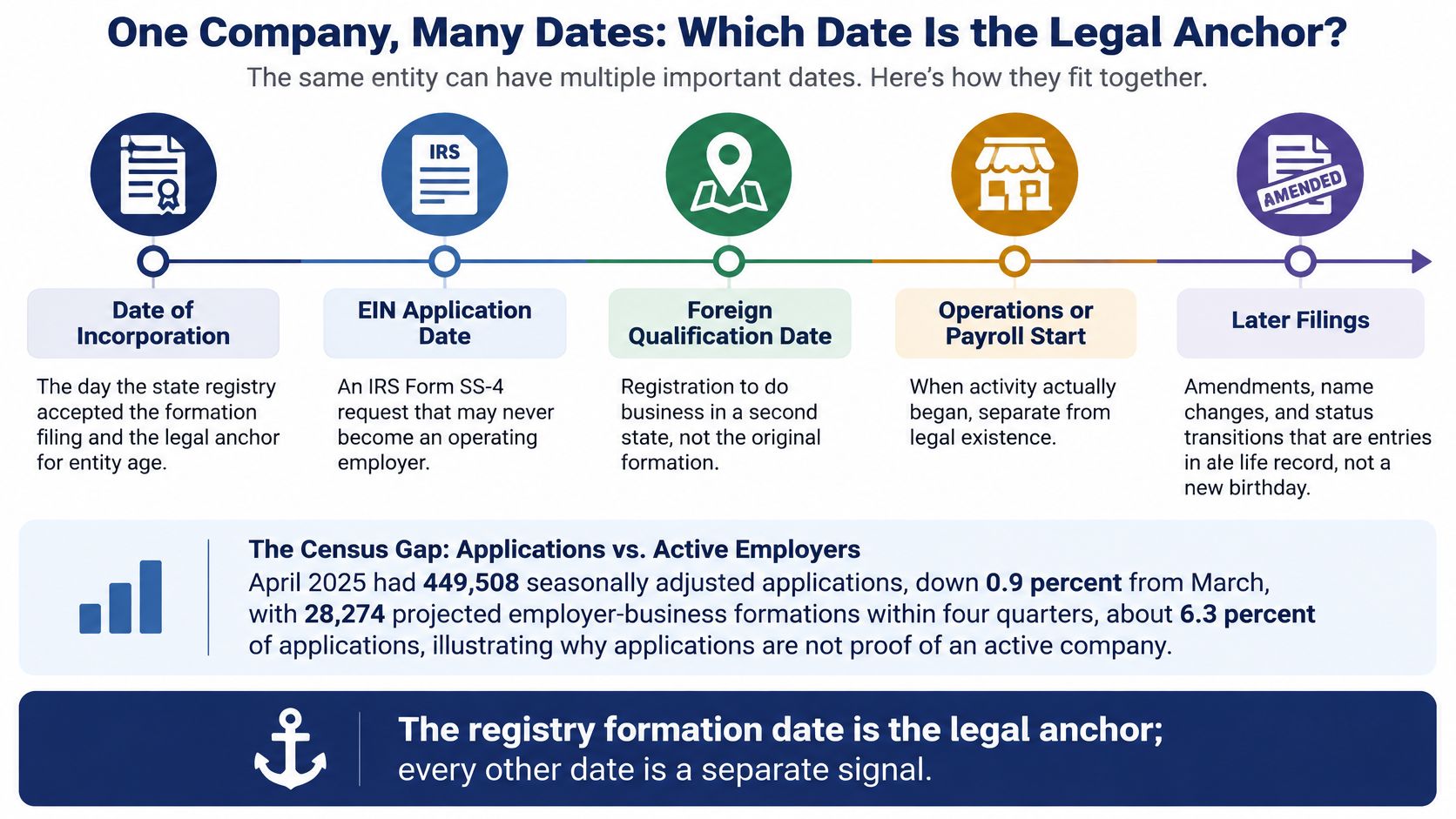
The takeaway is straightforward. A company can legally exist long before it hires anyone, and new paperwork doesn’t reset its history.
- January incorporation sets the original legal start date.
- February EIN application records a request for a federal tax number.
- March foreign qualification records registration in a second state.
- April payroll signals employer activity, not formation.
- Later filings document follow-up events that need their own context.
Distinguish Tax Applications From Employer Formation
The EIN application date comes from the federal tax process, not the state filing process. It’s more like getting an ID number than getting a second birth certificate.
Census data draws this line very clearly. A business application is typically tracked through an EIN request on IRS Form SS-4, while employer formation is tied to the first appearance of payroll-tax liability.
| Signal | What It Establishes |
|---|---|
| EIN application | A tax identifier was requested |
| State incorporation | The entity legally came into existence |
| Payroll-tax liabilities | Employer activity began |
For April 2025, seasonally adjusted applications reached 449,508, down 0.9 percent from March. Projected employer formations within four quarters totaled 28,274, or about 6.3 percent of applications.
That projection doesn’t count every incorporated company. Nor does it mean the rest failed. It measures one narrow outcome: becoming an employer inside that window.
Keep Expansion and Later Changes Separate
Foreign qualification simply means an existing company registers to operate in another state. Here, “foreign” means out-of-state, not out-of-country.
In the same way, operations and payroll dates describe activity. A store can open, sales can start, and employees can be paid on completely different timelines. Don’t merge those into the formation field.
- Preserve the original formation date with its jurisdiction and filing proof.
- Store later milestones separately, from amendments and name changes to status updates.
- Review continuity during restructuring, instead of assuming every change creates a new entity.
Before you sign off on a vendor, compare its original filing against its current record. Our guide to checking whether an LLC is active shows how to confirm present standing apart from historical age.
The registry formation date is the legal anchor; every other date is a separate signal.
Abstract definitions only help so much. The date of incorporation of a company starts to matter when someone has to make a call based on it.

The Fintech Onboarding Desk
A payments fintech is reviewing a merchant who says the business started in 2016. The state registry lists a formation date of 2019.
It would be easy to flag that as a mismatch and move on. A good reviewer pauses instead and checks the surrounding details: status, registered agent, and the full filing history.
Those filings tell the real story. A corporation formed in 2016 was converted and re-registered in 2019. Same operation, new record. Once you see that chain, the gap makes sense.
A mismatched year is a question, not a verdict. Read the record before you reject the merchant.
The Lender Segmenting by Company Age
A lender groups borrowers into risk tiers based on how old the entity is. The risk here is subtle. If a later amendment overwrites the original formation date, a nine-year-old company can suddenly look two years old.
The fix is simple in principle. Keep the original formation date frozen and put amendments on a separate timeline. That way your age calculation stays steady and the history stays intact.
The Procurement Team and the New Vendor
A procurement team vets a vendor formed just three weeks before the contract date. That timing alone does not disqualify anyone, but it shifts the questions you ask.
A young company with clean filings and a verifiable registered agent is one scenario. A young company with no filings and a residential agent address is something else entirely. The date gives everything else its context.
The Legal Filing Service and Name Clearance
A filing service checks name availability before it submits formation paperwork. If that name is already taken, the state rejects the filing and the incorporation date slides by days or weeks.
Clearing the name early lets the filing go through on the planned day. For a client up against a deadline, that single step protects the date itself.
Why Structured Facts Beat Activity Signals
The Census Bureau's Business Formation Statistics program publishes 12 series, with four application series and eight formation series for the United States, regions, and states, in adjusted and unadjusted form. That structure exists for a reason. Formation is a fixed historical fact, not just another sign of activity.
Applications and tax filings come and go. A formation date holds still.
- Preserve the original date as a fixed historical fact.
- Monitor subsequent filings to rebuild the entity's timeline.
- Treat every other date as context, not as a replacement.
For a deeper walkthrough of legitimacy checks, read our guide on how to see if a company is legitimate.
Take one workflow you own and find where the formation date enters it. Then make sure your system keeps that date untouched while everything else changes around it.
A date mismatch doesn't automatically mean bad data. It usually means you're looking at the wrong document, the wrong state, or even the wrong business.
Common Mistakes When Reading a Company Formation Date
The date of incorporation of a company should always trace back to a source you can prove. Spot the pattern first, then fix the stored value.
Symptom 1, onboarding matches the EIN letter. This happens when someone copies the tax ID issue date into the incorporation field. Both papers look official, so the mix-up is easy. Fix: Search the state registry by ID and open the original formation filing, effective date included.
Symptom 2, expansion makes an old company look new. A foreign qualification in a second state overwrites the true formation date. Suddenly a 20-year-old business looks like it started last year. Fix: Find the home jurisdiction, pull that formation record, and keep the qualification date in its own field.
Treat later registrations like additional chapters, not replacement birth certificates.
- Symptom 3, company age resets after routine paperwork. Filing lists sort newest-first, so it's tempting to grab the latest amendment or annual report. That date tells you when paperwork was filed, not when the company was born. Fix: Scroll to the earliest formation filing for that entity and use that timestamp.
Resolve Source and Identity Conflicts
Symptom 4, a profile disagrees with the filing. Third-party sites often cache old data or label a different milestone as the start date without explaining it. Fix: Re-run the search by registry ID, compare it to the actual formation document, and save what you found.
Symptom 5, similar names create conflicting dates. A broad name search can return several different businesses, and the first result isn't always yours. Fix: Line up jurisdiction, registry ID, addresses, and officers before you attach a date to your entity.
For this identity check, SOSfinder's entity search uses name and state to return the best match plus similar filings, each with status, registered agent, officers, and addresses. Explore SOSfinder's entity search.
A best-match result is a helpful starting point with common names. Still, don't lock a date into your system of record until you've ruled out the lookalikes.
- Confirm the entity's registry identifier and jurisdiction.
- Verify the formation date against its original filing.
- Save the evidence and explain any correction.
And if the official record is the problem? Ask for a correction from the state office holding the filing, not from a downstream profile.
Run these checks before you approve that next onboarding record. A few extra minutes now saves a lot of cleanup later.
Keep old formation proof apart from what the registry shows today, especially when you run into these tricky cases.
Frequently Asked Questions About Incorporation Dates
Can the date of incorporation of a company change? Normal amendments don't move it.
For a conversion or restructuring, look at the governing documents and state rules first. You need to decide if it's the same entity continuing or a brand-new successor. Keep the original date on file right next to anything that happened later. See “What a Company's Incorporation Date Actually Means” for more on continuity.
Do sole proprietorships and general partnerships have incorporation dates? Not unless they actually incorporate.
Don't invent a corporate birthday from an EIN or a business license. Record a documented start date or partnership agreement date instead, in its own clearly labeled field, and note where you got it. “Separating Incorporation From Other Important Business Dates” breaks down why those milestones aren't interchangeable.
An unavailable incorporation date isn't permission to substitute another milestone.
Resolve Missing Dates and Monitoring Questions
What if dates are missing or conflicting? Leave formation as unknown.
Hold on to the competing evidence and flag it for review instead of guessing. Follow “Finding the Incorporation Date in Official State Records” and run these checks before you sign off:
- Confirm jurisdiction and registry identifier.
- Compare filing and effective dates.
- Request clarification from the filing office.
How often should teams recheck records? It depends on your portfolio risk.
There's no one-size-fits-all schedule, but always reverify before a big decision. Monitoring alerts you when a tracked company changes status, registered agent, or address — it doesn't treat that historic birthday as something that moves. Explore SOSfinder monitoring.
For the full process, go back to “Real Examples of Incorporation Dates in Verification Workflows.”
- Preserve formation evidence and correction history.
- Review material changes against your escalation policy.
Use SOSfinder to verify your next onboarding record and set up ongoing checks. Preserve the formation date as historical fact; watch status and address as living fields.