10 Business Verification Software Tools for KYB

The popular advice is to choose the business verification software with the broadest coverage. That's too simple. Business verification isn't one uniform category. One product may provide official Secretary of State records through an API, while another combines KYB with UBO verification, KYC, AML screening, case management, payments onboarding, or commercial enrichment.
The right choice depends on the verification job. A lender checking a U.S. entity's status and filing history has a different requirement from a global marketplace identifying beneficial owners, or a fintech monitoring businesses after onboarding. The useful comparison points are jurisdictional coverage, source transparency, API and implementation model, monitoring, document access, pricing visibility, workflow depth, and the boundary between registry verification and regulated KYC or AML work.
The market's scale reflects that distinction. The global identity verification market, a close proxy for business verification and onboarding infrastructure, was estimated at US$14.34 billion in 2025 and is projected to reach US$29.32 billion by 2030, according to MarketsandMarkets. The 10 tools below aren't presented as interchangeable winners. Each is organized around the verification problem it solves best, from official registry access and global KYB to payments onboarding, data enrichment, orchestration, and continuous monitoring.
1. SOSfinder for official U.S. registry access
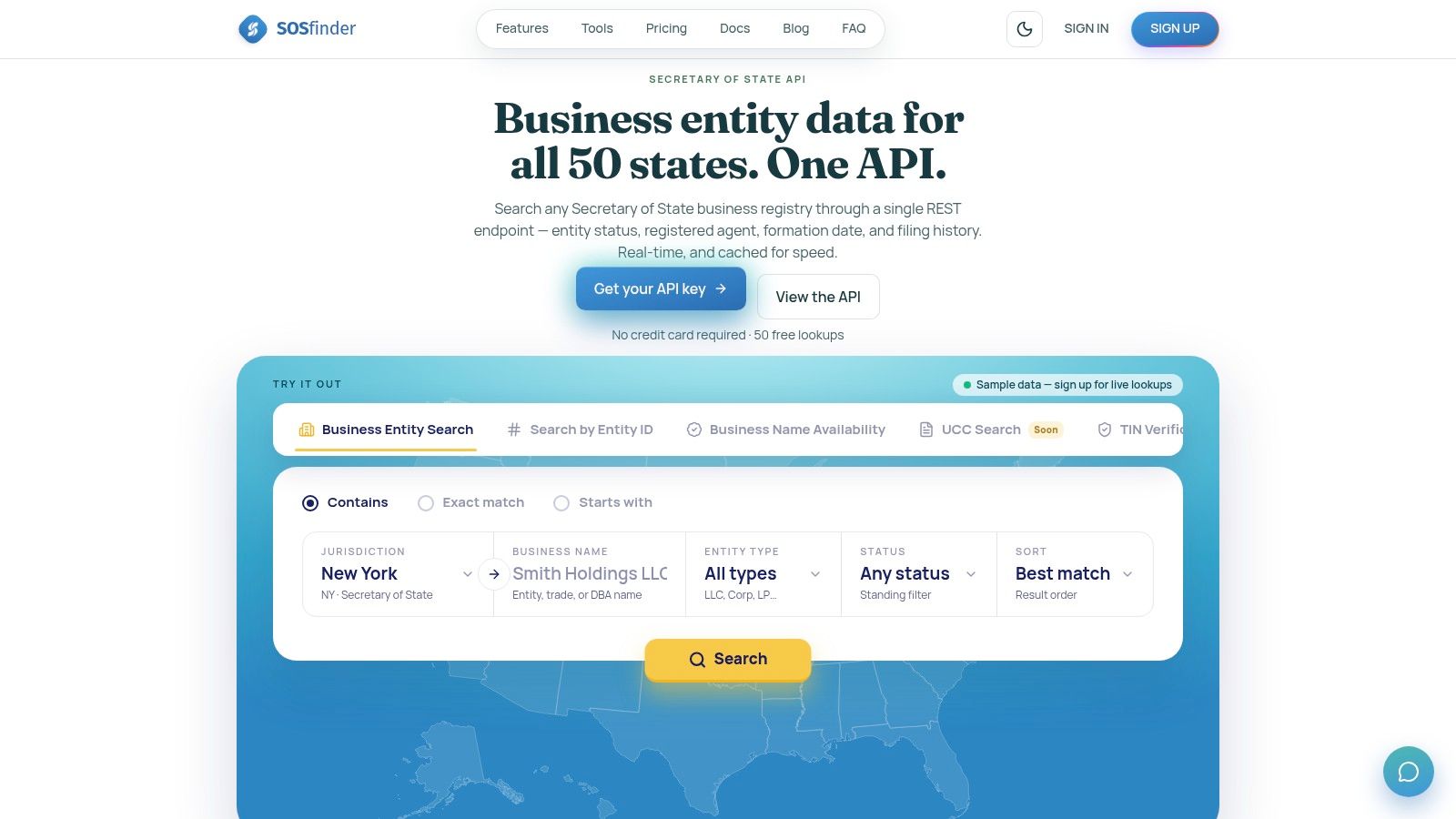
SOSfinder fits a specific verification problem: confirming what an official U.S. state registry records about an entity. Its API consolidates records from all 50 U.S. states plus the District of Columbia behind one REST endpoint, reducing the need to maintain separate integrations for each Secretary of State system. The published SOSfinder pricing page provides the product and plan details.
A single POST request can return normalized fields including legal status, entity type, formation or registration date, registered agent, principal address, filing history, and links to state PDFs where available. The service uses real-time lookups with low-latency caching, which can keep responses fast and reduce duplicate charges for the same record. Built-in retries address temporary registry blocks, a practical safeguard when state systems respond inconsistently.
What engineers get beyond a lookup
SOSfinder is designed for teams embedding registry data in onboarding, procurement, filing, or risk workflows. Predictable JSON responses, an API playground, and examples for cURL, Python, JavaScript, PHP, and Go can shorten implementation. CSV bulk verification supports portfolio checks, while webhooks can deliver change events to downstream systems.
Configurable monitoring covers changes to business status, registered agent, and address. Filing-history retrieval and state PDF links can support audits, underwriting, and manual review. UCC and officer or person lookup are listed as beta capabilities, so buyers should confirm availability before making them production dependencies.
Practical rule: Use a registry API to establish what an entity is and how its public record has changed. Do not treat registry data alone as proof of beneficial ownership, sanctions status, or individual identity.
SOSfinder uses a usage-based pricing model, with a free tier offering 50 lookups, subscription plans from $49 per month for 1,000 lookups, and non-expiring credit packs, according to its published pricing information. Higher plans add capacity, analytics, priority support, expanded monitoring, and a 99.9% uptime SLA. The service is privately operated and sources official state registries, not a government agency. Registry response quality, document availability, and retrieval speed can still vary by jurisdiction.
2. Middesk for U.S.-first KYB
Middesk is aimed at companies that need more than a registry search but still operate primarily in the United States. Its KYB workflows combine business entity verification with ownership confirmation, TIN or EIN checks, sanctions and PEP screening, and adverse-media signals.
That combination makes Middesk more suitable than a registry-only API for a U.S. fintech, lender, or platform that wants to connect entity verification with risk screening. Its developer materials describe concrete KYB steps and signals, which can help engineering and compliance teams agree on what the workflow should return before implementation begins.
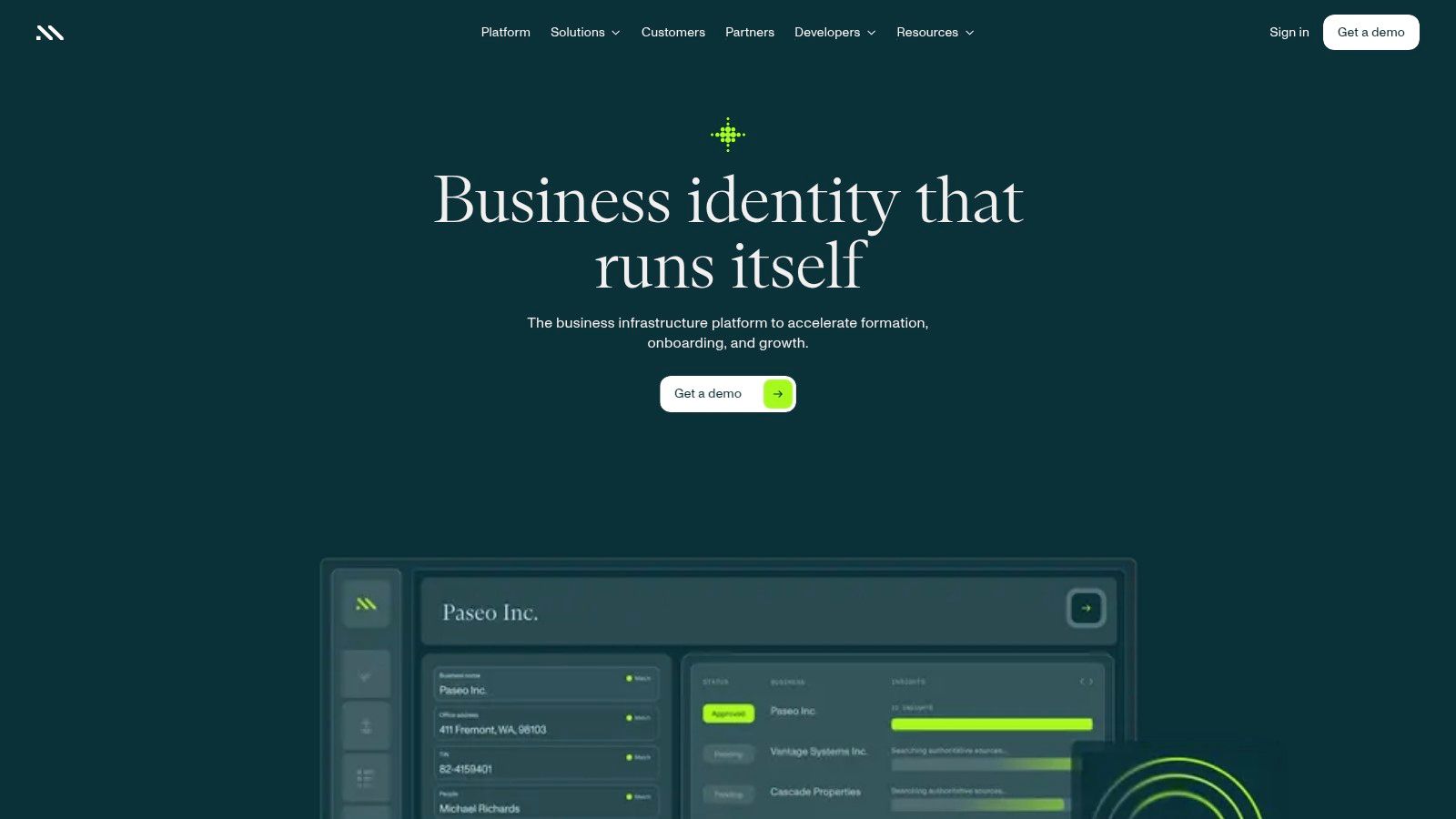
The trade-off is scope. Middesk's strongest positioning is its U.S. registry depth and KYB specialization, while international entities may be returned through a unified format without receiving the same local data depth available for U.S. businesses. Buyers verifying entities across many jurisdictions should test country-specific coverage rather than assuming that one response model means equivalent source quality everywhere.
Middesk also doesn't publish straightforward pricing on its public site. That sales-led approach may suit larger regulated programs, but it makes early cost comparison harder for smaller teams. Before requesting a quote, define the expected mix of entity checks, owner checks, screening, manual reviews, and monitoring. Otherwise, a simple per-check comparison won't show the actual operating cost.
For teams still defining the distinction between a registry match and a complete KYB decision, this guide to KYB verification provides useful terminology. Middesk is strongest when U.S. entity verification and associated risk signals need to live in one specialized workflow.
3. Trulioo for global KYB and owner verification
Trulioo addresses the problem that appears after a business operates across borders. Its Business Verification API supports entity search, verification, and watchlist hit details, while hosted and no-code flows give teams an alternative to building every screen themselves.
The important distinction is the KYB to KYC handoff. Trulioo can waterfall from business verification to verification of UBOs and associated individuals, allowing a company to connect the legal entity with the people who control it. That makes the platform a stronger fit for international marketplaces, financial services companies, and platforms that need one onboarding journey for businesses and their owners.
Where global coverage needs testing
Broad international coverage doesn't guarantee identical record depth in every jurisdiction. Registry structures, available ownership information, document access, refresh behavior, and naming conventions vary by country. A company with a common name, a translated operating name, or a recently changed registered address may produce a different review experience from a well-established entity in a highly digitized registry.
Trulioo's standardized responses and mature documentation can simplify implementation, but pricing is sales-quoted and may change with geography, volume, and the checks selected. Teams should test a sample that includes straightforward entities and difficult cross-border cases. A KYB API overview can also help separate the API layer from the underlying questions about source authority, owner verification, and screening.
Trulioo is a practical choice when global entity coverage and the KYB-to-KYC journey matter more than retrieving deep filing histories from one national registry. It isn't the obvious choice for a U.S.-only product that needs highly granular Secretary of State documents and predictable registry-specific behavior.
4. Persona for configurable KYB workflows
Persona treats KYB as a configurable workflow rather than a single company search. Its platform can centralize business and ownership data, capture and verify UBOs, and add credibility signals such as website presence, liens, industry information, and relationships between businesses, owners, and devices.
That broader signal set is useful when the risk isn't limited to whether a company exists. A legitimate entity can still be impersonated, connected to suspicious accounts, or represented by an applicant whose digital footprint doesn't support the claimed business activity. Persona gives teams more context for deciding when automation is safe and when a case should move to review.
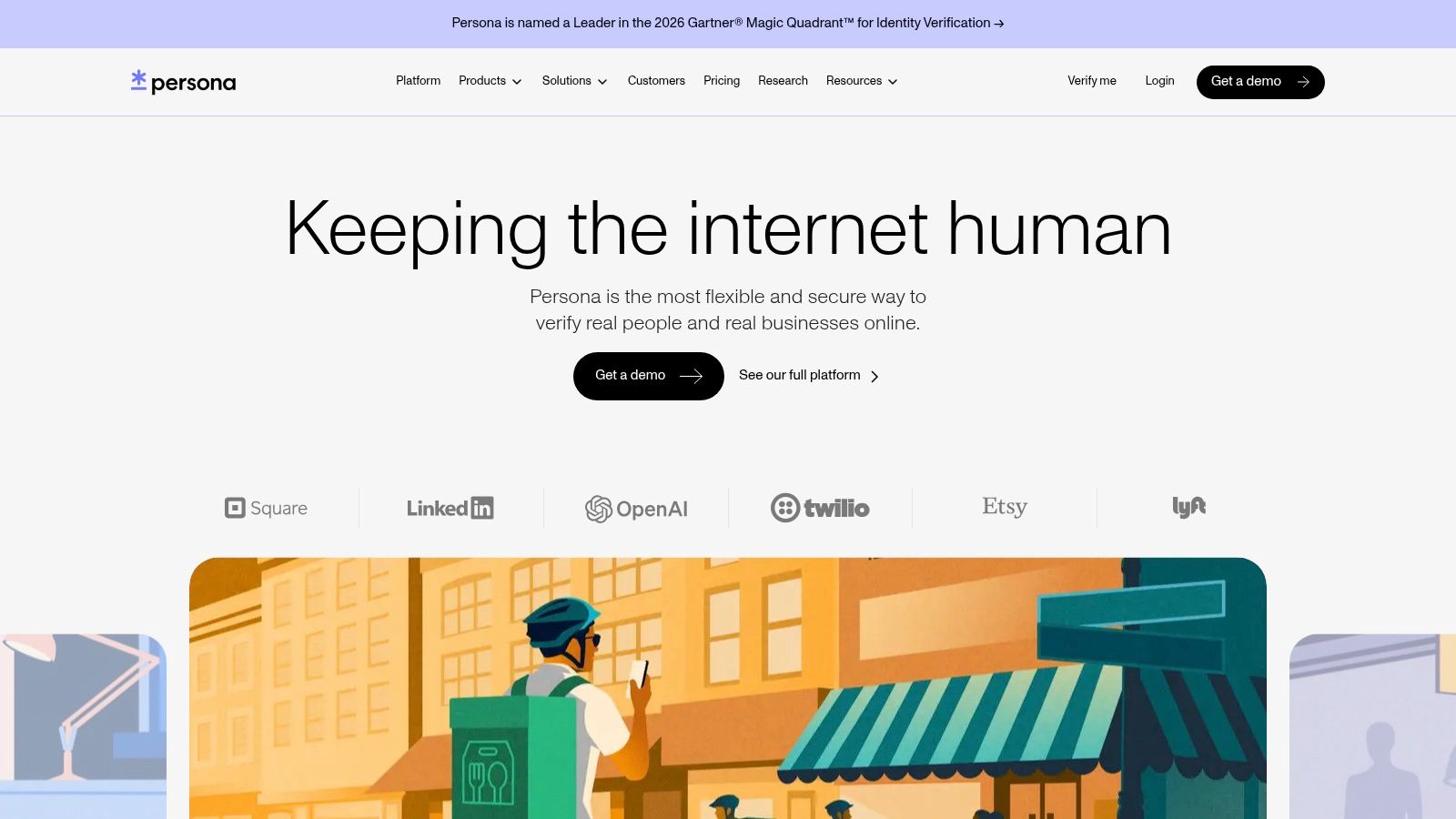
Persona's KYB workflows support more than 150 countries, according to its product materials, and its developer-focused approach includes workflow orchestration and APIs. Eligible startups can also access a program with free monthly verifications. That can lower the barrier to prototyping, though it shouldn't be confused with a permanent production price.
The main operational question is modularity. Advanced KYB capabilities may require plan upgrades or enablement through support, and per-check pricing can vary with the signals and workflow steps selected. Buyers should map the exact decision path, including business search, UBO capture, individual checks, credibility signals, document review, and escalation, before comparing quotes.
Persona fits teams that want to tune the onboarding experience and combine registry evidence with online and device-related context. It may be more capability than a procurement team needs for a straightforward legal-entity status check.
5. Sumsub for an integrated KYB, KYC, and AML stack
Sumsub is built for organizations that don't want separate vendors for business onboarding, individual identity checks, AML screening, and ongoing monitoring. Its business verification workflows support document-driven and data-driven checks, with configurable KYB levels and automated reading of company documents.
That end-to-end model is attractive for regulated businesses with a single onboarding program covering both companies and controlling individuals. A compliance team can define different verification levels by risk, while the platform connects KYB with KYC, screening, and lifecycle monitoring. The value is not just the number of checks. It is the reduction in handoffs between the application, document review, screening, and case decision.
The implementation trade-off
Sumsub's breadth also means that buyers need to understand what is available out of the box and what requires configuration. Several KYB capabilities may need support or a customer success manager to enable, and exact KYB pricing is typically quote-based. That makes a controlled proof of concept more important than a feature checklist.
Test how the platform handles a clean business, an entity with missing documents, a mismatch between submitted information and public data, and a UBO who requires individual verification. Record which steps are automated, which create a manual case, and what evidence remains available for later review.
Sumsub is a sensible choice when the business verification requirement is part of a larger identity and financial-crime program. A company that only needs official corporate records may pay for workflow and screening capabilities it doesn't use.
6. Stripe for payments-linked business onboarding
Stripe solves a narrower but common problem: verifying businesses that need to receive payments or payouts through a Stripe-powered platform. Stripe Connect provides embedded KYB for company accounts and seller onboarding, while Stripe-hosted onboarding can adapt as verification requirements change.
This is less a standalone registry-data product than an embedded payments workflow. For a marketplace or software platform already using Connect, keeping onboarding inside the payments infrastructure can reduce the number of systems engineers must coordinate. Stripe Identity adds individual document and selfie verification with biometric matching, which can support owner or representative checks where that identity layer is required.
The limitation is equally important. Connect KYB is primarily tied to platform onboarding and payments operations, not a general-purpose API for querying corporate records independently of a Stripe account relationship. Teams needing detailed filings, broad corporate-family analysis, or independent UBO research may need an external data partner.
Stripe publishes usage-based guidance for Identity, which can make that component easier to evaluate. KYB economics and requirements still depend on the Connect use case, account type, country, and payment flow. A buyer should confirm which checks Stripe handles, which data it exposes to the platform, and what happens when an account needs remediation.
Choose Stripe when payments already run through Stripe and embedded onboarding is the priority. Choose a dedicated business verification API when the business record itself is the product requirement.
7. Alloy for orchestration and perpetual KYB
Alloy is designed for teams that need to combine multiple data sources and make policy-driven decisions. Its identity decisioning platform supports KYC, KYB, and AML through one workflow engine, with integrations to more than 270 data partners, according to Alloy's product materials.
That architecture addresses a problem a single data provider can't solve alone. A registry may confirm legal status, a document source may provide incorporation evidence, a watchlist provider may identify sanctions exposure, and a credit or commercial source may add risk context. Alloy can route those signals through policies, send ambiguous cases to case management, and maintain a decision record.
A continuous monitoring program is only useful if an alert leads to a defined action, an owner, and retained evidence.
Alloy's perpetual KYB capability extends beyond initial onboarding by maintaining business identity and UBO views over time. That matters because registry data differs in definitions, formats, completeness, and update speed across jurisdictions. A state record can show a business as real while leaving teams to determine whether its status, address, agent, or control has changed.
The trade-off is implementation effort. Alloy is generally an enterprise deployment, and customers may need to integrate and contract with several underlying data sources. Pricing isn't public, and evaluations often involve proofs of concept. It's best suited to financial institutions and fintechs with complex policies, established compliance operations, and a need to avoid dependence on one provider.
8. Dun and Bradstreet D&B Direct+ for commercial enrichment
D&B Direct+ is useful when verification includes commercial identity resolution and company context. Its API supports company search, detailed firmographic profiles, corporate family linkage, and persistent identification through the D-U-N-S Number system.
That makes it different from a direct registry API. A procurement team may care not only whether a legal entity exists, but also how it relates to parent and subsidiary companies, how customer records should be deduplicated, and how a vendor portfolio can be monitored using a stable identifier. D&B's commercial dataset is built for those enrichment and linkage tasks.
The distinction matters in implementation. D&B Direct+ focuses on commercial data rather than direct access to official registry documents. If an underwriter needs an annual report, amendment, or state filing PDF, a separate registry source may still be necessary. Conversely, a registry response alone may not provide the corporate-family context required for vendor rationalization or account matching.
D&B provides JSON APIs, quota and rate-limit guidance, and batch options. Licensing and pricing can be complex, and agreements are typically enterprise-oriented. Buyers should clarify whether they're licensing lookup access, enrichment fields, monitoring, identifiers, batch processing, or a combination.
Use D&B Direct+ when the central challenge is entity resolution and commercial enrichment at scale. It's less suitable as the sole answer for a regulated KYB workflow that requires owner verification, sanctions screening, and a defensible case-management trail.
9. OpenCorporates API for transparent registry indexing
OpenCorporates provides a global company registry index through a REST API. Its value lies in searchable structured data, broad cross-jurisdiction matching, and provenance that points users toward official registers.
For an engineering team, OpenCorporates can serve as a first-pass entity resolution layer. Search by name, jurisdiction, or identifier can help identify candidate companies before a deeper verification step. That is particularly useful for vendor databases, investigative research, and products that need to normalize company references from many countries.
The source model deserves careful attention. OpenCorporates structures data from official registers, but local update frequency and field completeness can vary. Some jurisdictions may provide fewer fields or less current information than the official source, and a registry index isn't automatically equivalent to obtaining the underlying filing document.
OpenCorporates offers self-serve API plans, including open-data or free options for qualifying projects, plus bulk data extracts for commercial use. Those options can make experimentation easier than a sales-led enterprise platform. They don't turn the service into a complete KYB stack, however. UBO and individual KYC capabilities are limited, so teams may need complementary document, identity, and AML solutions.
This business entity data guide explains why the source and structure of corporate records matter. OpenCorporates is a strong starting point for global matching and research. Teams making high-consequence onboarding decisions should define when an index result must be confirmed against a current official record or supporting document.
10. Moody's PassFort and Orbis for regulated enterprise programs
Moody's PassFort and Orbis combine policy-driven workflow orchestration with a broad corporate-data backbone. PassFort can coordinate KYC, KYB, and enhanced due diligence, while Orbis supplies company profiles, ownership information, corporate relationships, and linkage data.
This pairing is designed for institutions that need to standardize due diligence across geographies and risk tiers. A compliance team can define policies, select data sources, route exceptions, and connect sanctions, adverse-media, and monitoring requirements to the onboarding process. Orbis adds corporate context that may be difficult to obtain from a single local registry.
The platform's strength is governance rather than lightweight integration. A bank, lender, or other regulated institution may value consistent controls, configurable policies, and an auditable workflow more than a simple developer-facing lookup. A smaller SaaS company may find the same structure heavy if its requirement is limited to confirming that a U.S. vendor is active.
Pricing and onboarding are enterprise-oriented, and multiple data subscriptions may be required depending on the institution's risk policy. Ask whether Orbis data, screening, adverse media, documents, and monitoring are included in the proposed configuration or priced separately.
This overview of compliance monitoring software is useful for separating ongoing oversight from a one-time entity check. PassFort and Orbis suit organizations that need a governed, multi-source compliance program, not teams searching for the shortest path to a normalized registry response.
Top 10 Business Verification Tools Comparison
| Provider | Core features | UX / Quality (★) | Price / Value (💰) | Target audience (👥) | Unique selling point (✨) |
|---|---|---|---|---|---|
| 🏆 SOSfinder | Single POST 50‑state entity search; normalized records, monitoring, bulk CSV, webhooks, filing PDFs | ★★★★☆ Low‑latency caching; 99.9% SLA (higher tiers) | 💰 Free 50 lookups; $49–$449/mo tiers; credit packs (~$0.06–$0.09/lookup) | 👥 Engineers, compliance/KYC teams, fintechs, legal & vendor management | ✨ Unified 50‑state schema, API playground, hosted MCP for AI queries |
| Middesk | Entity verification, TIN/EIN checks, sanctions/PEP, US registry focus | ★★★☆☆ Strong KYB workflows & docs | 💰 Sales‑quoted | 👥 US platforms onboarding businesses, risk teams | ✨ Deep U.S. KYB signals (TIN/EIN + sanctions) |
| Trulioo | Global KYB API, watchlists, KYB→KYC/UBO waterfall, hosted flows | ★★★★☆ Broad international coverage | 💰 Sales‑quoted; geography/volume dependent | 👥 Global platforms and marketplaces | ✨ Wide global coverage + no‑code/hosted flows |
| Persona (withPersona) | Configurable KYB workflows, UBO capture, online credibility signals | ★★★★☆ Strong workflow tooling | 💰 Per‑check; startup program with free verifications | 👥 Startups and platforms needing flexible workflows | ✨ Link analysis, device/signals + startup plan |
| Sumsub | End‑to‑end KYC/KYB/AML, automated doc reading, monitoring | ★★★☆☆ Integrated AML+KYB in one vendor | 💰 Quote‑based | 👥 Teams wanting single vendor for onboarding+AML | ✨ Automated company doc parsing & configurable KYB levels |
| Stripe (Connect & Identity) | Platform seller KYB (Connect), hosted onboarding, Identity doc/selfie checks | ★★★★☆ Smooth payments integration; transparent Identity pricing | 💰 Usage‑based Identity; tied to Connect pricing | 👥 Platforms already on Stripe for payments/payouts | ✨ Native payments + onboarding integration |
| Alloy | Decisioning engine, perpetual KYB, 270+ data integrations, case management | ★★★★☆ Enterprise orchestration & case management | 💰 Quote / PoC (enterprise) | 👥 Large regulated teams needing orchestration | ✨ Data‑source agnostic routing & complex policy support |
| Dun & Bradstreet (D&B Direct+) | Company search, D‑U‑N‑S profiles, corporate linkage, monitoring | ★★★☆☆ Established commercial dataset | 💰 Enterprise licensing / quote | 👥 Risk, procurement, vendor enrichment teams | ✨ Persistent D‑U‑N‑S IDs and rich firmographic enrichment |
| OpenCorporates API | Global registry index, REST API, provenance, bulk extracts | ★★★☆☆ Transparent provenance; self‑serve options | 💰 Self‑serve plans & free tier for qualifying use | 👥 Researchers, entity resolution, initial matching | ✨ Open registry provenance + bulk data extracts |
| Moody's PassFort + Orbis | Policy orchestration (KYC/KYB/AML) + Orbis corporate data integration | ★★★★☆ Enterprise‑grade policy & EDD tooling | 💰 Quote / enterprise pricing | 👥 Regulated institutions and enterprises | ✨ Orbis corporate backbone + dynamic policy orchestration |
Match the Tool to Your Verification Workflow
Start with the decision your system must make. If the requirement is to confirm an entity's legal name, status, formation date, registered agent, address, or filing history, a focused registry API is usually the most direct fit. SOSfinder is designed for that problem in the United States, with one endpoint covering all states and DC, normalized responses, document links where available, CSV verification, monitoring, and webhooks. OpenCorporates can help with global discovery and matching, while a direct source may still be needed for deeper local evidence.
Choose a global KYB provider when the workflow must identify businesses and connect them to UBOs or associated individuals across multiple countries. Trulioo is oriented toward international business verification with a KYB-to-KYC flow. Persona adds configurable workflows and credibility signals, while Sumsub combines KYB with KYC, AML screening, document reading, and monitoring. The question isn't which platform lists the most countries. Ask whether it returns the specific fields, ownership evidence, documents, and review outcomes your jurisdictions require.
An orchestration platform is the better fit when your compliance policy already spans several sources and risk decisions. Alloy is designed to combine data partners, route cases, apply decision logic, and support perpetual KYB. Moody's PassFort with Orbis takes a similar enterprise direction, pairing policy orchestration with corporate data and due-diligence workflows. D&B Direct+ is more appropriate when commercial enrichment, persistent identifiers, and corporate-family linkage drive the project.
Embedded onboarding deserves its own category. If payments and payouts already run through Stripe Connect, Stripe can reduce integration work by keeping seller onboarding and verification within the payments flow. It won't necessarily replace a dedicated source for independent corporate research, detailed filings, or deeper ownership analysis.
Before committing, test the workflow rather than the marketing page. Use representative jurisdictions, ambiguous business names, newly formed entities, thin-file companies, multiple operating names, recent jurisdiction changes, missing documents, and mismatched identifiers. A provider that performs well on a clean legal name may behave differently when a state registry uses another address format or lacks ownership information.
Evaluate what happens after a mismatch. Does the system choose a best match, return alternatives, request documents, open a case, or reject the applicant? Measure how your team will review alerts, retain evidence, retry a failed source call, and receive webhook events. For monitoring, confirm which changes trigger an alert, how quickly the system detects them, and whether an alert includes enough context for a reviewer to act without repeating the search manually.
Pricing needs the same practical treatment. Compare expected volumes, owner checks, document checks, screening, monitoring slots, batch processing, support, implementation, and data subscriptions. Public pricing can make a focused API easier to model, while sales-led platforms may offer capabilities that only become valuable at larger operational scale.
Finally, draw a firm line between entity verification and regulated KYC or AML obligations. A company can be active in a registry without its representative being verified, its owners being identified, or its name being clear of sanctions and adverse signals. Select the narrowest tool that reliably solves the immediate job, then add the ownership, screening, orchestration, and monitoring layers your risk policy requires.
SOSfinder gives product and compliance teams one REST endpoint for normalized business records from all 50 U.S. states and DC, with search, filing histories, document links where available, monitoring, webhooks, and bulk verification. If official entity data and multi-state integration are central to your KYB workflow, visit SOSfinder to explore the API and choose a plan that matches your verification volume.