Company Registration in USA: Step-by-Step Guide

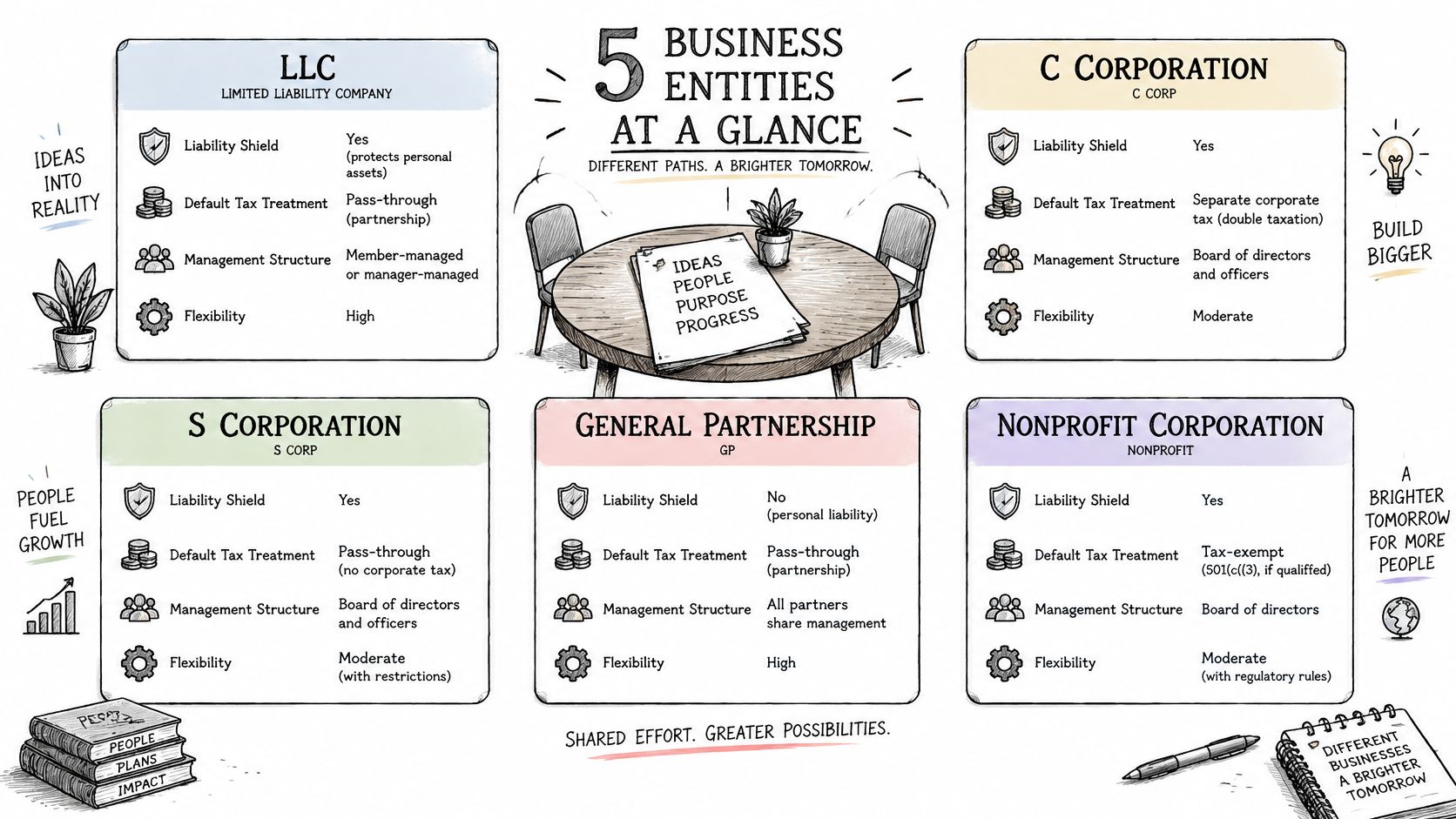
| Entity type | Liability shield | Default tax treatment | Ownership limits | Best when |
|---|---|---|---|---|
| LLC | Yes, members shielded from company debts | Pass-through unless it elects corporate tax | None for most states | Small to mid-size firms with a few owners |
| C corporation | Yes, shareholders shielded | Taxed at entity level, then dividends taxed again | None, multiple share classes allowed | Company planning to raise venture funding or go public |
| S corporation | Yes | Pass-through if eligible | U.S. individuals only, with no nonresident alien, corporate or partnership shareholders | Profitable owner-operated firm wanting pass-through tax |
| General partnership | No, partners personally liable | Pass-through | None | Rarely the right choice; formed by default when two people operate without filing |
| Nonprofit corporation | Yes | Tax-exempt only after IRS recognition | No owners, no distributions to insiders | Charities and member associations |
The table resolves most of the decision in a few minutes, and the Census Bureau's picture of the wider market explains why. It counted 36.4 million employer and nonemployer businesses in the United States in 2023, generating $50.0 trillion in receipts (Census Bureau business owner characteristics release). A large share of those operations have no payroll at all, so pick an entity for liability and tax treatment rather than for the headcount you hope to reach.
Two rows deserve a closer look. A general partnership is the only form you can land in without filing anything: two people who share profits and control create one by conduct, and in doing so they give up the very shield that motivates registration. The S corporation row is also misread constantly. It isn't a state formation. You form an LLC or a corporation under state law, then elect S status with the IRS, which is why the ownership restrictions come from federal tax rules rather than from the filing.
The formation state is not the operating map
Form where you live and where your first customers are. The formation state governs the company's internal affairs, the default rules that fill gaps in your operating agreement, the annual report and the franchise bill. Delaware earns its reputation for companies that will raise institutional money, because investors' lawyers know its statutes cold, but it buys familiarity, not immunity from other states.
Say a consultant in Ohio forms a Delaware LLC, then takes a long contract at a Texas office where two staff sit. Delaware stays the formation state. Texas now sees an entity formed elsewhere doing business locally, which brings a Texas application, a Texas registered agent, franchise tax exposure and state employment registrations. Skipping that step can leave the company unable to enforce the contract in a Texas court until the registration is cured.
Run this test before you file, and list every state where any of the following is true.
- A physical office, coworking desk or leased warehouse is in the state.
- Employees or regular contractors work there, including remote staff.
- Recurring in-person client work happens there, not a single conference trip.
- A significant share of revenue comes from customers based there.
Then confirm the name is clear in each of those states, because a registry approval confers no trademark rights and a name you can't use in Texas is a name you can't build on. The Secretary of State business name availability guide explains how each registry handles searches and reservations.
File the Formation Documents in the Right Order
Sequence matters more than founders expect, and always for the same reason: something approved out of order forces a refile, a second fee, or a name you can't use. The six steps below follow the order a filing survives on the first attempt.
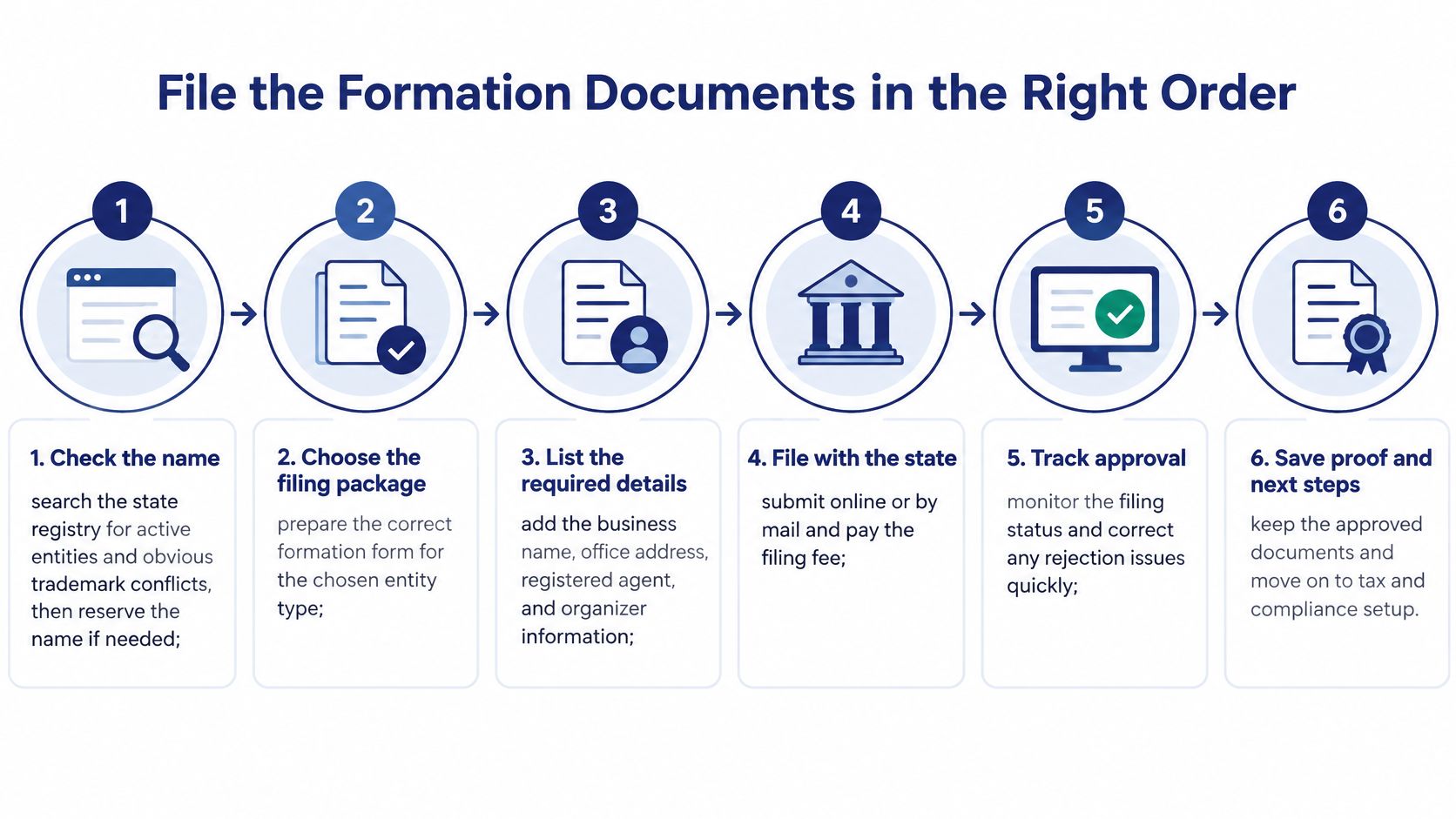
- Check the name in the state registry. Search active entities before you get attached to the name, and if you're weeks away from filing, reserve it where the state offers reservation so nobody takes it in the gap. A name missing its required entity suffix will be rejected: "Northwind Design" bounces where "Northwind Design LLC" clears.
- Appoint a registered agent with a street address in the formation state. The agent accepts service of process and forwards state mail, and most states want written consent from the agent filed with the application. A PO box or an office in another state does not meet the in-state street address requirement. The SBA's launch-your-business guide states the rule plainly: the registered agent must be located in the state of registration.
- Draft the formation document. Articles of organization for an LLC, a certificate of incorporation for a corporation, containing the company name, principal address, agent details and, for corporations, the number of authorized shares. That share count has a long tail. Authorize millions of shares in Delaware and the franchise tax calculation can produce a bill that surprises you a year later.
- File online or by mail and save the confirmation. The confirmation is your proof of the filing date, which sets your first report deadline and the effective date of everything that follows. Save the PDF somewhere a co-founder can find it, not in one person's inbox.
- Pay the state fee. Expedited processing costs extra and is worth paying only when a signed contract or a bank appointment depends on approval landing this week. Otherwise wait the standard processing time.
- Draft the operating agreement or bylaws and calendar the first state report. The formation document creates the entity and says almost nothing about who decides what, how profits split, or what happens when an owner leaves. The SBA notes that an initial report or tax-board registration often falls due within 30 to 90 days of approval, and that's before you get to the EIN, state tax IDs, banking or payroll.
If you want a walkthrough of the filing screen itself before you start, this video covers the sequence from name search to approved certificate.
Practical rule: treat the state of formation as one jurisdiction, not a national license. Treating a single filing as sufficient is the operational failure that generates the most expensive cleanup, because qualifying to do business elsewhere creates separate reporting, tax and agent obligations that start accruing the day you begin operating.
Budget for that with real numbers. The SBA puts registration at less than $300 in typical cases, with fees varying by jurisdiction and structure, and that figure covers only the formation state. A second state means a second application fee, a second agent and a second annual report. You can see what the document itself contains in this guide to company formation documents, which is worth reading before you pay for a template.
SOSfinder can confirm whether a name is already taken in a state before you file, so a taken name never reaches the filing-fee stage. We can't submit a filing, register an entity or change any official record for you. That power sits with the Secretary of State, and only there.
Annual Deadlines in Common States
The formation filing is a single event. The deadlines below repeat for as long as the company exists, and every state where the company operates runs its own calendar, so a Delaware company doing business in Florida answers to two schedules at once.
| State | First report or tax deadline |
|---|---|
| Delaware | Annual LLC tax due June 1 |
| Wyoming | Annual report due in the formation anniversary month |
| Florida | Annual report due May 1 |
| California | Statement of Information within 90 days of filing |
| New York | Biennial statement due in the anniversary month of formation, every two years |
| Texas | No annual report for LLCs; franchise tax report due May 15 |
Read the table as a calendar. The pattern that matters is timing, not size: some states want a first report within months of formation, while others leave the company alone until the anniversary. A missed deadline rarely hurts on the day it happens. The consequences arrive later as late fees, loss of good standing and administrative dissolution, which is the status that surfaces when the company applies for financing or signs a major contract.
The costs the table doesn't show are the ones that decide the first-year total. A registered agent charges annually in every state where you're registered. New York adds a publication requirement for LLCs, which means paying for notices in designated newspapers within a set window after filing, on top of the state paperwork. Delaware collects its annual LLC tax whether or not the company earned anything, and expedited processing is a surcharge on top of everything else.
Take a simple case. A Texas LLC pays a $300 filing fee and a $150 annual agent fee, so the first-year cost is already $450 before licenses, tax registrations or a single dollar of revenue. If the same company hires its first employee in Colorado, add a foreign registration fee and a Colorado agent on top, and Colorado's deadlines join the calendar as well.
- Compare the first-year total, not the filing fee. A cheap filing paired with an expensive annual report is the costly state after year one.
- Calendar every deadline the day you file. Put the anniversary month, the report due date and the agent renewal in the calendar the founders regularly check.
- Budget the second state. If the company will operate in two states, the foreign registration fee belongs in the plan, not in a surprise in month four.
For a look at how one state structures its formation document and what the filing requires on the page, this breakdown of articles of incorporation in Colorado is a useful reference point.
Get Your EIN, Tax IDs and Permits
The certificate is approval, not readiness. Work through the list below in order, because each item enables the next one, and the bank usually asks for proof of the earlier steps.
- Apply for the federal EIN on the IRS site. It's free, and you need it before opening a bank account, hiring anyone or filing a business tax return. Skip the paid intermediaries that charge a service fee for the same form.
- Register with the state revenue agency. Sales tax registration applies if you sell taxable goods or services in the state, and withholding applies the moment you put someone on payroll.
- Get the city or county business license. Many cities require one before you operate, and it's separate from the state registration even though the addresses on the two forms match.
- Check industry permits. A food business needs a health permit before opening day, a contractor needs a state license, and alcohol needs its own approval. These are the permits that stop an opening, because they're inspected rather than filed.
- Open the business bank account with the approved formation document, the EIN letter and the operating agreement. Inconsistent addresses and ownership percentages across those three documents are what slow an application down.
- Register for state unemployment insurance before the first payroll. This is the step new employers forget, and it surfaces as a penalty rather than a rejection.
Two businesses, two very different lists. A freelance designer forming an LLC needs step 1 and step 5 and can ignore the rest for now. A food truck owner needs all six, and the health permit has to clear before the truck serves anyone.
It helps to know what the volume statistics measure. The Census Bureau's Business Formation Statistics are built from EIN applications on IRS Form SS-4, and the July 2025 release recorded 470,571 seasonally adjusted business applications, up 2.6% from June, against just 28,494 projected business formations within four quarters (Census Bureau Business Formation Statistics release). An application means someone asked for an EIN. A projected formation means an applicant is likely to appear with payroll. The gap between the two numbers is the gap between registering and operating.
An EIN is the last piece of paperwork, not the first milestone. Getting one before the formation is approved leaves you with a number attached to nothing.
Before the bank asks, pull up the state record and confirm it shows the entity as active with the correct registered agent listed. A mismatch between the certificate and the registry entry is easy to fix early and awkward to explain later.
Stay Compliant After Formation
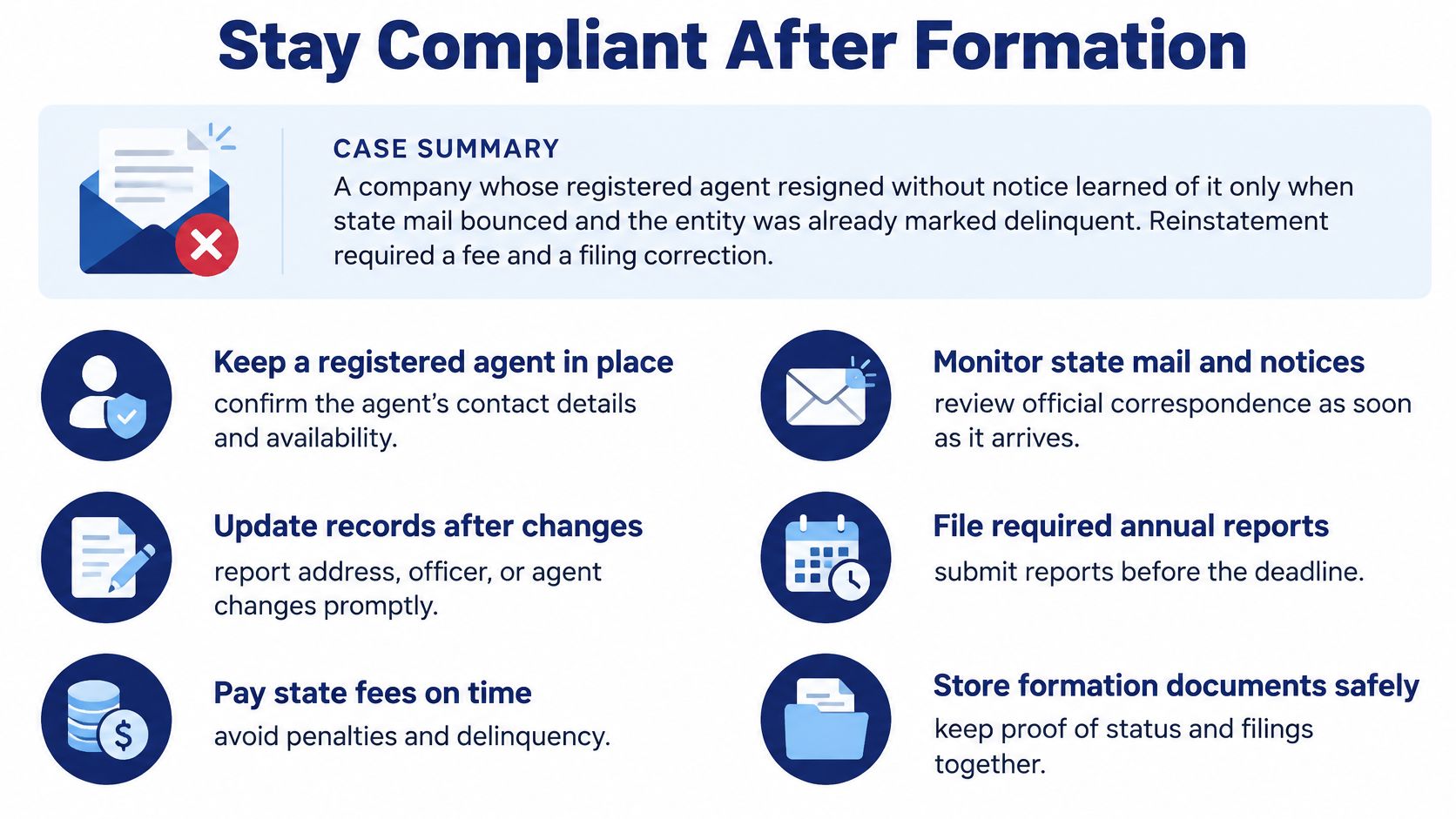
A company's registered agent resigned without notice. Nobody at the business noticed, because the state mail went to the agent's address and stopped arriving. The first signal was a bank asking why the entity showed as delinquent, and by then reinstatement meant a penalty fee, a late annual report and a corrected agent filing, all of it avoidable with one alert.
The duties that follow formation are not complicated. They are just easy to drop, because each one lives in a different place and none of them announce themselves.
- File the annual report or franchise tax every year in the formation state. The first deadline is in the table above, and it repeats forever, including in years with no revenue and no activity.
- Confirm the registered agent still accepts the role. Agents resign, get acquired or stop forwarding mail, and the company is the party that carries the consequence. Verify the agent's details are current and that the address is one a human checks.
- File amendments when the address, agent or management changes. An amendment is a separate filing with its own fee. The registry does not update itself because you moved.
- Register as a foreign company in every other state where you operate. Missing this can bar the company from bringing or defending a lawsuit in that state until it cures the default, which is a painful discovery at the moment you need to sue a customer who hasn't paid.
- Check beneficial ownership rules against the current guidance, not last year's article. Under FinCEN's March 2025 interim rule, entities created under U.S. law and their beneficial owners are exempt from Corporate Transparency Act reporting, while certain entities formed under foreign law that register to do business in a U.S. state remain reporting companies. The question to ask is therefore not "do I need a BOI filing" but "am I forming a U.S. entity or qualifying a foreign one, and which rule applies at the moment registration becomes effective."
That fifth item matters most to anyone forming from outside the country. A foreign corporation can appear in a state registry, hold a U.S. registered agent and carry a state file number while remaining legally organized elsewhere, and the FinCEN beneficial ownership guidance treats that registered-to-do-business category differently from a domestically formed entity. A registry record is not proof of U.S. incorporation, tax residence or operating substance, so keep an explicit entity-origin label next to every record you store.
Monitoring is what closes the gap between the annual checklist and reality. Our monitoring alerts you when a tracked company changes status, registered agent or address, so a silent resignation surfaces the same day rather than the quarter after. What monitoring can't do is fix the record. Corrections go to the state office that holds the filing, because no vendor can amend an official registry entry on your behalf. Here's what good standing actually means on a registry record and how states mark a company delinquent.
Repeat three checks every year, on the same date, for every state on your list.
- Status is active, not delinquent, suspended or revoked.
- Agent and principal address are current, with a street address the state accepts.
- Every operating state holds a valid registration, including the ones you entered mid-year.
Confirm Your Filing Plan Before You Submit
Do not file until all six of these are true. Each one corresponds to a rejection, a refile or a surprise bill that costs more than the extra day of preparation.
- Entity type is chosen, including whether the S election makes sense for the first profitable year.
- Every operating state is listed, using the office, employee, client and revenue test rather than a guess.
- The registered agent has an in-state street address and has given written consent.
- The name is checked in the state of filing, and in any other state where you expect to register.
- The first-year budget covers the filing fee, the agent fee and the first report, not just the filing fee.
- EIN timing matches the bank opening, so the account isn't waiting on a number you haven't requested.
If any line is open, hold the filing. A week of preparation beats a rejected application, and it beats discovering in month three that the name you built a website around is taken in the state where your biggest customer sits.
Run the name check before you pay anyone anything. On SOSfinder the Free plan covers all 50 states and DC with business entity search and business monitoring for 5 entities on weekly checks, cached results, an API playground and community support. It includes 50 lookups a month and requires no credit card, which is enough to test a short list of candidate names across several states in one sitting.
Once the name clears and all six checks pass, submit the formation documents directly to the Secretary of State for the state you chose, and keep the confirmation with the company records. The registry is the only authority that can approve the filing, and the confirmation it returns is the document every bank, landlord and licensing agency will ask you for later.
A name check takes a minute and prevents the most common formation rejection, which is why SOSfinder gives you 50 lookups a month across all 50 states and DC on the free plan, no credit card required. When the company is registered, the same records stay useful for onboarding checks, vendor due diligence and monitoring the standing of entities you already work with. Start with a name search at SOSfinder before you pay a filing fee, then keep the entity on a watch list so a resigned agent or a status change reaches you the day it happens.