How to Check if LLC Is Active: Steps and Status Meanings
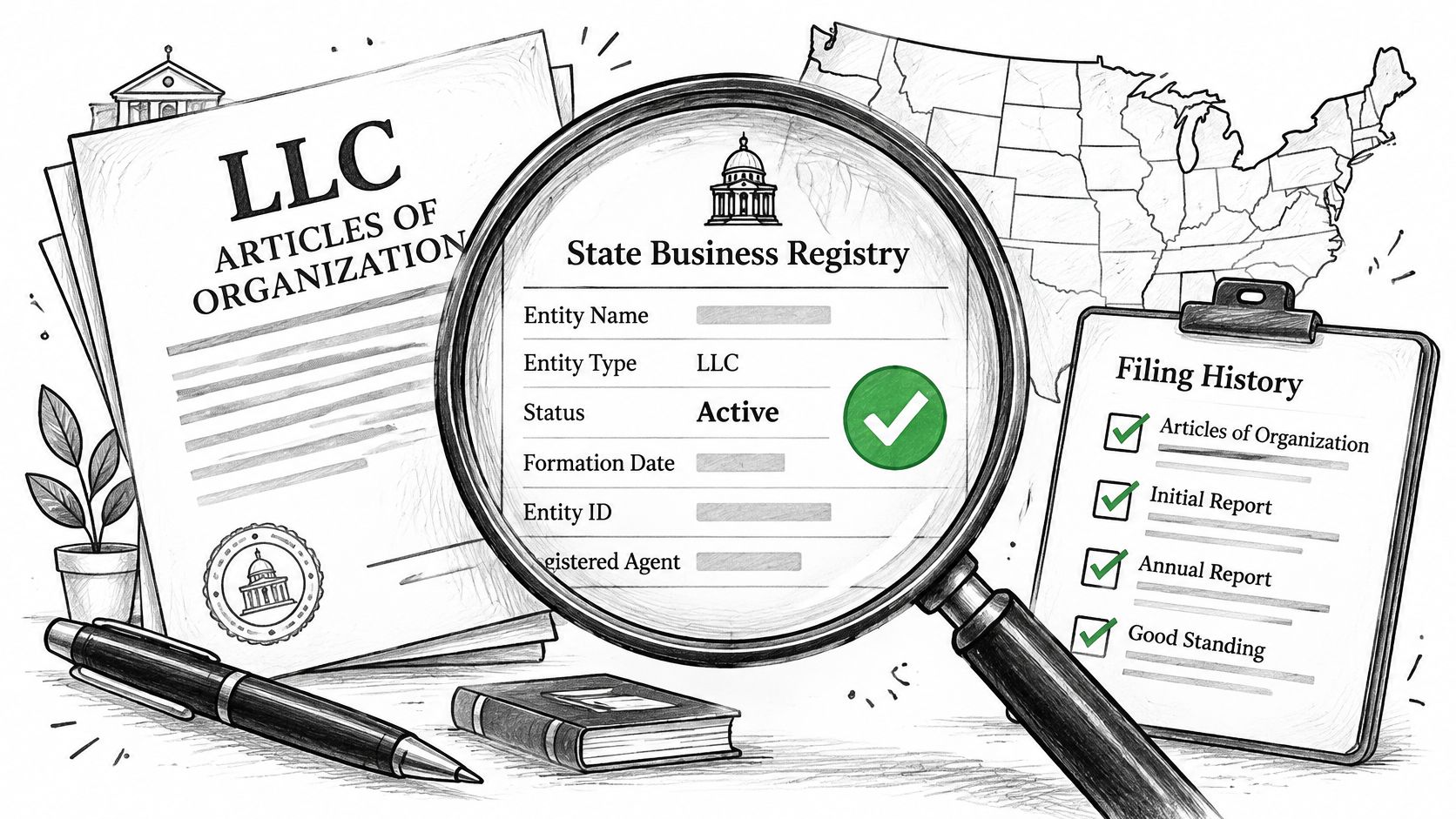
A vendor's onboarding packet arrives with a screenshot attached: a state registry page, a status field reading Active, and a payment date two days out. Everything looks settled. Then the file reaches someone who has done this before, and the questions start. Active in which state, as of what date, and does that status say anything about whether the company is allowed to do business where you need it?
A registry status is a starting point, not a verdict. It confirms that a state agency listed the entity on the day you looked. It says nothing about whether the last annual report was filed, whether the registered agent is still reachable, or whether the LLC has authority to operate outside its home state. Knowing how to check if an LLC is active means reading four things together: the status field, the filing history, any public tax record, and the foreign registrations in every state the company touches.
The steps below work whether you're onboarding a supplier, underwriting a loan, or clearing a name before formation.
Five Steps to Look Up an LLC in the State Registry
Start where the LLC was formed. A company with an office in Texas, invoices going out of Texas and staff hired in Texas may still be a Delaware entity, and Delaware is the only place its formation record lives. The United States has no national company register, which is why the U.S. Small Business Administration's state registration lookup exists: it routes you to the correct filing office for whichever state you name.
Run the search on the exact legal name, the state-assigned entity number, or both, then read the whole record rather than the status field alone. Formation date, registered agent, principal address and filing history all need to agree before the result means anything.
The five steps, in order:
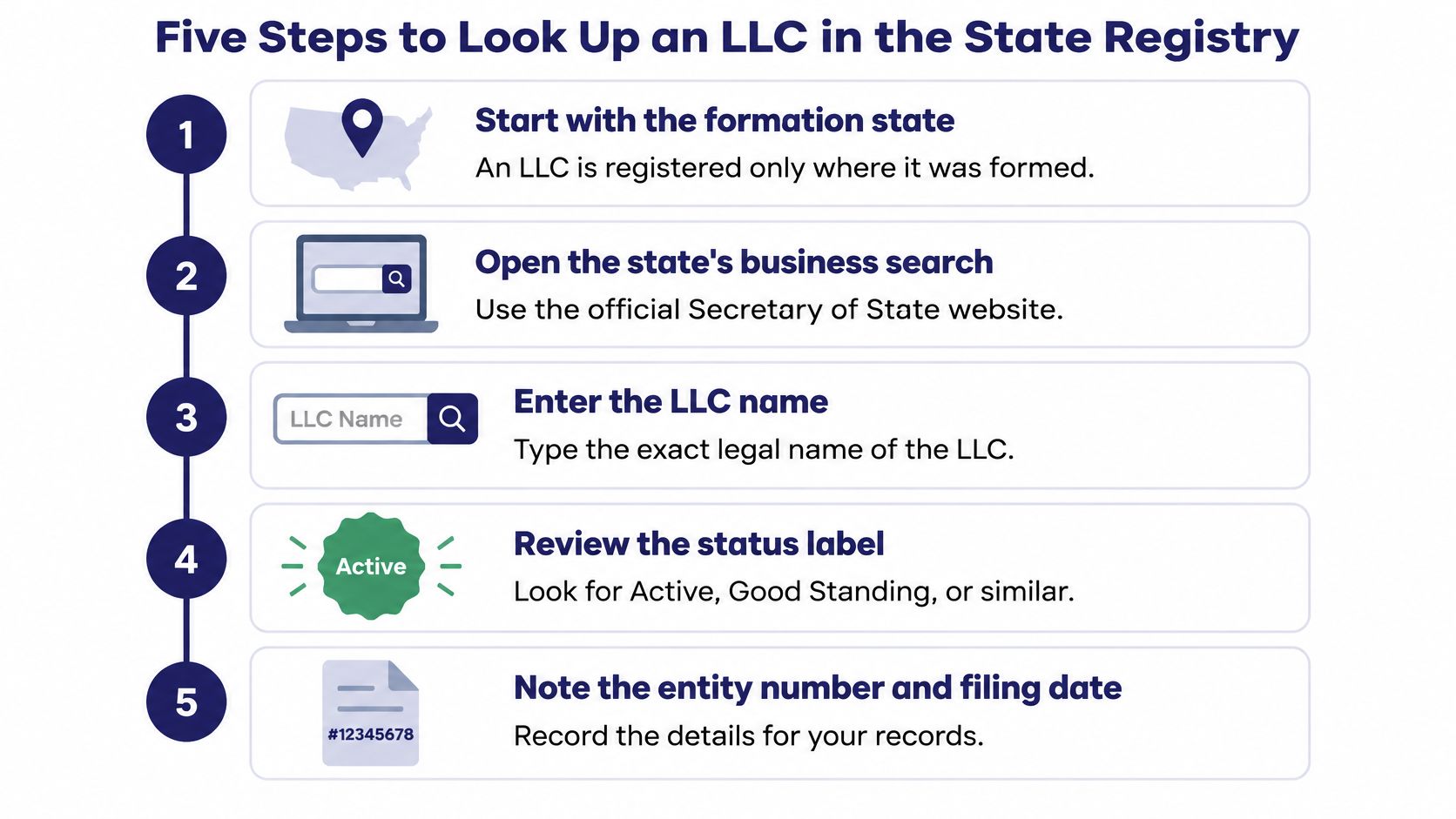
- Open the right office. That means the Secretary of State, corporation commission or equivalent agency for the formation state. Some states file business search under a division of corporations, others run a separate business portal. Use the official one for the record you'll rely on and treat aggregator results as a pointer, not evidence.
- Type the exact legal name. Keep the designator as the state writes it, whether "LLC," "L.L.C." or "Limited Liability Company." Drop the trade name. A DBA sits in a separate filing, and searching it in the entity register usually returns nothing, which people misread as "this company doesn't exist."
- Narrow with the entity number when the name is common. Every record carries one, though the label shifts by state: a document number in Florida, a file number in Delaware, an entity ID in New York or California, a control number in Georgia. Typing it in pulls one record out of a page of near-identical names.
- Match the details to the paperwork you were given. Entity type, formation date, jurisdiction, registered agent name and address, principal address. A mismatch here carries more weight than the status label, because it means the documents and the registry are describing different things.
- Record what you saw. Exact status label, jurisdiction, entity number, date and time of the lookup, and the page you pulled it from. That's what makes the check repeatable six months later, and it's the first thing an auditor asks for.
The last step earns its place the first time a deal goes sideways. Registry records change, often without anyone telling you, and the status you saw in March may not be the status in June. A status label is a word the state chose, and states don't agree on what the words mean.
What Each Status Label Really Tells You
States use different status labels, and the same label may not tell the whole story. One registry may say Active, another Current, and another In Good Standing. A clean label can also appear alongside a delinquency note. Read the exact wording and nearby notes in the record rather than assuming each state uses these terms the same way.
A useful first distinction is whether the entity remains on the state record. Registered on the state record includes labels such as Active, Current and In Good Standing. Compliance problem, often fixable includes Inactive, Delinquent and Revoked. Entity has ended includes Administratively Dissolved and Dissolved. Even a label in the first group needs to be checked against filing history and foreign-registration requirements before a signing decision.
Practical rule: An Active label answers whether the state still lists the entity. It does not establish that the LLC is allowed to sign with you.
The gap matters in onboarding. A status may appear current while a required report is overdue if the state has not yet updated the record. The formation state may also list the LLC as active even when it lacks authority to do business in the state where it is bidding.
| Status label | What it usually means | Next check |
|---|---|---|
| Active | Registered and recognized by the state | Check the next annual report due date |
| In Good Standing | No delinquent fees or reports shown | Confirm with a recent certificate for material decisions |
| Current | Filings are up to date in the registry | Review the filing history for the latest report |
| Inactive | On record but not authorized to conduct business | Request reinstatement documents |
| Delinquent | A required report or fee is overdue | Ask the LLC to file, then recheck the record |
| Revoked | State cancelled the LLC's authority to operate | Look for a reinstatement filing before relying on it |
| Administratively Dissolved | State dissolved the LLC, usually for missed filings | Confirm reinstatement and check the registered agent |
| Dissolved | Entity has ended through voluntary or formal termination | Identify any successor entity before contracting |
For decisions that depend on the meaning of good standing, review this guide to in good standing status. The status label is a starting point, not a substitute for checking the record's history and the LLC's authority where it operates.
Confirm Good Standing With Filings and Taxes
Filing history can reveal a compliance gap that a current status label does not. States commonly require an annual report or biennial statement. Its due date may follow the formation anniversary or fall on a fixed statewide date. Filing fees and franchise taxes vary by state, and initial reports are often due shortly after registration.
Use the registry record to check the underlying entries:
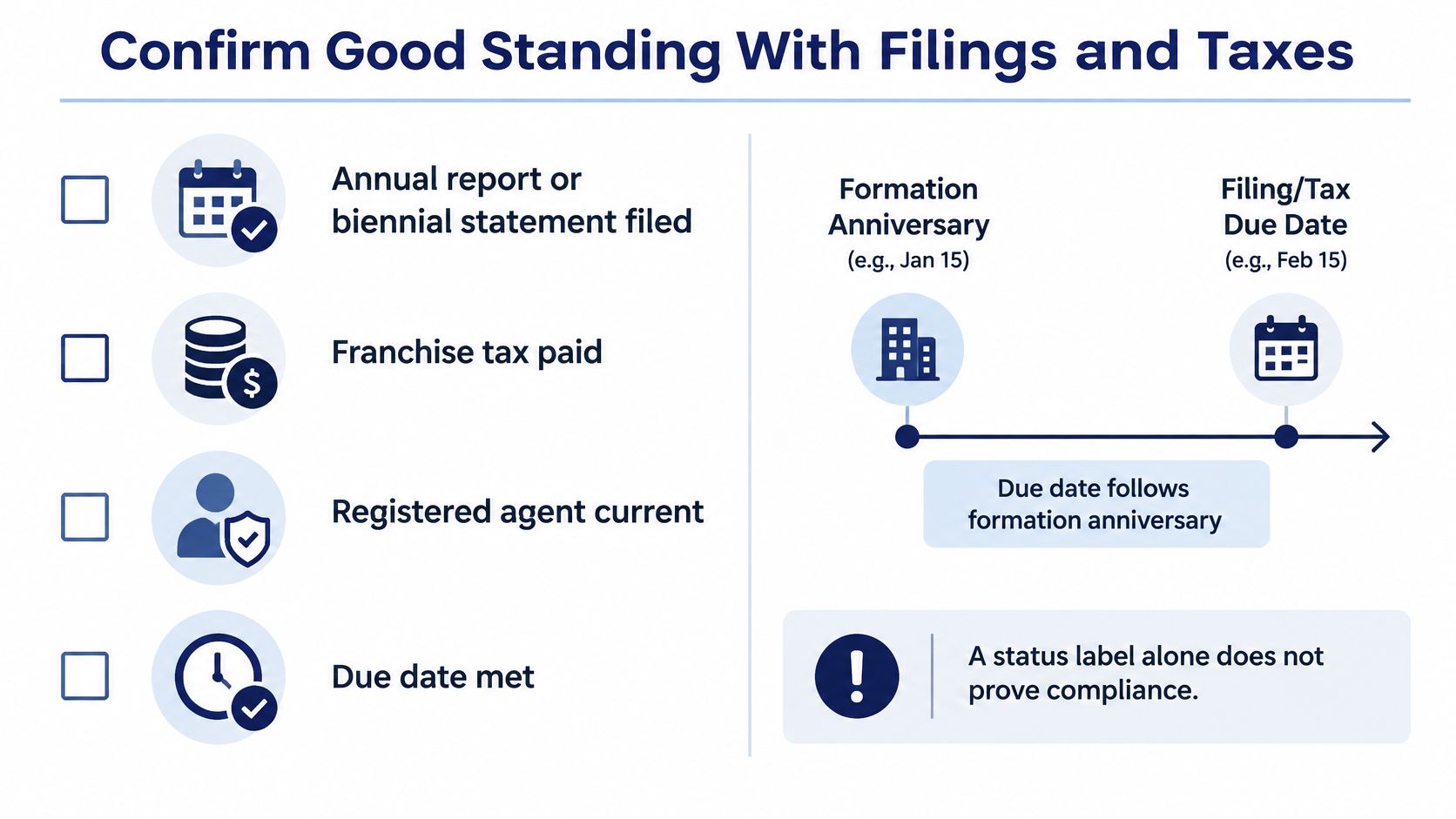
- Find the latest annual or biennial filing and its date. If a state requires annual filings but the most recent report is two years old, investigate whether a filing is missing.
- Check whether the next due date has passed. In anniversary-based states, the due date follows the formation month. Fixed-date states use a common deadline, which may not appear in the entity record. Check the state's published calendar.
- Review delinquency notes, administrative dissolution and reinstatement events. A reinstatement entry shows that the LLC returned to compliance after a lapse. Keep that history in the risk file, even if the current status is clean.
- Confirm the registered agent and principal address. If the agent resigned or the address is no longer current, legal notices may not reach the company.
- Check fee and franchise tax information where available. Some registries display payment status; many do not. An absent entry is not proof that fees or taxes were paid.
- Separate state standing from federal tax classification. An LLC may be a disregarded entity, partnership, C corporation or S corporation for federal tax purposes. That classification does not establish its standing with the state. A W-9 with an EIN shows that the IRS has a record for someone, not that the LLC is active.
For example, an LLC formed in March may have an anniversary-based filing deadline. If its record shows a 2024 report but no 2025 report, the Active label may remain until the state updates its status. The missing filing is the signal to investigate, not the label alone.
To identify what a filing-history entry represents, review this guide to company formation documents.
Check Foreign Registration in Every State It Operates
The record you need depends on where the LLC operates.
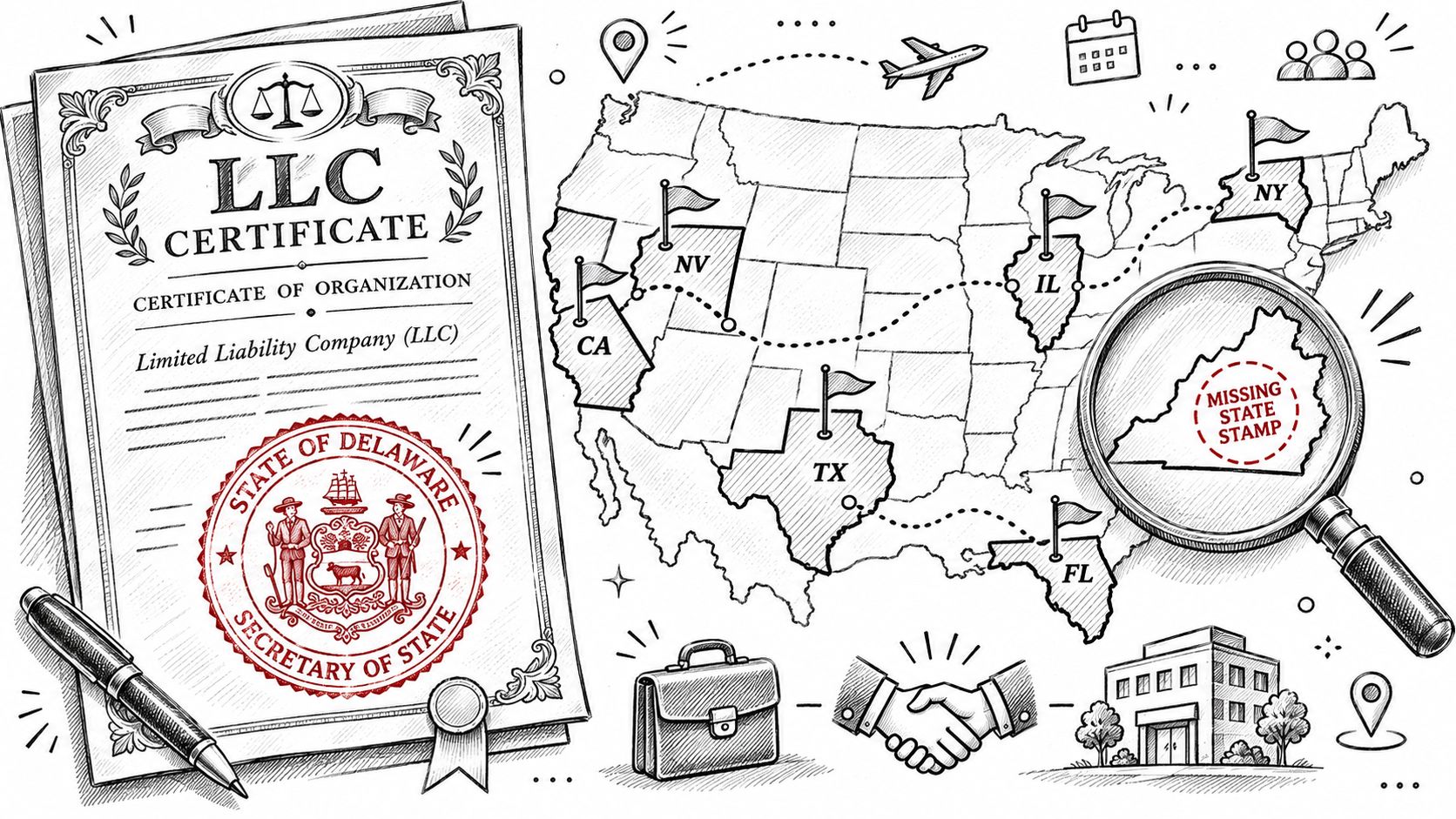
A clean home-state record can sit alongside a serious gap: no authority to do business where the work happens. The SBA's business registration guide spells out the mechanics, an LLC formed in one state may need foreign qualification in every other state where it conducts business, and those states may require a certificate of good standing before they'll grant it.
What counts as conducting business is a facts-and-circumstances question, but the triggers are concrete. A physical office, warehouse or leased space counts. So do employees who live and work in the state, a sales team holding regular in-person meetings, and a meaningful share of revenue earned from customers there. A software company with one remote engineer in Colorado may owe Colorado a foreign registration. A company that only ships goods into a state usually doesn't.
Work the map methodically. List every state where the LLC has offices, staff, property or regular customers, then search each state's registry for a foreign LLC record and compare its status and agent against the home-state record.
| Situation | What to check | Document to request |
|---|---|---|
| Formed and operating in the same state | Formation-state status and latest annual report | Current status printout or certificate of good standing |
| Formed in one state, operating in another | Foreign registration record in the operating state | Certificate of good standing from the formation state and the operating state |
| In-state employees or in-state revenue | Foreign qualification in that state | Foreign qualification certificate |
| Regular in-person meetings or physical presence | Foreign registration and any tax registration in that state | Certificate of good standing from that state |
File each state's search separately. A result from Delaware says nothing about whether the same company is registered to transact in Ohio, and reviewers who paste one screenshot across a whole file are the reason gaps survive into contracts.
Fixing Empty, Conflicting or Outdated Registry Results
The most common failure isn't a bad status. It's no result at all. Someone types the name from the invoice, hits search, gets an empty page, and concludes the company is a shell. Nine times out of ten the name on the invoice is a trade name, a misspelling, or the legal name with the designator dropped.
Fix that one first, because it costs nothing. Pull the name from the articles of organization or the formation certificate, copy it character for character including punctuation, and search again.
The harder cases each have a cause worth naming.
| Symptom | Likely cause | Fix |
|---|---|---|
| No results for the name | Trade name, misspelling or missing LLC designator | Search the exact legal name from the articles of organization |
| Several similar records | Common name or similar filings | Search again with the state entity number |
| Active label but no recent filing | Filing not yet posted or record lag | Request a certificate of good standing and recheck later |
| Registered agent differs from documents | Agent changed and the record was not updated | Review amendments in the filing history |
| Administratively Dissolved after a recent filing | Reinstatement pending or not yet posted | Look for reinstatement documents and recheck after a few days |
| Conflicting results across states | Formation record and foreign record differ | Check each state separately and request certificates |
Timing explains more of these than people expect. A reinstatement filed Friday may not appear on a state portal until the following week, and some states batch updates overnight while others take days. Recheck after a few business days instead of refreshing the page, and record the timestamp of each lookup so you can show what changed and when.
Two records that disagree are a finding, not a glitch. Write down both versions and the dates you saw them.
If the record and the documents still conflict after a recheck, stop leaning on the screenshot and request an official certificate. When a search returns nothing at all and you've already checked the legal name, this explanation of why a lookup returns no match found walks through the remaining reasons.
Decide Whether to Rely on the LLC
At some point the checking stops and someone makes a call. Turn that call into a rule so the next reviewer reaches the same answer from the same facts.
- Proceed when the formation-state record shows Active or In Good Standing, the latest annual report is on file with a future due date, the registered agent and principal address match the paperwork, and every state where the LLC operates shows a matching foreign record. All of it, not most of it.
- Hold when the status reads Inactive, Delinquent, Revoked or Administratively Dissolved, when a required report is missing, or when the record contradicts the documents you were sent. A hold means one specific request goes back to the counterparty, not a vague expression of concern.
- Escalate when the entity is dissolved, or when records still conflict across states after a recheck. A dissolved LLC can't sign, and a reinstatement takes time the deal may not have. If the entity is administratively dissolved, this explanation of what administratively dissolved means sets out the reinstatement path so you can judge whether waiting is realistic.
Then take the single next step that outranks everything else: before any contract, loan or payment above your materiality threshold, request a dated certificate of good standing from the formation state, plus each operating state where relevant, and file it with the lookup timestamp, state and entity number. A certificate is dated evidence from the agency. A screenshot is a moment you captured, and the difference shows up the first time a deal is disputed.
One LLC checked once is a manual job, and manual is fine at that volume. A vendor portfolio reviewed monthly is a different problem, which is where SOSfinder's monitoring fits: it watches tracked entities across all 50 states and DC and alerts you when status, registered agent or address changes, so you aren't re-running every lookup by hand.
Run a search on SOSfinder and you'll get back a normalized record from the relevant state registry, status, entity type, formation date, registered agent, principal address and filing history, in one schema instead of fifty different portals. Start with a counterparty you already know well, confirm the record matches what you expect, then put the same check in front of every new vendor, borrower or payee before money moves. The free plan covers all 50 states and DC, so the first lookup costs you nothing.