KY Corporate Search: How to Look Up and Verify Entities

A Kentucky-registered applicant is waiting for approval. The business name on its paperwork matches a registry result, but the detailed record raises a standing issue. Your onboarding team needs a decision, not another search result: approve the applicant, request corrected filings, or send the case to compliance review.
KY corporate search is entity resolution work. Finding a plausible company is the beginning. The useful outcome is a defensible connection between the applicant, the legal entity, and the registry evidence available when you made the decision.
The Onboarding Moment Where KY Lookup Decisions Get Made
Consider a hypothetical marketplace onboarding case. An applicant submits a legal business name, a Kentucky address, and incorporation paperwork. The analyst finds a matching name and initially treats the lookup as successful.
Then the analyst opens the detailed record and notices bad standing. The name match hasn't answered the operational question: does this applicant satisfy the marketplace's requirements for onboarding?
The review happens at the case file, where registry evidence must be reconciled with applicant documents.

Separate Identity From Eligibility
Design the workflow around distinct decisions. Identity resolution asks whether the registry record belongs to the applicant. Eligibility review asks whether that entity meets your product's onboarding policy.
Those decisions shouldn't share a single pass-or-fail flag. An exact entity match can still require compliance remediation, while a record without an obvious standing issue can belong to the wrong applicant.
In the hypothetical case, the analyst should preserve the match evidence before investigating the standing issue. Otherwise, a reviewer may receive an escalation without knowing whether the team has even resolved the entity.
Practical rule: A successful lookup means you retrieved evidence. It doesn't mean you approved the business.
The case should have an explicit route:
- Continue verification when identity evidence aligns and no unresolved registry issue blocks the applicable policy.
- Request remediation when the entity is resolved but the applicant needs to address a filing or registration problem.
- Escalate when the record conflicts with submitted documents or the analyst can't explain the discrepancy.
Keep those routes separate from customer identification and ownership checks. A CDD and KYC workflow needs a reliable legal-entity anchor, but it also needs evidence about the people associated with the applicant.
The engineering implication is straightforward: store the match conclusion, the registry condition, and the onboarding decision separately. That makes the analyst's reasoning visible instead of hiding it behind a green search-success indicator.
Search Keys Available in the Kentucky Business Registry
An applicant may provide a legal name that differs slightly from the registry entry, or paperwork may identify the business by number. The lookup should resolve the entity using the strongest available key, then retain enough evidence to explain why that record was selected.
Kentucky's registry supports searches by organization name, identification number, current officer, founding officer or initial director, and registered agent. These keys serve different purposes. An identification number is the most direct route when paperwork includes one. Names help find candidates; officer and agent searches can supplement incomplete records but do not establish which entity the applicant represents.
| Search key | Practical use | Review consideration |
|---|---|---|
| Identification number | Resolve an entity referenced in submitted paperwork | Check that the returned identity agrees with the application |
| Organization name | Find candidates when no identifier is available | Retain plausible alternatives |
| Current officer | Check a person's reported relationship to an entity | A relationship match alone does not identify the applicant's entity |
| Founding officer or initial director | Reconcile formation-era information | Distinguish historical relationships from current ones |
| Registered agent | Check the agent named in documents | An agent relationship does not establish applicant ownership |
Normalize Without Destroying Evidence
For name searches, create a comparison value with case-folding, punctuation handling, and corporate suffix normalization. Keep the submitted name unchanged as well. The normalized value helps match differently formatted names, but it should not overwrite the legal name or remove jurisdiction identifiers that distinguish records.
Normalization generates candidates, not a final match. If it returns several plausible records, compare their details and preserve the alternatives until the reconciliation rules support a defensible decision. Do not let result ordering make the decision for you.
Keep the raw inputs. That gives an analyst a way to reconstruct what the applicant submitted and assess how the comparison was made. Require review when candidates remain ambiguous.
Officer and registered-agent searches can help when paperwork is incomplete. Treat the result as a lead for entity resolution, not proof of ownership or identity. A familiar person may have a relationship to more than one entity, or a relationship that is no longer current.
The embedded walkthrough offers a visual reference for the lookup process.
A production pipeline needs both broad discovery and precise verification. Broad searches find candidates; tighter keys make it easier to confirm the intended record. Set different acceptance rules for each, and preserve the evidence behind the match.
Reading a Kentucky Entity Record Field by Field
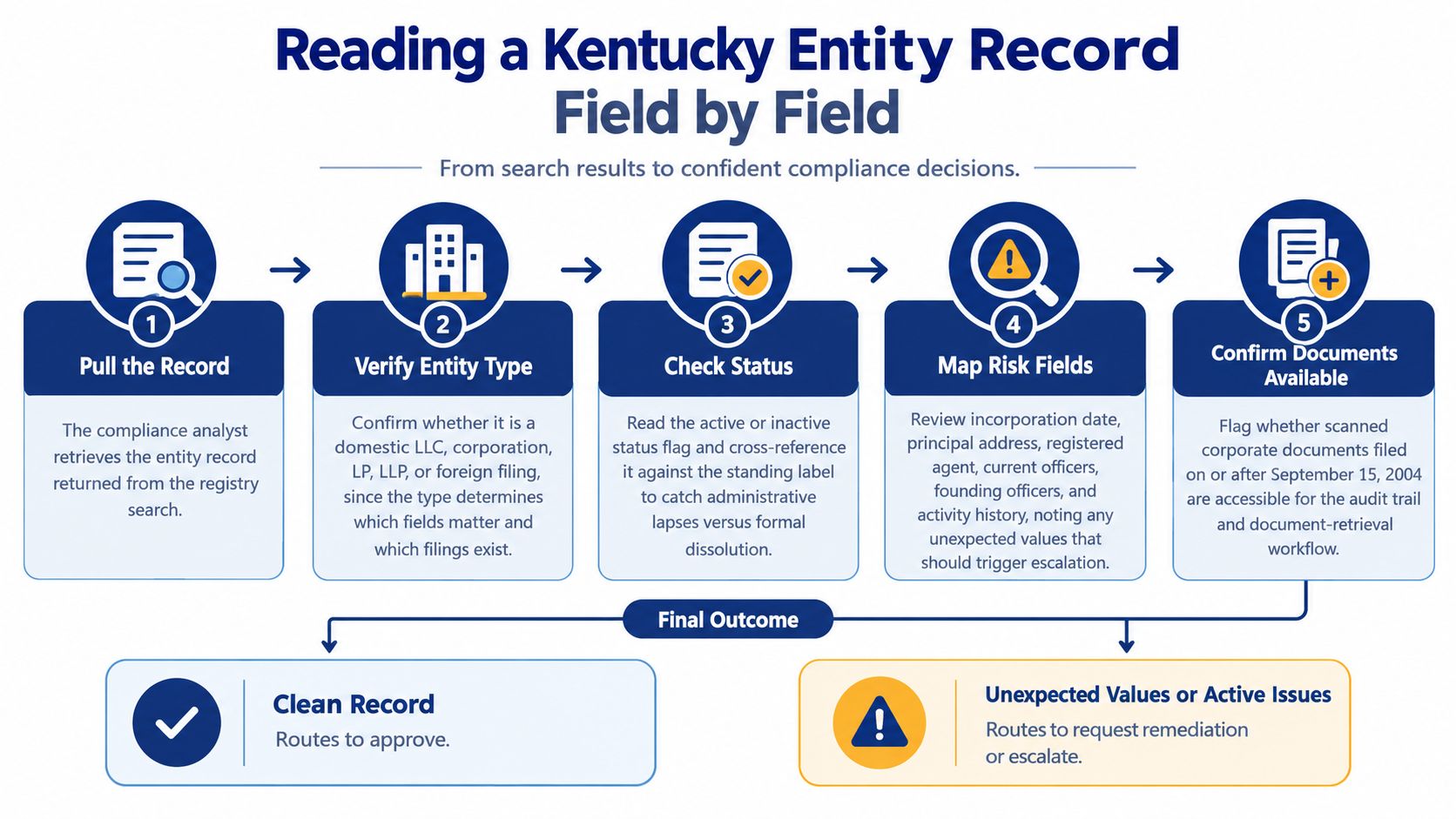
The Kentucky Secretary of State's business-record system and search guidance describe the available lookup methods and record fields, including entity type, status, organization or incorporation date, principal address, registered agent, officers, and activity history. Corporate documents filed on or after September 15, 2004 are available as scanned images, while older records become available as digitization proceeds, according to that same guidance.
Treat each field as evidence for a specific question. A clean record isn't a populated record. It's a record whose relevant values are consistent with the application and whose exceptions have been explained.
Fields That Change the Review
| Field | What to reconcile | When to request clarification |
|---|---|---|
| Entity type | Legal structure represented in the application | The applicant's documents describe a different structure |
| Status | Current registry condition | The value conflicts with onboarding requirements |
| Formation date | Registry date against formation paperwork | Submitted documents point to a different entity history |
| Principal address | Registry address against applicant information | The difference lacks an explanation |
| Registered agent | Agent information against relevant filings | Documents appear outdated or inconsistent |
| Current officers | Reported current relationships | The application relies on a relationship the record doesn't support |
| Founding officers | Formation-era relationships | Historical information is presented as current authority |
| Activity history | Filing sequence and relevant changes | Recent entries require supporting-document review |
An address mismatch is a question, not an automatic fraud finding. Ask the applicant to explain which address serves which purpose and provide supporting evidence where your policy requires it. Overwriting applicant data with the registry address removes the discrepancy without resolving it.
Likewise, don't collapse current and founding officers into a single people array. Reviewers need to know whether a relationship is current or historical before relying on it.
Documents and Audit Evidence
Retrieve the relevant filing when the summary record doesn't explain a discrepancy. Record document availability explicitly, and distinguish an unavailable image from an unsuccessful retrieval attempt.
Preserve the registry's original values beside your normalized fields. Reviewers need to see what the state reported, not just what your parser inferred.
A useful business entity data model supports both operational comparisons and evidence reconstruction. Store the source reference, retrieval time, and relevant documents with the case so a later reviewer can understand the decision without repeating the original investigation.
What Bad Standing in Kentucky Signals About an Entity
Bad standing alone does not establish insolvency, fraud, or that a business has stopped operating. Kentucky's business-record FAQs identify missed annual reports and a registered agent's resignation without a replacement as conditions that can leave an entity inactive and in bad standing.
For onboarding, the cause changes the decision. A missed filing or agent vacancy may be remediable, so rejecting every applicant with bad standing can turn an administrative issue into a lasting denial. Treat the status as a signal to investigate, not a complete risk finding.
Kentucky annual reports are due between January 1 and June 30 and carry a $15 fee. They confirm or update information about officers, managers, the principal office, and the registered agent, as detailed in the FAQs.
Match the Status to the Evidence
Read the exact status text alongside the filing history. A generic “inactive” category hides the distinction between a missing report and an agent vacancy, and gives reviewers too little to decide what to verify.
For a missing report, request evidence that the required filing was completed. For an agent vacancy, ask for evidence that a replacement was appointed. Set the verification threshold before the case proceeds. A receipt may show that remediation was attempted, but it does not by itself confirm that the registry now meets your policy.
Explain the specific registry condition to the applicant, rather than issuing a generic verification failure. If the filing history does not account for the status, obtain supporting evidence instead of inferring a cause. Record whether the case was approved after remediation, deferred, or declined under a stated policy.
Disposition depends on the relationship. A lender, marketplace, and procurement team assessing a critical vendor may apply different requirements. Make that distinction explicit in policy, not in the registry adapter.
A missed filing can also lead to consequences beyond a data discrepancy. The annual-report enforcement timeline described later shows why unresolved status warrants follow-up. Resolve the cause, verify the outcome, and apply the policy suited to the relationship.
Wiring KY Lookups Into a Multi-State Pipeline
A Kentucky adapter shouldn't dictate the schema of your entire onboarding system. Use a jurisdiction parameter and a normalized response contract, while preserving state-specific evidence for review.
There are workable alternatives: an internal registry adapter, manual lookup for exception cases, or a unified commercial API. Maintaining your own retrieval layer gives you direct implementation control, but your engineers also own interface changes, parsing failures, and source-specific error handling.
Define the Contract Before the Integration
The following is an illustrative application contract, not a vendor's documented request syntax. It describes what your internal service should accept and return without assuming an endpoint path or inventing a production payload.
| Contract area | Suggested shape |
|---|---|
| Request jurisdiction | jurisdiction = KY |
| Preferred search input | entity_id = applicant_supplied_identifier |
| Fallback search input | name = preserved_legal_name with a separate comparison value |
| Candidate response | Entity identifier, jurisdiction, legal name, type, dates, addresses, relationships, and filing history |
| Resolution metadata | Match basis, confidence category, alternatives, and review reason |
| Evidence metadata | Original status text, source reference, retrieved-at timestamp, and document references |
Your company data API integration should separate retrieval from adjudication. Even when a provider selects a best match, your application should retain alternatives and evaluate the selected record against its own acceptance criteria.
Use exact-ID matches as high confidence, normalized-name-plus-jurisdiction matches as medium-high confidence, and fuzzy-name-only results as review candidates. These are routing categories, not calibrated probabilities.
- Missing fields should remain missing, not become invented defaults.
- Retrieval errors should enter a retry or exception path, not become no-match decisions.
- Conflicting evidence should retain the conflicting values and a review reason.
Keep Ownership Verification Downstream
Corporate registry evidence establishes the legal entity; it doesn't independently establish ultimate ownership or control. For covered U.S. financial institutions, FinCEN's CDD framework requires identifying and verifying each natural person owning 25% or more, and one person exercising control, subject to applicable exclusions.
Don't convert the officer or registered-agent fields into a beneficial-owner conclusion. Feed the resolved entity identifier into the ownership-verification workflow, then collect and evaluate the evidence that workflow requires.
Engineering boundary: The registry adapter retrieves entity evidence. The policy engine decides how that evidence affects onboarding.
That boundary makes both components easier to test. It also gives compliance reviewers a clear explanation of which evidence supported entity resolution and which supported ownership verification.
Monitoring Kentucky Entities Between Due-Diligence Reviews
A Kentucky registry result is a snapshot. If a vendor's status changes after onboarding, the original lookup will not surface it, so monitoring needs to reconnect registry changes with the active case and its owner.
The annual-report cycle shows why status changes deserve attention. In 2019, 203,972 Kentucky businesses filed annual reports by the June 30 deadline, and more than 160,000 filed online, according to Kentucky's annual-report announcement. Those historical figures reflect filing activity, not today's rate of change. The announcement also says a business that misses its filing enters bad standing and receives a final 60-day notice. Failure to respond can lead to administrative dissolution or revocation of authority to do business in Kentucky.

A status change can affect whether a relationship remains eligible for use. Other changes call for different responses: a registered-agent resignation may leave an unresolved vacancy, while an address change may require updating internal records or reconciling the entity's identity.
Set up checks for status, registered agent, principal address, and filing history. Scheduled retrievals or supported webhooks can both work, provided every actionable change creates an owned case with a defined response. Store before-and-after values, deduplicate repeated alerts without deleting evidence, and record retrieval freshness so cached results are not mistaken for new checks. Choose a risk-based cadence and assign responsibility for exceptions.
Assess business monitoring software by the evidence its change events preserve and the controls available for routing and follow-up, not by its ability to send alerts.
For a higher-value vendor, a certificate of existence may be appropriate when contracting or compliance policy calls for formal state-issued evidence. It documents the entity at issuance; recurring checks serve a different purpose by surfacing subsequent changes.
A Kentucky Launch Checklist for Product and Compliance Teams
Before launch, turn the workflow into acceptance tests shared by engineering and compliance. A lookup isn't production-ready until the team can explain both its successful decisions and its exceptions.
Acceptance Criteria for Release
- Identifier routing: Given an applicant-supplied Kentucky entity ID, the service uses the identifier path and records the match basis.
- Name handling: The system preserves original input, stores a separate normalized comparison value, and retains ambiguous candidates.
- Evidence storage: The case contains registry identity fields, original status text, relationship distinctions, filing references, and retrieval metadata.
- Exception routing: Missing data, retrieval failures, and identity conflicts reach distinct queues rather than a shared verification-failed state.
- Standing review: Unfavorable status values create a review task with the observed condition and relevant filing evidence.
- Remediation completion: The application remains pending until the designated reviewer verifies the required outcome.
- Ownership boundary: Entity lookup completion doesn't mark beneficial-ownership verification complete.
- Monitoring ownership: The team configures a risk-based checking schedule, names an alert owner, and tests the escalation path.
- Audit reconstruction: A reviewer can reproduce the decision rationale from stored evidence without relying on the original analyst's memory.
Test unresolved cases, not just clean matches. An applicant with incomplete paperwork, ambiguous candidates, or an unexplained status should receive a controlled disposition rather than an accidental approval.
SOSfinder offers normalized business-entity search, filing-history access, and monitoring workflows as an alternative to maintaining separate registry integrations. Visit SOSfinder to evaluate how Kentucky lookups, source evidence, and change notifications can fit into your onboarding pipeline.