10 KYB Software Platforms: Features and Ideal Buyers

A quick database match can make a KYB decision feel complete until the registry changes and nobody notices. That gap is why kyb software is less about one check and more about what gets verified, how the data flows into your stack, and whether the record stays current after onboarding. The best fit depends on whether you need official registry evidence, orchestration across data sources, global business identity, or screening-heavy risk review.
1. SOSfinder
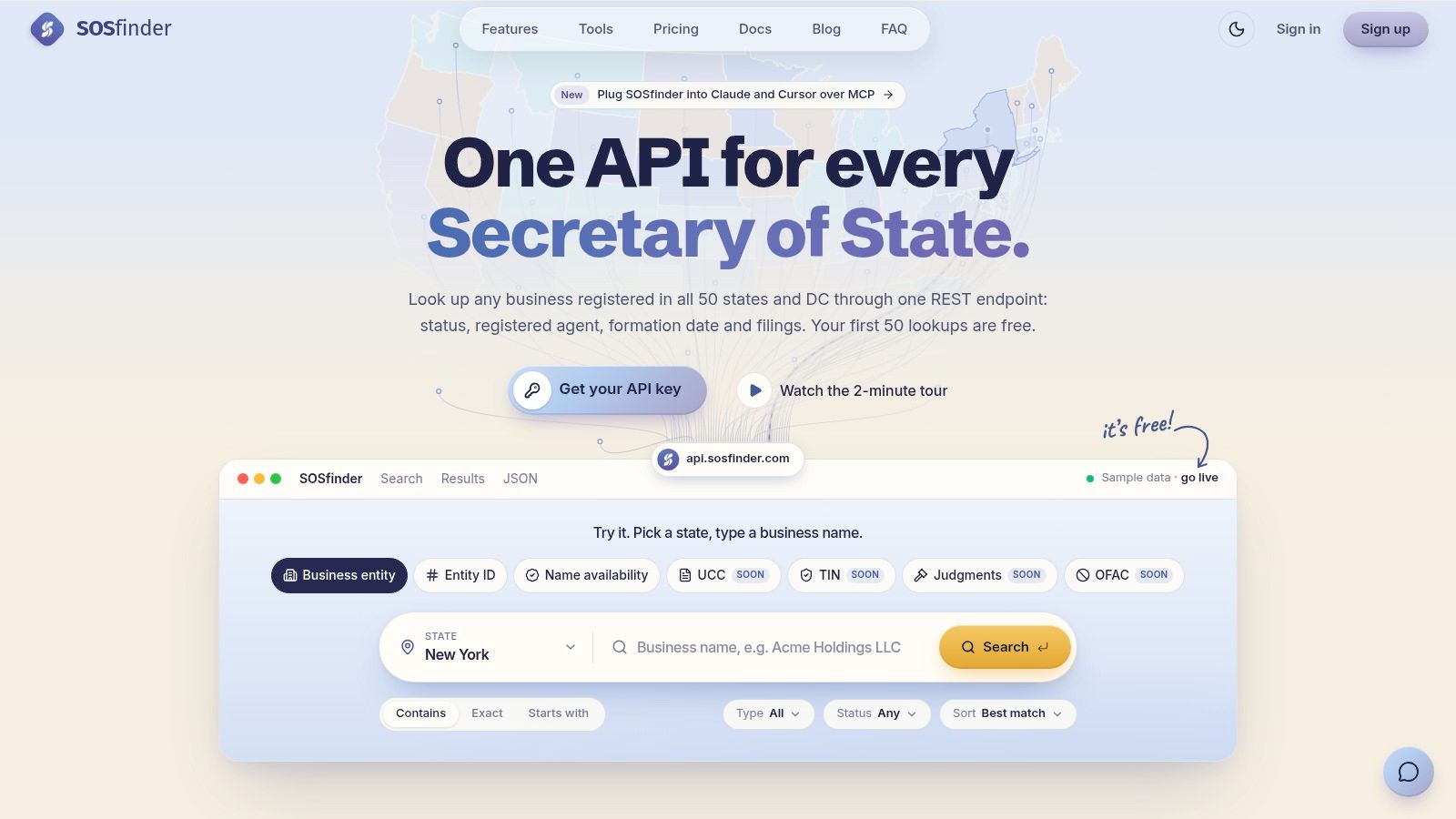
A KYB review breaks down fast when the registry record is stale or hard to trace. SOSfinder is built for that problem. It gives teams one API path into business records across all 50 U.S. states plus DC, so compliance and engineering teams can verify legal existence, status, formation details, registered agent, and filing history without stitching together separate state interfaces. It also fits operational work, with predictable JSON, an API playground, multi-language examples, monitoring, webhooks, bulk CSV verification, and an MCP-hosted server for natural-language querying. The KYB verification guide is the right internal reference if you need to explain the workflow to a broader team.
Where it stands out
SOSfinder fits teams that need a normalized registry layer for onboarding, periodic review, vendor due diligence, or legal filing support. Cached lookups reduce duplicate queries, automatic best-match logic helps with noisy name searches, and retries matter when a registry blocks repeated requests. Higher tiers add webhooks, advanced analytics, and a 99.9% uptime SLA, which suits production workflows that cannot wait for manual retries.
The trade-offs are clear. Some functions, including UCC and officer lookup, are still in beta, and document availability varies by state because the underlying registries do not expose the same metadata. That makes SOSfinder a better fit for buyers who want official-source coverage first and are comfortable with state-by-state differences.
Practical rule: choose SOSfinder when your evidence standard starts with the Secretary of State record, not with a risk score from a third-party graph.
Pricing is more direct than many enterprise KYB tools. There is a free tier, usage-based plans, non-expiring credits, and custom enterprise options, so teams can start small and expand without rebuilding the integration.
2. Middesk
Middesk fits U.S. onboarding teams that want a fast path from application data to a verified business decision. It focuses on entity verification, registration status, sanctions and watchlist screening, and workflow support, which is enough for many fintechs that don't want a sprawling platform on day one. The API-first design and public implementation guidance are a good sign if your team needs something engineering can ship without a long services engagement.
The main strength is that it covers the typical U.S. business onboarding bundle in one place. That means a team can validate a company, screen the business and associated people, and route the case through review without gluing together multiple tools. For buyers who want end-to-end decisioning rather than a data-only feed, that matters.
The limitation is coverage scope. International verification is available as an add-on, so firms with cross-border onboarding will need to confirm whether the package covers their actual footprint before committing. Pricing also isn't public, which usually means procurement will need vendor conversations before anyone can compare total cost.
Middesk suits compliance and product teams that care more about clean implementation than about deep official registry collection across every jurisdiction. If your workflow is mostly U.S. business onboarding and you want orchestration without leaving the vendor, it's a practical choice. If you need a registry-first evidence trail across multiple states, it is better as a decisioning layer than as a source-of-truth replacement.
3. Trulioo
A buyer usually reaches Trulioo when person checks and business checks need to sit in the same workflow. That comes up in cross-border onboarding, where beneficial owners, directors, and the company itself all need to clear the same review. The platform's business verification, delivery of standardized business records, and API or low-code integration options explain why global teams put it on the shortlist. For a primer on how business verification tools differ, see this overview of KYB tools before comparing global suites.
What stands out is breadth. A program that spans countries and needs one vendor across several verification paths can reduce tool sprawl with Trulioo. It also suits teams that want business checks, person checks, and UBO verification under one roof instead of splitting them across separate providers.
The trade-off is weight. For a U.S.-only workflow, it can feel larger than the problem, and that usually means longer procurement and implementation cycles. Pricing is enterprise-only in practice, so buyers should expect vendor conversations before they can compare cost.
Cross-border KYB works better as a single case file where business identity and person identity are reviewed together.
Trulioo fits buyers who value integration flexibility and international coverage more than direct registry depth in one country. It works for teams standardizing onboarding across markets. It is a weaker fit for teams that want the most granular Secretary of State workflow in the U.S.
4. Alloy
Alloy is the orchestration choice when a compliance team wants to centralize decisioning across many data sources. It brings together KYC, KYB, and AML in a configurable workflow engine, which is useful when policies are complex and no single data provider covers every rule surface. The connector model also helps teams avoid hard lock-in to one source of business data.
That structure makes Alloy a strong fit for banks and fintechs with layered policies, human review steps, and multiple vendor dependencies. It's the kind of platform you choose when the hard part is not fetching data, but deciding what to do with it, who reviews it, and how exceptions move through the case queue.
The drawback is implementation weight. Alloy is usually an enterprise deployment, and breadth costs time even when the platform is a good fit. Pricing isn't public, which means buyers need commercial conversations before they know whether the platform matches their program scale.
If your operation needs a central nervous system for compliance decisions, Alloy is worth a close look. If your main pain point is getting authoritative registry records quickly, Alloy is more of a control plane than a data source. That distinction matters because orchestration doesn't fix weak source coverage by itself.
Best fit by operating model
- Centralized compliance teams that want one policy engine across business, customer, and AML decisions.
- Multi-vendor stacks where source flexibility matters more than one data provider.
- Regulated institutions with queue management and case handling already built into the workflow.
5. Persona
Persona is a good fit when registry data alone doesn't tell you enough about whether a business is real. It blends KYB with other signals, including lien-style and website-related intelligence plus document intake, which helps when a company has thin official records or inconsistent metadata. For startup teams, the self-serve motion is often the draw because it lowers the friction of testing the platform before a full sales cycle.
The practical advantage is composability. Persona gives product teams building blocks that can be combined for KYB and KYC flows, rather than forcing a single rigid process. That makes it useful for companies that need to adjust verification depth as risk changes.
The limitation is that full KYB functionality can still require vendor engagement, and the startup plan is mostly U.S.-focused. That means it is not the first choice if your main requirement is multi-state official registry coverage with a strong audit trail. It is better when the evidence model can include documents and alternative business signals alongside registry checks.
For teams that frequently run into false negatives on registry-only workflows, Persona can be the better operational choice. For teams whose compliance posture depends on direct official-source retrieval, it should be treated as a complementary layer, not the entire answer.
6. Sumsub
Sumsub is the all-in-one option for teams that want onboarding, screening, and ongoing monitoring under one umbrella. Its KYB flows, document parsing, automation rules, and monitoring features make it useful for platforms that don't want separate tools for each stage of the lifecycle. That can simplify operations when a compliance team needs one vendor to own the full verification journey.
The best case for Sumsub is breadth with decent configurability. If your program spans onboarding, rescreening, and recurring checks, having those controls in one environment reduces handoffs and cuts the number of systems analysts need to learn. The documentation around KYB setup also helps implementation teams understand what can be automated and where manual review still sits.
The trade-off is fit. For a basic U.S.-only use case, Sumsub may be broader than necessary, especially if the core requirement is direct registry evidence from state filing offices. It also tends to land in the category of products where transaction pricing is customized, so buyers often won't know the actual cost until they've gone through sales.
Sumsub is strongest for teams that view KYB as part of a larger verification and monitoring program. It's weaker if the buyer wants a single-purpose registry tool with minimal overhead. In practice, that means it belongs in stacks where ongoing monitoring is a first-class requirement, not in teams that just need a fast business lookup.
7. Veriff
Veriff works well for teams that already use it for identity verification and want KYB in the same vendor relationship. Its business register cross-checks, sanctions and watchlist screening, and review tooling let compliance teams move from individual identity checks to business checks without changing vendors. That's convenient for startups and growth teams that want a self-serve path into verification.
The upside is simple operational continuity. If your KYC program is already in Veriff, adding KYB can be easier than introducing a separate business verification platform. The review and reporting tools also help teams manage cases without building everything from scratch.
The limit is depth by jurisdiction. KYB coverage can vary, so buyers need to confirm whether the platform meets their target markets before making it the foundation of a regulated workflow. Advanced KYB pricing also usually requires sales engagement, which makes side-by-side cost comparison harder.
Veriff suits teams that want an accessible entry point and a combined KYC-KYB setup. It is less attractive if the mandate is registry-first verification with explicit source documents from U.S. filing offices. In other words, it's a good fit for operational simplicity, but not always for the deepest official-record evidence chain.
8. ComplyAdvantage
ComplyAdvantage fits teams that care more about screening depth than registry collection. Its sanctions, PEP, and adverse media tools are the main draw, and the KYB API extends that financial-crime stack into business verification workflows. For regulated buyers, that can be enough, because screening and monitoring are where most of the review burden lives.
That makes it a practical choice for teams that already work from case management and risk scoring. The API documentation and workflow support help compliance staff open verification cases, then carry those cases into broader AML monitoring. Because screening and monitoring are where most of the review burden lives, see this guide to compliance monitoring software for how continuous monitoring differs from point-in-time checks. If your risk posture is screening-heavy, the fit is straightforward.
The trade-off is registry-level evidence. ComplyAdvantage can work well as a screening engine, while another source may still need to supply the corporate record underneath it. Buyers who need official PDFs, filing histories, and jurisdiction-specific evidence should plan for that gap.
Buyer signal: choose screening-first platforms when your biggest exposure is financial-crime signal depth, not when your first question is “does this entity exist in the registry?”
It suits programs where business verification sits inside a wider AML control environment. It is less useful as the only source of corporate truth.
9. Dun & Bradstreet Direct+
Dun & Bradstreet fits buyers who care about entity linkage, ownership hierarchies, and data enrichment at scale. Its D-U-N-S identity graph and business verification tools help when the job is not just confirming a company exists, but resolving duplicates, mapping corporate structures, and cleaning internal records. That matters in enterprise procurement, vendor risk, and global KYB programs.
The strength is breadth of commercial identity data. D&B supports hierarchy analysis and monitoring that help teams keep records consistent over time. For large organizations, that can cut down duplicate entities and make vendor and customer records line up more cleanly.
The trade-off is source visibility. Raw registry documents are not always embedded inline, so buyers who need direct official evidence may still need another product in the stack. Licensing also tends to be enterprise-oriented, which usually fits larger programs better than small teams.
D&B works best when the buyer wants identity graph intelligence, not just a point lookup. If your compliance team needs official filing evidence for every case, pair it with a registry source. If your main pain point is entity resolution across a global dataset, it becomes much more attractive.
10. LSEG World-Check One
LSEG World-Check One is a screening-first platform that works best in regulated environments with global exposure. It combines business identity verification with sanctions, PEP, and adverse media data, plus case management for teams that need one place to review and document decisions. For institutions that already trust the risk intelligence layer, that combination is compelling.
The upside is global reach and familiarity. Many regulated teams know the World-Check brand, and that recognition can shorten the internal conversation around whether the screening layer is credible. It also fits cases where KYB and KYC are managed together rather than in separate operational lanes.
The drawback is the same one you see in other screening-first tools. If you need registry documents, filing histories, and official state-level evidence, you may still need another source. The platform's emphasis is on risk intelligence, not direct registry retrieval.
That makes it a strong final-mile control for AML-led programs and a weaker first-mile source of record. Teams that want the strongest audit trail should pair it with registry data, not assume screening output is enough on its own.
Top 10 KYB Software, Feature Comparison
| Product | Core features ✨ | UX / Quality ★ | Pricing / Value 💰 | Target audience 👥 | USP / Why choose |
|---|---|---|---|---|---|
| SOSfinder 🏆 | ✨ 50‑state single POST; normalized records; monitoring; bulk CSV; webhooks; API playground | ★★★★☆ Predictable JSON, low‑latency caching, retries, SLA on higher tiers | 💰 Free 50/mo; $49/1k; $99/2.5k; $449/15k; non‑expiring credits | 👥 Engineers, product, KYC/KYB & compliance teams | 🏆 Recommended, single‑endpoint nationwide registry data; real‑time + cache; MCP server for AI; developer‑friendly |
| Middesk | ✨ Entity verification, TIN/address checks, sanctions & person screening, orchestration support | ★★★★☆ API‑first, clear docs & guides | 💰 Pricing private / enterprise | 👥 U.S. fintechs & onboarding teams | Purpose‑built KYB + decisioning flows for U.S. onboarding |
| Trulioo | ✨ Global business & person verification, UBO vetting, API & hosted UI | ★★★★☆ Broad international coverage | 💰 Enterprise / custom | 👥 Global enterprises, cross‑border onboarding | Broad cross‑border coverage; consolidates KYC + KYB |
| Alloy | ✨ Central decisioning engine, connectors, case management, workflow builder | ★★★★☆ Strong for regulated banks & complex policies | 💰 Enterprise / custom | 👥 Banks, fintechs needing orchestration | Orchestration reduces vendor lock‑in; powerful rules & workflows |
| Persona | ✨ Flexible signals (liens, web intel), document intake, APIs + hosted flows | ★★★★☆ Developer‑friendly; startup tier available | 💰 Startup/self‑serve + enterprise | 👥 Startups & product teams | Composable signals + self‑serve program to improve match rates |
| Sumsub | ✨ End‑to‑end KYB/KYC/AML, document parsing (ACDR), monitoring & automation | ★★★★☆ Configurable flows; good KYB docs | 💰 Public core pricing; transactional KYB often custom | 👥 Platforms needing onboarding → monitoring in one vendor | Integrated AML/KYB, strong document automation & rules |
| Veriff | ✨ Global register cross‑checks, sanctions/watchlist screening, reporting tools | ★★★☆☆ Self‑serve plans; review tooling | 💰 Self‑serve with volume discounts; enterprise plans | 👥 Teams seeking quick self‑serve onboarding | Easy entry + combined individual & business checks |
| ComplyAdvantage | ✨ KYB API + realtime AML risk DB, sanctions/PEP/adverse media | ★★★★☆ High‑quality screening signal depth | 💰 Enterprise / custom | 👥 Risk & AML teams at regulated firms | Exceptional adverse media & sanctions intelligence integrated with KYB |
| Dun & Bradstreet | ✨ D‑U‑N‑S identity graph, ownership hierarchies, firmographics & monitoring | ★★★★☆ Enterprise‑grade data quality & linkage | 💰 Enterprise licensing / fees | 👥 Enterprises needing UBO mapping & enrichment | Deep global identity graph for hierarchies and enrichment |
| LSEG World‑Check One | ✨ Business identity verification + World‑Check risk intelligence, case mgmt | ★★★★☆ Trusted risk data; wide country coverage | 💰 Enterprise / custom | 👥 Regulated institutions with global portfolios | Trusted World‑Check intelligence + integrated screening & case management |
Matching KYB Software to Your Evidence Requirements
Start with the evidence you need, not the category label. If your process depends on official registry records, normalized filings, and current registered-agent data, a registry-level API should sit at the center of your stack. If you mainly need sanctions, PEP, and adverse media control, a screening-first platform may be enough, especially when your review team already has another source for entity records.
Then map jurisdiction, volume, and workflow depth. U.S.-only teams with a need for fast implementation often do well with developer-first registry tools or orchestration layers. Global onboarding programs usually need broader identity suites, while screening-heavy financial institutions tend to prefer platforms that can manage case flow and risk review in one place. The right answer usually comes down to how many systems you want analysts to touch during a single decision.
A pilot is the fastest way to separate marketing from fit. Test with entities you already reviewed, including common names and records with recent status or registered-agent changes. That exposes whether the tool resolves edge cases cleanly, how fast evidence comes back, and how much analyst time the workflow really saves.
Pricing should stay part of the conversation from the start, because many vendors don't publish it. Ask for current rates, coverage by market, and what happens when a record needs manual review or an add-on package. The best kyb software is the one that gives you defensible evidence without turning your review queue into a support queue.
If your team needs a registry-first KYB layer, SOSfinder is built for that job. It gives you one API for all 50 U.S. states plus DC, with normalized business records, filing history, monitoring, and bulk verification that fit directly into onboarding and ongoing review. Visit SOSfinder to see how it can support your KYB workflow.