What Is a Registered Agent Address and Why It Matters

A registered agent address is the in-state physical address a business designates to receive lawsuits, subpoenas, liens and official state notices on its behalf.
If your company can receive invoices at an address, does that mean a process server can deliver legal papers there too? Not necessarily. The important distinction isn't whether an address looks professional or accepts mail. It's whether the designated person or provider can receive formal documents there under the state's rules.
What a Registered Agent Address Is
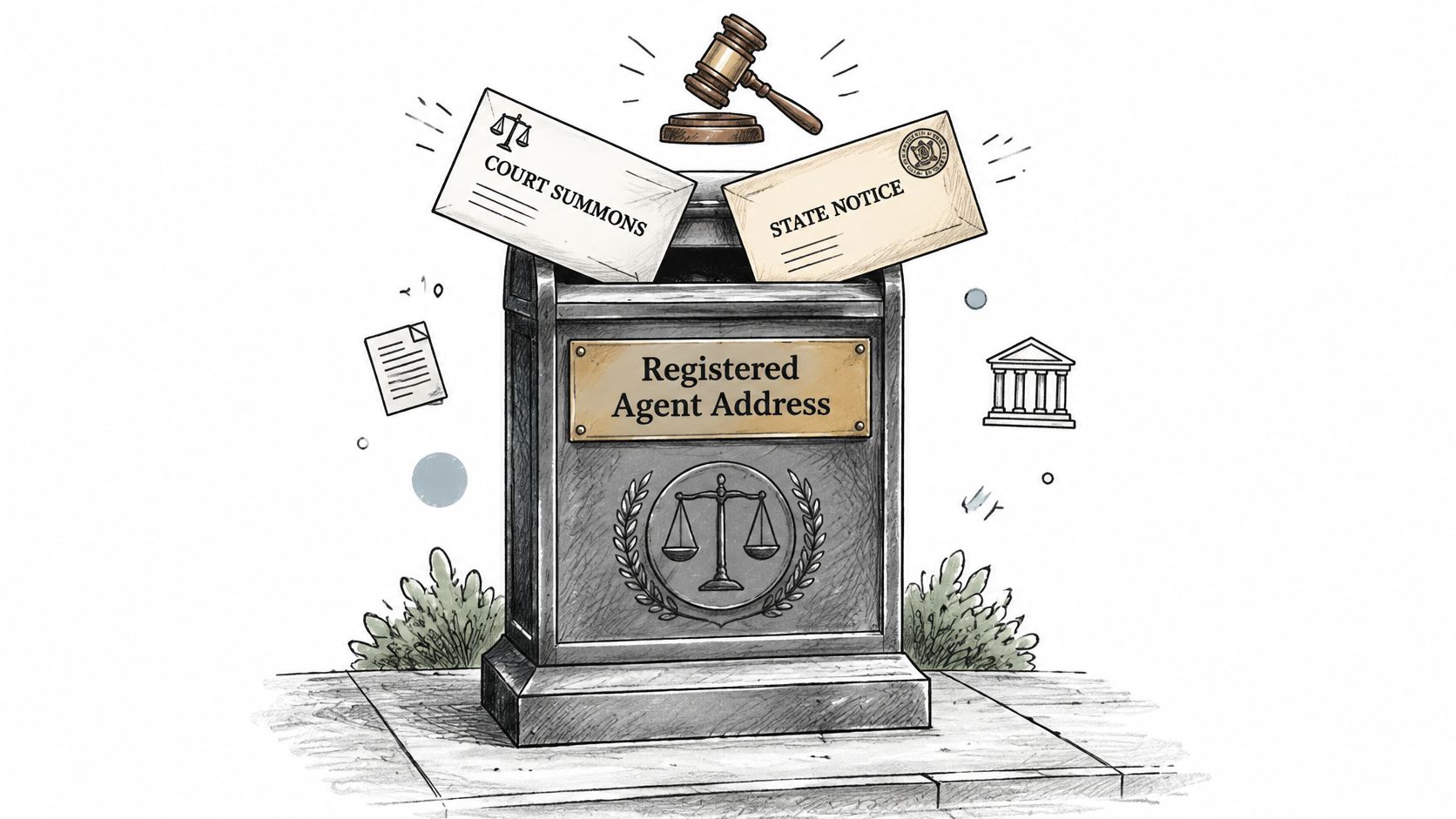
A registered agent address identifies the business's designated location for receiving official legal and government correspondence in a particular state. Think of it as a legal mailbox the company must keep available, with an actual person or provider standing behind it to accept papers.
Say you're forming a consulting LLC. You work from home, meet customers at their offices and send invoices electronically. None of those arrangements answers the state's practical question: where can someone deliver formal documents to your designated recipient?
The agent and the address work together
According to the U.S. Small Business Administration's business-launch guidance, LLCs, corporations, partnerships and nonprofit corporations generally need a registered agent before filing, and the agent must be located in the state where the business registers. The designation can be an individual who resides in the state or a professional registered-agent provider.
The agent is the designated recipient. The registered office is the location associated with that role. A name alone doesn't solve the delivery problem, and an address without someone available to accept documents doesn't solve it either.
Practical rule: Choose the recipient and the delivery location together, rather than filling in an address first and assuming someone will handle the papers.
For an LLC, registered-agent information typically appears in the articles of organization, alongside information such as the company name, address and member names. Treat that entry as a responsibility you're assigning, not an administrative blank you're completing.
Before appointing an individual, discuss availability during business hours and how documents will reach the person responsible for responding. Before appointing a provider, establish who inside your company will receive forwarded notices.
The answer to “what is a registered agent address” is therefore about legal delivery, not office occupancy. It tells the state where formal documents can reach an authorized recipient, not where your team sits or customers send everyday correspondence.
Registered Agent Address Versus Mailing and Principal Addresses
| Address type | Main purpose | Physical in-state address required? | Who receives it | Where it usually appears |
|---|---|---|---|---|
| Registered agent address | Receives service of process and official state notices | Yes, in the state of registration | Registered agent during business hours | Formation filings and state registry record |
| Principal business address | Where the company is managed and operates day to day | No requirement to be in every registration state | Company management | Annual reports and company records |
| Mailing address | Routine mail, invoices and banking correspondence | No registered-office requirement; a PO box or forwarding service can work for ordinary mail | Company staff or mail service | Websites, invoices and bank accounts |
| Virtual office address | Commercial mail and a business presence | Not necessarily; it may not satisfy registered-agent rules | Virtual office provider | Marketing and customer-facing materials |
These categories describe different jobs, even when a business uses the same street address for several of them. The principal address concerns the company's operations. The mailing address directs correspondence. The registered office supports delivery to the appointed agent.
The Oregon Secretary of State's registered-agent guidance requires a physical street address in Oregon and rejects a standalone post-office box or mail-forwarding address because a process server cannot physically serve the agent there. Receiving an envelope eventually isn't the same as making an authorized recipient available for service.
Why a street address alone isn't enough
Texas follows the same operational model: domestic and foreign filing entities must continuously maintain an in-state registered agent and physical registered office, which also receives Secretary of State correspondence. The underlying question is whether someone can deliver papers to the designated agent, not whether the location has a street number.
Say your business rents a virtual office that scans incoming mail. That service may handle supplier invoices perfectly. But unless the arrangement also meets the state's registered-agent requirements, you shouldn't enter it as the registered office merely because it looks like a conventional business address.
For onboarding and compliance systems, preserve separate fields:
- Registered-agent name: The individual or organization designated to accept documents.
- Registered-office address: The location attached to that appointment.
- Principal business address: The company's management or operating location.
- Mailing address: The destination for ordinary correspondence.
Keeping those fields separate prevents a reviewer from treating an agent's office as evidence that the company operates there. It also avoids routing customer mail to a provider whose role doesn't include handling it.
Use this screening test: if a process server couldn't deliver papers to the designated agent there during required business hours, don't treat it as a qualifying registered office. Passing that test still requires checking the particular state's filing rules.
Why the Registered Agent Address Carries Legal Weight
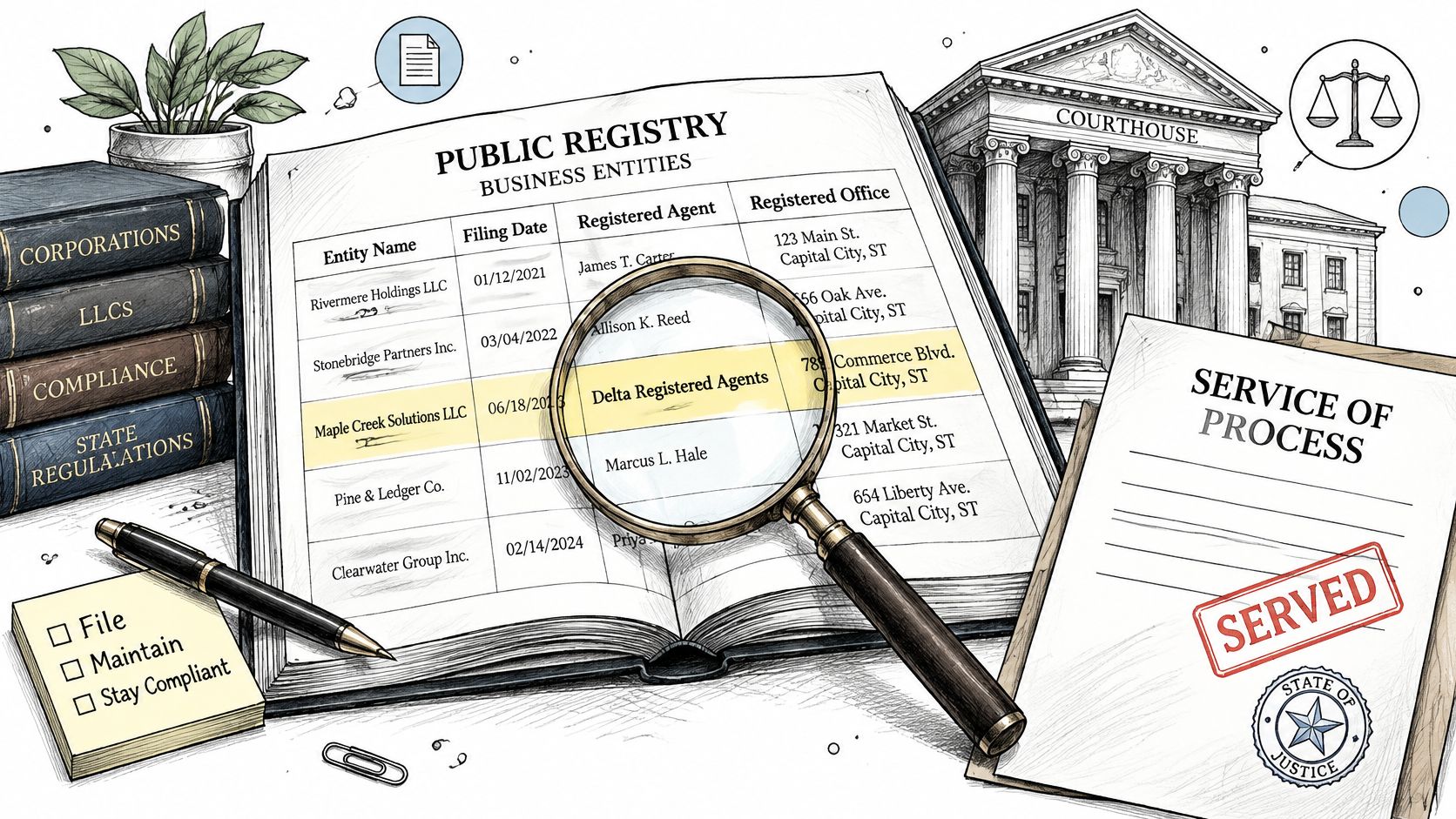
A registered agent address is the jurisdiction's official delivery point for the entity. The South Carolina Secretary of State's service-of-process guidance explains that entities provide registered-agent and registered-office information for service of process, and those fields are publicly searchable through its business-entity system.
Because that entry is public, a court, agency or counterparty can treat it as the location the business designated for formal delivery. The legal weight comes from the connection between three facts on the record: the entity, the named agent, and the office where that agent can be reached.
When the registered-office line changes, the reason matters. A new address may mean the company moved, or it may mean only the agent appointment changed while operations stayed put. Reading an agent's office as the company's operating location can send important papers to a provider whose role is limited to receipt.
An outdated entry creates a delivery risk
Say a company moves offices and hires a new registered-agent provider, but nobody completes the corresponding state update. Its internal spreadsheet lists the new provider, while the public record still identifies the former recipient. Someone relying on that record may attempt delivery using information the company no longer considers current.
An outdated entry can contribute to missed response deadlines, administrative dissolution or default-related exposure. Those outcomes aren't automatic whenever an address is wrong, but the risk is serious enough to make an agent change a review-triggering event.
A signed service agreement and an updated state record are different things. Verify that the public filing reflects the intended appointment.
Use company formation documents to establish the original designation, then examine later amendments. An address copied from an accessible formation document can be stale, and the document's availability does not prove the appointment is current.
Keep the distinction between receiving documents and responding to them in mind when reviewing the role. Receipt is the agent's function. The answer still belongs to the company.
Compare the registry's current agent and office fields with the filing history. A former address may remain visible in an archived document without being the active registered office. When a record is wrong at the source, the correction has to be made with the state office that maintains the filing. Record which filing supports your conclusion, and route unresolved discrepancies to the person responsible for the entity's filings.
Which Registered Agent Address Applies to Multi-State Businesses
| Business situation | Registered agent needed in | Routine mail can go to | Check before filing |
|---|---|---|---|
| Single-state company with no activity elsewhere | Formation state | Its designated ordinary-mail address | Agent and physical office in the formation state |
| Formed in one state, with staff or clients in another | Formation state, plus additional states where registration is required | A separate mailing address | Physical presence, employees, client meetings and revenue in each state |
| Foreign company registering in a new state | Each state where it qualifies to do business | A separate mailing address | State-specific registered-office rules |
| Remote team using a virtual office only | Formation state, plus other required registration states | Virtual office for ordinary mail | Whether the arrangement meets the agent rules |
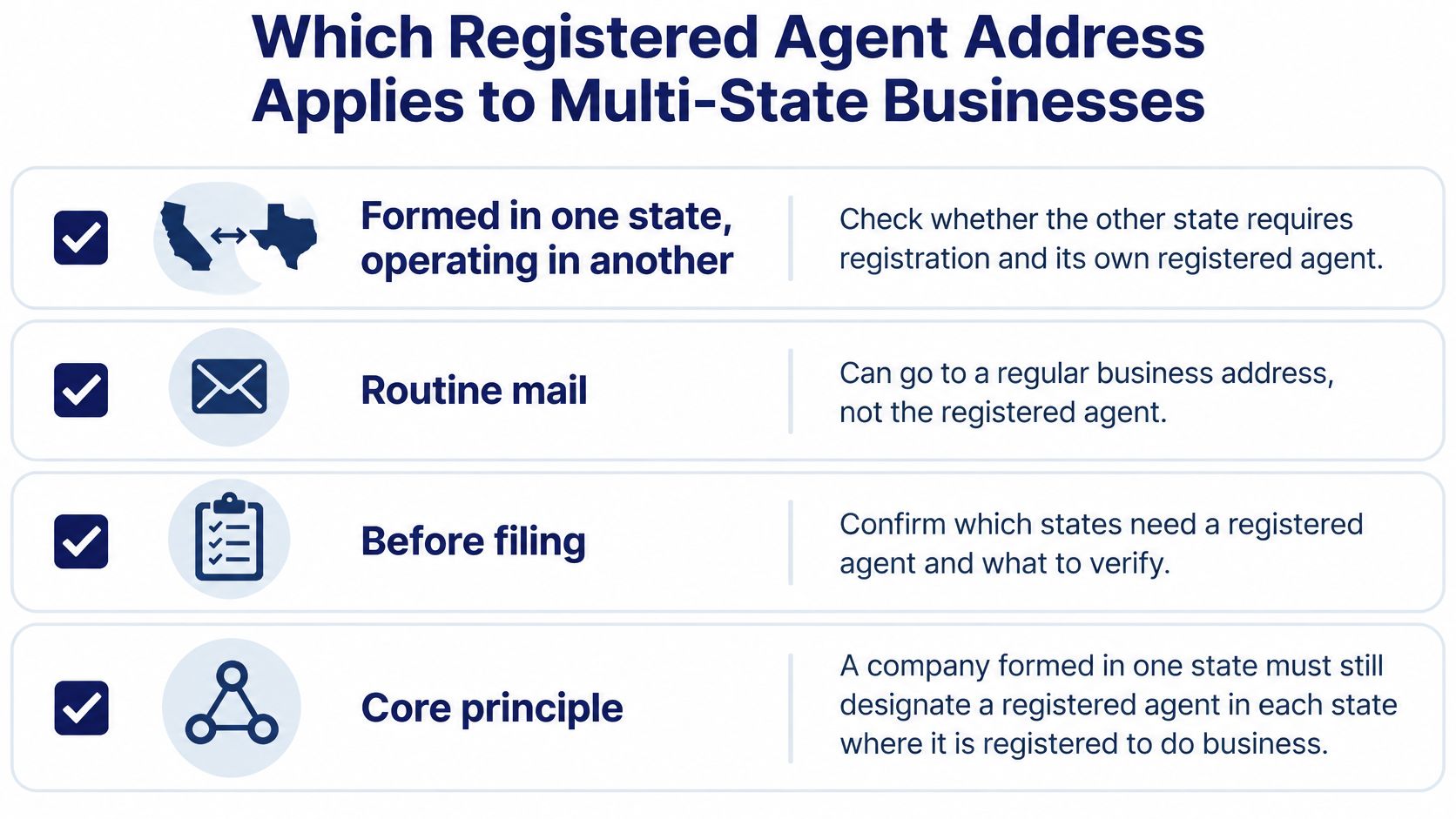
An entity's formation state isn't necessarily its only registration jurisdiction. A company formed in one state may need to register elsewhere because of its activities there. Staff or clients in another state should prompt a registration review, not an automatic assumption that every customer relationship requires registration.
Assess activity before choosing the address
Relevant indicators include a physical presence, frequent in-person client meetings, a significant portion of revenue and employees working in a state. Review those activities by jurisdiction rather than copying the formation-state entry into every record.
For example, a remote software company might have its founders in one state and employees in another. Its compliance review should determine where registration is required before deciding which registered-office details belong in the filings.
The Oregon Secretary of State's service-of-process explanation illustrates why commercial mail arrangements aren't interchangeable with registered offices: the location must support delivery to the agent. A virtual office suitable for websites, invoices or banking correspondence may still fail that requirement.
For a multi-state data model, attach the agent and registered office to the entity's jurisdiction-specific registration. Don't store a single universal agent address at the company level and overwrite it whenever another state's record arrives. A unified approach to state-registry lookups should preserve those jurisdictional differences.
- Before expansion: Determine whether the new activities trigger registration.
- Before filing: Confirm the agent and office meet that state's requirements.
- When comparing records: Identify whether an update concerns an agent, an operating location or both.
A changed registered-agent address may mean only that the company switched providers. It isn't, by itself, evidence that the company relocated. Your workflow should classify the changed field before updating operational-address records.
How to Verify and Monitor a Registered Agent Address
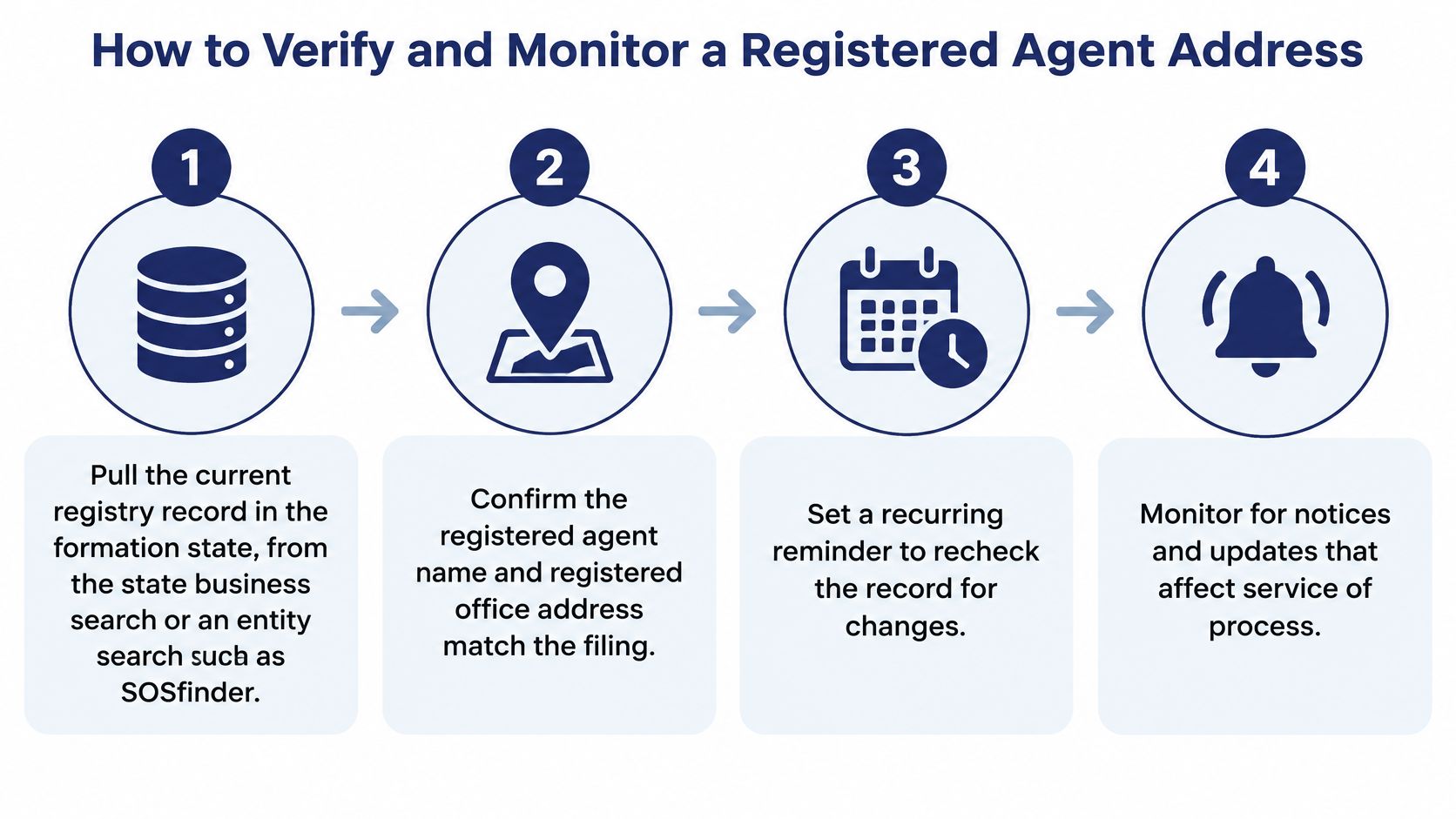
Start with the current public record, then check the supporting documents and the practical delivery arrangement. You're verifying both what the state records and whether that information matches the company's intended appointment.
Follow the record from lookup to review
Pull the current registry record in the formation state. Search the state's business database using the business name or registry identifier. Confirm you've selected the correct legal entity rather than a similarly named company.
Capture the agent and registered office separately. Note the registered-agent name and registered-office street address without substituting the principal address. Keep the jurisdiction attached to each entry so reviewers know which registration it describes.
Review the filing history. Look for amendments or other filings that changed the agent or office after formation. An older document can explain a discrepancy without establishing what is current.
Compare the record with company paperwork. Check the designated provider, appointment information and relevant internal records. Flag mismatches for resolution rather than choosing whichever address appears most often.
Confirm the delivery arrangement. Check that the location is physical, in-state and capable of receiving documents during required business hours. A registry entry is a starting point, not proof that today's staffing and forwarding arrangements work.
Repeat for every registration jurisdiction. Don't assume the formation-state result answers the question elsewhere. For a state-specific example of navigating a lookup, use the Mississippi business entity search guide.
Assign ownership for ongoing review. Decide who investigates changes to status, agent or address, and who confirms that any required filing was completed. A notification without an accountable reviewer doesn't finish the check.
Make comparisons consistent without erasing differences
Our entity records include status, entity type, formation date, registered agent and principal address, normalized into one consistent format. When a business name is searched, we ask the state's official registry for the record; monitoring alerts users when a tracked company changes status, registered agent or address.
Normalization makes cross-state comparisons practical, but your application should still preserve the meaning of each field. Don't merge the registered office into a generic address field to simplify a screen or database table.
Review checkpoint: Save the jurisdiction, registry identifier, checked record and unresolved discrepancy together so another reviewer can reproduce the decision.
For risk teams, the next action should match the discrepancy. A spelling difference may need document review; a different agent or unavailable office needs confirmation from the filing owner. Neither should be accepted as a routine formatting change.
Corrections to a wrong official record must be made with the state office that maintains the filing. Updating your onboarding database or an internal contact list doesn't correct the public record.
Confirm the Registered Agent Address Before You File
Confirm the jurisdiction-specific registered office before submitting a filing, onboarding a vendor or customer, or relying on an amended record. The right decision isn't just that an address exists. You need a matching entity, the intended agent and the appropriate office for that state's registration.
For teams handling company registration in the USA, make this a release condition rather than a cleanup task. If the paperwork names one provider and the current record names another, resolve the discrepancy before treating the appointment as confirmed.
Our coverage includes all 50 states and DC, so the jurisdiction can remain part of the same lookup workflow rather than becoming a separate research project. Preserve the state identifier in your results and review each registration on its own terms.
Keep verification separate from filing
We can't file documents, register entities or change an official record on a customer's behalf. An agent or office update must go through the applicable state filing process, directly or with the assistance of the provider responsible for submitting it.
Before proceeding, make the final comparison:
- Entity identity: Does the record belong to the intended business?
- Agent appointment: Does the named recipient match the company's paperwork?
- Registered office: Is the intended location recorded for the correct state?
Pull the current record for each relevant state, reconcile discrepancies and only submit once the agent and registered-office details match the intended filing.
Visit SOSfinder to check registered-agent information through a Free plan business entity search covering all 50 states and DC. For integrated verification, our REST endpoint returns status, registered agent, formation date and filings, helping your team compare official records before filing or onboarding.