KYB vs KYC: The Complete Guide for 2026 Compliance Teams

KYC verifies an individual's identity to prevent personal fraud, while KYB verifies a business's legal existence and ownership to prevent corporate-layer money laundering. KYB usually needs ongoing monitoring after onboarding, because ownership and registry data can change after the initial check.
You're probably dealing with a flow that looks simple on paper, then breaks in production. A customer passes identity review, a business partner clears onboarding, and two weeks later an address change or ownership update turns into a manual exception that no one planned for.
| Area | KYC | KYB |
|---|---|---|
| Subject | One person | One legal entity and its controllers |
| Main goal | Verify identity | Verify legal existence and ownership |
| Typical data | ID documents, personal details | Registry records, filings, directors, UBOs |
| Operational risk | Identity fraud | Shell entities, ownership opacity, drift |
| Best fit | Consumer onboarding | Business onboarding and vendor due diligence |

KYB vs KYC in Production Workflows
A common failure mode is treating a business applicant like a slightly more complicated person. That works until the first false positive, the first stale filing, or the first reseller account where the signer is clean but the company behind them isn't.
KYC is built around one identity. KYB is built around a legal entity, then the people and filings that control it. That difference matters because the control surface is wider, and the questions are different from the start.
Separate the decision path early
KYC answers, “Is this person who they claim to be?” KYB answers, “Does this company exist, who controls it, and is its registry footprint consistent?” If those get merged in the same workflow without clear branching, ops teams end up applying personal-verification logic to corporate risk.
Practical rule: if the onboarding record can include directors, registered agents, filings, and beneficial owners, you're in KYB territory even if a human signed the form.
That's why product teams need two distinct paths, not one blended checklist. The first path handles consumer identity verification, the second handles entity validation and ownership tracing, and the downstream review queues should reflect that separation.
Regulatory History and Market Growth
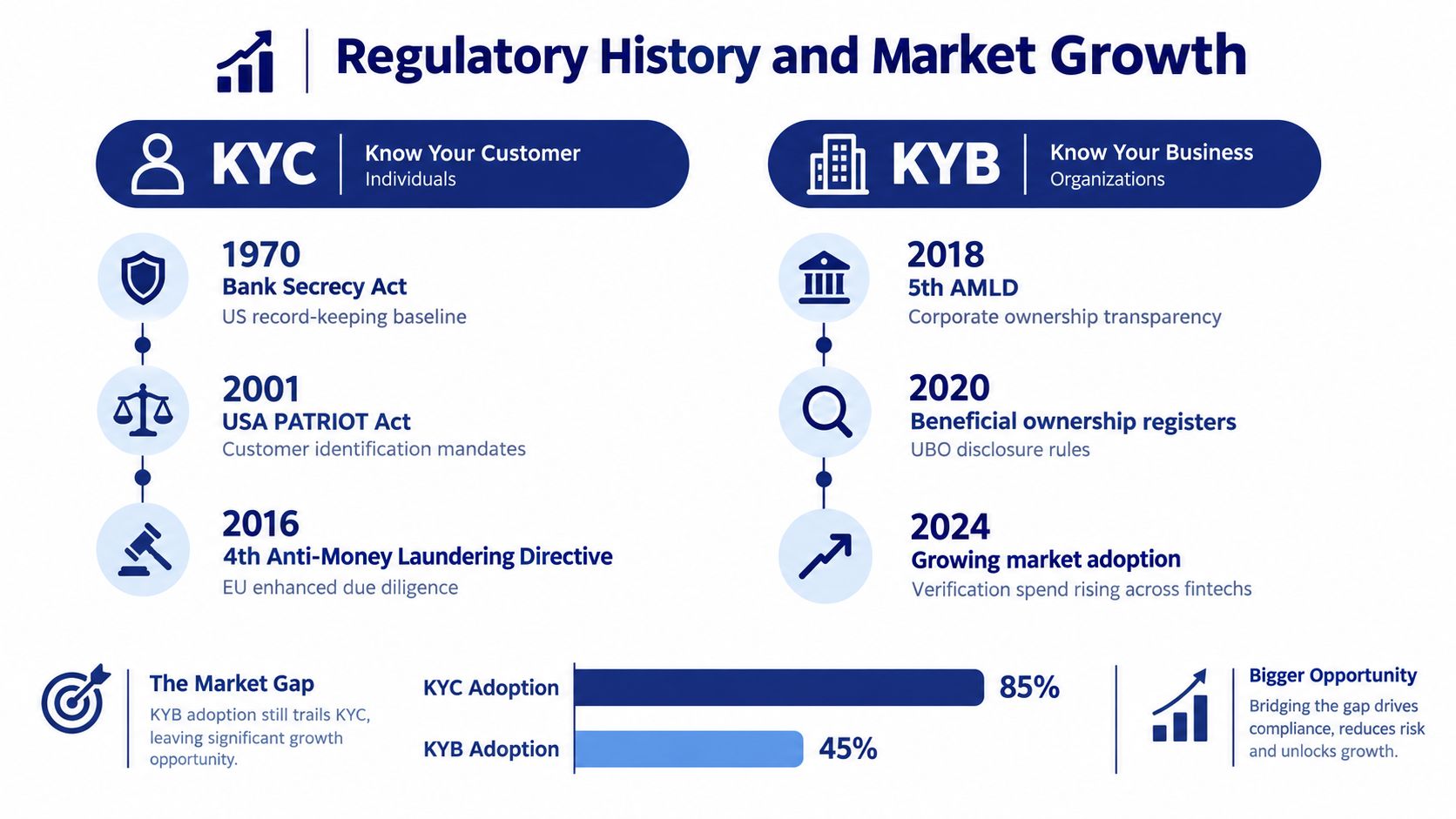
KYC has the older compliance pedigree. Know-your-customer requirements were first introduced by the U.S. government in the 1970s to combat money laundering, then expanded sharply after the 2001 USA PATRIOT Act, which strengthened identity and due-diligence expectations for financial institutions (historical KYC context).
KYB grew from a different operational problem. Business onboarding isn't just identity verification at scale, it's entity verification across registries, ownership records, and jurisdictions. One industry estimate places the global KYB market at $3.7 billion in 2024, with a projection of $10.6 billion by 2033 and a 18.2% CAGR (KYB market estimate).
Why the two tracks diverged
The market numbers matter because they reflect different workloads. KYC scaled out of consumer onboarding, where the unit of review is a person. KYB scaled because businesses create more moving parts, and every extra layer of ownership or control adds review burden. That's why modern onboarding stacks can't treat corporate verification as a sidecar to identity checks.
KYB grew because the operational problem is broader, not because the checkbox got fancier.
The result is a split architecture. Teams that only budget for identity verification usually underbuild their business onboarding stack, then pay for it later in manual review, exception handling, and stale entity records.
Depth Differences in Verification Checks
A KYC decision can close when a person's identity data matches. A KYB decision has a longer operational life. The team must establish who controls the entity, verify that its structure matches the application, and detect corporate changes after approval. That makes KYB an investigation of a legal graph, not a name match.
Ownership tracing changes the work
KYB workflows commonly draw on business registries, corporate filings, and UBO registries. Reviews can take hours to days when ownership is layered or opaque (KYB workflow depth). The time comes from tracing control through entities, directors, and beneficial owners rather than checking one person's credentials.
A production workflow also needs a monitoring path. An entity that passed validation at onboarding may later change its directors, registration status, ownership, or filing details. State-level verification gives teams a consistent basis for identifying those changes before they become an approval or counterparty problem.
If a business relationship creates exposure to sanctions, fraud, shell-company risk, or counterparty risk, confirming that the entity exists is only the starting point. Approval should depend on verified registration, control, and ownership, with relevant changes routed back into review.
What breaks when you under-check
A filing lookup can confirm existence without explaining control or showing whether the structure fits your risk appetite. KYB is a layered investigation, not a single lookup. For the full sequence, see what KYB verification covers.
SOSfinder's business entity data supports the first operational layer by consolidating state-level entity facts. It gives reviewers a normalized starting point for ownership analysis and helps create a baseline against which later corporate changes can be checked.
KYB Onboarding Performance Metrics
A healthy KYB program should be judged by friction and control at the same time. If onboarding is fast but sloppy, you've just moved risk downstream. If it's perfect but unusably slow, customers and vendors abandon the process.
The benchmarks that matter
Industry guidance cites application completion rates above 80%, time-to-decision under 24 hours, STP of 60–80% depending on segment, manual-review turnaround under 48 hours, false-positive rates under 20% of manual reviews, and document-request rates below 15% to avoid abandonment (KYB onboarding benchmarks).
| Metric | Target Threshold |
|---|---|
| Application completion rate | Above 80% |
| Time to decision | Under 24 hours |
| Straight-through processing | 60–80% depending on segment |
| Manual review turnaround | Under 48 hours |
| False positives in manual review | Under 20% |
| Document-request rate | Below 15% |
These thresholds are useful because they frame KYB as an operational system, not just a compliance rule. Completion rate tells you where friction lives. Time to decision tells you whether review is piling up. STP shows how much of the flow can be automated without sacrificing control.
How to read the numbers
If completion falls, your document asks are probably too heavy or poorly sequenced. If time to decision slips, reviewers are likely re-checking data from too many disconnected sources. If document requests rise, you're probably asking for proof too early, before the automated layer has done enough work.
The goal is simple. Keep the approved path smooth, keep the exception path controlled, and don't let manual review become the default operating model.
Real-World Use Cases for Each Approach
A fintech onboarding a retail user shouldn't run the same workflow it uses for a corporate reseller. The first relationship is personal, the second is corporate, and the control requirements are different even when the sales motion looks similar.

Where KYC is enough
Retail account opening, consumer lending, and individual wallet activation usually need KYC first. The risk lives in the person, so the workflow should verify identity, watch for impersonation, and keep the onboarding path light enough that real users finish it.
Where KYB is mandatory
Vendor due diligence, payment rail access for companies, lender underwriting for businesses, and enterprise procurement all need KYB. In those cases, the question isn't just whether the signer is valid, it's whether the company exists, who controls it, and whether the entity data is consistent enough to trust.
If a company will move money, receive inventory, or sit inside your supply chain, treat the business itself as the risk object.
That distinction saves teams from two expensive mistakes. Over-verifying a simple consumer creates abandonment. Under-verifying a company creates exposure that shows up later in chargebacks, failed audits, or bad counterparties.
The production pattern that holds up
The strongest flows keep consumer identity and business entity verification separate, then connect them only when the business relationship requires it. That gives compliance a clear control boundary and gives product teams a cleaner path to automation.
Building a Unified KYB Verification Workflow
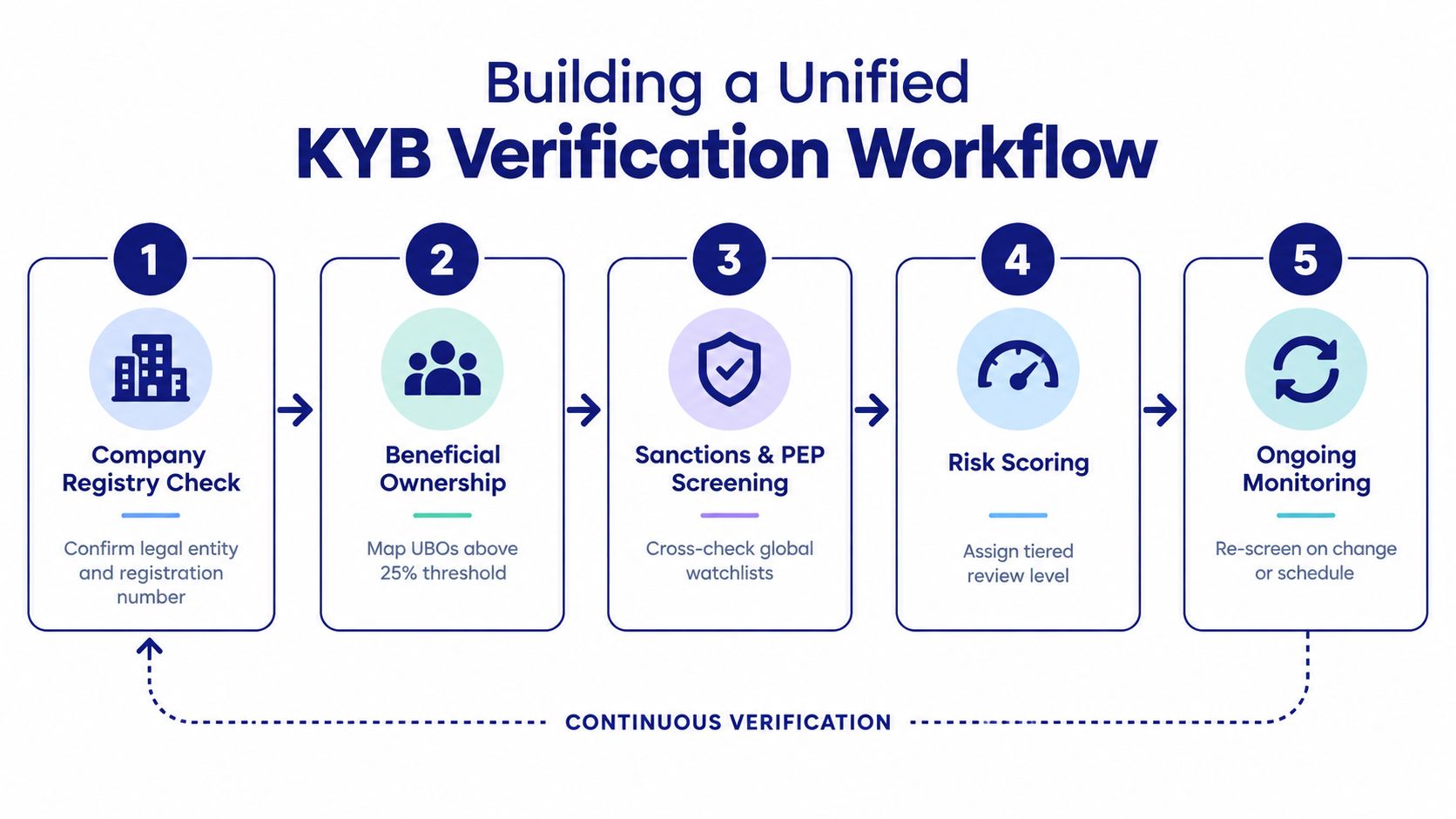
A one-time business check is not enough if the entity can change after approval. Ownership shifts, agent updates, status changes, and amended filings can all alter risk without creating a clean sanctions-style alert, which is exactly why post-onboarding monitoring matters (ongoing monitoring gap).
Make the workflow continuous
The right KYB design treats onboarding as the first checkpoint, not the last one. A registry match establishes that a company exists, but it doesn't guarantee the entity will stay in good standing or keep the same corporate footprint.
Build around normalized registry data
Unified state-level verification becomes the backbone. SOSfinder provides a single API over all 50 U.S. Secretary of State registries and the District of Columbia, with normalized entity status, formation data, registered agents, officers, filing histories, monitoring, and webhook alerts. That kind of setup reduces manual reconciliation because teams aren't stitching together different state portals by hand.
The operational advantage is not just speed, it's consistency. When every jurisdiction is normalized into one schema, your review logic can stop compensating for format drift and start focusing on actual risk signals.
Use monitoring for what registries actually change
A solid workflow watches for status, registered-agent, address, director, and filing changes. Those are the updates that matter when a company's risk profile changes after onboarding, and they're easy to miss if you only screen once at intake.
Practical rule: if the company relationship is still active, the verification stack should still be listening.
SOSfinder's KYB API fits this pattern when teams need a single entry point for registry lookups, change alerts, and downstream system hooks. That makes it easier to move from static onboarding to live entity maintenance without rebuilding every state integration.
Choosing the Right Verification Strategy
The right answer isn't KYC or KYB in the abstract. It's matching verification depth to the relationship you're creating, then deciding whether monitoring belongs in the same control plane.
Use the lightest control that still fits the risk
Basic KYC is enough when you're dealing with a single individual and the risk sits mainly in identity fraud. Full KYB is required when the counterparty is a company, especially if funds, credit, procurement, or regulated access are involved.
Continuous entity monitoring belongs in both cases only when the relationship can drift over time. For business accounts, that's often the default. For consumer accounts, it's usually a risk-triggered control rather than a constant one.
A simple decision framework
- Choose KYC when the account owner is a person and business ownership is irrelevant.
- Choose KYB when the counterparty is a legal entity, because you need registry, ownership, and control data.
- Add continuous monitoring when approval is not the end of the risk, especially for active vendors, borrowers, or payment counterparties.
- Escalate to manual review when registry data conflicts, ownership is layered, or filings have changed in ways your automated rules can't reconcile.
SOSfinder's business verification software is one option for teams that want registry data, monitoring, and standardized entity records in one workflow. The main thing is to stop thinking of KYB as a form and start treating it as a living control.
If you're building onboarding for businesses, use SOSfinder to normalize state-level entity data, monitor registry changes, and keep KYB from turning into a pile of manual exceptions. Visit SOSfinder to see how a unified verification workflow can support onboarding, monitoring, and review across your production stack.