10 Vendor Due Diligence Software Tools
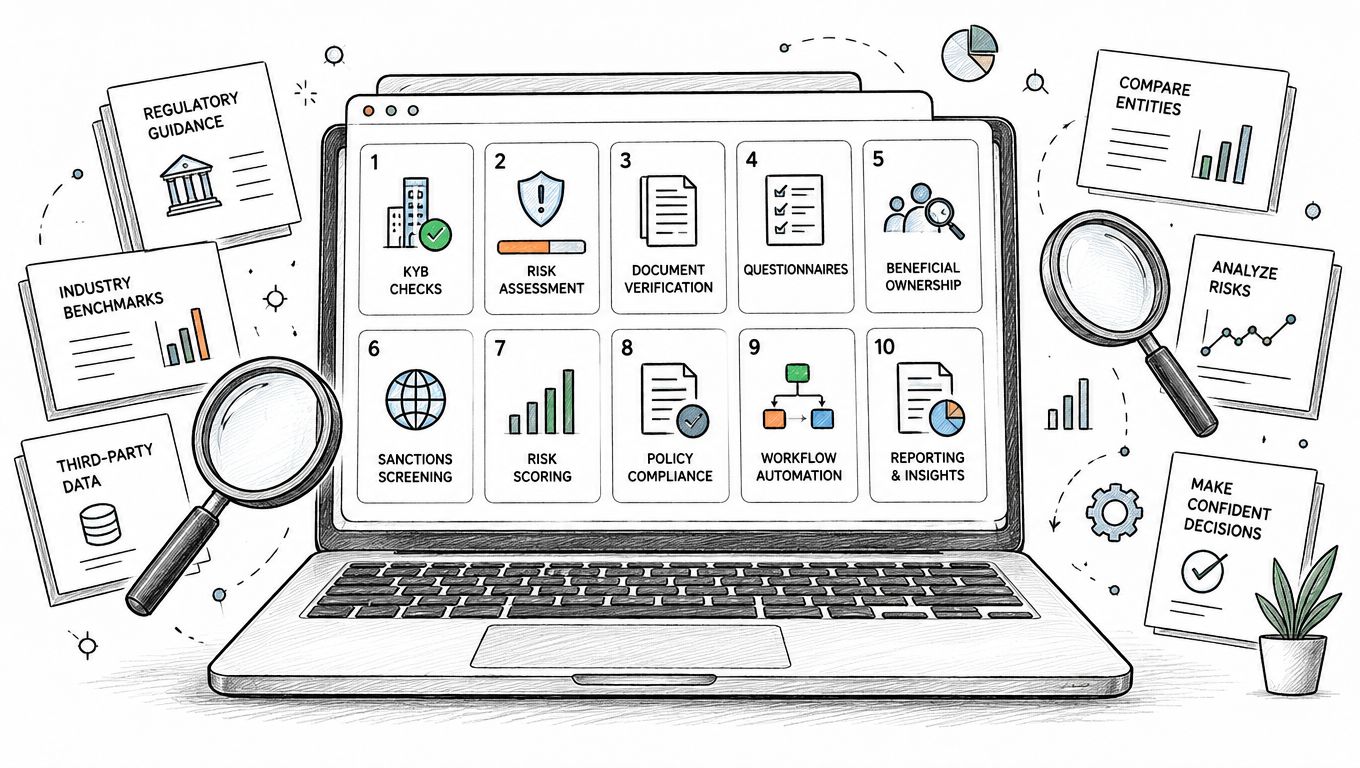
The most popular advice about vendor due diligence software is also the least useful: choose the platform with the longest feature list. These products don't all solve the same control problem. Some verify whether a legal entity exists and remains active. Others assess cybersecurity exposure, screen sanctions and adverse media, collect questionnaires, monitor changes, or connect risk decisions to procurement workflows.
A better evaluation lens starts with the job the software must perform: KYB and legal-entity verification, risk scoring, evidence collection, questionnaire management, continuous monitoring, and workflow integration. That distinction matters in a market that Fortune Business Insights values at USD 12.5 billion in 2025, with a projection of USD 45.3 billion by 2034, and a reported 15.38% CAGR for vendor risk management overall (Fortune Business Insights market analysis). The category now includes official registry infrastructure, cyber ratings, compliance screening, TPRM operations, and supplier management.
The tools below move from the narrowest foundational control, official business-entity data, to broader third-party risk and procurement suites. The practical question isn't which product has the most capabilities. It's which system owns each decision, what evidence it can retrieve, how well it covers your jurisdictions, and how easily alerts and exceptions reach the people who must act.
1. SOSfinder for Business Entity Data Across All 50 States
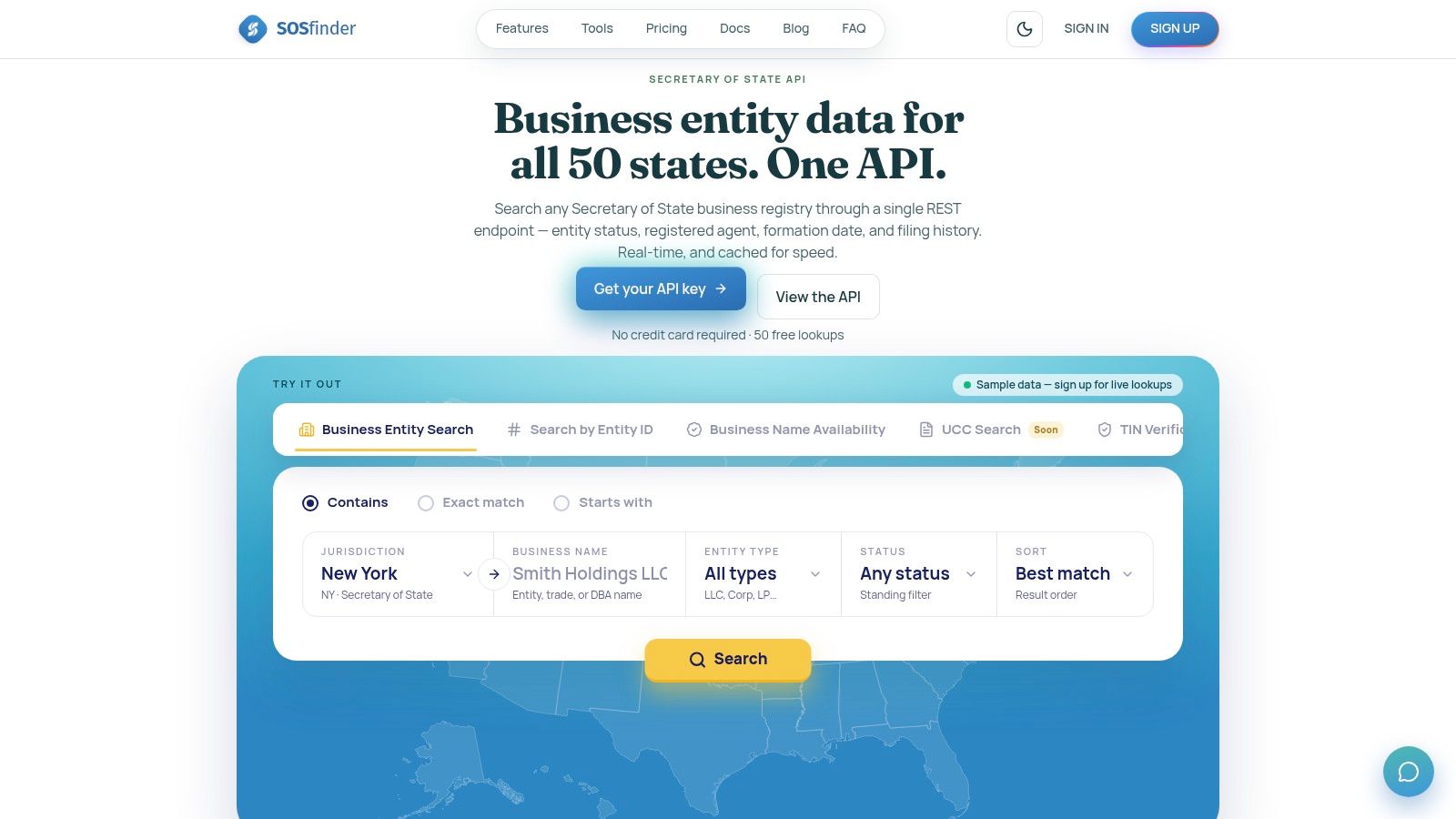
SOSfinder addresses the first question in vendor due diligence: is the company you're evaluating a real, identifiable legal entity, and what does its official registry record say? It's a developer-first API that aggregates Secretary of State records across all 50 U.S. states plus the District of Columbia through one REST endpoint (SOSfinder business entity data API).
A single request can return normalized fields such as entity status, entity type, formation or registration dates, registered agent, principal address, identifiers, and filing history. Real-time lookups are layered over caching, while automatic best-match logic helps with common-name searches. That design is materially different from a TPRM suite. SOSfinder isn't trying to replace cyber ratings, sanctions screening, or remediation management. It provides the authoritative corporate identity layer those systems may not provide.
Best fit for registry-led diligence
Compliance teams can use it to verify legal standing before onboarding a vendor, customer, borrower, or counterparty. Product teams can use the same endpoint for name clearance, bulk portfolio verification, filing retrieval, and downstream KYB workflows. Monitoring and webhooks can surface changes to status, registered agent, or address, turning a one-time lookup into a control for compliance drift.
The operational advantage is consolidation. Teams don't need to build and maintain a separate integration for each state registry, and predictable JSON responses make it easier to store evidence in an internal case system. The API playground, examples for cURL, Python, JavaScript, PHP, and Go, built-in retries, consistent error semantics, CSV processing, and hosted MCP server also make it practical for engineering-led operating models. Teams assessing business entity data workflows can start with a focused registry control instead of implementing a full TPRM platform.
Practical rule: A cyber rating can tell you about an exposed asset. It can't, by itself, prove that the vendor record in your procurement system matches the right legal entity.
SOSfinder's main limitation is jurisdictional depth. Filing PDFs and detailed records are available where offered by the state, so document coverage can vary. UCC filings and officer or person lookups are in beta, and monitoring capacity and service levels depend on the plan. The best operating model is therefore a registry-first stack: use SOSfinder for official entity identity and filings, then connect it to broader screening, cybersecurity, or workflow systems when those controls are required.
Pros
- Unified coverage: One endpoint covers all 50 states and DC, reducing per-state integration work.
- Normalized official data: Responses can include status, agents, addresses, identifiers, and filing references.
- Change monitoring: Alerts and webhooks can push status, agent, and address changes into downstream workflows.
- Portfolio processing: Bulk verification and CSV support suit multi-state vendor populations.
- Developer control: Predictable responses, examples, an API playground, and an MCP server support product teams.
Cons
- Uneven document depth: Filing links and detailed records depend on the jurisdiction.
- Enterprise features vary by plan: Monitoring capacity and advanced beta capabilities may require a paid tier.
2. OneTrust for Third-Party Due Diligence
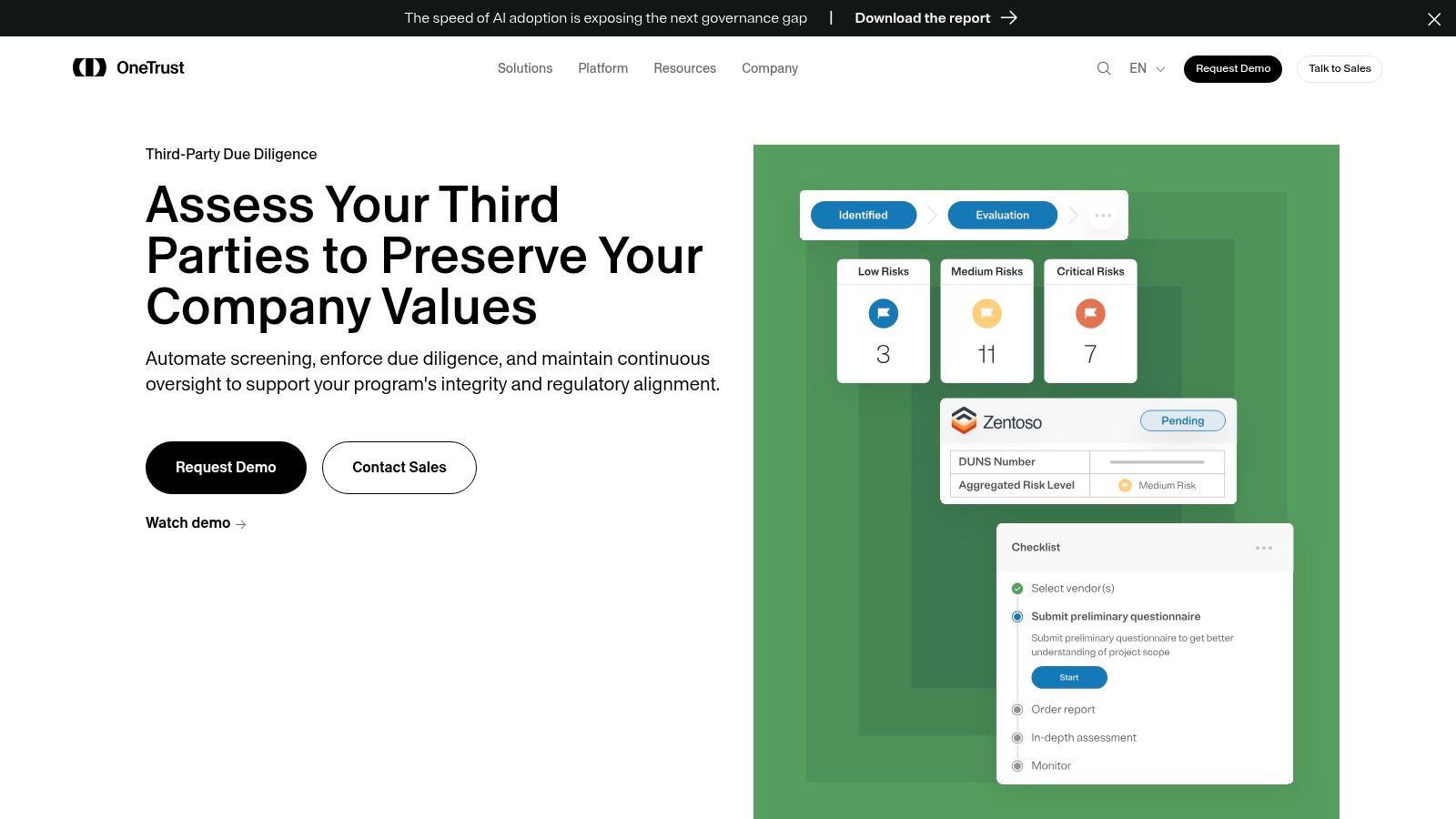
OneTrust is designed for organizations that want compliance screening, third-party assessments, risk tiering, remediation, and monitoring in a connected program. Its third-party due diligence product brings ethics and compliance checks, including sanctions, politically exposed persons, and adverse media, alongside external cybersecurity ratings through integrations such as RiskRecon and SecurityScorecard (OneTrust third-party due diligence).
That combination suits a centralized enterprise risk function. A compliance team can establish a vendor directory, apply automated risk scoring, send assessments based on a vendor's profile, track remediation, and retain reporting artifacts for audit. The product is broader than corporate identity verification, so buyers shouldn't assume its existence in the stack eliminates the need to validate the underlying legal entity or registry record. A focused business verification software workflow can remain a separate control where official corporate data is material.
Best fit for centralized compliance ownership
OneTrust works best when compliance owns the full vendor lifecycle rather than treating due diligence as a procurement form. The advantage is the ability to bring screening, assessment templates, continuous monitoring, remediation workflows, reporting, and audit evidence into one program. That reduces the handoffs between ethics teams, information security, procurement, and risk operations.
The trade-off is implementation effort. Quote-based pricing and an enterprise orientation may make it heavier than a focused API or a lighter assessment tool, particularly for smaller teams. Buyers should test whether the platform's workflow model reflects their approval paths, escalation rules, and evidence requirements rather than evaluating the feature catalogue in isolation.
3. ProcessUnity for Configurable Vendor Risk Programs
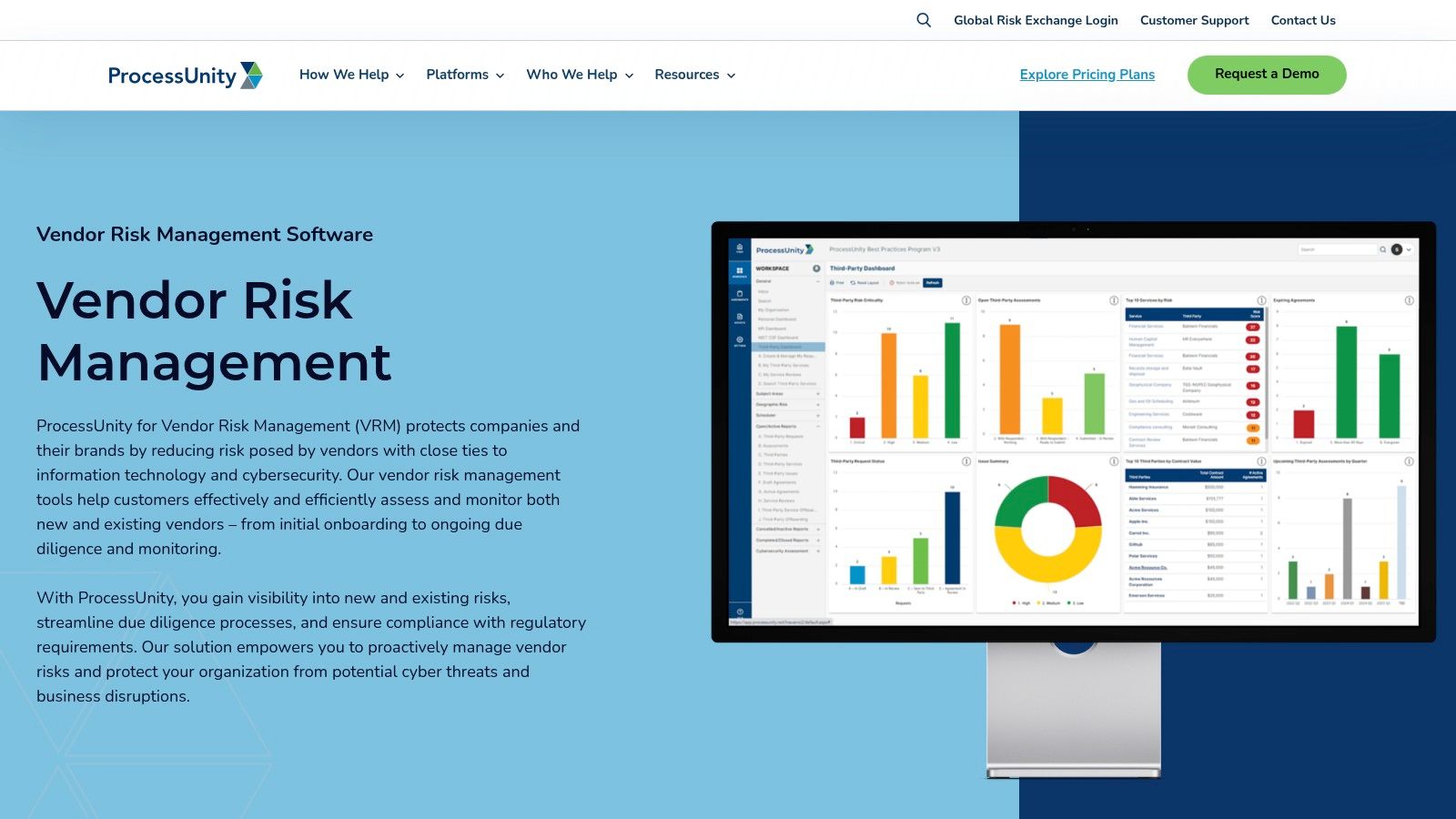
ProcessUnity is a purpose-built TPRM platform for organizations that need to scope inherent risk, configure due diligence workflows, monitor vendors, and report on a mature risk program (ProcessUnity vendor risk management). It is particularly relevant where vendor assessments vary by service, data access, criticality, or regulatory expectations.
The platform supports inherent-risk calculations, due diligence scoping, SIG questionnaires, continuous monitoring, external threat and risk intelligence, vendor portals, delegated reviews, bulk assessments, and dashboards. Its defining strength is configurability without custom code. That matters when a regulated organization has several business units, different review owners, and multiple evidence paths.
Best fit for mature TPRM administration
ProcessUnity is a strong choice when the central TPRM team needs to govern the process while delegating portions of the work to procurement, security, legal, or business owners. Bulk assessments and vendor portals help with scale, while configurable scoping prevents every supplier from receiving the same level of scrutiny.
The distinction between legal identity and risk assessment remains important. A questionnaire can establish what a supplier claims about its controls, but it doesn't automatically verify the supplier's official status or filing history. Teams clarifying KYB versus KYC can use that distinction to decide whether ProcessUnity should consume an external entity-verification result or own the broader assessment process.
The drawback is administrative depth. Pricing isn't public, and a platform with extensive configuration can require enablement and training. It makes most sense for a team that has a defined operating model and enough recurring assessment work to justify governance overhead.
4. Prevalent for Managed Assessment Operations
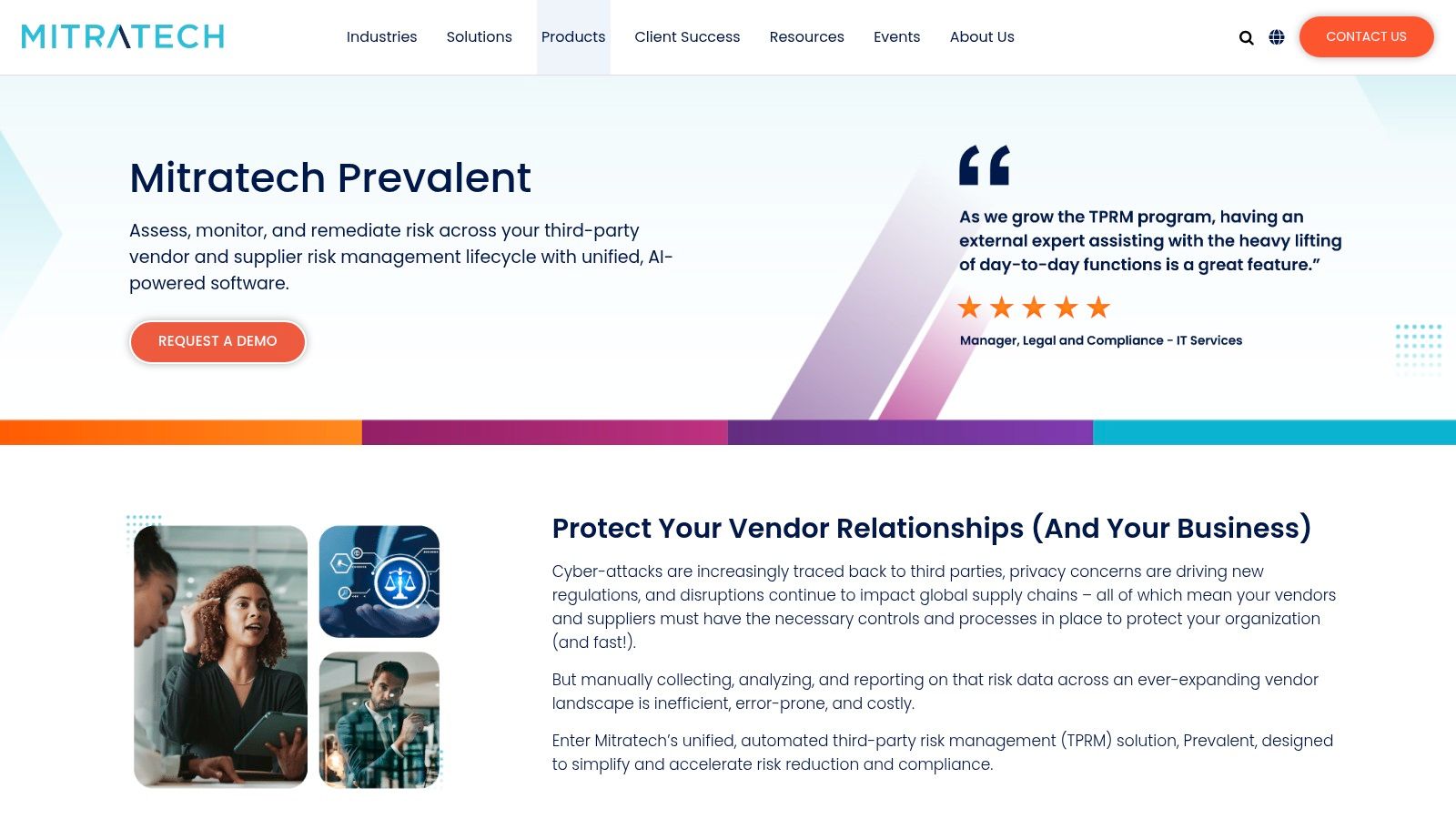
Prevalent is built around a practical bottleneck in third-party risk: collecting evidence from vendors and keeping assessment work moving. Its cloud platform combines standardized assessments, continuous monitoring, remediation tracking, reporting, a Vendor Intelligence Network, and managed services through its Risk Operations Center (Prevalent third-party risk management).
The managed-services option changes the ownership model. Instead of asking an internal team to chase every questionnaire, document, and follow-up, an organization can outsource parts of onboarding, evidence collection, and incident response. That makes Prevalent more than a software selection. It's a choice about how much operational work the business wants to retain internally.
Best fit for hybrid or outsourced TPRM
The Vendor Intelligence Network provides pre-built vendor risk reports that can accelerate initial review where the relevant supplier is covered. That can reduce duplicated evidence requests, but its usefulness depends on the vendor population and the currency and depth of the available material. Teams should validate representative suppliers rather than assuming network coverage will match their portfolio.
Prevalent is a good fit when the risk function wants a repeatable process but lacks the capacity to run every collection and review task. The trade-off is dependence on the managed operating model. Internal owners still need to define acceptance criteria, resolve exceptions, and decide whether a report is sufficient for a high-impact relationship. No managed service removes the need for accountable risk ownership.
5. SecurityScorecard for Cyber Ratings and Questionnaires
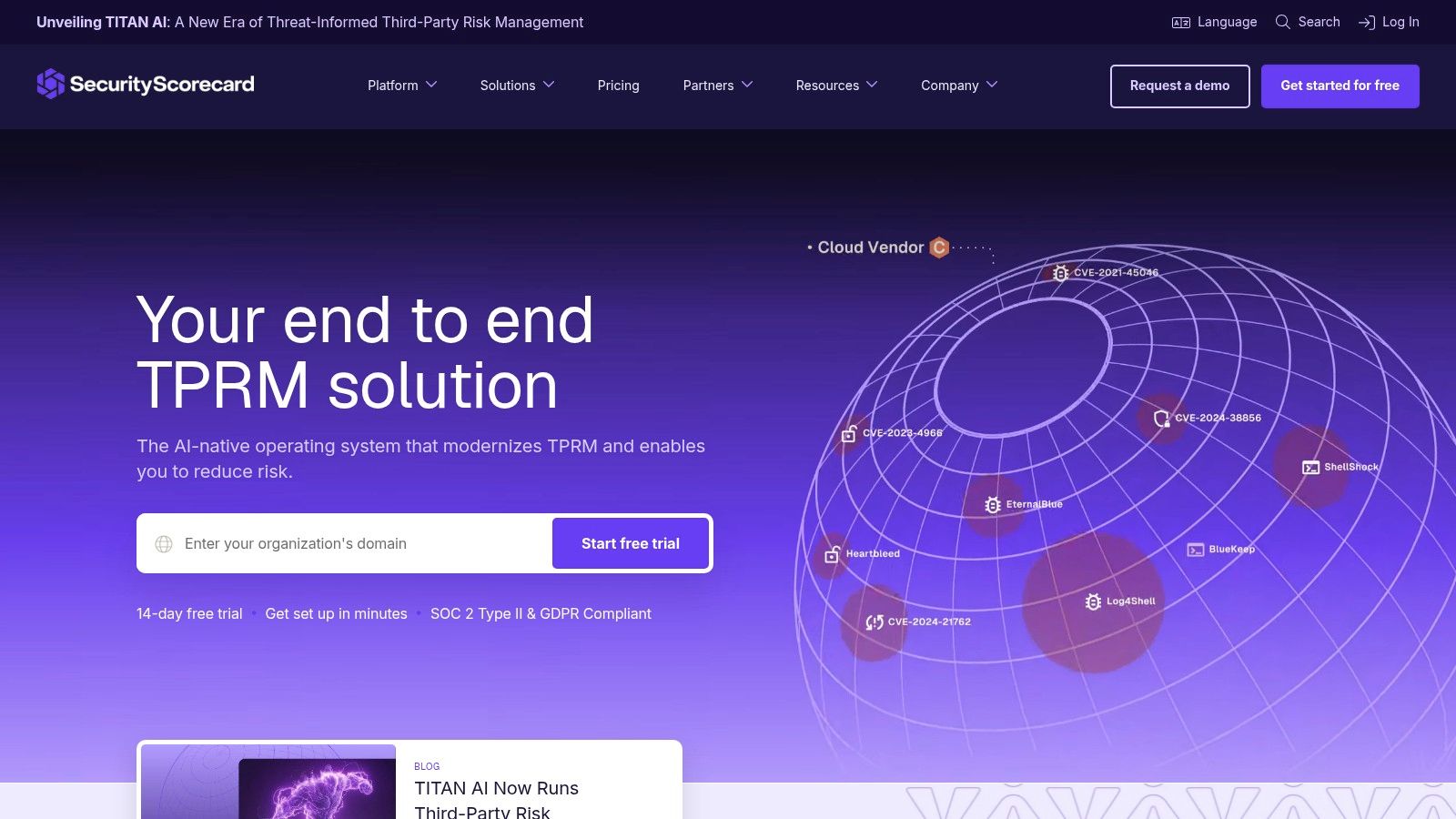
SecurityScorecard focuses on the cybersecurity portion of vendor due diligence. It combines external security ratings, portfolio insights, questionnaires, and AI-assisted workflows that map responses to ratings (SecurityScorecard). Vendors can respond through free accounts, which gives buyers a way to invite suppliers without requiring them to purchase the platform.
Its value is speed at the screening and monitoring layer. A security team can identify changes in an external signal, compare vendors across a portfolio, send a questionnaire, and use the results to support a more targeted review. That is useful for technical exposure, but it isn't the same as verifying incorporation, beneficial ownership, sanctions status, financial resilience, or procurement eligibility.
Best fit for security-led triage
SecurityScorecard suits an information security team that needs an external signal before deciding how much questionnaire and evidence work to request. Its free tier can support an initial pilot of basic workflows, while paid plans require a sales conversation. The platform is strongest when the organization treats ratings as a triage input rather than a final approval decision.
External ratings can generate false positives and still require evidence-based review. A low rating may identify an issue that doesn't affect the service in scope, while a stronger rating doesn't answer every question about internal controls or fourth parties. The operating model should therefore connect rating changes to human review, documented exceptions, and, where necessary, a request for supporting documents.
6. BitSight for Executive Cyber Risk Reporting
BitSight's vendor risk management offering is centered on security ratings, automated documentation requests, alerts, reassessment reminders, custom scoring, response validation analytics, industry coverage, benchmarking, and enterprise integrations (BitSight vendor risk management). It is best understood as a cyber risk intelligence and reporting layer, not a universal vendor due diligence system.
The platform helps security leaders translate external signals and questionnaire responses into portfolio-level views. Custom scoring models allow organizations to align risk interpretation with their own thresholds, while alerts and reassessment reminders support ongoing oversight rather than a one-time onboarding review.
Best fit for board-facing security governance
BitSight fits large or regulated enterprises that need a recognizable external cyber signal for executive reporting and a mature partner ecosystem for integrations. It can help a security organization prioritize vendor conversations and show how external risk changes over time.
The limitation is scope. A security rating doesn't establish the legal identity of a supplier, confirm sanctions exposure, or manage procurement approvals. Pricing isn't public and total cost may be significant for smaller programs. Buyers should also test how custom scores are explained to nontechnical stakeholders. A board-facing number is only useful when the organization can trace it to observable findings, vendor responses, and a clear decision path.
7. UpGuard for Lean Vendor Risk Teams
UpGuard combines external attack-surface monitoring, security questionnaires, vendor comparison, compliance mapping, portfolio analytics, and lifecycle management from intake through evidence capture (UpGuard vendor risk). Its positioning is practical for mid-market teams that want to move from intake to monitoring without assembling several separate cyber tools.
The product supports AI-assisted assessments and side-by-side vendor comparisons. Compliance reporting can map findings to frameworks such as NIST and ISO, while external monitoring supplies a continuing technical signal after onboarding. That combination gives a lean security or procurement-risk team a relatively direct operating path.
Best fit for speed and transparent budgeting
UpGuard publishes pricing and plan tiers, which makes early budgeting and pilot design easier than products that require a full enterprise sales process. Published vendor limits also make the capacity trade-off visible. A team can compare its portfolio against the relevant tier before committing to a larger rollout.
That clarity doesn't remove the need to inspect feature boundaries. Certain breach intelligence capabilities may require add-ons, and a growing portfolio may force an upgrade. UpGuard's primary strength remains cybersecurity and assessment workflow. It won't replace an official registry lookup or a procurement system that owns supplier creation, approvals, and purchasing controls.
8. RiskRecon by Mastercard for Outside-In Cyber Monitoring
RiskRecon is an outside-in cybersecurity monitoring platform that discovers and scores vendors' external assets, prioritizes findings by system value, tracks improvement, and connects questionnaires to ratings (RiskRecon by Mastercard). It is designed for teams that want technical visibility into the vendor's externally observable environment rather than a broad GRC record.
The prioritization model is important. A list of exposed assets is less useful than a view that helps analysts determine which findings matter most to the systems and services associated with a vendor. Questionnaire capabilities can then add the supplier's own explanation to the external picture, allowing the team to investigate discrepancies instead of treating either input as complete.
Best fit for security teams with an existing workflow
RiskRecon works well as a cyber monitoring layer alongside an existing assessment or TPRM platform. Its Mastercard backing can be relevant to organizations that value a large ecosystem, but the product remains focused on external and technical signals. It doesn't provide the full breadth of sanctions, corporate identity, procurement, or general compliance functions.
Pricing isn't public and the platform is generally aimed at mid-market and enterprise customers. A buyer should test whether findings can be linked to the correct vendor legal entity, business service, and owner. That mapping often determines whether a monitoring alert becomes an actionable control or just another security dashboard.
9. Whistic for Reusable Security Evidence
Whistic approaches vendor due diligence through shared security evidence. Its platform combines AI-assisted review summaries, executive reporting, a Trust Catalog of vendor profiles, Trust Centers, centralized questionnaire and evidence workflows, and control mapping (Whistic vendor security assessments).
The distinctive idea is that vendors can publish evidence proactively, allowing buyers to reuse available documentation instead of restarting the same collection process for every relationship. That can shorten assessment turnaround when a supplier has a complete and current Trust Center. It also creates a different relationship between buyer and seller, because the vendor's willingness to maintain reusable evidence affects the value of the workflow.
Best fit for high-volume security reviews
Whistic suits procurement and security teams that repeatedly review software vendors and want to reduce duplicate evidence requests. AI-generated summaries can help reviewers move through documents, but summaries aren't a substitute for checking the original evidence, its scope, its dates, and the controls relevant to the service being purchased.
The platform is primarily focused on security assessments. Broader GRC requirements, corporate verification, sanctions screening, and supplier financial analysis may require additional systems. Packaging includes a buyer and seller model, while detailed pricing and feature access require engagement with sales. The strongest use case is therefore an evidence-reuse layer, not a complete corporate and third-party risk stack.
10. SAP Ariba Supplier Risk for Procurement-Owned Due Diligence
SAP Ariba Supplier Risk places vendor risk inside the procurement environment. It aggregates signals such as ESG and country risk into supplier profiles, calculates exposure by supplier and category, provides API access for reporting, and connects with SAP Ariba Supplier Management and source-to-pay workflows (SAP Ariba Supplier Risk).
That ownership model matters. If procurement already controls sourcing, supplier onboarding, contract processes, and purchasing, embedding risk in the same ecosystem can reduce the gap between an approved supplier and a supplier that the business can buy from. External data enrichment and partner integrations, including sources such as D&B, can extend the profile beyond information maintained internally.
Best fit for SAP-centered supplier operations
SAP Ariba is a logical choice for a large enterprise consolidating procurement and supplier risk. Its value comes less from a single assessment feature than from connecting exposure scoring to category decisions, sourcing, supplier management, and reporting. Teams evaluating a KYB API may still add a dedicated official registry layer when they need direct verification of U.S. entity status and filings.
The trade-off is implementation complexity. Pricing is quote-based and typically tied to the broader SAP Ariba suite, so it may be excessive for an organization that only needs entity verification or a focused cyber assessment. Procurement leaders should define which decisions SAP owns and which evidence must come from specialist tools before expanding the implementation.
Top 10 Vendor Due Diligence Software Comparison
| Product | Core features & coverage | Integration & developer experience | Monitoring & compliance workflows | Target audience | Price & USP |
|---|---|---|---|---|---|
| 🏆 SOSfinder, Business Entity Data for All 50 States. One API. | Normalized official registry records (status, type, formation, agents, filings/PDFs where offered) ✨ | Single POST endpoint, predictable JSON, SDK examples, API playground, hosted MCP server for AI queries ✨ | Real‑time lookups + low‑latency caching, monitoring, webhooks, bulk CSV verification ★★★★★ | 👥 KYB, compliance, formation/name‑clearance, underwriting, audit teams | 💰 Usage‑based + free tier & non‑expiring credits, USP: one API for all 50 states |
| OneTrust, Third-Party Due Diligence and TPRM | Screening (PEP/sanctions/adverse media), risk tiering, assessments | Enterprise integrations, broad GRC connectivity; heavier implementation | Continuous monitoring, remediation workflows, audit artifacts ★★★★ | 👥 Large enterprises wanting end‑to‑end vendor lifecycle control | 💰 Quote-based, USP: full lifecycle GRC + ethics/compliance breadth |
| ProcessUnity, Vendor Risk Management | Inherent risk scoping, SIG support, vendor portal | Highly configurable no‑code workflows; admin enablement required | Continuous monitoring, delegated reviews, dashboards ★★★★ | 👥 Regulated industries & mature TPRM programs | 💰 Enterprise pricing, USP: deep configurability without custom code |
| Prevalent, Third-Party Risk Platform | Standardized assessments, centralized evidence, vendor intel | Managed services (ROC) option; integration-ready | Continuous risk monitoring, remediation tracking, on‑demand reports ★★★ | 👥 Teams wanting to outsource assessment operations | 💰 Pricing not public, USP: ROC managed services + vendor report library |
| SecurityScorecard, Ratings & Questionnaires | External security ratings, portfolio insights, questionnaires | Fast setup, free pilot tier, questionnaire AI mapping | Real‑time ratings and monitoring; vendor questionnaires ★★★★ | 👥 Security teams for rapid screening & monitoring | 💰 Free tier + paid plans (sales), USP: immediate external signal |
| BitSight, Vendor Risk Management | Security ratings, benchmarking, analytics | Integrates with enterprise reporting; mature ecosystem | Alerts on rating changes, automated reassessments ★★★★ | 👥 Large/regulatory orgs & boards needing external validation | 💰 Premium (sales), USP: recognized board‑level risk signal |
| UpGuard, Vendor Risk | External attack‑surface monitoring, AI assessments, compliance mapping | Transparent web pricing and published limits; quick pilots | Continuous monitoring, vendor comparison, evidence capture ★★★★ | 👥 Mid‑market teams seeking clear pricing & fast time‑to‑value | 💰 Published tiers, USP: transparent pricing & usability |
| RiskRecon by Mastercard | Outside‑in asset discovery and scoring, prioritized findings | Complements assessment workflows; enterprise integrations | Continuous discovery, improvement tracking, questionnaire features ★★★★ | 👥 Mid‑market & enterprise cyber teams | 💰 Pricing via sales, USP: Mastercard data & scale |
| Whistic, Vendor Assessments & Trust Catalog | Trust Catalog, vendor Trust Centers, AI review summaries | Vendor-published evidence, buyer/seller model; requires vendor participation | Zero‑touch assessments, centralized evidence & mapping ★★★ | 👥 Teams prioritizing speed and reusable vendor evidence | 💰 Sales-based, USP: Trust Catalog for rapid, reusable assessments |
| SAP Ariba, Supplier Risk | Supplier risk scoring (ESG, country risk), enrichment | Deep integration with SAP source‑to‑pay workflows | Exposure scoring, recommendations, procurement integrations ★★★ | 👥 Procurement-led large enterprises | 💰 Quote-based (part of SAP suite), USP: tight source‑to‑pay integration |
Build the Right Due Diligence Stack
The right choice starts with the first control, not the vendor logo. If the immediate question is whether a supplier exists, remains active, uses the correct legal name, and has a reviewable filing history, start with legal-entity verification. SOSfinder is suited to that official U.S. registry layer, with one API across all states and DC, normalized records, filing references where offered, bulk processing, and monitoring for selected entity changes.
If the first concern is cyber exposure, a platform such as SecurityScorecard, BitSight, UpGuard, or RiskRecon may be more appropriate. Those tools can provide external technical signals, questionnaires, ratings, findings, or monitoring. They don't automatically cover corporate identity, sanctions, adverse media, financial condition, or procurement approval. Choose them when security owns the initial triage and can connect alerts to a documented review process.
Compliance-led programs may need OneTrust or ProcessUnity when screening, risk tiering, assessment scoping, remediation, and audit records must operate in one governed workflow. Prevalent makes more sense when the organization wants managed help with evidence collection and assessment operations. Whistic is compelling when the recurring problem is the time spent reviewing reusable security documentation. SAP Ariba Supplier Risk fits a procurement-owned model where risk must influence sourcing and source-to-pay decisions.
The market evidence supports treating this as an operating-system decision rather than a simple software purchase. A 2025 survey reported that 64% of respondents used a dedicated TPRM platform, an increase of 19% year over year, while spreadsheet use declined by 29% (Venminder State of Third-Party Risk Management 2025). That shift makes integration and ownership more important. Replacing a spreadsheet with a platform doesn't solve the problem if legal records, questionnaires, monitoring alerts, and approval evidence still live in disconnected systems.
A practical selection process should answer four questions:
- What is the first control? Legal-entity verification, cyber exposure, sanctions and adverse media, questionnaire evidence, or procurement risk?
- Who owns the decision? Compliance, security, procurement, legal, finance, or a shared TPRM function?
- What evidence is required? Registry records, filings, certifications, financial documents, questionnaire answers, external findings, or remediation history?
- How do exceptions move? Test whether an alert, missing document, failed assessment, or changed entity status reaches the correct owner with a durable audit record.
Document review deserves particular attention. A 2025 TPRM survey identified collecting and analyzing vendor documents as a top bottleneck, while EY's 2025 survey described growing use of AI for automated collection and analysis of financial and compliance records (Ncontracts TPRM survey). Buyers should test extraction, normalization, source preservation, exception handling, and human review. Questionnaire automation alone won't resolve unstructured evidence.
The operating model is also becoming more extended. KPMG's 2026 survey reported that more than 80% of organizations use managed services, outsourcing, or both for core TPRM activities, while EY reported that 64% assess vendors' vendors and that 31% identify AI and machine learning for enhanced due diligence and contract monitoring as the top future investment driver (KPMG third-party risk management survey). Those findings make fourth-party visibility and human review of AI output selection criteria, not optional extras.
For many organizations, the practical answer won't be one universal platform. SOSfinder can provide the official U.S. entity and filing layer, while a broader TPRM tool handles assessments, cyber monitoring, screening, remediation, or procurement workflows. Test the combination with real vendors across relevant jurisdictions, then verify that every result can be tied to the right entity, owner, decision, exception, document, and alert.
SOSfinder gives product and compliance teams one API for official business entity records across all 50 U.S. states and DC, including normalized status, registered-agent, address, identifier, and filing data, plus bulk verification and monitoring workflows. Use it as the legal-entity foundation beneath your vendor due diligence software stack, then visit SOSfinder to evaluate the API for your onboarding, KYB, procurement, or audit workflow.