Vendor Onboarding Software: 10 Platforms Compared for 2026
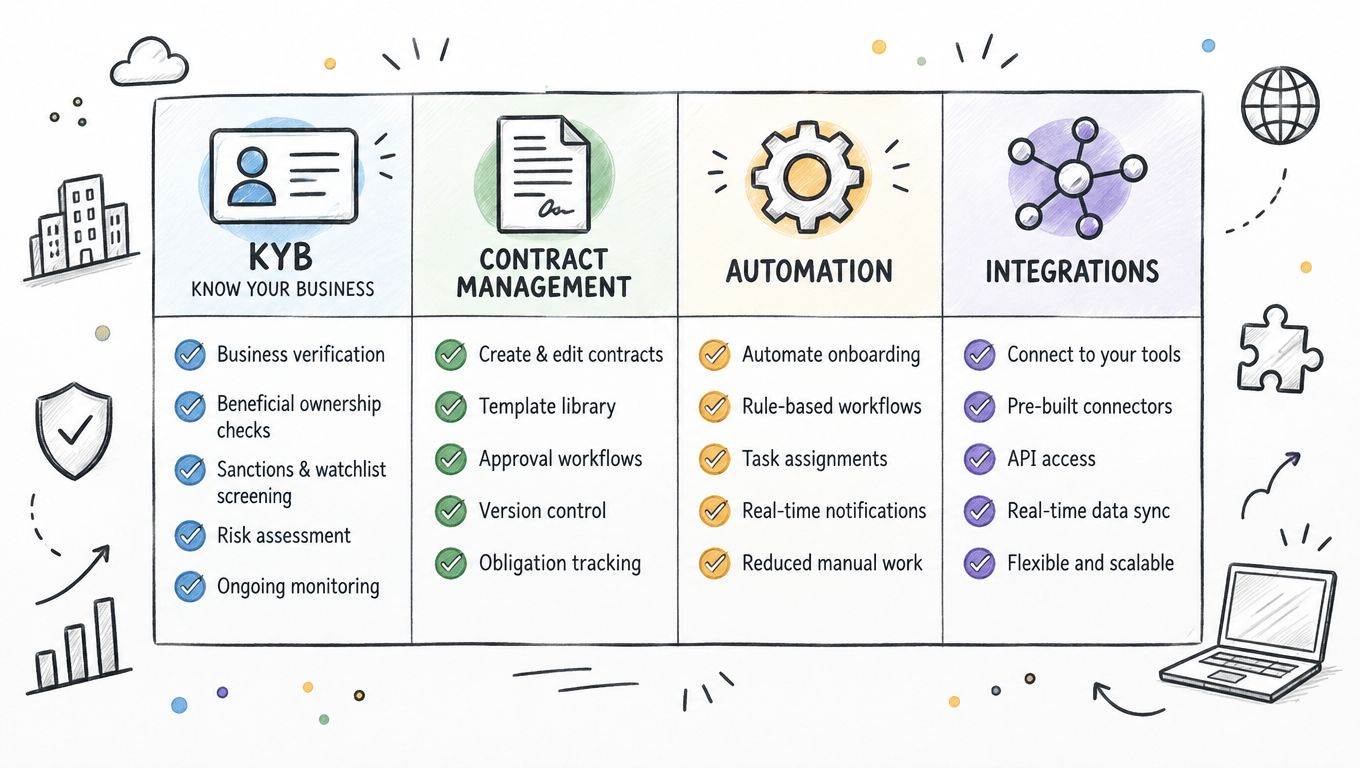
A supplier looks approved in procurement, then everything stalls. Tax forms sit in someone's inbox. Bank details need a second review. Legal wants contract language that wasn't in the original request. By the time the vendor is finally ready to transact, the team has already lost days, maybe weeks, to handoffs that should've been automated.
That's why vendor onboarding software is only useful when it solves the actual bottleneck. If the pain is KYB and tax validation, an AP-led portal may beat a full procurement suite. If the choke point is contract routing, intake orchestration matters more than a fancy supplier portal. If ERP sync keeps breaking, the best UX in the world won't save you.
The comparison below groups platforms by the step they remove from the critical path. I've kept the focus on KYB and tax checks, contract handling, automation load, and ERP integration, because that's how onboarding breaks in practice. The right tool is the one that fixes your worst delay without creating a new one elsewhere.
1. SAP Ariba Supplier Lifecycle and Performance
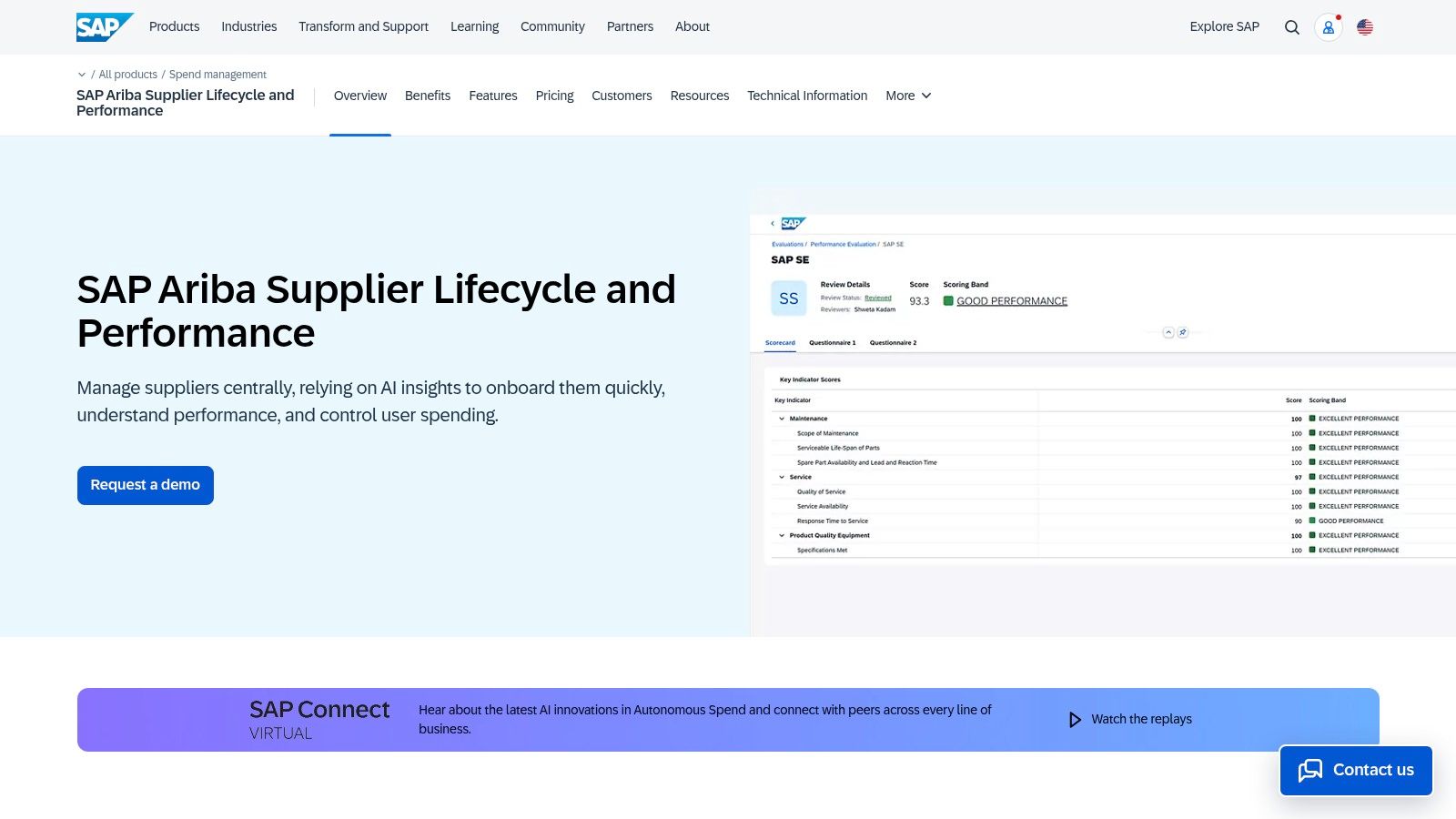
SAP Ariba SLP fits when onboarding is tied to a broader supplier governance program and the company already lives in SAP. It gives you one place for registration, qualification, risk/compliance assessment, and performance management, with a clear path back into SAP ERP and S/4HANA through master-data integration. The strength here is control, not simplicity.
Where it works best
Use it when supplier approval has to follow formal governance, segmentation rules, and cross-functional reviews. The portal layer through SAP Business Network works well for structured data collection, and the bidirectional ERP link matters if master-data consistency is a constant audit issue. That makes it a strong fit for global enterprises with a mature procurement operating model.
Trade-offs to expect
The trade-off is implementation weight. SAP ecosystems reward teams that can support long rollout cycles and heavier administration. Smaller procurement groups often find the UX more complex than they want, especially if they only need onboarding and tax capture rather than a full lifecycle stack.
Practical rule: buy SAP Ariba SLP when onboarding is part of enterprise governance, not when you just need a faster vendor setup queue.
For product details, start with the SAP Ariba Supplier Lifecycle page.
2. Coupa Supplier Management and Coupa Supplier Portal
Coupa is a strong choice when the supplier registration step has to sit close to payables and the organization already uses Coupa for procure-to-pay. The Supplier Portal gives suppliers a self-service path for profile maintenance, while the supplier management layer handles structured forms for legal entity, tax, and payment details. That pairing makes it practical for teams that care as much about AP accuracy as procurement intake.
Why buyers pick it
The portal is familiar to many suppliers, which lowers the friction that comes with first-time enrollment. In practice, that matters because supplier confusion creates more internal follow-up than software teams expect. If your AP team is spending time chasing missing banking data or inconsistent legal names, Coupa can take real pressure off the queue.
Where it can disappoint
Customization usually isn't effortless. If your approval logic is unusual, expect some services effort and admin tuning. Suppliers may also need a bit of hand-holding the first time they use the portal, especially if your process asks for more than basic registration.
For the platform entry point, use the Coupa website.
3. Ivalua Supplier Management
Ivalua is a better fit when onboarding can't be separated from sourcing, contracting, and supplier risk. It gives you a single supplier record across the lifecycle, with configurable questionnaires, risk and ESG tracking, and document-expiry monitoring. The appeal is flexibility without losing the data model underneath.
What it does well
Ivalua's strength is workflow design. Procurement, risk, and ESG teams can all work from the same supplier record, which reduces the usual split between onboarding forms and downstream governance. That matters when the business wants one process that can scale across categories instead of separate intake paths for every department.
What to watch
This is an enterprise product. It rewards teams that are willing to configure carefully and manage change properly. Pricing is custom, so there's less visibility up front than with simpler tools, and that can slow evaluation if finance wants quick commercial clarity.
A single supplier record sounds boring until you've spent a quarter cleaning up duplicates, conflicting contacts, and stale compliance notes.
For the official product overview, use the Ivalua supplier management solution.
4. JAGGAER Supplier Management and Performance
JAGGAER makes sense when procurement wants onboarding tied to formal supplier enablement and performance tracking. It supports self-service registration, compliance checks, configurable approvals, and a supplier network with enablement services. In practice, it tends to appeal to organizations that already run a broader JAGGAER environment.
Why it stands out
The portal and configuration options are mature. Duplicate checks, reminders, and structured approval paths help reduce the amount of manual cleanup that usually follows a first-pass registration form. That's useful in education, public sector, and enterprise procurement settings where process discipline matters.
Where it falls short
The platform can feel heavy if all you want is fast intake. Smaller teams may find the admin side more than they need, and the best value usually shows up when the wider suite is already in use. If onboarding is just one isolated workflow, the system may feel larger than the problem.
For the official platform page, use JAGGAER Supplier Management.
5. Oracle Fusion Cloud Procurement Supplier Registration and Qualification
Oracle works best when supplier onboarding has to align tightly with Oracle ERP controls. The staged path from prospective to qualified to transacting makes the workflow easy to explain internally, and the qualification rule sets give procurement a clean way to control who gets through and why. That structure matters when policy enforcement is the actual bottleneck.
Why teams like it
Oracle's strength is native alignment. If your procurement and finance stack is already Oracle-centric, the supplier record fits more naturally into the rest of the process. Internal and external registration paths also help teams separate employee-driven setup from supplier self-service without inventing parallel workflows.
What it costs you
The user experience can feel ERP-first rather than business-user-first. That's not a deal-breaker, but it does mean the admin model may be less intuitive for teams that want a lighter, more modern intake layer. It's a strong choice for control, less so for casual ease.
For product documentation, start with Oracle Fusion Cloud Procurement.
6. HICX Supplier Experience Management Platform
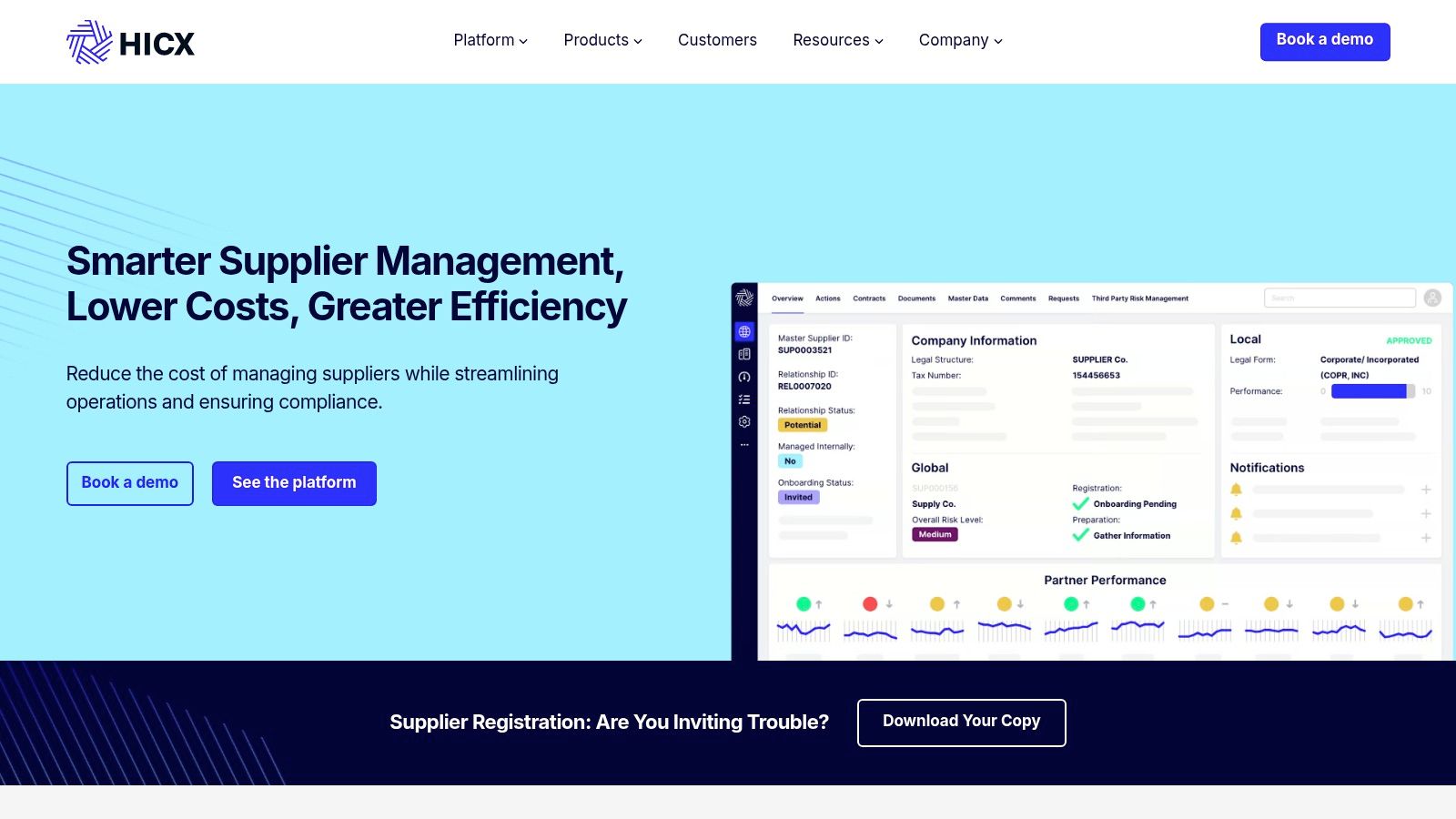
HICX is the right conversation when the underlying issue is supplier data quality, not just intake speed. It gives you one governed front door, master-data governance, low-code onboarding flows, and reminders for document renewal. That makes it useful for teams that have already learned that bad supplier data only gets worse when you automate it faster.
Where it earns its keep
The supplier-centric UX reduces back-and-forth. Instead of scattering onboarding across forms, email, and shared drives, HICX centralizes the record and gives governance teams more control over what becomes the authoritative version. That's especially valuable when multiple business units touch the same supplier.
The catch
HICX often complements transactional P2P and AP systems rather than replacing them. That's fine if you already have a core ERP or procurement stack, but it means buyers need to be clear about where HICX sits in the architecture. It's a governance layer first, not a full source-to-pay replacement.
For the official site, use the HICX platform.
7. Zip Intake to Procure
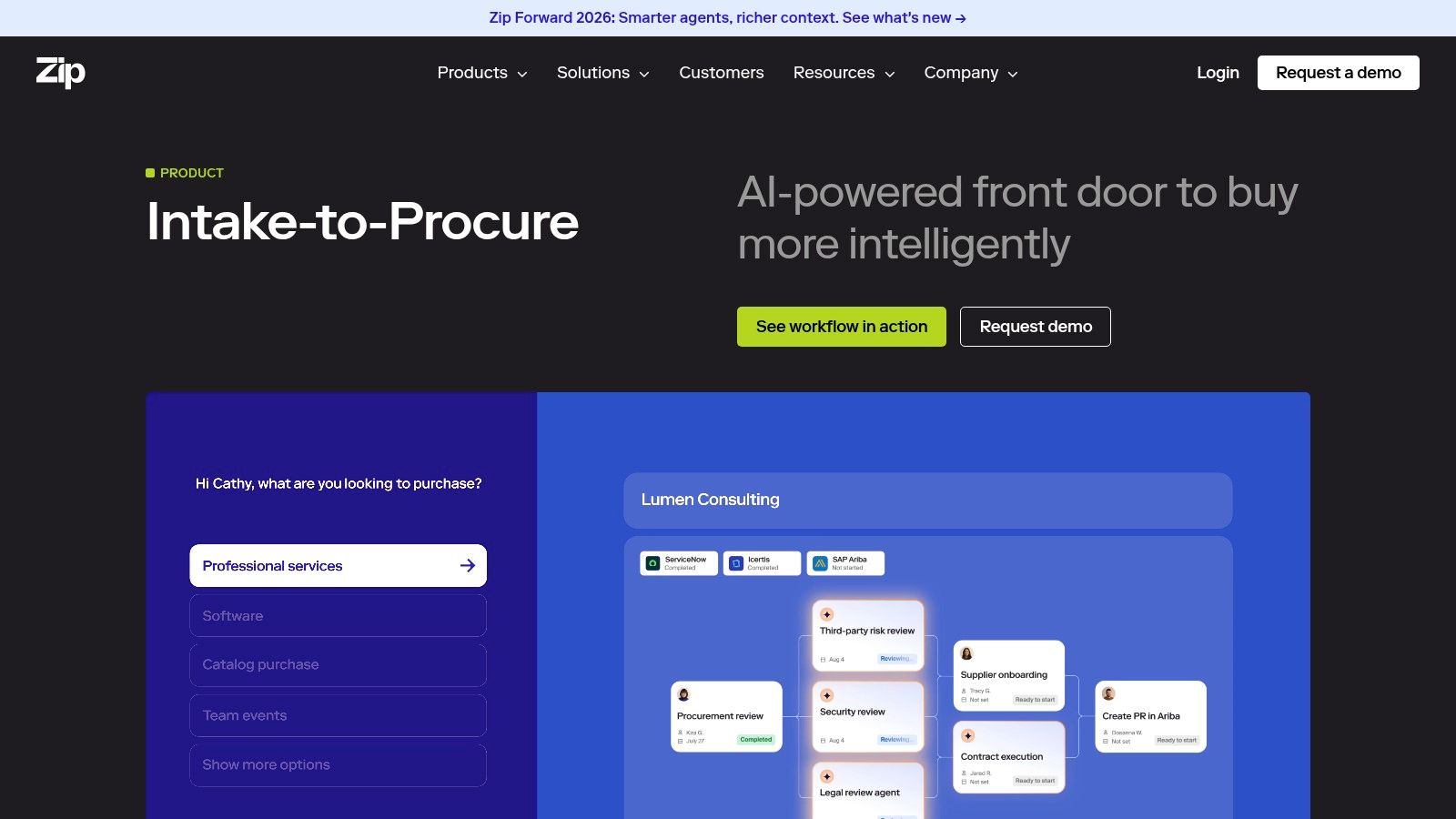
Zip is strongest when intake, approvals, legal review, and onboarding all need to move together. It acts like an orchestration layer, routing vendor requests across procurement, legal, risk, and finance without forcing teams to live inside one monolithic suite. For organizations where request chaos is the main issue, that can be a big improvement.
What it solves
Zip is useful when the biggest pain is coordination. It helps teams centralize intake, de-duplicate supplier requests, validate data, and track where each approval sits. That makes it a good fit for companies that want clear ownership and fewer “who has this now?” follow-ups.
Where it fits with due diligence
If vendor identity checks are part of your process, pairing Zip with a business-verification layer makes sense. A practical reference point is SOSfinder's business verification software overview, especially if your internal workflow depends on official entity records before procurement or finance approval.
What to be careful about
Zip works best alongside existing P2P, CLM, and ERP tools. It's an orchestration layer, not a full stack by itself. That's a strength if you want flexibility, and a weakness if you were hoping one purchase would replace several systems.
For the product page, use Zip Intake to Procure.
8. Tipalti Supplier Hub
A supplier is ready to be paid, then finance finds missing tax details, a bad bank account, or a sanctions issue. Tipalti fits that AP-heavy onboarding flow. It gives suppliers a self-service path, captures tax forms, validates bank details, and supports sanctions screening as part of payment setup. For the distinction between business and individual verification, see SOSfinder's overview of KYB vs KYC (https://www.sosfinder.com/blog/kyb-vs-kyc). If the main pain starts in accounts payable, this is a practical place to look.
Why it works
The workflow is guided and focused on payment data. Suppliers can enter what AP needs without many internal handoffs, and that reduces avoidable payment errors. It suits contractors, global vendors, and multi-entity payables where finance needs clean setup before the first payment runs.
What to watch
Tipalti does not replace a full source-to-pay suite. It stays centered on AP and payments, so sourcing, contract handling, and performance management still need other tools. Pricing is custom and can climb with volume and modules, so scope the payment use case carefully before you commit.
For the platform details, use Tipalti Supplier Management.
9. OneTrust Third-Party Risk Management
OneTrust belongs in the conversation when onboarding is really a risk workflow with a vendor attached. It supports intake, tiering, dynamic questionnaires, evidence collection, issue management, and continuous monitoring. That makes it more useful for security, privacy, and risk teams than for classic procurement-only setups.
Practical rule: if your approval hinges on evidence, not just forms, a risk platform will usually outperform a pure supplier portal.
Why it matters
The platform is built for conditional review. Higher-risk suppliers can trigger deeper questions and more evidence requests, while lower-risk ones can move through a lighter path. That is a better fit for teams that want to avoid treating every vendor as if it had the same exposure.
Where it doesn't replace procurement software
OneTrust is not a procurement suite. It usually sits beside P2P or S2P tools rather than replacing them. That's fine if you need a stronger risk layer, but it does mean procurement teams need to be clear about the system of record and who owns the final supplier master.
For the product page, use OneTrust Third-Party Risk Management. For a related due-diligence workflow reference, see SOSfinder's vendor due diligence software overview.
10. Graphite Connect
Graphite Connect is built for faster, standardized supplier onboarding with less repeated data collection. Its network model lets suppliers reuse profiles across connected buyers, and the platform adds validations for tax, banking, and sanctions data. That makes it attractive when distributed teams are tired of rebuilding the same vendor record over and over.
Why teams consider it
The supplier-facing experience is clean, and the reusable profile model can cut repeated questionnaire work across business units. That's particularly useful for organizations that don't want every department inventing its own intake form and creating duplicate records in the process.
The limitation
The network model only works well if suppliers participate. If your vendor base won't engage with the shared profile approach, the advantage shrinks fast. Graphite Connect also works best when it sits beside existing P2P, contract, or risk tooling rather than pretending to do everything itself.
For the product page, use Graphite Connect Supplier Onboarding. For a useful KYB framing reference, see SOSfinder's KYB verification guide.
Top 10 Vendor Onboarding Software Comparison
| Product | Core features | UX & Quality (★) | Value & Pricing (💰) | Target audience (👥) | Unique selling points (✨ / 🏆) |
|---|---|---|---|---|---|
| SAP Ariba Supplier Lifecycle and Performance (SLP) | Configurable registration, centralized supplier master, questionnaire workflows, SAP Business Network portal | ★★★★ robust; admin‑focused | 💰 Enterprise; services‑heavy implementation | 👥 Large global enterprises, SAP‑centric IT estates | ✨ Deep SAP ERP integration; 🏆 mature governance & partner ecosystem |
| Coupa Supplier Management + CSP | Self‑service registration, configurable legal/tax/payment forms, Coupa Pay integration | ★★★★ supplier‑friendly; broad adoption | 💰 Free CSP for suppliers; platform pricing via sales | 👥 Organizations using Coupa P2P; broad supplier base | ✨ Familiar supplier portal; 🏆 strong P2P alignment |
| Ivalua Supplier Management | Self‑registration, 360° supplier record, ESG & risk tracking, modular S2P | ★★★★ highly configurable; requires change mgmt | 💰 Custom enterprise pricing | 👥 Complex procurement orgs needing flexibility | ✨ Single data model across S2P; 🏆 strong workflow configurability |
| JAGGAER Supplier Management & Performance | Guided onboarding, compliance checks, supplier network, scorecards | ★★★ mature; procurement‑led UX | 💰 Enterprise; best with JAGGAER suite | 👥 Education, public sector, large enterprises | ✨ Supplier enablement services; 🏆 scale for formal procurement |
| Oracle Fusion Cloud Procurement, SQM | Internal/external registration, rule‑based qualification, staged onboarding | ★★★★ ERP‑first UX; strong policy control | 💰 Enterprise pricing; best with Oracle ERP | 👥 Oracle ERP customers, large enterprises | ✨ Rule‑based staged onboarding; 🏆 native Oracle alignment |
| HICX Supplier Experience Management | Governed supplier portal, MDM golden record, low‑code workflows, reminders | ★★★★ supplier‑centric; reduces back‑and‑forth | 💰 Custom enterprise pricing | 👥 Teams focused on master‑data governance & supplier experience | ✨ Golden record MDM; 🏆 strong supplier UX |
| Zip Intake‑to‑Procure | Centralized intake/orchestration, de‑duplication, AI agents, P2P/CLM integrations | ★★★★ fast deployment; cross‑functional visibility | 💰 Premium / custom pricing | 👥 Procurement + legal + finance orchestration teams | ✨ Orchestration + AI agents; 🏆 reduces cycle time |
| Tipalti Supplier Hub | Self‑service portal, tax form capture, sanctions & bank validation, global payments | ★★★★ AP‑led, guided tax/bank UX | 💰 Volume/module‑based pricing | 👥 AP/payables teams and global payers | ✨ Built‑in payments & validations; 🏆 reduces payment errors |
| OneTrust TPRM | Vendor intake, risk tiering, dynamic questionnaires, continuous monitoring | ★★★★ built for risk/privacy teams | 💰 Premium; typically paired with S2P tools | 👥 Security, privacy, and risk & compliance teams | ✨ Continuous monitoring & evidence mgmt; 🏆 deep TPRM capabilities |
| Graphite Connect | Supplier self‑service profiles, automated validations, ERP integrations, network reuse | ★★★★ strong supplier UX; quick time‑to‑value | 💰 Subscription; value increases with network | 👥 Distributed buyers seeking fast onboarding | ✨ Supplier‑managed reusable profiles; 🏆 reduces duplicate data collection |
Matching the Platform to Your Onboarding Bottleneck
The fastest way to choose the right vendor onboarding software is to stop asking which platform is “best” in the abstract. Ask which step is breaking first. If the pain is KYB, tax capture, and bank validation, Tipalti or Graphite Connect may fit better than a heavy procurement suite. If the bottleneck is contract routing and cross-functional intake, Zip has a stronger case. If the issue is ERP sync and master-data control, SAP Ariba, Oracle, or HICX will usually deserve a closer look.
The same rule applies on the risk side. OneTrust is a stronger fit when onboarding is driven by evidence collection, conditional approval, and continuous monitoring. SAP Ariba, Coupa, Ivalua, and JAGGAER make more sense when onboarding has to live inside broader procurement and supplier management programs. None of these tools is perfect, and that's the point. Each one trades simplicity, flexibility, and depth differently.
The teams that avoid rework usually do three things. They map the current onboarding workflow end to end. They count every system the process touches, from intake to ERP. Then they test two shortlisted platforms against the same vendor batch, using the same documents and the same approval path. That exposes the hidden friction fast, and it tells you whether the software is removing work or just moving it somewhere else.
If your current process still depends on spreadsheet chase-downs, inbox approvals, and repeated vendor checks, pick the bottleneck first and buy for that. The cleanest onboarding stack is the one your team can run consistently on a busy week, not the one with the longest feature list.
SOSfinder gives product teams and procurement workflows a direct way to verify business entities before vendor activation. It returns normalized corporate records through one API, supports monitoring and change alerts, and fits well when onboarding needs official registry data instead of manual lookups. If you want to add entity verification to your onboarding flow, visit SOSfinder.